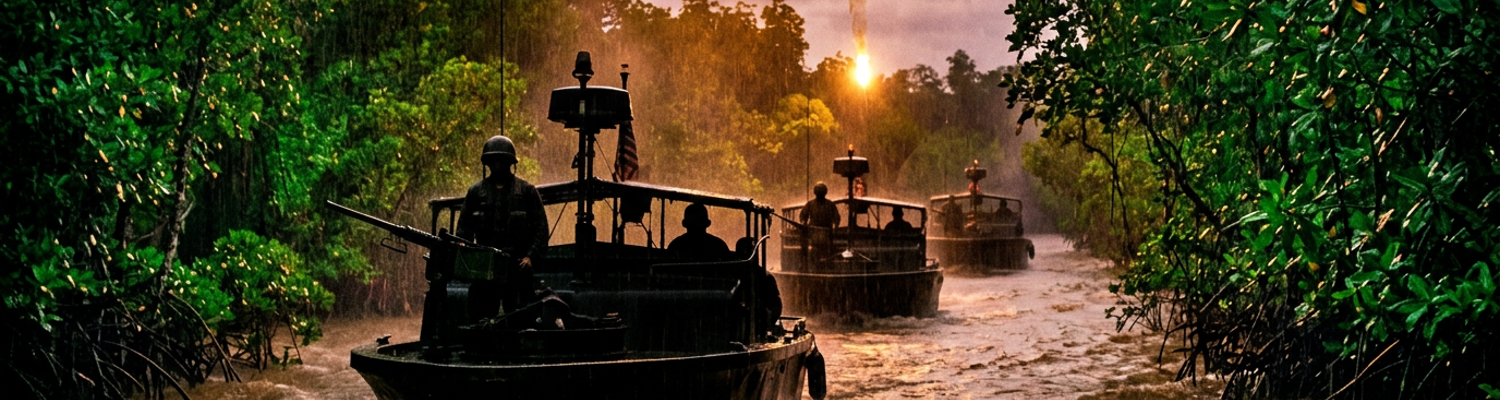

Sea Float Logistics and Tidal Hydrography
Navy manuals prescribed linear patrol grids and firm ground bases for counterinsurgency units. Troops arriving in the Mekong Delta found an unstable world made entirely of deep mud and shifting water. Mobile Tactical Support Base Sea Float operated as an anchored complex of twelve interconnected Ammi barges moored along the Cua Lon River. Steel cables strained against eight knot tidal currents that rushed through the hull lines twice every day. The rushing water churned up brown silt and tossed heavy floating workshops against fuel pontoons. Senior officers in Saigon headquarters examined clean wall maps and treated this floating fortress as a conventional outpost. Distant commanders issued aggressive directives without grasping how quickly the river current wore down machinery and men. Mooring chains groaned under the relentless pressure of floating logs and debris. Boat crews stood watch with pike poles through the night to push heavy timber away from the fragile hulls.
Pike poles splintered against massive submerged tree trunks as the tide rushed past the barges. SEAL Team One Detachment Golf deployed Light SEAL Support Craft into the complex tidal hydrography and pitch black mangrove canals around Nam Can to satisfy the headquarters mandates. Aluminum hulls scraped over submerged root systems as coxswains navigated narrow waterways. Falling tides dropped water levels by ten feet in a few hours and threatened to strand entire patrols in thick silt. Twin inboard diesel engines ingested mud and river grass. Crewmen cleared raw water cooling strainers by hand in total darkness while maintaining strict silence to avoid alerting nearby ambushes. Tactical charts drawn at headquarters showed clean river channels. The actual waterways twisted through endless walls of dense foliage that masked Viet Cong rocket teams and swallowed compass bearings. Squad leaders relied on dead reckoning and hand signals to guide the boats through the labyrinth of mudbanks.
Mudbanks shifted daily under the heavy tidal flow and trapped patrol craft that strayed from the deep channels. Radios carried on board could not throw clean signals through the dense mangrove canopy. Boat crews found themselves completely cut off from the floating base as soon as they rounded the first river bend. Staff officers sitting in air conditioned operations rooms hundreds of miles away in Saigon waited for situation reports that arrived hours late or never came at all. Delayed operational traffic forced those distant commanders to make critical tactical decisions on outdated assumptions. Headquarters sent follow up orders to strike coordinates that the enemy had already abandoned. Junior officers on the Cua Lon River absorbed the mounting pressure from superiors who demanded quantifiable results and successful sweeps. A single low tide could trap an entire unit under hostile crossfire. Command memos kept demanding aggressive incursions deeper into the interior swamps. Local intelligence warned that Viet Cong sappers were preparing heavy recoilless rifles and water mines to sever the river route entirely.
Water mines floated just beneath the muddy surface and threatened every vessel leaving the Ammi barges. Boat crews mounted heavy machine guns on the forward decks of the support craft and checked their night vision scopes for the evening deployment. Detachment commanders balanced rigid operational orders from Saigon against the raw physical hazards of the estuary. Officers selected routes where swift currents might hide engine noise from bank ambushes. Mechanics replaced damaged propeller blades and cleared fouled water intakes beneath the barge floodlights. Coxswains plotted backup rally points along the Nam Can perimeter. Spotters on the perimeter barges swept their searchlights across the black river surface. Guards watched for floating branches that might conceal swimming sappers carrying satchel charges toward the hulls. Crews cast off their heavy mooring lines and steered the patrol craft away from the Ammi pontoons. Coxswains throttled up their engines into the dark canal system to execute their mission.
Intelligence Disconnects at the Joint Personnel Recovery Center
Engines idled low as the boats slipped into the winding waterways to chase reports of downed aircrews and captured personnel. The Joint Personnel Recovery Center operated from headquarters in Saigon and created severe communication lag with naval special warfare operators stationed deep in the southern waterways. Staff officers in the capital received sightings of missing personnel through layered military reporting chains. Clerks typed the summaries onto official message forms and routed them through multiple command desks before dispatching alerts south. High frequency radio traffic traveling between Saigon and the floating base on the Cua Lon River frequently degraded in atmospheric noise. Static garbled grid coordinates and delayed target updates. Detachment Golf commanders scrambled their men based on fragmentary radio bursts. Teams guessed whether an evasion beacon belonged to an American pilot or an ambush set up by an enemy patrol. Squad leaders checked their weapons in the humid darkness. The distance separating the planning rooms in the capital from the mangrove swamps gave the Viet Cong ample time to move their prisoners to secure camps farther inland.
Prisoners marched through the dense swamp under heavy guard every time an unverified sighting reached regional intelligence desks. Viet Cong guards moved American captives between makeshift bamboo pens along the tree line. Bureaucratic clearance layers and administrative delays routinely postponed rescue tasking until actionable field intelligence had expired. Watch officers in Saigon insisted on securing written authorizations and boundary clearances across overlapping military sectors before approving an insertion into the Nam Can swamps. Procedural checkpoints stalled launch orders for six to twelve hours. Clerks verified paperwork and coordinated with territorial commanders who knew little about tactical operations in the delta. SEAL commanders pacing the Ammi barge decks listened to the ticking clocks. Forward operators remained helpless to deploy their boats while enemy forces marched their captives deep into fortified base areas beyond the riverbanks. Fresh footprints and discarded equipment discovered by scout teams during earlier sweeps vanished under daily tides long before staff directors in Saigon signed the required rescue authorizations.
Authorizations clattered out of the teletype machines at Sea Float hours after the target window had shut down. Boat crews loaded extra ammunition belts and spare magazines into their light support craft anyway. Men knew they were running into cold sectors where the original intelligence no longer matched the physical terrain. Point men disembarked from the aluminum craft into waist deep mangrove muck. Boots sank past their knees as operators forced their way toward reported camp coordinates through dense walls of root systems. Every campsite pinpointed by the Joint Personnel Recovery Center turned out to be cold. Scouts found only burnt cooking fires and bamboo sleeping platforms that had been abandoned hours or days before the boats arrived. Viet Cong local forces had already stripped the hideouts and moved along hidden canal networks. Recovery teams stood in empty clearings surrounded by mangrove swamps.
Swamps swallowed the sounds of the retreating enemy columns as patrol leaders searched the trampled mud around the empty shelters. Squad members looked for discarded rations or fresh boot prints that could confirm which unit held the area. Riflemen set up security perimeters along the canal banks and watched the tree line for snipers. Squad radiomen sent contact reports back to the operations center on the Ammi barges. Saigon headquarters received the negative contact report hours later and logged the sortie as an inconclusive reconnaissance sweep. Staff planners did not update the flawed process that caused the failure. SEAL commanders called their squads back to the idling riverboats. Prolonged delays gave local enemy units sufficient warning to set up claymore ambushes along the primary extraction routes. Crewmen pulled their muddy teammates over the aluminum gunwales. Coxswains swung the support craft back into the main river channel before the falling tide could pin them against the exposed mudbanks.
Viet Cong Holding Camps and Dry Holes
Mudbanks threatened to trap the retreating aluminum hulls as detachment officers received urgent radio traffic directing them to hit another set of coordinates further inland. Acoustic signatures of riverine transport craft and delayed launch orders enabled enemy guards to move prisoners deeper into the Nam Can mangrove networks. Heavy diesel rumbles and churning propellers vibrated through the shallow canals for miles. Engine noise gave Viet Cong sentries ample warning as boats navigated the twisting bends. Navigators checked their compasses against erratic landmarks while coxswains struggled to keep their hulls from bottoming out on hidden mud ridges. Commanders isolated inside air conditioned command bunkers in Saigon treated waterborne insertions as simple straight lines on a plastic map. Distant officers ignored how easily sound traveled through shallow delta water. Bureaucratic authorizations trickled down through regional command posts far too slowly. Guerrilla guards bundled their captives into wooden sampans and poled quietly into narrow side creeks long before American forces arrived.
Sampans left shallow grooves in the creek mud that led the patrol inland. Scouts crawled through waist deep silt to probe the designated target coordinates where aerial reconnaissance had reported active enemy huts. Forward SEAL swimmer squads executed high risk insertions into targeted camp coordinates only to discover camps already sanitized and evacuated by Viet Cong cadres. Bamboo sleeping platforms stood stripped of mosquito netting. Fire pits contained only cold ashes soaked by the rising river tide. Enemy fighters had carefully gathered every scrap of loose paper and spent cartridge casing. Guerrillas left behind empty clearings that offered no immediate clues about which direction the column had fled. Operators pressed their palms against the packed earth floor of the huts. Scouts found no lingering body heat to indicate that guards or prisoners had occupied the shelters within the past several hours.
Shelters stood completely empty as radiomen hoisted their heavy field transmitters onto fallen logs. Operators sent coded dry hole reports back through the relay network to headquarters. Staff officers in Saigon received these negative contact reports with growing frustration. Planners questioned the aggressiveness of the forward units rather than examining the massive time lag built into their own approval pipeline. Maps hanging on the office walls in Saigon recorded neat grid squares. Paper charts concealed the reality of tidal marshes where enemy squads moved with complete local knowledge. Command desks continued to treat morning aerial photographs as real time intelligence. Headquarters failed to understand that a camp visible from an aircraft at noon was routinely dismantled and abandoned before dusk. Squad leaders knew that every fruitless sweep burned precious daylight and drained their physical endurance in the thick mud. Extended patrols exposed the boats to retaliatory ambushes along predictable waterways. Weapons specialists rigged demolition charges to blow apart the empty bamboo bunkers. Engineers spiked the cleared pathways with punji stakes to deny the site to returning enemy patrols.
Patrols triggered the timed charges and shockwaves flattened the surrounding bamboo thickets. Detonations sent columns of black mud and splintered wood high into the mangrove canopy. Squad members withdrew under the falling debris and waded backward through the canal. Riflemen kept their carbines raised toward the tree line to guard against trailing sniper fire. Light support craft idling near the canal mouth took the exhausted men aboard. Gunners swung their machine gun turrets toward the banks to cover the extraction. Coxswains accelerated back into the Cua Lon River. Navigators marked the empty campsite off their operational charts. Crews waited for the next speculative target coordinates to arrive from Saigon.
Night Observation Device Failures Under Monsoon Cover
Saigon operations centers transmitted new target coordinates to the radiomen on the river. Operators handed wet grease pencil notes to detachment leaders preparing for another immediate night insertion into the Nam Can interior. Squad members lifted their bulky first generation AN PVS 2 Starlight scopes from protective transit cases. Men clamped the heavy optics onto rifle receivers and expected the image intensifiers to reveal the canal banks ahead. Planners at headquarters based their nocturnal rescue orders on laboratory manuals that promised clear night vision through passive light amplification. Heavy monsoon cloud ceilings rolling across the delta blocked the moon and stars completely. Dense clouds left no ambient starlight for the photocathode tubes to collect and multiply. First generation AN PVS 2 Starlight scopes and early experimental thermal systems suffered total failure due to zero ambient starlight beneath the storm cover. Team leaders lowered the useless green tubes and leaned over the aluminum gunwales. Men strained their unassisted eyes to identify the mouths of incoming canals before the current swept the craft past the turn.
Turns in the narrow canal mouth forced the craft to brush against overhanging mangrove branches. Thick foliage cut off what little open sky remained above the water. Extreme humidity and dense mangrove canopies blinded the electro optical systems. Environmental conditions plunged insertion elements into point blank riverbank ambush zones. Moisture seeped past factory rubber seals on the scope housings. Condensation fogged internal prisms and turned viewing screens into milky green blurs. Heat signatures from concealed guerrilla defenders failed to register on experimental thermal sensors. Driving monsoon rain and saturated foliage brought the entire swamp to a single uniform temperature. Viet Cong squads exploited this sensory blackout and remained invisible beneath overhanging roots. American crews navigated through total darkness. Guerrilla machine gunners waited silently in fortified mud bunkers along the canal curve. Enemy fighters tracked the sound of idling boat engines until the lead craft drifted directly into their pre sighted kill zones.
Kill zones erupted with tracers from the dark tree line at point blank range. Armor piercing rounds smashed into the forward armor plates of the light support craft before the crew could raise their weapons. Machine gunners on the boats fired blind bursts into the mudbanks. Gunners aimed only by the flash of enemy muzzle blasts because their optical sights remained completely black. Helmsmen spun their steering wheels hard and threw the throttles into reverse. Drivers fought the rushing tidal current to keep the aluminum craft from beaching on hidden mud flats. Squad members threw fragmentation grenades into the mangrove roots to suppress the crossfire. Crewmen dragged a wounded forward gunner into the boat well. Bullets ricocheted off the gun tubs and engine cowlings. Flying metal splinters filled the cramped decks. Damage to the boats mounted quickly as rifle bullets punched through fuel lines and shattered deck fittings. Patrol commanders abandoned the rescue sweep and limped back toward open water.
Water flooded the bilges as staff officers in Saigon received the ambush reports over delayed radio relays. Headquarters drafted operational critiques questioning why the river patrols had failed to locate the enemy camp before taking fire. Distant commanders reviewed technical manuals and test reports that described electro optical gear as infallible night fighting tools. Planners refused to acknowledge how completely the weather neutralized the hardware. Geographic isolation kept the staff desks ignorant of the pitch black conditions and the torrential rain. Thick canopy made modern electronics useless in the delta swamps. Operational directives from the capital continued to treat technology as a substitute for environmental reality. Bureaucrats blamed local tactical leadership rather than systemic optical failure. Detachment commanders at Sea Float unloaded their wounded onto the Ammi barge aid station. Men piled the fogged scopes onto repair tables for inspection. Technicians dried the optical assemblies with hot air blowers and checked weapon mounts for the next patrol. Morning teletypes from Saigon would order them back into the same blind canals.
Seawolf Gunship Integration and Emergency Extractions
Teletypes clattered out of the receivers at dawn and carried rigid directives from Saigon planners. Headquarters demanded an immediate return to the Nam Can waterways. Boat crews reentered the winding canal corridors under heavy monsoon clouds. Guerrilla gunners hidden in reinforced mud bunkers opened fire at point blank range. Torrential rain and overhanging mangrove branches created zero visibility conditions that completely blinded the operators. Squads found themselves pinned down in waist deep mud without clear withdrawal lanes. Staff officers inside the air conditioned Saigon operations center monitored the mission as a static grease pencil mark on a wall map. Planners remained completely insulated from the crossfire that tore through the mangrove roots. Detachment Golf squads relied on Navy HAL 3 Seawolf UH 1B helicopter gunships to deploy parachute flares and break contact in zero visibility conditions. Radiomen keyed their transmitters through heavy static. Operators shouted coordinates directly to the approaching helicopter crews as rifle bullets chewed through the wet foliage overhead.
Foliage shook violently as turbine engines screamed through the monsoon drizzle. Two UH 1B Seawolf gunships descended across the treetops to answer the emergency call. Crewmen kicked parachute flares out of the open cabin doors. Magnesium canisters drifted beneath the low cloud base to turn the pitch black swamp into a stark expanse of bright white light and dark shadows. Helicopter pilots rolled their gunships into steep dives over the illuminated tree line. Aviators fired seven-tube rocket pods and raked the shoreline mud bunkers with flexible machine gun mounts. Suppressive fire and cascading magnesium glare broke the enemy ambush. Air support gave the pinned down operators the critical seconds they needed to pull back toward the riverbank. Distant commanders in Saigon noted the initial radio transmissions as a brief operational update. Planners remained unaware that the forward team was fighting through deep tidal silt with wounded men slung across their shoulders. Operators established a tight perimeter among the exposed mangrove roots at the water edge. Riflemen trained their weapons on the smoking tree line while awaiting extraction.
Extraction required the Light SEAL Support Craft to navigate narrow river chokepoints using Seawolf aerial illumination. Helmsmen stared through the drifting smoke at the canal surface. Drivers used the white magnesium glare to identify submerged logs and hidden sandbars that would have grounded the boats in total darkness. Enemy snipers firing from fortified canal bends hammered the aluminum hulls with small arms rounds. Seawolf door gunners tracked the muzzle flashes from above and smothered the firing positions with heavy machine gun bursts. Boat coxswains maintained full throttle through the narrow curves of the channel. Hulls threw up high plumes of brown water as they drove directly toward the flashing signal strobes of the squad. Forward gunners on the support craft spun their weapon turrets toward the shoreline. Weapons laid down continuous protective fire over the mangrove bank to keep remaining enemy squads suppressed. Boat crews swung their craft alongside the root tangled shoreline. Coxswains cut their speed just long enough to let the waiting ground team scramble toward the gunwales.
Gunwales provided minimal cover as crewmen reached over the armor plating and hauled the muddy operators onto the deck well. Sailors pulled the wounded across the metal deck while rifle fire chipped the surrounding aluminum. Coxswains slammed their throttle levers into reverse to break away from the bank. Boats pivoted in mid channel before accelerating downstream toward the Cua Lon River. Seawolf gunships circled above the retreating boats until their fuel gauges approached empty. Helicopters dropped final flare canisters to illuminate the extraction route and discourage pursuit along the bends. Radiomen on the boats transmitted extraction confirmations back through the communication chain to Saigon. Night watch officers filed the contact as a completed patrol without understanding the near disaster that had unfolded in the swamp. Mechanics waiting on the Ammi barges at Sea Float guided the battered craft into the mooring slips. Technicians readied their tools to repair fresh bullet holes and service the weapons for the next scheduled launch.