
Covert Chemical Stockpiling at Chibana Depot
Radio handsets crackled into dead static across the security perimeter, severing direct telephone lines between the guard posts and the regional command bunker miles away. Soldiers of the 267th Chemical Company immediately locked the entry gates and assumed emergency security procedures on their own initiative because senior commanders remained trapped inside their distant administrative offices without real-time reports. Personnel assigned to this covert unit worked inside the restricted Chibana Ammunition Depot, maintaining over 13,000 tons of chemical agent munitions under Department of Defense Project 112. Commanders stationed at the headquarters complex issued strategic readiness directives based on outdated morning manifests, completely unaware that ground crews were manually clearing supply tracks and checking bunker doors without dispatch confirmation. Crews loaded portable leak-detection gear into olive-drab trucks, knowing that every mechanical valve and gasket across the sprawling compound fell under their direct supervision until field telephones sputtered back to life.
Trucks rolled past the heavy steel doors of the depot storage sites, revealing thousands of artillery shells, bombs, and spray tanks stacked inside specialized bunker igloos. Technicians monitored these temperature-controlled vaults because the stockpile contained lethal sarin, VX nerve agents, and blister agents like distilled mustard stored in specialized bunker igloos. Chemical specialists strapped on protective masks and rubber gloves to run manual colorimetric testing kits over the palletized casings, searching for early signs of metal corrosion or weeping sealants. Senior officers miles away at the high command center rarely visited these damp concrete structures, choosing instead to manage safety buffers and transfer timetables through paper memorandums that took hours or days to reach the depot gate. Frontline handlers wiped condensing moisture from rusted bomb lugs and repositioned shifting wood dunnage by hand whenever stacked munitions settled unevenly on the concrete floors.
Concrete floors extended outward toward chain-link fences that held back local residents only yards from these corroding munitions, shielding storage operations conducted without the consent or formal notification of the Government of the Ryukyu Islands or local Okinawan communities. Department officials in Washington and military planners in regional headquarters enforced strict secrecy classifications, hiding the presence of lethal nerve and blister agents from municipal mayors who managed water systems and schools directly downslope. Okinawan farmers worked their family plots along the outer patrol roads, completely unaware that tons of distilled mustard and VX agent sat under earthen mounds just across the cleared perimeter ditches. Depot sentries patrolled the perimeter with strict orders to turn away wandering residents and municipal surveyors without offering explanations for the heavy respirators strapped to their utility belts. Unit leaders locked every access lane with steel swing gates, establishing an independent inner cordon to contain any accidental chemical plume before vapor clouds could drift across the civilian property boundary.
Boundary cordons required constant maintenance, prompting specialists from the 267th Chemical Company to roll pressurized decontamination trailers toward the bunker aprons and stage calcium hypochlorite neutralizing drums near the locked gates. Radio dispatchers inside the isolated headquarters command center still sent routine training schedules over teletype machines, failing to realize that depot personnel were actively running emergency seal checks on high-pressure VX cylinders. Technicians lowered canvas tarpaulins over exposed pallet stacks, secured tie-down straps against rising coastal winds, and replaced damaged rubber gaskets on bunker ventilation louvers. Maintenance squads worked in two-man buddy teams through the heat, manually tightening casing plugs with non-sparking brass wrenches to halt vapor seepage before toxic concentrations triggered depot sirens. Squad leaders logged each sealed munition on clipboards, kept their gas masks at hip readiness, and positioned chemical neutralizer hoses directly in front of the bunker doorways.
The July 1969 Chemical Munition Leak
Bunker doorways at Chibana Depot Site 8 became the center of a crisis on July 8, 1969, when technicians aimed pressurized sandblasting nozzles at pitted bomb casings to strip old paint and rust from metal surfaces. Steel grit struck a weakened casing or valve assembly, puncturing a corroded seal and triggering an accidental toxic vapor release into the work bay. Invisible gas escaped into the hot air before maintenance workers could pull their respirators over their faces, causing men to drop their tools, choke, and collapse on the concrete floor with pinpoint pupils and severe muscle spasms. Soldiers grabbed the staged neutralizer hoses to douse the leaking munition in calcium hypochlorite foam while other crewmen dragged their fallen comrades into open air away from the spreading plume. Base ambulances rushed to the scene to transport twenty-three American military service members and one American civilian technician to the military hospital for emergency decontamination and medical treatment.
Medical treatment involved doctors injecting atropine and pralidoxime into the convulsing patients while distant headquarters commanders struggled to understand what had happened at the depot. Telephone lines to the regional command bunker remained jammed with contradictory field reports, leaving senior staff officers isolated inside their offices without reliable information on which chemical agent had escaped into the maintenance bay. General officers hesitated to notify outside civilian hospitals or sound public warnings because official contingency binders did not account for an accidental vapor leak during routine sandblasting. Depot officers on the ground directed their own decontamination teams to isolate the contaminated gear, scrub the asphalt pads, and verify bunker air samples without waiting for clearance from the rear command staff. Duty officers in the administrative headquarters eventually stamped the incident logs as strictly classified, burying the casualty reports within secure military channels instead of dispatching emergency assessment teams to inspect the damaged munitions.
Classified casualty lists detailing the exposure to these damaged munitions traveled across the Pacific to the Pentagon in courier pouches, but military censors failed to keep the mass poisoning quiet. Reporters from The Wall Street Journal learned about the twenty-four hospitalized Americans and published an investigative account of the accident, blowing operational secrecy and exposing the hidden Okinawan chemical stockpile to the entire world. Headlines revealed that lethal nerve agents and blister weapons were secretly stored on the island without the knowledge or consent of the local population or Japanese leaders. Commanders in the regional headquarters scrambled to draft defensive public statements as foreign news wires picked up the report and broadcast details of the Chibana leak across multiple continents. Switchboards inside the headquarters complex lit up with urgent inquiries from defense officials who demanded immediate explanations for the covert storage site they had failed to protect from public exposure.
Public exposure prompted diplomats in Tokyo to confront American ambassadors with furious demands for an explanation, creating severe international diplomatic friction between Washington and Tokyo. Japanese lawmakers accused the United States of endangering thousands of Okinawan families living directly downslope from the Chibana perimeter, sparking mass street demonstrations and threatening ongoing negotiations over the return of the Ryukyu Islands to Japanese control. Senior leaders in Washington bypassed the isolated Pacific commanders entirely, stripping regional headquarters of decision-making authority and taking direct control of the crisis. Pentagon officials ordered an immediate suspension of all chemical maintenance at Chibana Depot, sealed the remaining bunker complexes under round-the-clock guard, and directed logistics planners to draft emergency transport orders to remove every chemical munition from the island.
USCAR Command Gridlock and Strategic Isolation
Removal plans fell to Lieutenant General James Lampert, who directed the operation from within the Office of the High Commissioner of the Ryukyu Islands while remaining insulated from the tactical depot floor. Lampert worked from an air-conditioned office suite in Urasoe miles away from the storage bunkers, surrounded by staff officers, polished conference tables, and paper maps. Strict deadlines dictated by the Nixon administration required rapid transfer of the chemical arsenal prior to the scheduled 1972 Okinawa Reversion. White House officials warned military leaders that any lingering chemical munitions would derail political negotiations with Japanese leaders and damage treaty agreements to return the islands to Japanese control. Lampert studied logistical charts and theoretical convoy routes behind closed doors, issuing rigid packing quotas to chemical handlers whose practical work conditions he never personally inspected.
Work conditions deteriorated further as teletype machines in the USCAR communication room chattered out endless revisions from Washington, plunging command operations into severe operational delays caused by communications lag with the Pentagon and constant State Department oversight. Lampert cleared every movement plan through secure message channels with government offices located halfway around the world. Pentagon planners continuously altered maritime shipping schedules while State Department diplomats demanded written assurances that chemical convoys would avoid Japanese residential districts. Thirteen-hour time zone differences meant that simple clarification requests regarding transport containers or seal inspections took days to receive answers. Depot crews remained stuck in administrative limbo during these long pauses, waiting beside loaded trailers while USCAR staff debated safety regulations with distant defense bureaucrats.
Bureaucratic delays gave protesters in neighboring towns time to bring this sluggish planning to an abrupt halt, as local resistance surged following the December 1970 Koza riot. Thousands of Okinawan civilians had taken to the streets after an American military car struck an Okinawan pedestrian, overturning and burning dozens of American vehicles while breaching the perimeter fences of nearby Kadena Air Base. Violent clashes proved to island communities that organized collective resistance could confront the military administration, sparking widespread strikes and road blockades across the central district. USCAR planners realized that civilian crowds would likely obstruct any convoy attempting to haul toxic warheads down public roads toward coastal ports. Lampert feared that an engine breakdown or minor traffic collision along narrow island highways would spark mass riots and trap vulnerable nerve agent trucks in hostile territory.
Hostile territory forced Lampert to order military police officers to map alternative convoy routes around civilian population centers, pushing the evacuation timetable closer to the strict White House reversion deadline. USCAR staff officers worked in isolation to assemble classified movement schedules that required armed convoys to roll out in the middle of the night along secured secondary roads. Depot commanders received these heavily revised route binders through couriers, but security rules barred them from coordinating with local Okinawan police forces or municipal road crews. Profound isolation of USCAR leadership produced an operational stalemate where headquarters demanded total secrecy while depot soldiers managed deteriorating chemical seals and volatile political surroundings. Ground crews at Chibana Depot checked their truck winches, locked the bunker doors, and adjusted their protective masks, bracing for the order to drive their dangerous cargo into the dark.
Transit Route Planning and Civilian Evacuations
Planners inside the USCAR headquarters mapped an eight-mile convoy route running from Chibana Depot across central Okinawa to Tengan Pier to guide those waiting trucks toward the sea. Staff officers selected this narrow roadway because it provided the shortest direct path to the loading cranes at the coast, but the chosen path ran directly through crowded farming villages and suburban neighborhoods. Headquarters commanders debated road grades and bridge weight limits from their air-conditioned conference rooms without driving the pavement themselves to see how close local houses sat to the road shoulder. Communications delays between USCAR and the Pentagon dragged out the final approval of the path for weeks, forcing depot dispatchers to keep their transport drivers on constant standby beside their secured trucks. Command staff eventually approved the transit blueprint without walking the tight intersections, relying entirely on aerial photos and theoretical safety radii that downplayed the risk of an accidental crash.
Theoretical safety radii dictated mandatory evacuation zones along the transit corridor, temporarily displacing thousands of Okinawan residents from towns including Misato and Ishikawa. Municipal workers drove sound trucks through quiet residential streets before sunrise, instructing families to extinguish cooking fires, shut off gas valves, and board buses bound for temporary shelters. Okinawan families walked into public school gymnasiums carrying blankets and small bundles of clothing, uncertain whether a chemical leak would contaminate their property while they waited out the transit window. Depot handlers understood the danger of a ruptured casing on a crowded street, but headquarters commanders in their distant office suites monitored the mass displacement only as a checklist of cleared map grid squares. Senior staff officers remained completely insulated behind their desks, never hearing the sirens or witnessing the disruption of entire communities.
Patrolmen deployed across those cleared map grid squares to establish security perimeters around the transit corridor. Joint cordons established by military police and the Ryukyu Police Department cleared Route 13 and Route 73 of civilian traffic before each movement serial. Officers set up wooden sawhorses, parked patrol sedans nose-to-tail across side streets, and rerouted commercial delivery trucks onto unpaved dirt lanes. Japanese and American patrolmen stood shoulder to shoulder in the humidity, waving away confused motorists and checking the identification cards of local farmers trying to reach their fields. Radio operators inside the lead police cruisers repeatedly called command headquarters for clearance updates, but bureaucratic delays and patchy radio relays left the roadblock crews standing on empty asphalt for hours without knowing when the trucks would arrive.
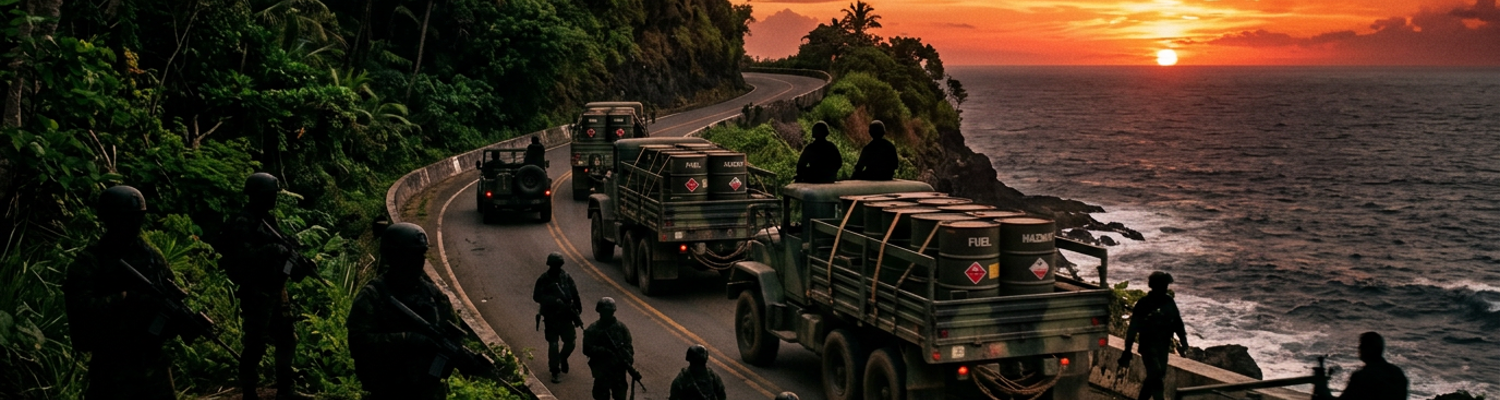
Truck drivers at Chibana Depot finally received clearance to start their engines when the delayed departure order arrived from headquarters. Lead vehicles pulled onto the deserted blacktop of Route 13, rolling forward between the silent checkpoints under the watch of heavily armed escorts. Decontamination trucks equipped with water tanks and chemical spray nozzles followed directly behind each flatbed, ready to douse any leaking canister before toxic gas could drift toward the evacuated houses. Technicians inside the vehicle cabs kept their respirators within reach, scanning the empty curbs and quiet storefronts while distant staff officers monitored the movement as tiny grease-pencil symbols creeping across a briefing board miles away. Drivers shifted into third gear as the road climbed into the hills, accelerating toward Route 73 and the open docks at Tengan Pier.
Phase I Munitions Movement and Military Police Escorts
Trucks ground uphill through the darkness toward Tengan Pier as Phase I commenced in January 1971 to move 150 tons of distilled mustard agent as an operational test run. Headquarters commanders viewed this limited initial shipment as a low-risk trial to evaluate their transit timelines before attempting to relocate thousands of tons of deadly nerve gas. Senior officers remained gathered around conference tables in their distant administrative compound, unable to see the narrow roadside gullies or gauge the nervous tension gripping the convoy personnel. Chemical specialists riding in the truck cabs kept their protective masks resting against their chests, knowing that blister agents could corrode storage containers and burn skin on contact despite assurances from staff officers miles away. Every shudder of an engine transmission reminded the drivers that they were handling real chemical munitions on real mountain curves without direct tactical support from their superiors.
Munitions were loaded onto flatbed trailers under armed military guard and dispatched in closely spaced vehicle serials so that each crew could monitor the truck ahead. Handling crews at Chibana Depot had stacked the wooden crates and steel pallets under intense scrutiny, securing every bundle with heavy canvas wraps and steel tie-down chains. Armed guards shadowed every forklift movement inside the depot igloos to prevent sabotage or handling errors before the vehicles received clearance to depart. Distant headquarters staff had drawn up convoy intervals that assumed wide separations between trucks to minimize blast damage in an accident, but tactical leaders on the ground compressed the spacing to prevent vehicles from being cut off. Drivers kept their headlights aimed at the bumper directly ahead, closing the gaps as the convoy rolled steadily past darkened farmhouses.
Darkened farmhouses prompted soldiers of the 531st Transportation Company and the 20th Military Police Company to provide armed route security against potential anti-base demonstrations. Military police gun jeeps flanked each serial with loaded automatic weapons, ready to interpose their vehicles between angry crowds and the toxic freight. USCAR commanders remained sequestered inside their fortified headquarters in Urasoe, monitoring the operation strictly through coded status updates delivered over delayed radio relays. Ground escorts made split-second decisions at every intersection without waiting for guidance from those distant headquarters desks, knowing that even a five-minute hesitation could allow protesters to barricade the road. Drivers gripped their steering wheels through sweaty work gloves, maintaining their momentum as the lead jeeps swept through the silent bypasses.
Silent bypasses gave way to floodlights along the perimeter of Tengan Pier, cutting through the ocean mist as the lead serial rolled past the final checkpoint toward the waterfront. Dockside gantry cranes loomed above the concrete wharves, waiting to lift the mustard canisters onto transport ships bound for Johnston Atoll. Distant commanders in the headquarters bubble breathed a sigh of relief as successful phase reports arrived over the teletype lines, viewing the clean transit as proof that their theoretical evacuation models were sound. Depot soldiers and military police on the piers knew better, having navigated narrow streets, mechanical stresses, and hostile isolation entirely through their own field discipline. Riggers fastened lifting slings around the flatbed pallets, hoisting the heavy agent containers off the trailers and swinging them over the open cargo holds.
Bio-Detection Protocols and Roadside Chemical Security
Cargo holds received the palletized mustard containers at Tengan Pier, concluding the initial test run and shifting operational focus back to Chibana Depot for the far more dangerous evacuation of nerve agent munitions. Live caged rabbits were placed on truck flatbeds and at roadside monitoring stations to serve as visual bio-detectors for lethal nerve agent leaks. Planners inside the distant USCAR headquarters drafted movement schedules under the assumption that factory seals and steel casings would hold, but frontline chemical handlers refused to trust theoretical safety margins for odorless agents like sarin and VX. Soldiers selected rabbits because the animals possessed nervous systems exceptionally vulnerable to organophosphates, ensuring that any microscopic aerosol leak would trigger violent convulsions in the cages within seconds. Handling teams secured the wire hutches alongside the munition pallets on the flatbed trailers and positioned identical cages on folding tables at highway checkpoints, providing an immediate visual warning system for guards who had no electronic detector alarms. Roadside sentries kept their flashlights trained on the white fur of the animals, knowing that a sudden spasm meant an invisible vapor cloud was already drifting into their path.
Vapor clouds required convoy personnel to operate in full protective gear with M17 masks and carry-on atropine injectors to survive an instant release. Senior officers miles away in their climate-controlled administrative bunker mandated these protective postures on paper, entirely insulated from the physical exhaustion of wearing heavy charcoal-impregnated suits in the subtropical heat. Rubber M17 masks pressed tightly against the faces of the truck drivers, restricting their peripheral vision and fogging their eyepieces as sweat accumulated inside the rubber cheek pouches and muffled spoken words between vehicle cabs. Drivers clipped spring-loaded atropine autoinjectors directly to their load-bearing suspenders, drilling themselves to slam the needles straight through their trouser legs into their thigh muscles at the first sign of pinpoint pupils or chest tightness. Radio handsets hissed with dead static across the convoy column, reminding every soldier behind the wheel that headquarters could not hear their emergency calls or send medical assistance before nerve agent toxicity paralyzed their breathing.
Medical assistance fell to crews following the transport columns, maintaining immediate countermeasure capabilities because radio isolation made distant headquarters irrelevant during a catastrophic breach. Mobile chemical decontamination units from the 267th Chemical Company trailed each convoy equipped with specialized decontaminating apparatus and neutralizing slurry. Power-driven pumps mounted on the beds of these specialized trucks remained pressurized to spray high-output streams of calcium hypochlorite solution across ruptured munitions or contaminated roadway asphalt. Staff officers back at the administrative complex tracked the movement as pencil marks advancing across map overlays, never smelling the chlorine bleach or confronting the dangerous chemistry of nerve agent leaking onto hot blacktop. Technicians rode on the running boards of the trailing decontamination trucks with spray nozzles in hand, prepared to coat any damaged cargo in neutralizing wash without waiting for telephone approval from Urasoe.
Urasoe headquarters remained silent as tires rolled slowly over the cleared asphalt of Route 73 and the nerve agent serials pressed eastward under these frontline security precautions. Checkpoint guards inspected the caged rabbits at every road junction, signaled all-clear with green flashlights when the animals sat still, and waved the heavy flatbeds through the cordoned intersections. Teletype machines inside the USCAR command center clicked intermittently with delayed transit reports, allowing senior staff officers to assume their rigid operational plan was proceeding normally while frontline troops handled the toxic hazard through direct field discipline. Convoy drivers tightened their grips on steering wheels, breathed through their rubber facepieces, and guided the lethal cargo down the final coastal descent toward the waiting security perimeter at Tengan Pier.
Phase II Transport of Corroded Nerve Munitions
Tengan Pier cranes swung the final mustard pallets into ship holds at the waterline, clearing the way for Phase II to begin the relocation of over 12,000 tons of nerve agents across 1,332 flatbed trailer loads organized into 148 convoys. Depot crews at Chibana entered the dark storage igloos to inspect the primary stockpile, confronting thousands of lethal sarin and VX rounds that were far more volatile than the blister agent moved during the test run. Chemical handlers discovered that years of humid tropical storage had severely rusted the outer skins of the weapons, creating pitted metal surfaces and brittle seals that threatened catastrophic toxic leaks if bumped during transport. Depot crews overpacked structurally compromised M55 rockets and MC-1 bomb casings inside sealed steel drums before transit. Specialists in rubber suits and protective masks hoisted each deteriorating rocket and aerial bomb with non-sparking mechanical winches, slid the corroded casings into thick cylindrical containers, and torqued down airtight clamping rings over rubber gaskets. Command officers back in the air-conditioned headquarters at Urasoe tracked daily overpack numbers on paper tally sheets, issuing rigid loading quotas without witnessing the flaking rust or smelling the sour ozone inside the humid bunker bays.
Bunker bays echoed with engine noise as forklifts rolled the heavy steel overpack drums out onto the concrete loading aprons, hoisting rows of sealed cylinders onto military flatbed trailers that queued up for the hazardous eight-mile journey. Drivers secured each row with heavy steel binder chains, cinched canvas tarpaulins over the loads, and fastened wire rabbit cages to the trailer frames to detect microscopic vapor leaks before departing the depot gates. Headquarters commanders experienced tense communication blackouts as convoys navigated narrow island roads under threat of mechanical breakdowns. Static smothered the radio frequencies the instant the heavy trucks entered the hilly terrain of central Okinawa, dropping signal strength across deep roadway cuts and severing direct links to the command bunker. High Commissioner Lampert and his administrative staff paced across their quiet offices in Urasoe, staring at silent teletype consoles and unmoving grease-pencil markers on briefing maps while heavily laden vehicle columns crept blindly through the dark. Staff officers were completely unable to broadcast route adjustments or emergency alerts to the convoy commanders, leaving frontline officers and military police to guide the toxic cargo along narrow pavement without higher command support.
Pavement grades forced truck engines to labor in low gear along the steep asphalt curves of Route 13 and Route 73, pushing transmissions and cooling systems to their mechanical limits under the crushing tonnage of the steel drums. Frontline drivers listened anxiously to the whine of straining differentials and watched dashboard temperature needles climb, knowing that any blown radiator hose or cracked axle would halt an entire convoy serial along roads with zero shoulder clearance. Mechanical teams riding in rear support trucks carried spare belts, coolant cans, and heavy tow cables, preparing to push stalled vehicles off the roadway on their own authority because radio operators could not call the headquarters bunker for recovery assets. Drivers shifted their weight inside damp protective suits, adjusted fogged M17 mask eyepieces with gloved fingers, and kept their headlights locked onto the trailer bumpers immediately ahead to prevent collisions on sharp turns. Military police jeeps held tight formations at every intersecting farm track, blocking cross streets with their vehicle grilles while the convoys maintained steady forward momentum past rows of darkened, evacuated homes.
Darkened homes faded behind them as lead jeeps guided the final trailer serial down the coastal descent toward the high-intensity floodlights ringing the concrete docks at Tengan Pier. Dock workers directed each rumbling flatbed into the crane staging lanes, checking the wire cages on the truck beds to verify that every rabbit remained still and alert after the bumpy trip. Riggers looped braided steel lifting cables around the sealed overpack drums, signaled the crane operators, and swung the heavy nerve agent containers through the hatchways of waiting cargo ships bound for Johnston Atoll. Distant commanders in the headquarters bubble received confirmation of the arrival only after dockside telephone lines relayed the completed serial numbers long after the vehicles had cleared the highway. Transport drivers unfastened their rubber respirators, wiped sweat from their faces, and turned their empty tractor-trailers around to drive back toward Chibana Depot for the next loading cycle.
Maritime Embarkation and Johnston Atoll Relocation
Loading cycles continued as riggers stepped into the vehicle lanes cleared by the departing tractor-trailers, hooking heavy spreader bars to the staged chemical pallets so dockside cranes at Tengan Pier could load the toxic cargo into Military Sealift Command vessels, including the USNS Francis X. McGraw. Crane operators hoisted the palletized artillery shells, aerial bombs, and drummed rocket assemblies high over the wharf aprons, swinging the hazardous containers through open hatchways into the lower cargo bays. Longshoremen working inside the dim ship compartments caught the swinging loads, chaining the munitions to deck pad-eyes and wedging heavy timber shoring around the stacks to stop any shifting during heavy seas. Naval inspectors carried portable monitoring equipment and caged rabbits through the lower companionways to verify air safety, knowing that a ruptured seal deep within a packed hull would kill shipboard personnel before anyone could climb topside. Staff officers inside the distant USCAR headquarters monitored the operation through delayed paper tallies in Urasoe, completely isolated from the greasy cable winches, the stifling humidity in the holds, and the constant threat of dropped loads along the water. Ship captains received their final sailing clearances over coastal teletype lines, ordered deck hands to batten down the steel cargo hatches, and signaled harbour tugboats to pull the vessels away from the pier.
Vessels sailed thousands of miles across the Pacific Ocean to offload the munitions at Johnston Atoll for long-term storage. Merchant marine crews and military chemical detachments endured weeks of pitching swells, standing continuous watch over the sealed holds while navigating through tropical storm systems without direct tactical support. Atmospheric interference often blanked high-frequency radio transmissions across the vast ocean expanses, leaving the vessels out of touch with headquarters commanders who waited for transit updates inside air-conditioned offices thousands of miles to the rear. Shipboard officers solved their own operational problems, adjusting hull ventilation blowers by hand when scorching sunlight heated the steel decks and threatened to expand volatile agent gases inside the cargo holds. Technicians checked rabbit hutches outside hold air vents three times every shift, ready to don gas masks and inject atropine if nerve vapor escaped into the ship circulation systems. Navigators eventually sighted the low white reef line of Johnston Atoll after weeks at sea, guiding the laden freighters through the narrow dredged channel to drop anchor inside the sheltered lagoon.
Sheltered lagoon waters allowed shore crews on Johnston Atoll to maneuver floating cranes and heavy barges alongside the moored transport hulls, beginning the round-the-clock labor of removing the toxic cargo from the damp holds. Soldiers operating dockside forklifts and mobile cranes hoisted the corroded munitions off the vessels, transferring each pallet onto heavy trailers for transit to open-air storage zones and concrete bunkers constructed across the coral island. Logistical officers stationed on the remote atoll managed equipment breakdowns, salt air corrosion, and intense heat without timely guidance from the Pentagon, relying on local field expedients to keep the cranes moving. Completion of cargo offloading in September 1971 marked the conclusion of Operation Red Hat and cleared a key obstacle to the reversion of Okinawa to Japan. Dock workers secured the heavy hatch covers over the empty holds, coiled the shoreward mooring lines, and watched the transport vessels weigh anchor to begin their return voyages across the Pacific.