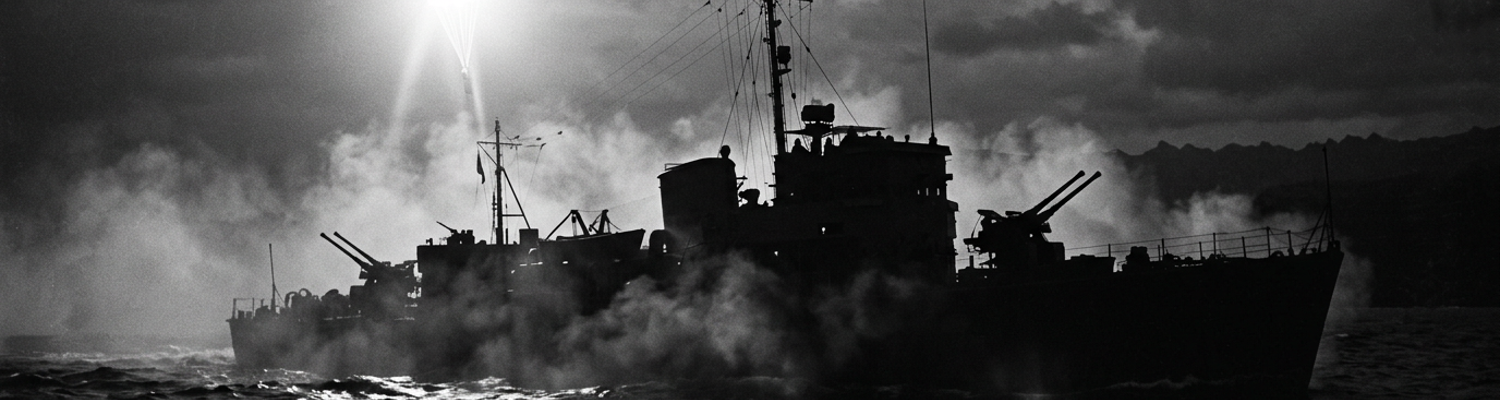

Nasugbu Amphibious Landings and Balayan Bay Cordon
When examining the historical record of Operation Mike Six, Eighth Army amphibious landings at Nasugbu exposed acute tactical vulnerabilities. Lieutenant General Robert L. Eichelberger put the 11th Airborne Division ashore on the open sand of Wawa Beach on January 31, 1945. They landed without heavy division-level artillery. Eichelberger bet everything on rapid movement toward Manila along Route 17. This thrust bypassed the Japanese Fuji Force dug into Mount Carilao and the southern Batangas hills. The landing corridor remained exposed to coastal flanking assaults from the south. Archival evidence shows that Japanese units possessed dozens of motorized Daihatsu craft and wood-hulled sea-trucks. These vessels were concealed inside the coves of the Calatagan Peninsula and Balayan Bay. Rear Admiral William C. Fechteler received intelligence reports confirming that Japanese troops were preparing to shift artillery and mortar teams by sea. They intended to hit the landing beaches from the rear.
Darkness turned the shallow shoreline into an untracked kill zone.
Task Group 78.2 countered this threat by deploying Task Unit 70.1 motor torpedo boats alongside gunboats from Support Craft Flotilla Seven. They established overlapping night cordons to isolate the Batangas coast. These patrol sectors stretched from Cape Santiago up past Calaca and Balayan. The cordon encompassed the inner shelf between coordinates 13 degrees 50 minutes North and 14 degrees 02 minutes North. Standard operational doctrine mandated continuous perimeter sweeps. Higgins-built 78-foot and Elco 80-foot PT boats held outer station in deep water. Converted Landing Craft Infantry vessels crept into the shallows fifty yards off the mangrove line. These were the LCI(G) platforms. Each LCI(G) packed three 40mm Bofors cannons and twin 20mm Oerlikon mounts. They also carried forward-firing 4.5-inch rocket racks designed to saturate shore redoubts. Patrol commanders maintained continuous interlocking arcs of fire across every inlet between Pagaspas Bay and Lemery.
Mechanical components failed under the strain of continuous saltwater operations.
A close review of operational logs indicates that the physical environment inflicted severe attrition on these light vessels. Volcanic silt and floating debris churned up by coastal currents repeatedly choked the raw-water heat-exchanger strainers on the Packard 4M-2500 engines. Coolant temperatures spiked past 210 degrees Fahrenheit. This caused head gasket blowouts. Gunboat crews spent hours in the engine spaces of the LCI(G) platforms clearing sediment from bilge pumps. They scraped corroded copper cooling pipes with improvised reamers. Electronics fared no better in the tropical humidity. The SO-series surface search radars regularly suffered magnetron failure. Watchstanders were left blind across forty-degree forward sectors. Shoreline sea clutter mirrored small surface targets on the radar scopes. Gunnery officers had to track contact vectors using bare binoculars. They relied on magnesium parachute flares fired from Mark 7 40mm cannons.
Tactical friction deepened significantly after the Japanese 10th and 12th Shinyo Squadrons launched explosive motorboats. They operated from hidden revetments along Balayan Bay. On the night of January 31, 1945, these two-ton plywood suicide skiffs struck Task Group 78.2 off the landing area. They drove two explosive charges into the hull of PC-1129 at 14 degrees 05 minutes North, 120 degrees 30 minutes East. The subchaser sank within minutes. Flotilla Seven gunboats received standing directives in response. They were ordered to treat every unlit surface profile moving west of Cape Santiago as an active suicide ramming craft. Watch crews kept their 20mm mounts manned around the clock. Their fingers rested on the foot triggers. They swept dark water where native outriggers drifted alongside combat wreckage.
The order was absolute.
Japanese Sea Raiding Units and Shinyo Motorboats
Naval records from NARA Record Group 338 detail Imperial Japanese Navy 10th and 12th Shinyo Squadrons operating alongside the Imperial Japanese Army 26th Sea Raiding Base Corps. They controlled the rocky coves between Cape Santiago and Pagaspas Bay. Engineering detachments excavated and expanded natural volcanic limestone grottos along the waterline at coordinates 13 degrees 52 minutes North, 120 degrees 39 minutes East. They transformed narrow sea caverns into blast-resistant staging pens. Japanese crews concealed eighteen-foot wood-hulled Shinyo Type 1 motorboats inside these damp recesses. They hid them beneath heavy layers of coconut timber framing and woven nipa mats. Mechanics positioned each craft on greased mahogany slipway rollers. A six-man shore party could shove an explosive hull into the surf within ninety seconds of an alert.
Engine fumes accumulated beneath the rock ceilings.
Archival evidence shows that operational readiness deteriorated rapidly inside these humid littoral hideouts. Each Type 1 Shinyo relied on a modified Toyota automobile engine rated at sixty-seven horsepower. This power plant was never engineered for prolonged exposure to tropical marine environments. Salt crust formed inside the unjacketed cast-iron exhaust manifolds during test runs. This created severe thermal hot spots that cracked engine blocks and contaminated the lubricating oil. Japanese technicians worked by shielded carbide lanterns. They stripped down carburetor bowls to clear volcanic silt drawn in through unsealed intake cowlings. The primary payload consisted of a 300-kilogram Type 98 high-explosive bow charge. It was rigged to dual inertia switches and a mechanical contact detonator on the prow. A flooded carburetor bowl meant an engine stall during launch. The vessel was left vulnerable to incoming swells that slammed the plywood keels into exposed coral heads.
A close review of operational logs indicates that Japanese combat doctrine required these suicide craft to strike in coordinated waves. They attacked during the darkest phase of the lunar cycle. The motorboats were piloted by lone naval enlistees with fewer than thirty hours of maritime training. They were ordered to execute flat-out high-speed nocturnal ramming attacks against anchored Allied transport and patrol vessels. The targets were stationed off the Nasugbu beaches. Attackers throttled up to twenty-three knots. They aimed straight for the waterlines of lightly armored subchasers and converted infantry landing craft anchored at 14 degrees 04 minutes North, 120 degrees 36 minutes East. Pilots navigated through shallow reefs without running lights. They followed shore silhouettes and distant muzzle flashes to hold their attack headings.
Impact switches required a direct strike at speeds exceeding sixteen knots. This force crushed the bow horn and tripped the internal detonating cord. Bright Allied searchlight beams blinded Japanese helmsmen in the final run. Charging boats lost alignment and skipped off hull armor before detonating thirty yards clear of the target hulls.
The blast shock waves tore the light wooden frames apart instantly.
Allied lookouts spotted white bow wakes cutting through the swell. Gun crews aboard the interdiction cordons answered with rapid-fire 40mm Bofors and 20mm Oerlikon sweeps. The low-profile suicide skiffs presented a target barely two feet above the waterline. Allied gunners had to depress their barrels to absolute negative limits. Many Japanese craft suffered catastrophic mechanical failures while executing evasive turns. Galvanized-iron rudder linkages warped under torque at full throttle. This locked the steering gears and forced boats into uncontrolled wide circles in front of active Allied gun batteries. Two Shinyo craft broke through the perimeter toward the anchorage on the evening of January 31, 1945. One struck Patrol Craft 1129 amidships on the port side. The explosion sheared the engine room bulkheads. The subchaser went beneath the surface in eight minutes at a depth of thirty fathoms.
Eighty-four men went into the water.
Terrain Interference and Calaca Shoreline Radio Blackouts
Declassified action reports confirm the jagged volcanic topography of western Batangas created an impenetrable acoustic and electromagnetic shield along the Calaca shelf at coordinates 13 degrees 56 minutes North, 120 degrees 48 minutes East. Steep ridges formed by prehistoric basalt flows from the Mount Taal volcanic complex rose abruptly out of the water. They reached elevations exceeding four hundred meters. These ridges flanked the coastline with vertical mineral-heavy stone faces. Frontline patrol craft from Support Craft Flotilla Seven and Task Unit 70.1 relied on TCS-12 transmitter-receiver sets and SCR-608 radio gear. This equipment operated across high-frequency bands between 2.0 and 12.0 megacycles. These signals required unobstructed line-of-sight paths or shallow-angle ground-wave propagation across open water. They needed to reach the joint operations room aboard the command ship USS Spencer anchored twenty nautical miles west off Nasugbu.
Radio static obliterated outgoing voice transmissions.
The moment an eighty-foot Elco boat or converted LCI(G) slipped behind the jagged volcanic bluffs fronting Calaca, the physical mass of dense iron-bearing rock completely blocked transmitter output. Received signal strength dropped from forty decibels down into ambient background noise. Archival evidence shows that local atmospheric conditions worsened this physical shielding during the pre-dawn hours of February 1945. Tropical temperature inversions settled over the warm brackish water of Balayan Bay. This trapped ionized air layers beneath the elevation of the coastal ridgelines. The inversion bent radio energy away from the surface and accelerated signal attenuation. Ceramic antenna insulators on gunboat masts were caked with windblown volcanic dust and salt spray. They suffered severe dielectric leakage that dropped transmitter radio-frequency output to less than five watts.
Transmission logs indicate that patrol vessels attempting to relay contact reports back to Task Group 78.2 received only unmodulated carrier hum and deafening squelch. Signalmen frantically spun radio tuning dials across assigned tactical channels without establishing contact. The vessels were isolated completely from the primary naval net.
Every gunboat skipper operated in total isolation.
A close review of operational logs indicates that this total communications blackout stripped frontline commanders of centralized radar vectoring. They lost contact with the Combat Information Centers of destroyers operating in outer waters. Without remote radar tracking, gunboat skippers could not confirm whether an unlit slow-moving blip on their rudimentary SO-series screens was a Japanese Shinyo suicide boat creeping out from a shoreline grotto or an indigenous wooden banca carrying escaping Filipino families. Patrol commanders had to establish immediate autonomous local fire-control protocols. They delegated target classification and battery release directly to deck officers standing behind open bridge shields. Gun crews had to acquire track and engage potential threats entirely through visual range estimation. They peered through magnesium flare glare and murky coastal smoke without firing data from offshore tracking stations.
Lookouts directed point-defense batteries using only unassisted vision and handheld binoculars.
Gun captains aboard the LCI(G) vessels manually cranked their twin 40mm Bofors cannons and 20mm Oerlikon mounts toward dark coastal sectors without radar clearance. They followed hand-signaled bearing markers from the flying bridge. Deck officers relied on Mark 14 gyro sights calibrated by eye for targets closing at speeds between twelve and twenty-five knots. This left a margin of error under four seconds to identify an inbound silhouette before it reached lethal ramming proximity. Gun crews kept their thumbs pressed against local firing buttons. Searchlight operators swept coastal coves. They illuminated the water sixty yards ahead of the bow where the hull could strike submerged volcanic shelves at low tide. Operational directives required watch officers to authorize point-blank cannon sweeps across unannounced surface wakes without waiting for flag-level firing clearance. They risked fratricide to ensure survival against explosive ramming hulls.
At 0312 hours on February 2, 1945, lookouts aboard LCI(G)-439 tracked a low-slung thirty-foot wooden silhouette closing at nine knots across the Calaca shelf.
The ship TCS radio emitted continuous dead static at 2716 kilocycles.
Civilian Maritime Corridors and Target Misidentification Hazards
Archival evidence shows indigenous Philippine fishing bancas carrying displaced villagers routinely crossed active night combat sectors between Lemery, Calaca, and Cape Santiago. Japanese ground sweeps by the 158th Independent Infantry Battalion had driven thousands of noncombatants out of burning coastal barrios toward the water. Families lashed together double-outrigger bancas measuring six to nine meters in length. These were constructed from hollowed red lauan logs with bamboo stabilizers. These light craft traveled without running lights or compasses across coordinates 13 degrees 53 minutes North, 120 degrees 44 minutes East. They were pushed along by frayed canvas spritsails or hand paddles through the six-fathom coastal shelf. Escaping refugees sought to cross Balayan Bay south toward liberated sectors on Mindoro Island. They wanted to evade artillery exchanges around Route 17.
Low light conditions rendered all surface contacts visually identical to attack profiles.
The low double-ended wooden profiles produced a visual signature that registered on lookouts binoculars as an indistinguishable black smear against dark volcanic beach gravel. Bamboo outrigger booms rode flush with the surface. They cast fragmented wake patterns in bioluminescent coastal plankton. This closely mimicked the twin bow waves of idling Shinyo suicide skiffs. Archival evidence shows that patrolling crews armed with 40mm cannons and .50-caliber machine guns faced extreme target misidentification risks in shared littoral waters along the Calaca shoreline. Gun captains manning Mark 3 twin 40mm Bofors mounts on LCI(G)-439 and LCI(G)-441 held high-explosive Mark 2 shells loaded in four-round charger clips. They were ready to discharge 120 rounds per minute per barrel. Flanking gun tubs housed Browning M2 water-cooled .50-caliber machine guns loaded with armor-piercing tracer belts. These weapons were capable of splintering a wood hull in four seconds.
Standard operational doctrine issued by Seventh Fleet Support Craft Flotilla Seven required gunners to engage unannounced craft closing inside four hundred yards without waiting for visual recognition signals. At that distance under blinding magnesium flares drifting down from Mark 7 pyrotechnic mortars, shadows cast across bamboo outriggers warped the appearance of human heads and bundled possessions into the contours of explosive charges or twin depth-bomb release racks. Firing batteries operated with split-second margins. An actual Shinyo Type 1 craft covered four hundred yards in under thirty seconds at full throttle. An errant four-round burst of 40mm high-explosive ordnance obliterated a civilian banca and its occupants on contact.
A single hesitation invited an explosion.
A close review of operational logs indicates that deck officers aboard LCI(G)-439 experienced this tactical dilemma firsthand at coordinates 13 degrees 55 minutes North, 120 degrees 47 minutes East during the 0312 contact on February 2, 1945. Ensign Thomas Brennan stood watch behind the quarter-inch splinter shield on the open bridge. He tracked an unidentified thirty-foot craft drifting four hundred yards off the port beam. Radio interference from the basalt bluffs had killed outgoing voice traffic to USS Spencer. The bridge team was left without fire clearance or radar confirmation from offshore destroyers. The vessel portside .50-caliber gunners trained their barrels on the contact. Their fingers depressed the thumb triggers halfway against the spring stops. The 40mm loaders prepared to drop a fresh clip into the feed guides.
The distance closed to three hundred yards.
Brennan ordered the bridge 12-inch carbon-arc searchlight unmasked. The beam penetrated the smoke haze from Calaca to illuminate a central dugout loaded with fifteen civilians paddling frantically against the outgoing ebb tide. Quartermasters spun the helm twenty degrees hard to starboard to wash the outrigger clear with the wake. They cleared the civilian boat by twenty-five yards before returning to interdiction station off the Calaca shelf.
Log entries recorded the contact clear at 0316 hours.
Tactical Fire Discipline Under Parachute Illumination
A close review of operational logs indicates the deployment of 40mm Mark 7 pyrotechnic star shells and 3-inch parachute flares introduced severe visual liabilities for gun crews aboard Flotilla Seven gunboats. Suspended beneath thirty-inch silk parachutes caught in oscillating thermal downdrafts off Mount Carilao, 300,000-candlepower magnesium illuminants swayed through arcs of forty degrees. They drifted downward at seven feet per second. This pendular motion generated constantly sweeping high-contrast shadows across the wave troughs at coordinates 13 degrees 55 minutes North, 120 degrees 47 minutes East. It radically altered the perceived size and distance of floating objects.
Light shifted across the chop with violent unpredictability.
To watchstanders peering through salt-filmed Mark 14 gun sights, stationary volcanic logs and low-profile bamboo outriggers appeared to surge forward in unnatural accelerated bursts. Glare reflecting off wet hull plates and choppy seawater washed out reticle graduations. The intense white magnesium flame stripped lookouts of their scotopic night vision. This created blind scotomas across their central visual fields every time their eyes swept past the flare canopy. Archival evidence shows that this optical degradation crippled the ability of deck officers to calculate closing velocities with standard lead-angle tables. The fluctuating elevation of the descending illuminant constantly shifted the angle of illumination relative to surface contacts. It cast elongated shadows that artificially doubled the apparent hull height of small vessels.
A low-profile craft idling four hundred yards out cast an inverted shadow forward across the water. This visually reproduced the continuous bow displacement of a Japanese Shinyo suicide boat charging at twenty knots. Deck officers aboard LCI(G)-439 were forced to distinguish between true hull displacement and moving flare shadows within intervals as brief as three seconds. Burning magnesium compounds produced clouds of heavy white oxide smoke that hung over the damp windless surface of Balayan Bay. This diffused light into a milky haze that obscured the waterline of incoming vessels.
Radar screens displayed only static interference patterns.
A close review of operational logs indicates that patrol officers on the Balayan cordon operated under standing orders to neutralize charging suicide skiffs before they closed within two hundred yards. They repeatedly delayed weapons release to protect native maritime traffic. Between 0312 and 0316 hours on February 2, 1945, Ensign Thomas Brennan confronted this exact tactical dilemma. An unidentified thirty-foot vessel breached the inner perimeter at coordinates 13 degrees 55 minutes North, 120 degrees 47 minutes East. Cut off from USS Spencer by continuous radio static, the watch officer held absolute local authority over his gun batteries. The ship twin 40mm Bofors and three forward 20mm Oerlikon mounts were fully manned. Elevation was set to zero degrees. Gunners tracked the dark hull as it drifted inward against the ebbing tide.
An inbound Type 1 Shinyo carrying 660 pounds of bow-mounted explosives required immediate destruction before impact. Opening fire on an unlit civilian outrigger meant slaughtering noncombatants with high-explosive fragmentation rounds.
Gun captains waited with thumbs pressed flat against deadman switches.
Patrol officers resolved this hazard by substituting searchlight verification for immediate point-blank battery discharge. They deliberately exposed their own vessels to suicide ramming runs during the final seconds of an approach. At a range of two hundred and fifty yards, Brennan refused permission to open fire. He ordered the bridge quartermaster to trip the shutter on the 12-inch carbon-arc lamp. The concentrated 800,000-candlepower beam penetrated the smoke-diffused flare light. It revealed a double-outrigger fishing banca crowded with fourteen civilians. Women and children sheltered beneath woven nipa awnings. Their paddles froze mid-stroke.
The bridge team backed the starboard engine down full to swing the gunboat clear. They directed the outrigger toward shallow waters west of the Calaca shoals with hand signals. The craft disappeared into the dark shore shelf at 0317 hours.
The radio remained dead.