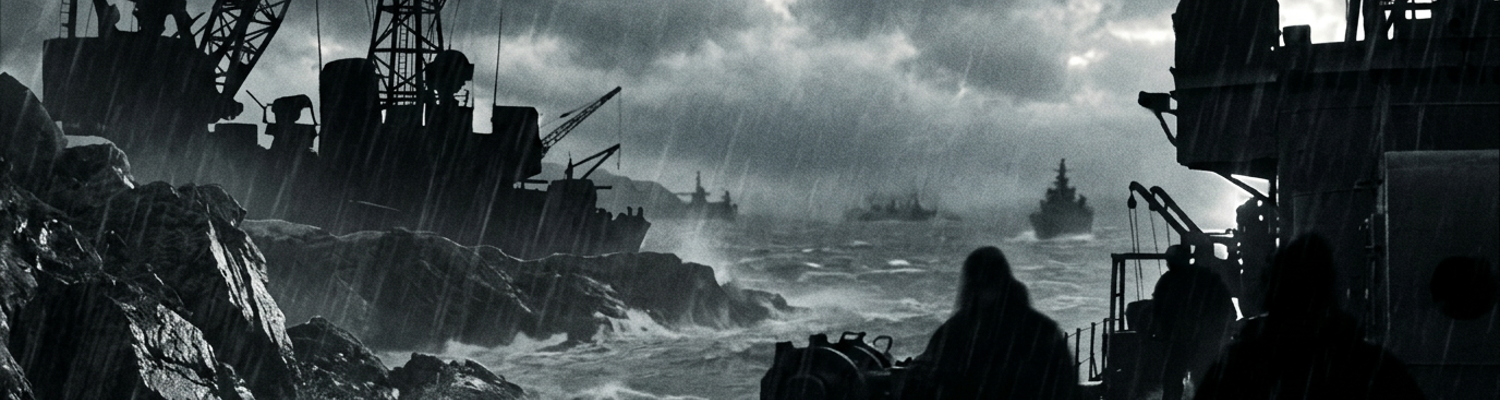

Strategic Isolation Aboard USS Helena
Inside the radio central compartment of the heavy cruiser USS Helena, the drive shaft of a Model 28 teletype assembly seized. A hardened steel worm gear sheared three consecutive teeth against an unlubricated bronze spur. Metal shavings fell directly into the gear housing. This bound the main motor spindle. The governor assembly spun out of alignment and dropped line pressure across the pneumatic tube feeder from ninety pounds per square inch to zero. Radio technicians stripped the housing under red battle lanterns. They scraped out powdered alloy with dental picks while the teletype paper roll hung motionless in the platen. Anchored in the oily swells of Keelung Harbor at the northern tip of Taiwan, the cruiser served as the floating headquarters for Task Force 72. Vice Admiral Wallace M. Beakley and Rear Admiral Paul P. Blackburn Jr. ran the regional response from this warship. Concrete breakwaters and two hundred miles of open water separated them from the target zones. Command staff tracked the crisis on wall-sized plotting boards using grease pencils and delayed transmission strips. Armor plate blocked direct radio propagation and trapped exhaust heat.
Keelung sat deaf and motionless.
Archival evidence shows that this physical separation bred a deep strategic disconnect between flag officers aboard Helena and the frontline tactical conditions facing Republic of China garrison troops on Kinmen. Seventh Fleet operational directives assumed that amphibious landing craft could maintain scheduled offloading cycles beneath the cover of American destroyer escorts holding five miles off the coastline. Staff officers in Keelung drafted logistics tables requiring Nationalist utility landing craft and mechanized landing craft to run directly into the surf line at Liaolo Bay on precise thirty-minute turnarounds. On the beaches of Kinmen, Chinese Communist artillery batteries on the Amoy and Tatun peninsulas had pre-registered every square yard of the shingle with 152mm and 122mm howitzers. They fired upwards of fifty thousand shells in single twelve-hour bombardments. When Republic of China Navy vessels approached the surf, high-explosive fragmentation fire cratered the landing ramps. Shells blew apart unarmored diesel fuel lines. Crews reversed engines before dropping their cargo. Flag officers aboard the cruiser continually miscalculated beach capacity because their operational planning models treated Kinmen as an ordinary amphibious supply point. The island was an encircled target trap under observed cross-strait artillery fire.
Distance transformed tactical doctrine into sheer paperwork.
A close review of operational logs indicates that this disconnect worsened because command staff worked within intelligence cycles dependent on couriers. High-frequency radio traffic between Kinmen and northern Taiwan suffered severe disruption from atmospheric ducting and deliberate Chinese Communist electronic jamming. Artillery strikes repeatedly severed shore antenna cables. To confirm supply consumption rates and civilian casualty figures, Seventh Fleet planners relied on physical document packets carried aboard Martin PBM Mariner flying boats and Republic of China Navy patrol craft. When rough sea states in the strait exceeded sea-state four, these physical dispatches stalled at transport nodes in Penghu or Kaohsiung. Information reaching the chart tables inside Helena arrived between twenty-four and forty-eight hours after the shells had detonated. Staff planners moved marker pins for artillery ammunition depots that had already exploded two days prior. They allocated supply shipments to concrete pier heads that were already rubble. In one specific dispatch sequence on September 4, Task Force 72 operations staff issued routing orders for three Republic of China Navy medium landing ships to deliver fifteen thousand artillery rounds to Liaolo Bay. A People's Liberation Army artillery barrage had already sunk the primary salvage tug and driven the local beachmaster personnel into subterranean tunnels hours before the orders cleared the cruiser message board.
Severed Submarine Cables and Tactical Blackouts
Archival evidence shows that secure communication between the offshore garrisons and the naval command collapsed during the first seventy-two hours of bombardment.
When examining the historical record of the Republic of China Army Signal Corps, the primary physical link between Kinmen and the naval base at Makung in the Penghu archipelago rested on twin submarine telegraph lines. These lines ran out from the shingle at Liaolo Bay across sixty nautical miles of shallow seabed. They were insulated with gutta-percha and armored in double-wound galvanized steel wire. On the afternoon of August 24, high-explosive 152mm rounds fired from People's Liberation Army coastal batteries at Amoy struck the concrete cable terminal perched on the bluffs of Kinmen southern shoreline. Concussive blasts ripped the copper conductors out of their terminal blocks. Near-miss detonations in the surf sheared the marine armored casing three hundred yards off the low-water mark. Motorized junks operating out of mainland fishing communes dragged heavy grapnels across the seafloor. They snagged and severed the remaining secondary line running toward Penghu. The garrison lost all telegraphic and teleprinter connection to Makung.
Hardwired communication vanished in an afternoon.
A close review of operational logs indicates that fallback high-frequency radio transmissions failed to bridge the gap. Kinmen Defense Command relied on tactical radio sets operating in the three-to-thirty megahertz spectrum to broadcast combat status reports to Navy receivers at Keelung and Tsoying. Intense late-summer ionospheric instability over the Formosa Strait created severe signal attenuation. This dropped transmission ranges by more than seventy percent during daylight hours. Electronic warfare units from the Chinese Communist 31st Army compounded the atmospheric interference. They ran broadband jamming transmitters from positions on Tatun Island and the Xiamen peninsula. This flooded the specific frequencies used by Republic of China field units with unmodulated continuous-wave noise. On the rocky slopes of Mount Taiwu, fragmentation from repeated artillery strikes stripped the ceramic stand-off insulators from whip antennas and demolished dipole array masts. Radio operators strung jury-rigged copper wire inside granite tunnels. Signal degradation became so severe that radio operators aboard Seventh Fleet vessels intercepted only fragmented Morse code characters through heavy electrical noise.
Static dominated the naval circuits.
Inside the plotting spaces of USS Helena, staff officers directed naval movements using inventory manifests that bore no relation to the ammunition bunkers on Kinmen. Rear Admiral Paul P. Blackburn Jr. tracked supply status markers on Plexiglas bulkheads using courier reports delivered by patrol boats three days earlier. Those records listed Kinmen artillery reserves at sixty-five percent capacity. Fifty thousand rounds of 105mm and 155mm high-explosive ordnance were logged as available for counter-battery fire. General Hu Lien artillery units had actually burned through four thousand rounds every twenty-four hours to suppress PLA gun positions at Weitou. This reduced ready ammunition stocks to fewer than twelve rounds per tube by the morning of August 29. Seventh Fleet planners allocated screening destroyers to protect slow transport vessels carrying dry rations. They prioritized flour and dried vegetables over artillery shipments. Combat units on Kinmen rationed their shells to three shots per battery per hour. Fleet headquarters in Keelung held ammunition transports at dockside. They operated under the mistaken belief that the island underground magazines were adequately stocked.
Subterranean Fortifications in Kinmen Granite Adits
Archival evidence shows that Kinmen Defense Command began driving horizontal adits into Mount Taiwu diorite-granite core long before the first salvos of August 1958. General Hu Lien assigned the Republic of China Army 58th Infantry Division and dedicated sapper units to hollow out the 253-meter massif. They deployed pneumatic rock drills driven by aging Le Roi diesel air compressors. Crews drilled hexagonal five-hole burn cuts into the bedrock. They tamped sixty percent straight gelatin dynamite into thirty-millimeter blast holes to fracture the dense quartz stone. Sappers hauled out thousands of tons of fractured granite on wooden handbarrows through 2.5-meter-wide drift tunnels. This established deep-set artillery redoubts and shell-proof command galleries seventy meters beneath the peak. The finished adits housed fortified casemates for 155mm howitzers. These featured double-leaf steel blast doors twenty-five millimeters thick designed to channel atmospheric overpressure outward along reverse-slope exit drifts. By mid-August, this underground complex linked central headquarters at Wuqian directly to concealed firing positions cut into the reverse northern cliff faces overlooking the mainland coast.
Granite absorbed what armor plate could not.
When examining the historical record of the 1958 bombardments, the structural integrity of these subterranean bastions depended directly on engineer battalions operating under constant artillery saturation. People's Liberation Army batteries across the Amoy, Dadeng, and Lianhe sectors dropped more than forty thousand high-explosive rounds per day onto the slopes of Taiwu Shan. Republic of China combat engineers entered active strike zones to reinforce failing gallery arches. Sapper teams from the 8th Engineer Battalion hauled corrugated steel arch liners and ten-inch timber shores down narrow galleries slick with pulverized quartz mud. Shockwaves from 152mm shell detonations repeatedly ruptured low-pressure ventilation hoses. This flooded active work faces with carbon monoxide and diesel exhaust from subterranean generators. Squads shored up cracked ceiling spans with quick-setting calcium chloride cement mortars. They worked with hand sledgehammers and hydraulic jacks under red emergency flashlights. Heavy railroad iron was wedged against sheared rock faces to stop lateral tunnel wall displacement while explosions shook the mountain above.
Engineers worked without fresh air.
A close review of operational logs indicates that the primary danger inside the deep adits came from concussive surface detonations producing lethal granite spalling. Heavy 152mm high-explosive fragmentation rounds detonating across the summit ridges transmitted compressive stress waves through the continuous rock mass. Upon hitting the free air surfaces of interior tunnel ceilings, these compression pulses reflected back as tensile waves. This exceeded the tensile strength of untreated granite and snapped jagged stone slabs from overhead bulkheads. Jagged rock fragments weighing up to eighty pounds detached from gallery roofs at high velocity. They crushed personnel and severed internal battery fire-control telephone lines. On September 11, a coordinated three-hour bombardment triggered a structural collapse across a forty-meter stretch of the secondary transport adit near Shanwai. Twelve tons of fractured caprock dropped onto an ammunition handling section. Thirty-two troops were trapped behind a sealed granite wall. Excavation crews required eighteen hours of continuous pickaxe clearing to penetrate the rubble field and extract four survivors.
Atmospheric Hazards and Sapper Trauma Underground
Archival evidence shows that the most immediate lethality facing Republic of China sappers deep beneath Mount Taiwu developed from invisible atmospheric poisoning within unventilated blind saps. Engineer squads driving counter-mining drifts and ammunition niches operated in dead-end tunnels extending up to ninety meters from the main gallery air courses. Every detonation of sixty percent straight gelatin dynamite discharged dense volumes of carbon monoxide and nitric oxide directly into confined rock faces. Chinese Communist coastal artillery batteries at Dadeng maintained continuous interdiction fires against exterior tunnel portals. Bunker crews kept heavy steel blast doors locked shut for twelve to fourteen hours at a time. The trapped atmosphere rapidly degraded as combustion byproducts displaced breathable oxygen. Ambient carbon monoxide concentrations pushed past eight hundred parts per million. Sappers breathing this contaminated air suffered carboxyhemoglobin saturation levels exceeding forty percent within forty-five minutes. Men collapsed at the rock face with severe frontal headaches and motor ataxia. They dropped pneumatic drills onto stone floors while companion miners succumbed attempting extraction. Secondary smoke drawn through damaged intake dampers compounded the hazard. This saturated deep adit work faces with acrid sulfur dioxide residues that scorched respiratory tracts.
Dead air killed without a sound.
When examining the historical record of casualty clearing stations at Wuqian, blast overpressure and catastrophic blunt-force trauma incapacitated sapper personnel at rates exceeding surface fragmentation injuries. Heavy 152mm high-explosive ordnance detonating directly against granite portal entrances forced high-velocity shock fronts down the narrow 2.5-meter drifts. The planar geometry of these tunnels prevented atmospheric shock dissipation. Peak overpressures above twenty-five pounds per square inch channeled through interior work faces. Unprotected combat engineers caught in horizontal saps sustained bilateral tympanic membrane ruptures and primary blast lung contusions. Internal hemorrhaging occurred as the concussive fronts struck their chests. Reflected stress pulses threw men violently against jagged diorite walls. This fractured ribs and caused base-of-skull fractures. Secondary rock displacement inflicted severe mechanical trauma. Compressive shockwaves vibrated through unreinforced rock spans. Vertical load timbers snapped under eccentric loads and collapsed multi-ton overhead granite slabs onto workers. Sapper teams sustained complex crushed limb injuries and traumatic pelvic shearing. Emergency field amputations took place in subterranean aid stations lit by battery lamps. Surgeons worked without whole blood reserves.
Shockwaves compressed tunnel air at supersonic velocities.
A close review of operational logs indicates that the Kinmen Defense Command engineer staff counteracted this subterranean crisis through the emergency deployment of pneumatic exhaust fans. Sapper companies salvaged Joy Axivane portable vaneaxial pneumatic fans from damaged mining stockpiles. They coupled them directly to two-inch steel air lines driven by underground Le Roi diesel compressors. Incoming artillery detonations constantly shredded standard rubberized canvas ventilation tubing. Engineers developed field-expedient solutions inside the mountain workshops. Mechanics cut twenty-gauge galvanized culvert pipes and discarded fifty-five-gallon fuel drums into interlocking exhaust sleeves. They soldered the metal joints with lead wire salvaged from telephone distribution boxes. At adit portals, sappers installed sheet-iron duckbill exhaust nozzles fitted with weighted leather flapper valves. Under positive drive from the pneumatic fans, stagnant air and toxic blast gases pushed the duckbill flaps open to vent fumes along the reverse-slope portals. Detonations of People's Liberation Army artillery rounds within fifty yards of the exit generated exterior overpressure. This slammed the flexible leather lips flat against steel stops. The ducts sealed and prevented external shockwaves and toxic combustion dust from backdrafting down into the subterranean troop chambers.
Service Squadron 3 Replenishment in the Pescadores
Archival evidence shows that Service Squadron 3 established its forward operational anchorage inside the sheltered western roadstead of Makung in the Penghu Islands. This location sat roughly sixty nautical miles southeast of Kinmen. Positioned at 23 degrees 32 minutes North, 119 degrees 31 minutes East, the task element anchored auxiliary repair vessels and fleet tugs among the volcanic shoals. This created a mobile support point outside the firing arc of mainland artillery. Captains maintained auxiliary feed pumps and steady steam in their propulsion turbines day and night. They kept ground tackle from parting against unpredictable bottom currents. Logistics officers under Commander Service Force, Pacific Fleet recognized that running transports back to Kaohsiung consumed seventy-two hours per turnaround cycle. Makung cut that round-trip run down to ten hours of sprint steaming. Service Squadron 3 deployed depot tenders and stores ships to receive and re-stow ordnance incoming from Subic Bay and Yokosuka. They reallocated standard naval supply runs directly into high-speed assault echelons.
Basalt shoals hemmed the warships into shallow waters.
When examining the historical record of ship manifests, the ammunition ship USS Mount Katmai arrived at the Penghu anchorage carrying cargo far outside typical naval ordnance allotments. Kinmen Defense Command had transmitted urgent logistics requisitions for tunneling equipment to shelter garrison troops from continuous artillery barrages. Inside the lower holds of the C2-S-AJ1 vessel, deck hands bypassed five-inch naval shells to hoist forty Ingersoll-Rand pneumatic rock drills and portable air manifolds. They moved two thousand pounds of DuPont sixty percent straight gelatin dynamite. Storekeepers assembled thousands of feet of high-pressure two-inch air hoses and carbon-steel drill rods intended for sapper companies boring into Mount Taiwu. Below the main deck, hospital corpsmen and supply clerks organized wooden cases containing three thousand units of normal saline and dextran blood plasma expanders. Surgical irrigation sets needed by subterranean aid stations were also packed. Working beneath dim incandescent cargo lights, sailors packed the fragile pharmaceutical crates into wire-reinforced wooden boxes lined with excelsior. They lashed the medical supplies and explosives onto wooden pallets covered by heavy waterproof canvas to withstand open-ocean transfer.
Dynamite cases sat stacked beside cartons of blood plasma.
A close review of operational logs indicates that running this material forward to amphibious transport divisions required underway high-line transfers executed in sea state five. Heavy ocean swells running four to six meters through the Formosa Strait forced Mount Katmai and receiving vessels to hold parallel courses eighty feet apart at eight knots. Republic of China Navy landing craft and Seventh Fleet destroyers participated in these maneuvers. Gun crews fired line-throwing bronze projectiles across the gap to pass three-quarter-inch wire highlines between kingpost winches and receiving bitts. Winch operators fought erratic surging as waves rolled the ships twenty degrees out of phase. This repeatedly stretched the steel cable beyond its working load limit and snapped hydraulic relief valves open. Line tension fluctuated wildly. Pallet nets carrying pneumatic tools and glass medical bottles plunged into rising crests before being jerked airborne by counterweight winches. Riggers on the receiving decks used ten-foot wooden maneuvering spars to fend off the swinging crates. They pinned the loads to deck plates and released the pelican hooks while seawater washed across the scuppers.
Winch cables frayed under thousands of pounds of shock tension.
Between September 8 and September 14, Service Squadron 3 high-line teams transferred over four hundred tons of pneumatic equipment and packaged surgical solutions to forward-deployed amphibious transports. They did not drop a single cargo net into the strait. Nationalist logistics crews aboard landing ships immediately stowed the delivered hardware into lower vehicle decks. They chained the air compressors and dynamite crates beneath armored bulwarks before heading out on their final eighty-mile dash to the Kinmen landing beaches. Mechanics on the transport decks worked with hand wrenches in total blackout conditions. They secured hydraulic line fittings and replaced damaged air hose couplings with spare bronze nipples stamped by the Makung repair depot.
Amphibious Beach Replenishment Runs to Liaolo Bay
Archival evidence shows that during the dark-of-the-moon cycles of early September 1958, Republic of China Navy landing craft attempted high-tide night beaching runs into the southern curve of Liaolo Bay. Skimming across the shallow offshore sandbars at twenty-four degrees twenty-four minutes North, crews aboard mechanized landing craft cut their running lights three miles out. They navigated solely by the dark silhouette of Mount Taiwu. Shallow-draft vessels ran their Detroit 6-71 diesel engines at full throttle. They rode breaking surf toward the exposed shingle. Chinese Communist coastal batteries on the Amoy and Weitou peninsulas opened fire with optical rangefinders tracking the white foam of their wakes. Salvos of 152mm high-explosive fragmentation shells struck the wet sand and intertidal shallows. Geysers of water mixed with sharp shrapnel punched through unarmored quarter-inch steel wheelhouses. On the evening of September 7, high-velocity fragmentation tore through the cooling manifold of an incoming utility landing craft. This dumped engine coolant across the bilge and caused the starboard engine to seize sixty yards before the keel touched sand. Trapped in the breaker line, Nationalist coxswains fought the rudder lines under direct artillery fire. They dropped heavy bow ramps directly into five feet of water while machine-gun fire raked the exposed cargo decks.
Ramps dropped into churning foam under direct shellfire.
When examining the historical record of Task Group 77.7, Seventh Fleet destroyer escorts operated under strict tactical rules of engagement drafted in Honolulu and Washington. These orders prohibited them from closing within three nautical miles of the Kinmen shore. Destroyers including USS Rowan and USS Walke escorted the Nationalist supply columns across the open strait. They screened them against People's Liberation Army torpedo boats with SPS-6 air search and SPS-10 surface radar sweeps. Reaching the three-mile territorial boundary line, ship captains executed sharp rudder orders. They turned their vessels onto broad offshore patrol tracks to avoid entering waters claimed by Beijing. Watch officers on the open flying bridges tracked incoming mainland artillery trajectories on their radar repeaters. They observed radar-indicated shell splashes walking directly across the beaches of Liaolo Bay. Gun crews stood by their five-inch thirty-eight-caliber mounts with loaded hoists. Local fire-control directors locked onto mainland gun positions at Tatun. They were forbidden from firing counter-battery salvos to suppress the batteries chewing up their allies in the surf. Naval commanders anchored hundreds of miles away in Keelung maintained this offshore holding position. This kept the Seventh Fleet outside the direct zone of warfare. Nationalist landing craft cleared the final five thousand yards entirely alone.
American guns remained silent at the three-mile line.
A close review of operational logs indicates that the offloading effort on the shingle at Liaolo Bay descended into mechanical and organizational collapse within minutes of the ramp landings. Nationalist garrison troops lacked motorized rough-terrain forklifts and functional heavy winches on the sand. Shore parties hauled individual eighty-pound wooden crates of 105mm artillery shells by hand down steep bow ramps. Communication links between Kinmen Defense Command and the local beachmaster unit had broken under earlier bombardments. Incoming cargo landed without manifest sorting or organized dispersal teams. Enlisted soldiers piled wooden boxes of high-explosive ordnance and dry field rations directly on the water edge. This created fifty-yard-long linear dumps along the high-water line. Spotters on the Weitou bluffs observed these growing stacks through ten-power battery telescopes. They brought down pre-registered walking barrages of 122mm howitzer fire across the open sand. At 0115 hours on September 11, a single high-explosive shell detonated two stacked tiers of Republic of China Army artillery powder canisters. This triggered a violent sympathetic detonation that obliterated three hundred yards of the beachhead. The blast killed twenty-four stevedores and set fire to four parked landing vehicles. Eight-foot-deep craters tore into the beach exit roads. Subsequent landing craft were trapped against the sand with no route to move ammunition into the inland granite bunkers.
Command Manifest Conflicts and Logistical Delays
Archival evidence shows that supply officers working inside the logistical depot at Keelung Harbor continuously prioritized five-inch and three-inch naval gun ammunition over structural reinforcement materials requested by combat engineers. Working off pre-planned amphibious deployment schedules drawn up before the August 23 bombardments, Task Force 72 planners loaded Republic of China Navy landing ships with thousands of rounds of naval ordnance intended to replenish offshore escort vessels. Inside the granite galleries of Mount Taiwu, Republic of China Army sappers faced catastrophic tunnel collapses caused by continuous 152mm artillery impacts that fractured overhead stone spans. Kinmen Defense Command filed emergency requisitions for heavy Douglas fir timber shores and twelve-foot structural steel I-beams needed to support disintegrating adit ceilings. Keelung cargo masters struck these lumber requisitions from loading manifests to make room for four hundred pallets of surface-to-air and naval anti-aircraft shells that could not be fired from shore emplacements. When the landing ship tank Chung Hai finished loading at the Keelung wharf on September 6, its lower tank deck contained two hundred tons of 40mm Bofors shells and five-inch ammunition. Eight hundred required bridge-timbers and mine-shoring posts sat abandoned under tarpaulins on Pier 4.
Tons of unneeded naval ammunition sat on wet docks while falling granite crushed the miners below.
When examining the historical record of Task Force 72 quartermaster operations, written requisitions from the front endured a forty-eight-hour communication lag before reaching desk officers in northern Taiwan. High-explosive shellfire from Chinese Communist batteries on Amoy and Tatun had severed the direct seabed telegraph lines. Nationalist beachmasters at Liaolo Bay transmitted supply changes using courier packets run by wooden sampans and fast patrol boats to Penghu. From Makung, radio operators relayed typed carbon summaries across fragile high-frequency channels that were subject to daylight ionospheric blackouts. A requisition stamped by General Hu Lien staff reached the logistics desks aboard USS Helena after the tactical situation on the beachhead had changed twice over. On September 9, beachmaster officers logged an urgent demand to halt deliveries of sacked flour and dry rations due to burning beachhead supply dumps. They demanded track-laying salvage dozers to drag sunken landing craft out of the surf line. Quartermasters in Keelung received this dispatch two full days late on the afternoon of September 11. They had already cleared another two landing ships packed with six thousand bags of wheat flour directly into the artillery kill zone.
Paperwork moved across the strait by boat over days while artillery shells crossed it in seconds.
A close review of operational logs indicates that the complete maritime blockade of Liaolo Bay forced Joint Operations Center planners in Taipei to execute emergency low-altitude air-drops directly over the island interior drop zones. Chinese Nationalist Air Force C-46 Commandos and C-47 Skytrains operating out of Hsinchu Air Base flew low-level runs over the western approaches to Kinmen. They skimmed thirty meters above the water to slip underneath mainland optical fire-control networks. Parachute riggers loaded the aircraft fuselages with specialized cargo assemblies containing glass bottles of lyophilized human blood plasma and surgical vein-cannula sets packed inside rubberized shock-absorbing drop canisters. Crews wired wooden crates containing hardened tungsten-carbide pneumatic drill bits and replacement chuck collars directly to cargo slings. They dropped them alongside the medical supplies over the red-clay flats near Shangyi airstrip. Sapper units required these specific drill bits to replace cutting heads blunted against Mount Taiwu diorite formations. Broken drills had halted the excavation of underground surgical suites.
Drop cords snapped in the prop wash as planes banked hard across the ridges.
Between September 12 and September 17, transport crews kicked eighty tons of plasma cartons and drill steel through open cargo doors. People's Liberation Army anti-aircraft batteries at Dadeng bracketed the drop zones with 37mm explosive fire. Ground crews from the 58th Infantry Division sprinted onto active impact fields under shellfire. They hauled ruptured crates of intravenous fluids and drill rods down into drainage ditches before incoming shrapnel punctured the aluminum canisters. Soldiers stacked the salvageable ampoules of dried plasma inside cool ammunition niches sixty feet below ground. Surgeons mixed the powder with sterile water under flickering generator lamps to treat hemorrhaging sappers.
Tactical Communications Reforms and Island Defense Doctrine
Archival evidence shows that the destruction of open-air supply dumps along the Liaolo Bay shingle forced Seventh Fleet planners and the Kinmen Defense Command into a sweeping reassessment of forward logistics command vulnerability during littoral artillery sieges. Positioned at twenty-four degrees twenty-four minutes North, early coordination tents and exposed communications trailers operated within direct line-of-sight of Chinese Communist optical rangefinders on the Amoy and Weitou peninsulas. When 152mm high-explosive barrages cratered the waterlines, shrapnel sheared exposed wiring looms and wrecked beachmaster field radios. Staff officers attempting to clear supply manifests from wooden folding tables were killed. Surface command posts on open shorelines represented unviable targets under persistent artillery registration. Vice Admiral Wallace M. Beakley and Nationalist army leaders abandoned centralized beach control. Logistics command authority shifted entirely inside subterranean diorite caverns bored seventy meters deep into Mount Taiwu. Cargo dispersal authority was delegated to decentralized, platoon-sized engineer squads sheltering within reverse-slope trench networks.
Exposed coastal headquarters invited immediate destruction.
When examining the historical record of Signal Corps operations, communications engineers resolved the failure of severed undersea telegraph lines by constructing hardened multichannel microwave relay links across the Formosa Strait. Repeated grapnel drags by mainland motorized junks and artillery bursts off Liaolo had permanently disabled the twin gutta-percha marine cables linking Kinmen to the naval base at Makung. To restore secure voice and teleprinter transmission without relying on jam-prone high-frequency bands, American technical advisors and Republic of China Army technicians deployed AN/TRC-24 radio sets equipped with directional parabolic antennas. Engineers anchored these steel lattice dish mounts onto concrete footings excavated into the reverse granite ridges of Mount Taiwu at an elevation of 240 meters. They aimed line-of-sight microwave beams sixty nautical miles southeast toward receiving stations in the Penghu archipelago. Utilizing twelve-channel frequency-division multiplexing within the ultra-high frequency spectrum, this microwave relay transmitted encrypted teletype signals far above the continuous-wave jamming frequencies generated by People's Liberation Army coastal transmitters.
Directional microwave signals bridged sixty miles of open water without touching the seabed.
A close review of operational logs indicates that the catastrophic loss of beached landing ships prompted a complete revision of Seventh Fleet joint underway replenishment doctrine for contested island redoubts. Service Squadron 3 and Task Group 77.7 abandoned standard amphibious doctrine. That doctrine required slow, unarmored Landing Ships Tank to grind their hulls onto exposed sandbars under daylight observation. Under revised tactical instructions drafted aboard USS Helena, American dock landing ships and accompanying fleet auxiliaries held station five miles offshore. They launched amphibious tracked vehicles from flooded well decks under cover of night. Nationalist crews aboard Landing Vehicles Tracked received pre-palletized loads of 155mm artillery shells directly from shipboard cargo booms. They motored through the surf and climbed directly into inland granite ravines rather than pausing on the vulnerable waterline.
Contested beaches ceased to function as conventional cargo unloading zones.
Naval support commands at Makung and Kaohsiung rebuilt their supply procedures around this deep-water transfer model by late September 1958. Riggers strapped artillery propellant canisters and pneumatic drill components onto five-ton wooden pallets secured with quick-release steel wire bridles. Winch crews on Seventh Fleet replenishment vessels reduced open-ocean highline transfer times to ninety seconds per pallet. They transferred hundreds of tons of munitions in total blackout before shore-based radar batteries on the mainland could track the formations.