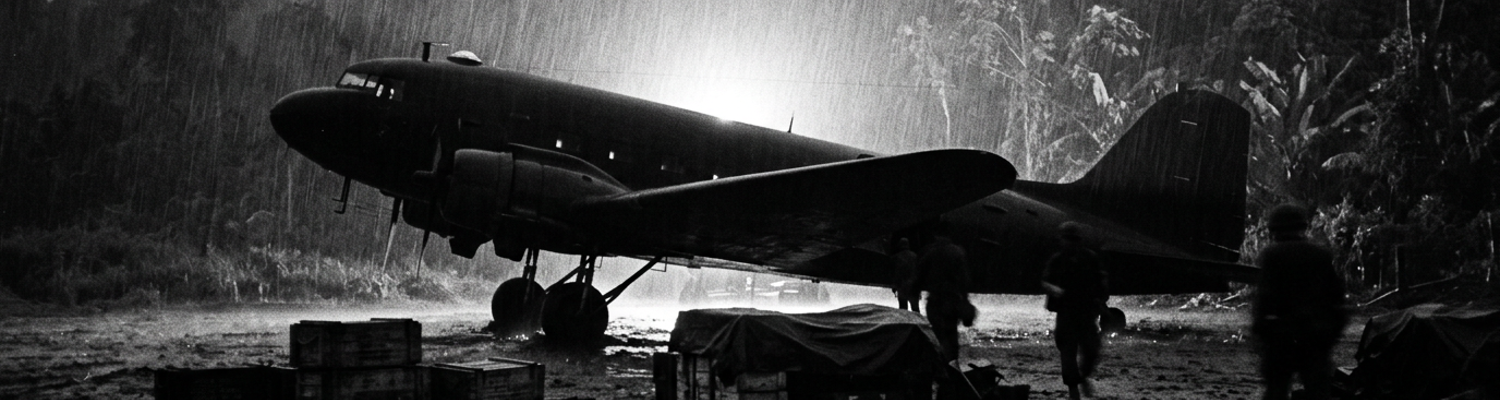

Clandestine Staging at Opa-locka and Kelly AFB
At 0340 local time on June 18, 1954, high-frequency radio contact between forward rebel columns deployed near the Guatemalan border post of El Florido and headquarters in Florida failed completely.
Transmitters operating on the tactical 4205-kilocycle band collapsed into unreadable static. This severed the invasion force from regional command. Decrypted field traffic reveals that Carlos Castillo Armas and his two hundred and fifty irregular fighters stood isolated in the rain-soaked ridgelines. They lacked confirmation of their promised resupply drops. They possessed no ability to call in air support against Guatemalan military garrisons.
The nerve center directing this unraveling push sat over one thousand miles north in Florida.
Archival evidence shows that operational headquarters for Operation PBSUCCESS operated out of a decommissioned naval air station barracks in Opa-locka. This facility functioned under the cryptonym LINCOLN. Heavy mechanical maintenance operated simultaneously at Kelly Air Force Base in Texas. Technicians inside Kelly Air Force Base stripped Douglas C-47 and four-engine C-54 cargo transports of all military serial numbers. They removed exterior insignia and manufacturer data plates to establish total deniability. Civilian-clothed mechanics with the San Antonio Air Materiel Area ran round-the-clock overhauls on Pratt & Whitney R-1830 and R-2000 radial engines. They installed auxiliary rubber fuel bladders inside the cargo bays to extend flight range across the Gulf of Mexico. Ground personnel packed the airframes with crates of .30-caliber ammunition and 81mm mortar rounds. They loaded canvas drop containers stuffed with hand grenades. Bureaucrats prepared falsified civilian manifests designating the cargo as commercial mining equipment bound for private enterprises. These documents routed the heavily laden planes through the Yucatán Peninsula toward Central American distribution nodes.
Flight clearances were forged.
When examining the historical record, flight logs confirm that active-duty personnel from USAF Air Resupply and Communications wings operated unmarked C-47 and C-54 transports throughout May and June 1954. These aircrews flew hazardous supply sorties directly into rough clearings carved out of the jungle at El Aguacate in eastern Honduras and Puerto Cabezas on the Atlantic coast of Nicaragua. Crews flying sterile twin-engine C-47s through mountainous gaps along the Cordillera Isabelia contended with zero-visibility tropical squalls. They possessed no ground radar. They lacked functional low-frequency radio homing markers. Severe carburetor icing choked the engines during high-altitude crossings. Short clay landing strips triggered catastrophic brake lockups and blown tires upon touchdown.
Ground support at El Aguacate was non-existent.
Local laborers used hand-cranked wobble pumps to transfer aviation fuel out of rusted fifty-five-gallon drums into the wing tanks during blinding torrential downpours. By the second week of June, intense mechanical wear crippled the air bridge. Two C-47s sat abandoned at the edge of the Honduran strip with ruptured hydraulic lines.
Central command had run out of operational airframes.
A close review of operational logs indicates that planners at Opa-locka scrambled to replace these disabled military transports with contract planes chartered from Civil Air Transport. Depot managers at Kelly Air Force Base expedited replacement hydraulic cylinders and landing gear assemblies. Supply-chain delays along the Texas-to-Honduras route left rebel units stranded without functional transport links. Nicaraguan strongman Anastasio Somoza permitted CIA ground mechanics to cannibalize grounded civilian transports at Las Mercedes airfield in Managua to assemble one working C-47. Replacement cowlings flown in from San Antonio arrived with mismatched bolt patterns. Operational logs document that on June 22, an unmarked C-54 carrying fourteen tons of weapons aborted its approach into Honduras. Oil pressure in the number three engine collapsed over the Caribbean Sea.
Cargo Rigging Deficits and Weight Imbalances
Weight calculations on the dirt runway at El Aguacate were conducted by guesswork.
Archival evidence shows that ground handlers routinely loaded twin-engine Douglas C-47s beyond their certified military maximum takeoff weight of 31,000 pounds. This occurred daily at the forward airfield in El Aguacate at coordinates 14°44′N 85°49′W. Flight manifests logged at the Honduran base recorded official payloads of two tons of infantry rations, field dressings, and .30-caliber ball ammunition. In practice, CIA project officers delivered unmanifested wooden crates holding heavy 81mm mortar shells, bazooka rockets, and crated 7mm Mauser rifles directly to the apron minutes before departure. Ground crews stacked these additional deliveries inside the main cabin aisle on top of non-standard rubberized 300-gallon auxiliary fuel bladders. These bladders bypassed the standard fuel selector valves. They allowed the twin-engine transports to cover the four-hundred-mile circuit over mountainous terrain to remote Guatemalan drop zones without refueling.
Gross aircraft weight repeatedly climbed past 33,500 pounds.
Pushing twin Pratt & Whitney R-1830-92 radial engines past fifty inches of manifold pressure to generate lift on damp dirt strips caused cylinder head temperatures to exceed 260 degrees Celsius within sixty seconds of throttle advance. Main landing gear oleo struts bottomed out completely on rutted soil. This fractured hydraulic seals and sprayed red mineral oil across heated brake assemblies.
Tires tore open on river gravel before the tailwheels could even rise.
A close review of operational logs indicates that the cargo aircraft completely lacked standard military aerial delivery equipment. Technicians operating under CIA contract at Kelly Air Force Base and Las Mercedes had previously stripped out the heavy floor-mounted tie-down fittings and cargo restraint nets. They did this to accommodate civilian-style passenger benches and cargo pallets. Standard CGU-1/B tie-down chains, floor tracks, and tensioning devices were completely absent from the airframes. Local Honduran laborers lashed heavy pallets of small-arms ammunition to rotting plywood floorboards using frayed manila hemp rope and surplus canvas parachute risers. Tie-down knots were tied by hand without mechanical tensioners or load-spreaders. Transports encountered severe convective turbulence and thermal downdrafts while descending through the 8,000-foot granite passes of the Sierra de las Minas. These improvised lashings snapped under negative-G loads.
Unsecured four-hundred-pound crates slammed against the rear bulkheads.
When examining the historical record, mission reports from low-level supply runs through the Motagua River valley document instantaneous and catastrophic shifts in aircraft center of gravity. Broken crates holding thousands of .30-06 and 9mm rounds slid across wet plywood floorboards during low-altitude turbulence at four hundred feet above the terrain. The unsecured mass piled against the tail compartment bulkhead. This uncontrolled shift forced the center of gravity well aft of the thirty percent mean aerodynamic chord limit established for the Douglas airframe. Horizontal stabilizers lost pitch authority. The nose pitched upward into an acute, uncommanded climb toward stall speed. Pilots fought the controls with both hands. They rolled nose-down elevator trim tabs to their mechanical stops without halting the pitch excursion. Flight kickers stationed inside the cargo compartment crawled over loose wooden cases and leaking fuel lines. They physically shoved mortar rounds and munitions boxes through the open cargo door to restore horizontal stability before the wings stalled into the jungle canopy. On June 23, a C-47 crew attempting a drop near the garrison town of Gualán jettisoned twenty crates of anti-tank rockets directly into a riverbed to prevent a fatal spin. This left the rebel vanguard without weapons against Guatemalan light tanks.
Navigational Beacon Disruption Across the Caribbean
Electronic warfare over the Caribbean Basin instantly turned against its own operators.
Archival evidence shows that Project LINCOLN planners failed to establish a coordinated frequency allocation matrix between competing operational branches. Inside the Gulf of Honduras and the western Caribbean, three separate American apparatuses flooded the high-frequency spectrum simultaneously. The Central Intelligence Agency operated tactical field links on the 3-to-8 megahertz band between Opa-locka, the rebel command post at Managua, and forward air controllers at El Aguacate. Clandestine mobile transmitters broadcasting psychological warfare programming under the Voice of Liberation pumped five-kilowatt propaganda signals across adjacent bands from positions near the Honduran frontier. United States Navy destroyers executing Operation Hardrock Baker to interdict maritime arms shipments broadcast continuous fleet-traffic signals through high-output AN/URT transmitters in the same maritime corridor. These transmissions shared unshielded harmonic sidebands. Severe cross-modulation and heterodyne squeals jammed CIA receivers. Tactical radio operators at regional command nodes logged signal degradation exceeding eighty percent. Ground stations could not confirm flight positions or acknowledge supply drop confirmations.
Radio discipline ceased to exist across the operational theater.
A close review of operational logs indicates that naval electronic countermeasures compounded this degradation by disabling airborne navigation. Naval jamming equipment radiated raw, high-wattage noise across medium- and low-frequency bands between 200 and 500 kilocycles. These ships sat offshore to suppress Guatemalan government radio traffic from state-run broadcaster TGWB and disrupt coastal military outposts. Naval commanders initiated broad-spectrum carrier sweeps without alerting civilian-chartered CIA transport pilots flying Douglas C-47s and C-54s out of Florida and Honduras. Those unarmed transport airframes possessed no modern radar. Crews relied on Bendix BC-433 and AN/ARN-7 automatic direction finders tuned to coastal non-directional homing transmitters along the Yucatán channel and Swan Island to maintain their flight tracks over open water.
Flight routes planned on paper collapsed inside the cockpits.
When examining the historical record, flight logs from June 1954 demonstrate that shipborne electronic jamming blinded these airborne direction finders across hundreds of miles of open sea. Powerful naval jamming signals overwhelmed the weak carrier waves emitted by shore-based homing stations. Inside the cockpit of a heavily laden C-47 flying through nighttime cloud banks, the needle on the radio compass indicator oscillated wildly between thirty and ninety degrees off course. It slaved directly onto the offshore naval vessels rather than the mainland landing fields. Pilots attempting to locate the airstrip at Puerto Cabezas or follow the coastline toward the Motagua River valley tracked false azimuths into open ocean. Thick cloud layers prohibited visual dead reckoning. Flight crews burned critical reserve fuel while executing wide, disoriented search patterns over mountainous terrain.
On the night of June 21, a C-47 transport ferrying five tons of small-arms ammunition toward an inland clearing near Gualán drifted seventy miles off its planned track. Naval signals swamped the non-directional transmitter at Puerto Barrios. Low-frequency homing needles pointed directly toward a naval patrol vessel steaming off the Bay Islands instead of the Honduran shoreline. The crew ran critically short on aviation fuel as cylinder head temperatures spiked. They discarded four pallets of .30-caliber carbines over the Gulf of Honduras before making an emergency landing on a commercial grass strip outside San Pedro Sula. They possessed less than twenty gallons of gasoline remaining in the main tanks.
Ordnance Delivery Failures in the Guatemalan Jungle
Pilot visibility down the Motagua River valley collapsed to zero beneath a ceiling of black storm clouds at daybreak on June 19, 1954.
Archival evidence shows that contract aircrews operating Douglas C-47 transports out of El Aguacate repeatedly mistook civilian agricultural slash-and-burn clearings and lightning flashes for prearranged insurgent signal fires. Planners at LINCOLN headquarters had instructed ground units to mark assigned drop zones in the Department of Chiquimula using white cloth panels arranged in an inverted L pattern alongside twin kerosene lanterns. High winds and blinding downpours blew those fabric markers into drainage gullies. The landing clearings sat completely unmarked. Unfamiliar with the complex topography of southeastern Guatemala, transport pilots crossed the international frontier at 1,500 feet. They flew blind through the knife-edge granite cols of the Sierra del Merendón near coordinates 14°38′N 89°17′W. Aircrews opened the cargo doors and shoved drop bundles out into blank cloud layers. They needed to dump their dangerously overloaded planes before downdrafts slammed them into limestone rock faces. Over thirty wooden crates containing 60mm mortar tubes, M1 Garand rifles, and crates of .30-06 ammunition descended seven miles off target. They smashed through triple-canopy rain forest along the uninhabited ridges of the Montaña del Merendón.
Torn cargo parachutes hung tangled across the upper branches of ninety-foot mahogany trees.
A close review of operational logs indicates that Carlos Castillo Armas and his field commanders possessed neither the personnel nor the equipment to retrieve payloads buried under miles of trackless jungle. Ground teams assigned to recover the arms caches carried no climbing spikes, long ropes, or heavy cutting axes. Irregular fighters sent into the cloud forests spent twenty-four hours hacking through thick undergrowth. They found supply containers broken open on jagged karst outcroppings and iron ammunition tins submerged in swollen mountain torrents. Defective cargo parachutes failed to deploy cleanly. Crates of sensitive 81mm high-explosive mortar rounds free-fell onto granite boulders. The impact crushed the tailfin assemblies and cracked the casing threads. Two entire weapons bundles containing fifty thousand rounds of small-arms ammunition vanished into a vertical subterranean sinkhole east of Esquipulas. Search parties returned empty-handed.
The invasion columns moved forward virtually unarmed.
When examining the historical record, field muster rolls demonstrate that over seventy percent of the rebel vanguard arrived outside the departmental capital of Chiquimula holding unserviceable bolt-action rifles and less than fifteen loose cartridges per man. Three irregular squads under the direct command of Mario Sandoval Alarcón advanced along the railroad track toward Zacapa carrying empty Thompson submachine guns. They had received thousands of incompatible 7.62mm rifle cartridges dropped from a transport flight on June 20 instead of .45 ACP ammunition. Guatemalan military garrisons at Zacapa and Chiquimula sat entrenched with functioning heavy artillery and machine-gun nests. Castillo Armas halted his two-hundred-man column four miles short of its tactical objective. He ordered his men to bury their remaining dry weapons in roadside dirt banks. Rebel radio operators transmitted falsified battle reports to Opa-locka to conceal their complete supply collapse.
Quartermaster Manifests and High Payload Attrition
The inventory ledgers compiled in Florida bore no resemblance to the shredded cargo scattered across the interior of Guatemala.
Archival evidence shows that after-action technical debriefs compiled by Project LINCOLN quartermasters documented that over forty percent of all air-dropped logistical payloads were destroyed by terminal impact damage, moisture ruin, or packaging failures. Riggers stationed at El Aguacate packed heavy infantry munitions inside standard commercial wood crates lacking interior rubberized vapor seals or waterproof asphalt-laminated liners. Transports pushed these containers out over drop zones near Bananera at coordinates 15°17′N 88°59′W during torrential cloudbursts. Twenty-four-foot G-1 cargo parachutes repeatedly failed. Static lines sheared off at the anchor cables. Fifty-five-gallon drums of 80-octane fuel and heavy weapons crates entered uncontrolled free falls from altitudes exceeding eight hundred feet. The kinetic shock of impact crushed brass primer casings, split cast-iron mortar shell bodies, and detonated white phosphorus grenades inside their shipping tubes. Ground teams attempting to salvage airdrops near the Motagua River found field rations soaked in aviation gasoline and crated M1 carbines with warped receiver groups. Persistent tropical humidity exceeding ninety percent dissolved unsealed cardboard packaging within three hours of ground contact. This coated machine-gun links in corrosive rust and rendered thousands of paper-wrapped powder charges inert.
Over four out of every ten supply crates dropped into the canopy shattered upon landing.
When examining the historical record, quartermaster dispatch records reveal that clandestine drops repeatedly delivered incorrect ammunition calibers for rebel small arms. This demonstrated total logistical breakdown across the supply pipeline. Carlos Castillo Armas had equipped his irregular vanguard with an unstandardized mix of surplus weapons purchased across Central America. These included 9mm Parabellum submachine guns, 7.92x57mm Mauser rifles, and American commercial .30-30 lever-action carbines. On June 24, transport crews overflying the advance camp outside Chiquimula dropped ten wooden canisters containing fifty thousand rounds of .303 British rifle ammunition packed in five-round Enfield stripper clips. This inventory lot was completely useless to fighters carrying German rifles. Irregular squads manning roadblocks along the rail junction at Zacapa opened delivery containers marked for automatic weapons. They discovered loose .38 Special revolver cartridges and 7.62x63mm machine-gun belts fitted with disintegrating metal links that could not feed into their box-magazine submachine guns. Rebels attempted to pry apart linked belts with hunting knives to salvage powder. This damaged rifle chambers and blew out extractors during weapon test-firing.
The irregular vanguard was effectively disarmed by its own supply chain.
A close review of operational logs indicates that this total collapse of field logistics was saved only by Jacobo Arbenz resigning in Guatemala City. By June 26, Castillo Armas commanded fewer than one hundred and fifty operational troops in the field. His forward units were down to fewer than five functional rounds per man and pinned down by armed local peasants. Regular Guatemalan army officers stationed at the Zacapa garrison held complete tactical superiority. They possessed over one thousand well-equipped infantrymen, functioning 75mm Krupp mountain guns, and fortified trench systems. Those field commanders refused to advance against the hollow rebel force. Psychological warfare radio transmissions and American diplomatic pressure convinced them that an overwhelming foreign amphibious invasion was already underway. President Jacobo Arbenz broadcast his formal resignation over national radio at 2100 on June 27. He yielded power to a military junta led by Colonel Carlos Enrique Díaz. Regular Guatemalan army battalions never discovered that their invading opponents possessed no functional ammunition.