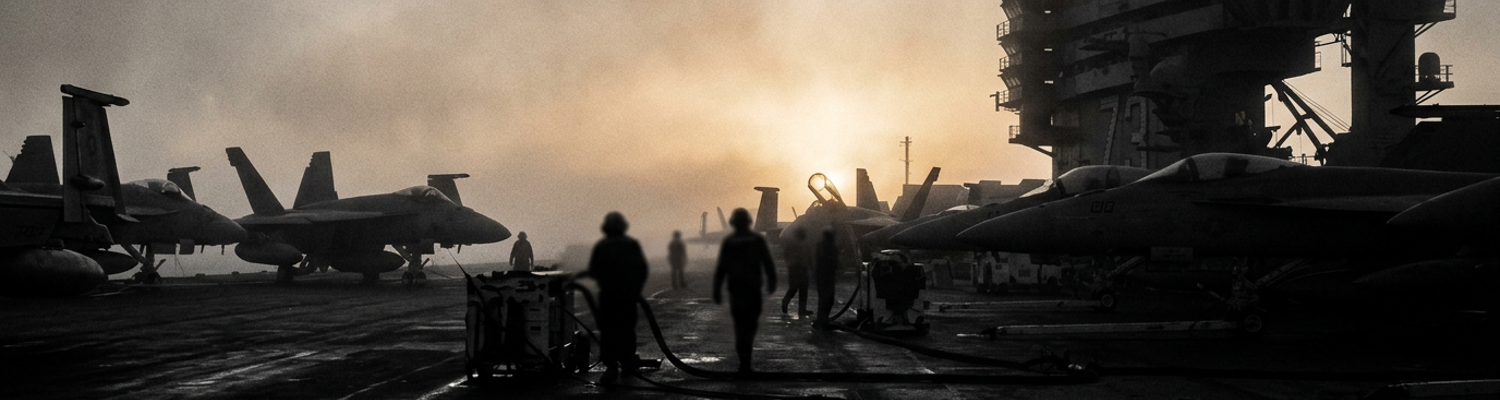

Flawed Carrier Air Support Operations
At 0540 on August 6, 1950, a panicked tactical transmission broke across Eighth Army ground control frequencies. North Korean troops had crossed the Naktong River in force near Ohang. Forward observers from the 34th Infantry Regiment shouted coordinates into low-power field radios. They requested immediate air strikes to suppress the advancing 4th Division. Naval public relations units later portrayed the response as an instantaneous demonstration of carrier-based firepower.
The archives tell a different story.
Escort carrier decks were never designed for sustained land bombardment campaigns. A close review of operational logs indicates that Task Element 96.5.3 struggled against its own equipment throughout August 1950. The escort carriers USS Sicily and USS Badoeng Strait operated in the Tsushima Strait under Rear Admiral Richard W. Ruble. They faced severe mechanical limitations. The Casablanca and Commencement Bay hulls managed top speeds of barely nineteen knots. Across the stagnant summer waters of southern Korea, natural surface winds frequently dropped below five knots.
This created an immediate physics problem.
Vought F4U-4B Corsairs of Marine Fighter Squadrons 214 and 323 required twenty-five knots of wind over the deck to launch safely with full ordnance loads. Flight deck officers faced severe weight penalties. Crews pulled half the high-velocity aircraft rockets and reduced fuel loads before aircraft could be launched from the H-4B hydraulic catapults. Catapult seals degraded quickly under 104-degree ambient flight-deck temperatures. Red mineral-base hydraulic fluid leaked across the wooden planking. On August 10, three Corsairs from Badoeng Strait aborted takeoffs. Pressure drops in the launching accumulators threatened to drop loaded airframes into the bow wake.
Equipment failure was only the first barrier.
The command apparatus on land created worse bottlenecks than carrier machinery. Marine Corsairs arrived over the Naktong Bulge equipped with VHF ARC-1 radios. Fifth Air Force tactical air control parties assigned to the 24th Infantry Division operated on high-frequency SCR-300 ground sets. Marine pilots could not talk directly to front-line infantry. They circled in fuel-wasting holding stacks at 6,000 feet near Miryang. They waited for airborne controllers in lumbering T-6 Texan aircraft to relay directions. Target assignment ran through the joint operations center at Taegu. This introduced authorization lags that stretched from forty to ninety minutes.
By the time pilots received clearance to roll in on targets near Obong-ni Ridge, the coordinates were obsolete.
Pilots relied on out-of-date 1:250,000 scale aeronautical charts that lacked local topographic contours. On August 11, an errant salvo of 5-inch rockets struck positions held by Company A of the 19th Infantry Regiment near Tugok. Seven American soldiers were wounded. They were mistaken for North Korean riflemen digging into the reverse slope. Official press releases systematically converted these delayed sorties into surgical strikes. Action reports filed by Carrier Division 15 recorded that out of forty-eight scheduled close air support sorties dispatched between August 7 and August 12, twenty-two flights failed to identify assigned ground targets.
They jettisoned their ordnance into secondary river mudflats.
Ordnance Shortages Aboard Sicily and Badoeng Strait
Carrier combat capacity did not collapse from enemy fire. The breakdown began in the ammunition holds. Daily flight tempos demanded by the Eighth Army around the Naktong Bulge rapidly burned through peacetime ordnance reserves allocated to USS Sicily and USS Badoeng Strait. Major Robert Keller of VMF-214 and Major Arnold Lund of VMF-323 were expending up to ninety-six 5-inch High Velocity Aircraft Rockets every twelve hours. They targeted entrenched North Korean infantry positions across Cloverleaf Hill and Obong-ni Ridge.
Forward naval supply dumps at Sasebo could not keep pace.
By August 12, shipments of Mark 55 tail fuses and 5-inch HVAR rocket assemblies ceased arriving from Japan entirely. Escort carrier supply officers had budgeted for short anti-submarine patrols rather than sustained land campaigns. Rear Admiral Ruble issued emergency restrictions on August 13. He ordered squadrons to strip the standard eight-rocket loadouts down to two per Corsair.
Depots in Sasebo had run dry.
Archival evidence shows that the lack of Mark 55 mechanical impact tail fuses crippled precision air support across the entire perimeter. The Mark 55 employed an arming vane mechanism engineered to delay detonation until general-purpose bombs penetrated hardened log bunkers. Without them, flight deck crews on Badoeng Strait and Sicily were forced to install instantaneous nose fuses on five-hundred-pound AN-M64 bombs. Crews released these weapons against steep Korean ridgelines. The bombs detonated against scrub oak branches fifty feet in the air. Shrapnel sprayed harmlessly into the sky.
North Korean trenches below stayed intact.
The complete exhaustion of Mark 4 Mod 1 rocket motors and Mk 6 warheads compounded this deficiency. Ordnance lockers on Sicily held fewer than twelve functional HVAR rounds by noon on August 14. Badoeng Strait fared no better. Aviation gunners discovered that over half the remaining 5-inch rocket igniters had corroded in their wooden packing crates during transit from Guam. Pilots launched into the Naktong corridor carrying incomplete bomb trains with unarmed tail cavities. This destabilized aircraft center-of-gravity envelopes during steep diving runs.
Shipboard armorers inherited the fallout.
Aviation ordnance ratings on both escort carriers worked twelve-hour shifts deep within crowded hangar decks under dim red blackout lighting. Naval regulations required ships running night courses through the Tsushima Strait to maintain strict light discipline against potential submarine periscopes. Red glow lamps cast faint shadows across twenty tightly lashed F4U-4B fuselages. Volatile 100-octane aviation fuel vapors filled the poorly ventilated spaces. Armorers used hand tools to improvise firing trains for unstable ordnance.
Men ground down rusted thread collars with metal files.
They forced non-standard Army M100-series nose fuses into naval bomb bodies. Technicians used pliers to strip and splice deteriorated electrical pigtails on decades-old World War II rocket motors. These motors had sat in humid Pacific storage depots since 1945. Ratings scraped crusts of crystallized explosive salts off corroded tetryl booster cups using brass putty knives. Swells in the strait repeatedly rocked the escort carriers. Unanchored bomb casings rolled across steel decks while men handled exposed detonators.
On the evening of August 14, an ordnance mate aboard Sicily accidentally stripped the threads of an uncertified adapter ring inside a live AN-M64 bomb casing. A cocked firing pin jammed less than two millimeters from an active lead azide detonator resting beside an open fuel drain.
Communication Failures with Marine Forward Air Controllers
The tactical breakdown between ground spotters and carrier cockpits originated at the radio mounting bracket. Forward air control teams from the 1st Provisional Marine Brigade operated AN/MRC-20 radio jeeps fitted with modified AN/ARC-1 very-high-frequency transceivers. Carrier-based Navy aviators arriving from Task Force 77 flew with aircraft sets configured for fleet communications. They had begun transitioning to ultra-high-frequency AN/ARC-27 equipment.
Quartz crystals governing preset communication channels on the aircraft were tuned to carrier air wing tactical nets.
They were not tuned to Marine division coordination frequencies. Ground controllers attempting to establish contact on 116.1 megahertz were locked out. Incoming naval strike flights checked in on non-standard channels or lacked the physical crystal inserts required to receive ground transmissions. When jeeps stalled in the mud of the Changnyong road, controllers lost access to vehicle-powered generators entirely.
Tuned frequencies met dead air.
Marine forward air controllers hauling twenty-eight-pound AN/PRC-10 backpack transceivers up the steep granite of Hill 117 found themselves electronically cut off from carrier strike flights. The 38-to-54 megacycle frequency-modulated signals emitted by infantry backpack sets could not bridge to the amplitude-modulated very-high-frequency gear mounted inside carrier cockpits. Heavy humidity and 100-degree summer heat rapidly degraded the BA-270 dry-cell batteries that powered the portable sets. Transmitter power drops reduced effective broadcast ranges from five miles down to under four hundred yards.
On August 18, a forward air observer from the 5th Marines watched three Navy aircraft circle six thousand feet directly overhead for twenty-five minutes. They burned aviation fuel while the ground controller hammered the casing of a dead AN/PRC-10 against a rock ledge.
Radios went silent midway through target runs.
A close review of operational logs indicates that doctrinal friction caused even greater disruption than scrambled frequencies. Marine close air support doctrine required ordnance release within fifty to one hundred yards of friendly foxholes to crack fortified lines. Marine pilots were instructed to fly steep sixty-degree dives. They released general-purpose bombs at one thousand feet before pulling out at three hundred feet directly over contested ridge crests.
Fleet-trained Navy aviators operated under radically different rules.
Navy flight manuals mandated shallow thirty-degree glide paths. They required minimum pullout altitudes of fifteen hundred feet and safety buffer zones of at least one thousand yards from friendly ground units. Over Obong-ni Ridge, Navy pilots refused forward air controller demands to deliver ordnance directly against the reverse slope of Cloverleaf Hill. They cited regulations against blind drops over friendly heads. Terminal target guidance broke down completely. Marine forward controllers fired M19 60-millimeter white phosphorus mortar rounds to mark North Korean bunker openings. Pilots pulling out at fifteen hundred feet misjudged the drifting smoke markers against the dust of the valley floor.
They dropped 500-pound bombs five hundred yards short into unpopulated ravines.
Target Misidentification Across the Obong-ni Ridge
Atmospheric conditions over the Naktong river bend destroyed pilot visibility before strikes even reached the target. At 0600 on August 17, a thick thermal inversion trapped damp air across the basin. This created a four-hundred-foot layer of dense valley fog that sat directly over the western approaches to Hill 102 and Hill 117. Forward observers from the 1st Battalion, 5th Marines, attempted to burn through this layer.
They directed 81mm mortar crews to fire Mark 46 white phosphorus shells against suspected enemy machine-gun nests along the lower finger spurs.
Instead of marking discrete impact points, the bursting phosphorus ignited dry sumac and terraced rice straw. This released heavy phosphoric anhydride smoke that could not penetrate the stagnant inversion boundary. The chemical cloud rolled laterally across the draw. It merged with the river mist to form an opaque white canopy over the entire eastern approach. Four VMF-214 F4U-4B Corsairs flew off the deck of USS Sicily. They arrived over the coordinates at 0635.
Pilots scanned through oil-streaked plexiglass windscreens at three hundred knots.
They could not distinguish ground contours or target stakes. Reflective glare from the rising sun bounced off the top of the fog bank. This blinded pilots during their five-thousand-foot dive entries. Flight leaders were forced to pull out blindly at eight hundred feet above the ridge crest.
Pilots flew blind into burning fog.
When examining the historical record, what appeared from the air to be primary enemy trenches were unoccupied drainage ditches and natural erosion scars along the forward crest. Major General Lee Kwon-mu of the 4th Infantry Division had engineered defensive positions according to Soviet tactical doctrine. His troops constructed camouflaged earthen bunkers deeply integrated into the reverse slope of Obong-ni Ridge. North Korean soldiers from the 18th Infantry Regiment excavated two-man weapon pits beneath four layers of fresh pine logs. They packed the roofs with two feet of red clay and replanted live dwarf scrub oak to erase spoil mounds.
From an incoming Corsair cockpit altitude of fifteen hundred feet, these bunker apertures were invisible against the natural terrain.
Marine pilots mistook the false parapets, abandoned irrigation berms, and plowed terrace walls along the military crest for active defensive perimeters. Flight leaders dropped their five-hundred-pound general-purpose bombs against these vacant agricultural terraces along the forward slope. The actual North Korean fighting bunkers three hundred yards away on the reverse slope remained completely undamaged. When the 2nd Battalion, 5th Marines advanced up the ravine toward Hill 109, intact heavy machine-gun nests from the 18th Regiment opened fire from unmolested positions on the reverse crest.
Two rifle companies were pinned against exposed shale by overlapping Maxim fire.
Target confusion escalated into friendly fire during the midday strikes on August 18. Tactical Air Control Party Baker, attached to Company G of the 5th Marines, tried to redirect a two-plane section from VMF-323 flying off USS Badoeng Strait using an SCR-300 field radio. Static interference from the ridge iron content disrupted the voice channel. The transmission cut off mid-sentence as the flight leader initiated a thirty-degree glide bombing run.
The trailing Corsair confused a line of freshly dug American foxholes along the southern saddle with the 4th Division secondary fallback line. The pilot released eight 5-inch High Velocity Aircraft Rockets into the friendly positions at coordinate 084-523.
The rockets detonated across an open communications trench. They destroyed the tactical antenna of the forward air control team, severed hard telephone lines running to the regimental command post, and left three Marine riflemen dead in their fighting pits. Ordnance safety officers had no visual means of verifying target lines from the air without continuous ground smoke. Every fresh smoke round fired by Marine mortars only thickened the blinding cloud across the canyon floor.
Friendly Fire Deviations Along Marine Frontlines
Mechanical failures inside carrier bomb racks repeatedly turned close air support sorties into friendly bombardments. Mark 51 bomb shackles mounted beneath the center sections of VMF-214 Corsairs suffered from worn electrical release solenoids. Distorted mechanical latch hooks had warped under repeated catapult launches. During high-angle dive runs exceeding fifty degrees, aerodynamic pressure against the bomb bodies forced defective release jaws to slip before pilots depressed their cockpit stick switches.
At 0915, an F4U-4B rolling in over Hill 102 suffered an uncommanded release of a 500-pound AN-M64 general-purpose bomb at three thousand feet.
The weapon fell four hundred yards short of the targeted North Korean trench line. It detonated directly inside an earthen mortar pit occupied by Company B, 1st Battalion, 5th Marines. Blast overpressure collapsed three interconnected foxholes. It buried an 81-millimeter mortar tube under two feet of pulverized shale and wounded five Marine mortar men with jagged casing fragments.
Shackle solenoids sheared under high-g dive pullouts.
Archival evidence shows that rocket deviations occurred with equal frequency because of deformed Mk 4 folding-fin assemblies and rusted electrical pigtails on 5-inch High Velocity Aircraft Rockets. Salt spray absorbed during open-deck transit aboard USS Sicily caused internal corrosion inside the rocket motor igniter caps. This created dangerous ignition delays when pilots fired wing-mounted salvos. Uneven thrust development caused projectiles to yaw eight to twelve degrees off their intended flight path the instant they cleared the zero-length launching stubs.
Midday on August 18, a two-plane section from VMF-323 targeted North Korean heavy machine guns dug into the ridge shoulder at coordinate 083-528.
One salvo of four rockets suffered immediate motor failures. They fishtailed across the draw and struck the forward rifle pits of Company C, 1st Battalion, 5th Marines. High-explosive warheads detonated against the rocky parapets. Two riflemen were killed instantly. An M1917A1 water-cooled machine gun was shredded. The main landline wire running back to the battalion observation post was severed.
Erratic rocket motors fishtailed across friendly foxholes.
Flight geometries flown by carrier pilots repeatedly forced ground commanders to broadcast emergency cease-fire aborts. Navy aviators arriving from Task Force 77 escort decks consistently initiated their attack dives along the spine of Obong-ni Ridge rather than executing runs perpendicular to the frontline trenches. Approaching on this longitudinal axis meant that any long release or premature drop traveled directly down the friendly line of advance. Forward air controller Captain John W. Stevens observed four incoming aircraft establishing dive headings centered on the reverse slope of Hill 109. He realized the strike path placed friendly troops directly beneath the weapon release envelope.
Stevens keyed his AN/MRC-20 transmitter.
He broadcasted repeated emergency abort commands over the tactical air direction channel to break off the run immediately. Radio static from vehicle generators distorted the transmission. Ground observers were forced to fire red star parachute flares from hand-held pyrotechnic projectors while rifle squads threw red smoke grenades onto the forward slope. Flares and smoke signals failed to stop every incoming aircraft in time.
One trailing Corsair ignored the waving visual markers and dropped a 500-pound bomb forty yards behind the Company F command post near Tugok.
The blast showered the command dugout with hot stone and deafened the company staff. Lieutenant Colonel Raymond L. Murray reacted by revoking air strike clearance across the entire 5th Marines sector for two hours. Murray ordered forward air control teams to shut down all carrier target runs until strike leaders confirmed attack axes flown at strict ninety-degree angles across the Naktong River bend. Two subsequent flights of Corsairs circling overhead at five thousand feet were denied attack approval. Flight leaders jettisoned eight armed general-purpose bombs into empty mud banks four miles south of the perimeter.
Naval Intelligence Censorship of Combat Camera Footage
Visual evidence of close air support was never left to civilian press pools. Combat camera teams from the Pacific Fleet Photographic Unit operated under direct task group control. They deployed camera operators aboard USS Sicily and forward with 1st Provisional Marine Brigade ground liaison teams near the Naktong River. Cameramen hauled twenty-pound Bell and Howell Eyemo 35mm cameras across the rice terraces of Tugok.
They relied on mechanical spring motors and three-lens rotating turrets fitted with 50-millimeter Cooke lenses.
When spring coils gummed up with fine river silt and hydraulic soot from carrier flight decks, technicians hand-cranked the camera gearing at sixteen frames per second to document sorties. These hand-cranked Eyemo reels captured raw mechanical failures in direct tactical sequence. VMF-214 Corsairs dropped unguided rockets with bent tail fins. Jammed bomb shackles dragged ordnance across carrier arresting cables. Erratic Mark 4 rocket trajectories struck dirt outcroppings forty yards from forward Marine trenches.
Spring-wound clockwork mechanisms jammed in the heat.
Cameramen standing on the flight deck catwalks of USS Badoeng Strait documented severe launch equipment defects that official post-strike dispatches omitted. Lensmen recorded loaded Corsairs bouncing violently over defective catapult runouts. They caught the precise moment Mark 51 release solenoids dropped five-hundred-pound general-purpose bombs onto wooden deck planking during hard landings. On the ground at Obong-ni Ridge, operators using 100-foot daylight-loading 35mm film spools recorded strike impacts that detonated on friendly coordinates.
Footage exposed near coordinate 083-528 captured the August 18 rocket deviation into Company C positions.
The film showed pulverized fighting pits, dead Marine riflemen, and fractured 81-millimeter mortar assemblies shrouded in dense chemical smoke. Camera operators labeled these exposed aluminum film cans with grease pencils. They noted time stamps, carrier squadron designations, and ground strike coordinates before packing the negative rolls into waterproof canvas pouches for shipment to processing facilities at Sasebo.
Canisters of exposed negative never reached public distribution.
Naval intelligence officers stationed at Fleet Activities Sasebo initiated systematic impoundment procedures the moment transport aircraft arrived from the Korean front. Security teams from Commander Naval Forces Far East met incoming supply flights at the airstrip. They demanded the immediate surrender of every unprinted motion picture negative container. Inspectors broke postal seals and cross-referenced photographer slate sheets against tactical strike coordinates.
They isolated every roll depicting friendly fire casualties, carrier arresting-gear failures, or unexploded ordnance errata.
Negative reels recording the fatal rocket strike on Company E at Tugok were assigned immediate classified security tags. They were locked inside steel document safes within the base intelligence annex. Shipments bound for the Naval Photographic Center in Anacostia were purged of negative sequences that documented defective bomb shackles or dead American soldiers. This left only sanitized flight-deck operations and wide-angle bomb strikes against empty agricultural ridgelines.
Seventy rolls of 35mm nitrate negative depicting front-line ordnance failures were transferred to secure storage vaults in Yokosuka on August 22, 1950.