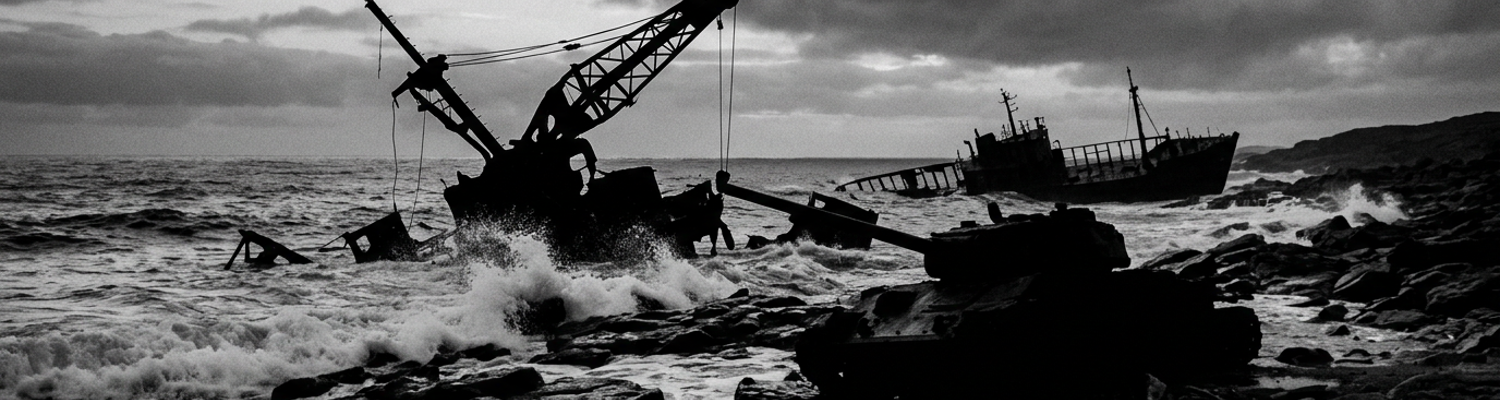

Fallback to Mariveles Naval Section Base
Fifty-four Japanese twin-engine bombers destroyed eighty percent of the Cavite Navy Yard in under two hours on December 10, 1941. The strike incinerated more than two hundred thousand rounds of ammunition. Over two hundred and thirty service members died on impact.
A close review of operational logs indicates that the surviving industrial footprint of the 16th Naval District ceased to exist within forty-eight hours of that attack. Rear Admiral Francis W. Rockwell faced an immediate command crisis. Japanese forces advanced toward Manila from both Lingayen Gulf and Lamon Bay. MacArthur declared Manila an open city on December 26. This gave the Navy less than seventy-two hours to strip what usable materiel remained before the capital fell.
Rockwell issued evacuation directives from a cramped office inside the headquarters compound. These orders scattered his administrative apparatus across Manila Bay. Small diesel tugs and coal-burning yard craft ferried approximately 2,100 naval personnel across twenty miles of open water toward the southern tip of the Bataan Peninsula. Convoys crawled past the Corregidor minefields under constant threat from Japanese naval aviation based at Nichols Field.
Machinery spares and medical crates were dumped haphazardly on the beaches of Mariveles Harbor at geographic coordinates 14 degrees 26 minutes North, 120 degrees 29 minutes East.
Men slept on bare ground beneath camouflage netting strung between banyan trees. They were cut off from real-time intelligence. Army commanders twenty miles north fought chaotic delaying actions along the Porac-Guagua line.
Nobody possessed an inventory manifest for the cargo unloaded on the rocks.
Archival evidence shows that local defense fell to Commander Francis J. Bridget. He organized a provisional Naval Battalion out of grounded aviation mechanics from Patrol Wing 10. Sailors from the scuttled submarine tender Canopus joined displaced ammunition handlers. These men had no infantry training. Their white shipboard uniforms stood out against the dark volcanic soil of Mount Pucot. Personnel dipped their clothing into vats of boiled coffee grounds. This produced a blotchy yellow-green camouflage that washed out during heavy tropical downpours.
Defense positions were gouged into the jungle slopes overlooking Longoskawayan Point. Weapons were improvised from salvaged naval stocks. Aviation mechanics stripped twin .30-caliber Lewis machine guns from disabled PBY Catalina flying boats. They bolted them onto discarded boiler pipes driven directly into the dirt.
Without firing tables or standard infantry tripods.
When examining the historical record, the breakdown of command connectivity between Mariveles and General MacArthur's staff inside Malinta Tunnel created severe operational friction. Rockwell found himself isolated at the section base. He relied on motorcycle couriers and intermittent radio bursts. These transmissions frequently failed due to the dense jungle canopy and high mineral content of the Zambales mountain range. Food rations were immediately halved to fifteen hundred calories per day. Meals consisted primarily of canned salmon and evaporated milk.
Mechanics aboard the repair ship Canopus ran machine shops on emergency diesel generators. They fabricated replacement firing pins for worn Springfield M1903 rifles. Replacement parts for water purification units never arrived from the Manila depots. Saltwater contaminated the primary coastal wells. Three hundred men drank untreated river water. Bacillary dysentery spread through the improvised perimeter within seventy-two hours.
By January 15, the naval dispensary at Mariveles reported sixty-eight men unfit for watch duty.
Scuttling Operations and Freshwater Distillation Collapse
A close review of operational logs indicates that panic inside the Mariveles perimeter accelerated the destruction of maritime infrastructure days ahead of schedule. Lieutenant C. J. Weschler and civilian engineer Jose Otero received fragmented demolition directives on the afternoon of April 8, 1942. These orders originated from naval liaisons inside Malinta Tunnel. Weschler and Otero were stationed aboard the 18,500-ton auxiliary floating drydock USS Dewey. The YFD-1 was moored off the western shelf of Mariveles Harbor.
The demolition detail acted without confirming whether remaining motor torpedo boats still required dry-docking for hull repairs. Torches severed the anchor cables. Technicians opened the main flooding valves across all twenty-four internal buoyancy compartments. Scuttling charges blew through the center pontoon bulkheads. The 500-foot steel structure went down into thirty fathoms of water at 14 degrees 25 minutes North, 120 degrees 30 minutes East.
The premature loss of the Dewey eliminated the naval base's only heavy mechanical lift capacity. Surviving gunboats were left immobilized against shallow coral heads. They were completely exposed to incoming dive-bombers from the Japanese 14th Army.
No surviving vessel could repair a cracked propeller shaft.
Archival evidence shows that the simultaneous demolition of coastal fuel depots turned the inner harbor into an uninhabitable environmental trap. Navy demolition squads blasted open the above-ground storage tanks along the rocky shoreline. They ignited thousands of barrels of heavy Bunker C fuel oil and high-test aviation gasoline. Thick petroleum rushed down volcanic drainage gullies directly into Mariveles Bay. Unburned crude soaked into coastal gravel beds.
Rising tides pushed this viscous chemical sheet into the freshwater estuaries feeding the naval encampment. Subsurface seepage breached the perimeter's shallow artesian wells. Clear water supplies turned into a toxic mixture smelling of sulphur and heavy aromatics. Firefighters attempting to draw water from coastal pump stations found suction lines clogged with black sludge. The oily surface scum settled over the intertidal zones where retreat units had pitched emergency casualty tents.
Unrefined crude covered every drinking water inlet along the southern beach.
When examining the historical record, the mechanical failure of shore-based and shipboard freshwater distillation systems directly caused the final medical collapse of the naval garrison. The repair ship Canopus had operated its multi-effect vacuum evaporators continuously for four months. The crew lacked access to replacement boiler tubes or spare gasket rubber. Heavy marine scale fouled the copper evaporator coils. Freshwater output dropped from five thousand gallons per day to less than two hundred.
Shore distillation units broke down after sand and dispersed petroleum choked their centrifugal sea-suction strainers. Deprived of potable distilled water, thirsty sailors broke discipline. They drank from stagnant drainage pools loaded with human fecal waste. Entamoeba histolytica swept through the bivouac areas within seventy-two hours. The protozoan parasite bored into the mucosal lining of the large intestine. This induced severe amoebic dysentery characterized by violent abdominal cramps and continuous fluid discharge.
Field dispensaries set up under jungle banyans ran out of emetine hydrochloride within thirty-six hours of the initial water contamination. Navy corpsmen lacked intravenous saline solutions to replace massive electrolyte losses. Men died of acute circulatory shock on canvas litters soaked with blood. Medical personnel recorded rectal temperatures exceeding 104 degrees Fahrenheit among patients. Daily fluid loss exceeded four liters.
Over seven hundred military personnel at the Mariveles base were physically incapable of holding a weapon by the evening of April 8.
At midnight, sixty-four dysentery patients lay abandoned on the concrete pier at Cabcaben.
Organization of the Composite Naval Battalion
Archival evidence shows that Commander Francis J. Bridget organized the Composite Naval Battalion on January 15, 1942. His objective was to seal a four-mile defensive breach across the southwest coast of Bataan between Caibobo Point and Mariveles Harbor. Bridget pulled together roughly one hundred and fifty aviation mechanics and radiomen from Patrol Wing 10. Their PBY-4 and PBY-5 Catalina flying boats had been destroyed on the water.
This naval aviation contingent was merged with one hundred and thirty ordnance specialists from the destroyed Cavite Ammunition Depot. Approximately one hundred and twenty machinists and firemen reassigned from the repair ship USS Canopus joined the formation. The 4th Marine Regiment transferred a cadre of experienced non-commissioned officers and an infantry platoon under First Lieutenant William F. Hogaboom to inject tactical ground discipline into this assembly of shipboard personnel.
The men were organized into three provisional rifle companies designated Companies A, B, and C. They were assigned to defend Mount Pucot and the adjacent coastal cliffs against Japanese amphibious landings.
Sailors whose duties had previously centered on radial engine overhauls received obsolete M1903 Springfield rifles. These weapons were pulled from storage crates coated in hardened cosmoline. Many personnel received their rifles less than forty-eight hours before moving into the jungle.
Infantry marksmanship training consisted of firing five test rounds directly into the surf off Longoskawayan Point.
A close review of operational logs indicates that the battalion possessed zero standard M1910 T-handle entrenching shovels when Bridget ordered the immediate fortification of Pucot Hill. The coordinates were 14 degrees 27 minutes 45 seconds North, 120 degrees 28 minutes 10 seconds East. The volcanic bedrock of the ridge resisted penetration. Sailors scraped through dense root mats and basalt outcroppings using rusted mess-kit spoons and 16-inch M1905 bayonets.
Sandbags and heavy spools of tactical barbed wire were completely absent from the Mariveles naval supply inventory. Aviation mechanics stripped stainless steel control cables from ruined PBY airframes. They strung these cables between bamboo thickets to serve as tripwires. Construction of structural timber revetments stalled due to a total lack of pioneer axes. Repair personnel from Canopus cut scrap iron plates with oxyacetylene torches to fashion hand spikes.
Slit trenches gouged out along the perimeter averaged less than fourteen inches in depth. They provided minimal shelter against 70mm Type 92 battalion gun shells striking the canopy overhead.
Shallow trenches exposed the defenders to deadly wooden shrapnel thrown by tree bursts.
When examining the historical record, the complete absence of serviceable protective chemical respirators left the provisional companies vulnerable to toxic particulate clouds. Mariveles depots held fewer than forty field gas masks for over four hundred men assigned to the sector. Existing shipboard Mark I and Mark II diaphragm respirators suffered severe rubber hardening under eighty-five percent jungle humidity.
Storage drums had leaked during the hurried evacuation from Cavite. Salt water contaminated facepiece seals and broke down the charcoal filters needed to neutralize blistering agents like mustard gas. Bridget's headquarters operated under continuous warnings that incoming artillery from the Japanese 20th Infantry Regiment could deliver Type 99 smoke shells loaded with toxic diphenylcyanoarsine irritants.
Without field masks, company commanders issued survival orders directing riflemen to hold urine-soaked cloth patches over their noses and mouths during heavy bombardments.
By January 24, dense cordite fumes and brushfire soot blinded eighteen lookouts on the forward crest of Mount Pucot.
Ridge Engagements at Longoskawayan Point
Archival evidence shows that three hundred Japanese infantrymen from the 2nd Battalion, 20th Infantry Regiment landed across the volcanic beaches of Longoskawayan Point on the morning of January 23, 1942. The landing occurred at coordinates 14 degrees 25 minutes 30 seconds North, 120 degrees 28 minutes 20 seconds East. Commander Francis J. Bridget deployed eighty sailors from Company A and an understrength Marine rifle platoon under First Lieutenant William F. Hogaboom to clear the jagged ridges commanding the coastline.
Men advanced along knife-edge shelves covered in dense thorny bamboo. Sharp basalt outcroppings shredded standard-issue naval dungarees. Japanese infiltrators had established concealed fighting pits beneath the root buttresses of massive banyan trees. They swept the ridges with Type 99 light machine guns and Type 89 50mm grenade dischargers.
The sailors attempted to suppress these positions using salvaged PBY Catalina .30-caliber Lewis guns mounted on scrap pipe standards. Volcanic grit blew directly into the open pan magazines. The feed mechanisms jammed after three or four rounds. Gunners switched to water-cooled Browning M1917 machine guns. The continuous vibrations sheared the improvised mounting bolts. The heavy weapons tumbled down forty-foot embankments into unmapped ravines.
Sailors fired blind into dense bamboo thickets without hitting enemy gunners.
A close review of operational logs indicates that Bridget attempted to direct company-level flanking maneuvers across four distinct ravines without topographical maps or operational telephone wire. Messengers dispatched between ridge positions had to climb near-vertical slopes under continuous fire from Japanese snipers tied into tree crowns. Bridget requested artillery support from the coastal defense batteries on Corregidor nine miles to the south. Delayed wire relays through the Mariveles switchboard delayed firing coordinates by more than four hours.
When the 155mm GPF guns of the 91st Coast Artillery finally opened fire, the high-explosive shells exploded in the thick jungle canopy fifty feet above ground. Falling branches and steel fragments rained directly onto Bridget's sailors. They held shallow scrape-holes without overhead cover. Japanese squads exploited the confusion. They crawled through dead ground in the gullies to throw Type 97 hand grenades into the naval skirmish line before fading back into the jungle undergrowth.
Headquarters inside Malinta Tunnel learned of the tactical stalemate six hours after the forward naval line broke.
When examining the historical record, the forward elements fighting on Longoskawayan ridge operated without a sustained casualty clearing station or a functional medical supply chain. Bridget's battalion carried only three canvas field medical bags for the entire force. These bags contained twenty-four paper-wrapped field dressings and twelve morphine Syrettes. Navy corpsmen ran out of sterile gauze and tourniquets within forty minutes of the initial firefight.
Wounded men suffering from shattered limbs and arterial bleeding lay in the dirt for hours. Litter teams consisted of exhausted riflemen who had to improvise litters from shelter halves and bamboo stalks. Moving a single casualty down the razorback ridge to the nearest dirt road required four sailors and took upwards of three hours over vertical basalt rock.
The intense heat of ninety-two degrees Fahrenheit triggered rapid dehydration. Men with untreated abdominal wounds entered irreversible hemorrhagic shock before reaching transport. Replacement dressings and blood plasma never reached the ridge from the Mariveles supply base. Naval storekeepers had already locked down supply depots under incoming air raids.
By dusk on January 24, eleven wounded sailors lay dead along the rock trail awaiting basic bandaging.
Subterranean Isolation in Malinta Tunnel
Archival evidence shows that by late January 1942, military surgeons abandoned the exposed surface hospital at Topside Corregidor. They re-established casualty receiving operations inside the Hospital Lateral of Malinta Tunnel. Carved directly beneath four hundred feet of solid rock at coordinates 14 degrees 24 minutes 18 seconds North, 120 degrees 34 minutes 20 seconds East. This subterranean wing was designed to house three hundred patients. It was rapidly overwhelmed by more than one thousand sick and wounded men.
Air movement depended entirely on five forced-draft mechanical blowers. These fans sucked dust and diesel exhaust from the central east-west axis directly into the surgical wards. When bomb concussions jarred the electrical power plant, the ventilation fans stopped entirely. Temperatures inside the concrete-lined vault surged beyond ninety-five degrees Fahrenheit. Relative humidity stabilized at near-saturation levels.
Without air turnover, clouds of vaporized ether mingled with the stench of spreading gas gangrene and wet bandages. Medical teams led by Colonel W. C. Cook performed amputations under bare incandescent bulbs. These lights flickered with every direct artillery impact on the ridge above. Water pressure dropped below ten pounds per square inch. Surgeons rinsed surgical instruments in stagnant carbolic acid basins rather than running water.
Soot covered the white hospital bedsheets within twenty minutes of an air strike.
A close review of operational logs indicates that the physical destruction of external copper field telephone lines completely severed the headquarters staff from Corregidor's defensive network. Twisted-pair W-110-B field wire had been strung overland across volcanic ravines and nailed to wooden poles. This wire linked Malinta's switchboard with forward observation posts and the naval command posts at Mariveles.
Beginning in February, Japanese 240mm Type 45 siege howitzers and 150mm Type 89 guns positioned along the southern slopes of Bataan dumped hundreds of tons of high explosives directly onto the island's surface communications corridors. Shrapnel sliced through the vulcanized rubber insulation. Ground shock from 500-pound aerial bombs sheared buried lead-sheathed trunk cables near the tunnel's West Entrance.
Linemen from the 60th Coast Artillery and the Philippine Department Signal Corps made repeated sorties into open impact areas with friction tape and wire pliers to splice severed copper strands. Japanese artillery batteries targeted the exposed repair crews with pre-registered bracket fire. They killed fourteen wiremen along Bottomside within five days.
Only two of fourteen external telephone trunks survived intact on April 10.
When examining the historical record, this loss of wire connectivity forced commanders inside Malinta Tunnel to direct the harbor defenses while operating inside an informational void. Without functional telephone lines, officers relied on foot couriers. These men had to run through heavy artillery barrages across the scorched crater field of Malinta Hill. Messages arrived three to six hours late. They described tactical situations that had already dissolved.
Inside the command lateral, staff officers plotted artillery coordinates on grease-pencil situation maps based on outdated estimates from Battery Geary and Battery Way. Gun crews operating the massive twelve-inch mortars were left to track incoming naval vessels through optical coincidence rangefinders blinded by smoke. Orders directing emergency counter-battery barrages routinely reached gun pits after Japanese artillery had already shifted firing positions.
At dawn on April 12, a runner carrying mortar coordinates to Battery Crockett lay dead forty yards from the tunnel portal with unburnt dispatch paper clenched in his fist.
Surgical Ward Breakdown and Rampant Sepsis
Archival evidence shows that by April 14, 1942, Lateral 3 and Lateral 4 of the Malinta Tunnel hospital housed more than nine hundred patients. They were stacked on double and triple-tiered steel bunks designed for two hundred and forty men. Stagnant rock air heated to ninety-eight degrees Fahrenheit by uninterrupted diesel generator exhaust created an ideal environment for anaerobic bacteria. Soil clinging to clothing and fragmentation wounds from Bataan contained heavy concentrations of Clostridium perfringens.
Blast-wound victims developed fulminant gas gangrene within eighteen hours of admission. Subcutaneous tissues swelled with gas bubbles. This produced crackling crepitus under touch and turned muscle tissue into black liquefied mass. The mechanical blowers failed twice daily when artillery strikes severed the power lines from Bottomside. Air stood motionless inside the dead-end drifts.
Bacillary dysentery spread along the concrete floor drains where bedridden casualties lost bowel control directly onto canvas litters. Orderlies emptied open waste buckets into uncovered sump pits at the eastern portal. This drew swarms of blowflies that migrated back into the operating lateral and landed directly on exposed visceral wounds.
Blowflies coated open abdominal incisions before surgical teams could tie off bleeding arteries.
A close review of operational logs indicates that the Malinta surgical pharmacy completely exhausted its reserve of ether and ethyl chloride on April 19. Navy and Army surgeons performed eighty to one hundred major surgical interventions every twenty-four hours across four wooden surgical tables set forty inches apart under unshielded incandescent bulbs. Medical officers rationed remaining cans of liquid ether by dripping drops onto cotton sponges clamped over wire face masks. They used only enough vapor to keep casualties unconscious during initial bone cuts.
When ether canisters ran dry, surgical teams administered oral doses of straight torpedo-propellant grain alcohol. They cut through necrotic limb tissue while hospital corpsmen held the patient's shoulders flat against the wood. Supplies of crystalline sulfanilamide and oral sulfathiazole ceased to exist after medical supply crates failed to survive the transfer from Mariveles. Corpsmen resorted to treating foul-smelling stumps with dilute Dakin's solution made from unstable bleach powders. This corroded healthy skin margins without killing deep bacterial spores.
Boiled cotton bandages hung from rusted rock bolts failed to dry in the ninety-five percent humidity.
When examining the historical record, the loss of uncontaminated dressings forced surgeons to pack open suppurating wounds with recycled surgical gauze scraped clean of dried pus. Philippine Department medical orderlies washed soiled cotton rags in galvanized water cans heated over kerosene burners. Low water pressure and fuel shortages prevented the water from reaching sustained boiling temperatures.
Spores of Clostridium tetani and Streptococcus pyogenes survived the wash basins. Reapplied wet rags began rotting directly on patient flesh within twenty-four hours. This bred maggots that crawled from severed stumps into adjacent burn wounds. Navy surgical teams under Lieutenant Commander Cary Smith converted Lateral 12 into an overflow septic ward. Men dying of systemic bacteremia and acute peritonitis were moved off the surgical schedule. Arterial ligatures routinely tore through softened gangrenous femoral arteries. Patients bled to death beneath wet canvas sheets before night shifts arrived.
On April 28, seventy-four men died of post-operative septic shock inside Lateral 12 between dawn and midnight.
Headquarters Directives and Communication Severance
A close review of operational logs indicates that by May 4, 1942, staff officers inside Malinta Tunnel's Lateral 2 were issuing tactical fire orders based on situation reports that were fourteen hours out of date. High-explosive impacts from Japanese 240mm howitzers on Bataan had severed the lead-sheathed underground signal cables terminating at the subterranean Western Electric BD-72 switchboard. Captain Kenneth M. Hoeffel commanded the remaining 16th Naval District forces from an office desk in Lateral 10. He plotted defensive artillery support coordinates for sectors already cleared by enemy combat patrols.
Messengers tasked with running paper coordinates across the three hundred yards of scorched earth between the tunnel's east portal and the forward artillery plotting rooms regularly disintegrated under heavy fragmentation barrages.
At 0300 hours on May 5, headquarters staff ordered the 12-inch coastal mortars of Battery Way to lay down defensive concentrations around the shoreline of Cavalry Point at coordinates 14 degrees 24 minutes 02 seconds North, 120 degrees 35 minutes 15 seconds East. When the mortar crews adjusted their elevation screws to obey, gunners discovered that three of the four steel mortar tubes had frozen solid from shattered traverse rings and bent recoil cylinders. This left only one operational tube to fire into coordinates that Japanese landing barges had bypassed two hours prior.
Paper maps tacked to the tunnel bulkheads showed continuous frontline cordons that did not exist.
Archival evidence shows that senior headquarters leadership maintained an administrative tempo that bore no relation to the disintegration of the surface perimeter. Radio operators operating the subterranean SCR-197 transmitter relied on intermittent signals bounced off atmospheric layers. They sent routine clerical memos and inventory status summaries to Allied naval offices in Melbourne while the 4th Marine Regiment and naval riflemen on the surface ran out of basic ammunition.
When Japanese forces began amphibious beach assaults across the eastern tail of the island near North Point at 2300 hours on May 5, subterranean commanders possessed no optical reconnaissance of the assault craft. Subsurface officers drafted counterattack directives for Company A of the 4th Battalion. This unit was composed entirely of displaced naval ratings from the Cavite Navy Yard and grounded patrol squadrons. The orders directed them to advance north along the Kindley Field runway.
These men carried no hand grenades and lacked 60mm mortar ammunition. They possessed fewer than thirty rounds of .30-06 ammunition per rifle. When the company reached the designated trench line, they walked directly into a crossfire of Japanese Type 92 heavy machine guns and two landed Type 97 Chi-Ha medium tanks that Malinta headquarters insisted could not cross the coral reef.
No anti-tank guns guarded the runway tarmac.
When examining the historical record, the subterranean naval command operated in complete physical detachment from the surviving perimeter defenders during the final eighteen hours before capitulation. Inside the concrete vaults of Lateral 10, Captain Hoeffel oversaw the systematic smashing of cryptographic equipment. He sledgehammered the rotors of the CXJH cipher machines and burned signal codebooks in steel wastebaskets while air filtration fans vented the acrid ash throughout the command warren.
Outside, two hundred yards east of the tunnel entrance, sailors and Marines engaged in hand-to-hand fighting with bayonets and entrenching tools across shell craters filled with pulverized rock and human remains. Telephone wiremen from the 60th Coast Artillery had exhausted their last reels of copper wire. This terminated all tactical coordination between the subterranean naval staff and the perimeter foxholes.
Hoeffel prepared coded surrender authorizations and destruction notices for transmission to the Navy Department in Washington. He logged the scuttling of the river gunboat USS Mindanao (PR-8) and auxiliary tugs off the south dock. Perimeter rifle squads pinned behind shattered concrete water tanks at Bottomside received no notification that capitulation negotiations had begun.
Sailors were still firing rifles at advancing Japanese armor when white flags rose over the main portal.