
Bulldozers and the Establishment of Detachment A 421
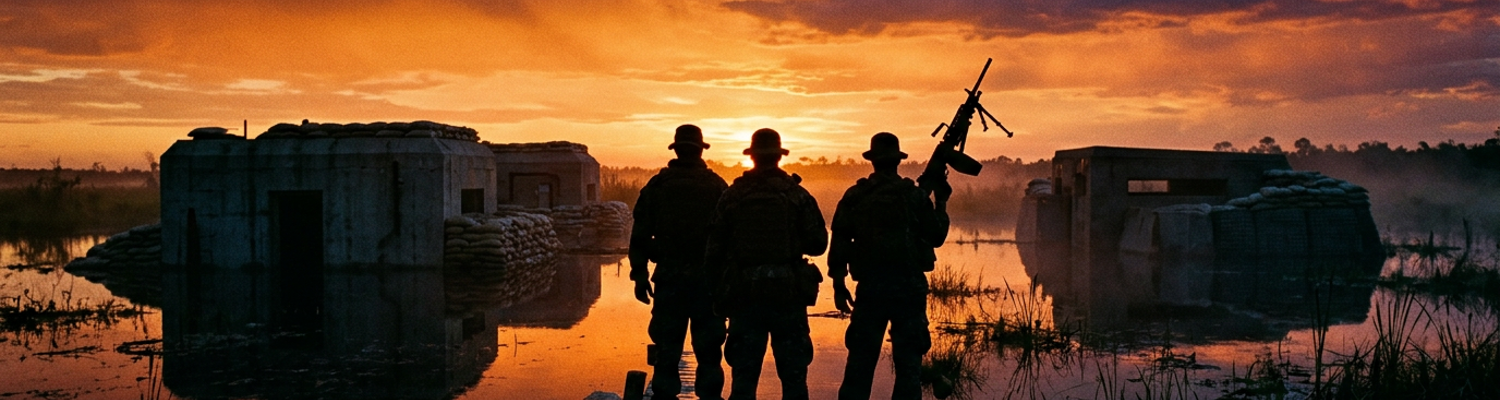
Bulldozer blades sheared into the waterlogged clay of Chau Doc Province, instantly turning the planned perimeter of Camp Ba Xoai into a thick slurry of gray mud. Soldiers from 5th Special Forces Group Detachment A 421 had deployed into this remote border corner with standard military construction manuals, but those paper blueprints completely failed to account for the sodden reality of the Mekong Delta. Field regulations dictated digging deep firing trenches and subterranean command bunkers reinforced with heavy timbers, yet groundwater flooded every excavation within minutes of breaking the surface grass. Engineers watched their wooden survey stakes tilt and float away in the rising swamp water as transport helicopters dropped pallets of sandbags onto ground too soft to support their weight. Green Beret sergeants immediately halted the futile digging, ordered their men to throw down their trenching shovels, and began stacking mud filled burlap sacks upward on top of the bog rather than down into the earth. Troopers scrambled to build these raised firing platforms while team officers spread out paper maps across an overturned ammunition crate to adjust their surveillance mandate along the nearby Cambodian border.
Border infiltration units operated freely across that open frontier, paddling supply sampans through marshlands and footpaths that bypassed conventional checkpoints. Detachment A 421 held orders to track and interdict these supply routes, which funneled fresh combat regiments and heavy mortar ammunition from neutral Cambodian staging areas into the interior of South Vietnam. Doctrinal handbooks taught the team to establish interlocking observation outposts across dominant terrain features, but the flat floodplains surrounding Ba Xoai offered no elevation except for distant granite hills that lay firmly in hostile hands. American foot patrols attempted to probe the reed beds on foot to plant electronic acoustic sensors and wire trip flares, but the chest deep silt ruined their pack radios and exhausted the men after only a few hundred yards. Special Forces officers realized that their twelve man team could neither seal the waterlogged gaps in the border nor survive sustained counterattacks without recruiting a massive indigenous screening force. Commanders directed their team medics and cross cultural specialists to enter the surrounding hamlets to recruit local ethnic Khmer fighters for a new Civilian Irregular Defense Group force.
Khmer volunteers from the nearby Chau Doc border settlements arrived at Ba Xoai by the hundreds, motivated by long standing ethnic rivalries with the Vietnamese communists to defend their ancestral villages. Detachment A 421 processed these local recruits into the Civilian Irregular Defense Group, issuing them olive drab fatigue uniforms, canvas webbing, and surplus M1 and M2 carbines. American weapons specialists grouped the volunteers into rifle companies and heavy weapons squads, training them in company level defensive movements across the swampy terrain. Theoretical infantry tactics gave way to practical riverine warfare as the Khmer troops demonstrated how to navigate the canals on lightweight wooden boats and identify disturbed marsh grass where enemy reconnaissance teams had passed. Team leaders assigned these newly formed irregular units to defensive sectors across the camp perimeter, placing indigenous gun crews behind twin fifty caliber machine gun mounts and eighty one millimeter mortar tubes. Combined patrols composed of Green Beret advisors and Khmer irregulars began sweeping the border canals day and night, transforming the fragile outpost into an active combat barrier.
Concertina wire unspooled through the shallow swamp grass around the active barrier, anchoring a triple layered obstacle belt into the mud. Khmer work parties chopped thick bamboo from nearby groves to sharpen thousands of punji stakes, planting them in hidden pits between the wire lines to defeat enemy sappers. Special Forces engineers bolted steel culverts and corrugated roofing into the raised fighting bunkers, covering the firing ports with woven wire mesh to deflect incoming rocket propelled grenades. Ammunition boxes, water bladders, and battery banks were hauled into elevated wooden revetments that kept sensitive gear raised above the fluctuating swamp water. Detachment commanders positioned their heaviest crew served weapons to lock down the canal crossings, aiming their barrels toward the border tree line where North Vietnamese scouts watched the construction.
Granite Peaks and Terrain Constraints of the That Son Region
Spotters tracking those heavy gun barrels relayed coordinates back into the jagged granite peaks of the That Son region, known locally as the Seven Mountains, which towered over the camp and destroyed every defensive assumption in American military handbooks. Standardized United States Army field manual fortification doctrine instructed engineers to establish subterranean bunkers, interlocking communication trenches, and deep parapets to protect troops against hostile rocket and mortar barrages. Fortification manuals assumed soldiers would encounter uniform temperate soils that could be easily shoveled and tamped, but the rocky topography of the Seven Mountains broke that theoretical model completely. Green Berets walking the survey lines found their entrenching tools shattering against jagged rock faces whenever they tried to trace the prescribed perimeter patterns. Officers quickly discovered that the standard doctrine offered zero practical guidance for an outpost pinned against sheer geological barriers that gave hostile gunners unobstructed lines of sight directly down into the camp.
Granite knolls cropping out around the base of these heights blocked soldiers from sinking their defense works into the earth. Heavy excavation machines and hand shovels struck solid stone just inches below the sparse topsoil, preventing the manual and mechanical excavation of standard subterranean defensive trenches. Steel pickaxes bounced off the dense rock with blinding sparks, dulling within minutes and leaving behind shallow scrapes instead of protective fighting pits. Combat engineers brought in tractor mounted backhoes to force deeper cuts through the perimeter, but the steel buckets sheared their hydraulic fittings against the stubborn stone shelves. Men could not dig standard six foot deep shelters to shield their mortar pits or command posts from plunging enemy fire. Detachment A 421 had to abandon the underground layout mandated by military blueprints and search for alternative ways to protect their fighting positions on top of the bare stone.
Rainwater from seasonal Mekong Delta monsoons worsened this defensive crisis by pouring down off the stone knolls directly into the low ground surrounding the camp. Torrential downpours lasting for weeks raised the local water table until it pushed up through the topsoil across the entire valley floor. Water flooded the surrounding rice paddies for miles in every direction, turning dry agricultural dikes into submerged mud banks and cutting off overland supply trails. Sump pumps hauled from supply depots choked on thick silt as water backed up against the outer wire barriers and filled every low spot with waist deep runoff. Special Forces sergeants and Khmer troops waded through the murky floodwaters to rescue floating ammunition crates and anchor their weapon platforms before the perimeter washed away entirely. Supply helicopters found their landing clearings swallowed under dark water, forcing pilots to hover above the flooded paddies while crews kicked rations and sandbags directly into the swamp.
Sandbags retrieved from the muddy water became the primary building material for an improvised above ground fortress. Working parties packed wet clay into hundreds of thousands of burlap bags, stacking them into thick breastworks along the narrow spine where rock met the floodwaters. Engineers laid pierced steel planking and cut palm logs over the mud to create elevated boardwalks, keeping patrols moving between defensive sectors without sinking into the flooded paddies. Machine gun teams constructed raised wooden bunkers on heavy timber pilings, anchoring their firing ports high enough to maintain clear fields of fire over the submerged countryside. Detachment leaders realized that their survival no longer depended on theoretical field manuals, but on constantly raising their perimeter walls above the rising tide of water and mud. Troopers reinforced the outer revetments with additional layers of wire and packed sand, bracing for the inevitable enemy assault against their exposed island outpost.
Sandbags and the Failure of Standard Timber Defenses
Sandbag berms absorbed the standing swamp water within hours of placement, softening the packed soil inside until the bottom rows flattened under the immense weight of the walls. Field manuals printed at Fort Bragg had assured commanders that earthen revetments would solidify over time, but continuous immersion caused the wet fill to turn into loose mud that leaked through the coarse burlap weave. Untreated palm logs and local timber uprights rotted rapidly in the hot, stagnant pools that gathered against the ramparts. Fungus and bore insects penetrated the wet wood, weakening thick defensive pilings until they broke under ordinary ground pressure. Green Beret sergeants watched the outer wooden frames bow outward as the heavy, water soaked revetments shifted across the slippery rock shelves beneath the mud. Irregular soldiers stacked fresh layers of sandbags over the sagging logs to preserve their defensive fire positions, but the added weight only crushed the rotted timber supports and accelerated the collapse of the perimeter.
Downpours sheeted across the camp throughout the monsoon season, driving heavy runoff down from the higher ground and washing away the unreinforced trench walls. Saturated earth along the communication trenches caved inward under the hydrostatic pressure, burying telephone wire lines and ammunition storage boxes beneath tons of mud. Fighting bunkers flooded waist deep as surface runoff bypassed the ruined sandbag barriers and poured directly into the sunken weapons positions. Khmer defenders stood on floating wooden crates inside the firing bays, struggling to keep their weapons and ammunition dry in the rising water. Sump pumps operated continuously to drain the defensive line, but the gritty river silt ground down the pump impellers and clogged the discharge hoses until the machinery burned out. Standing water remained trapped inside the sunken fighting pits, weakening the structural footing of the bunkers and leaving the occupants exposed inside collapsing holes.
Mortar crews stationed on the commanding granite slopes of the That Son mountains observed this defensive breakdown and targeted the degraded works with heavy indirect fire. Communist gunners fired eighty two millimeter mortar systems into the compound, landing fragmentation rounds squarely on top of the weakened bunker roofs. Standard wooden overhead cover that was rated to withstand light shrapnel splintered instantly when the rotted timbers took direct hits, showering the submerged occupants with wood fragments and wet earth. North Vietnamese heavy weapons teams soon brought one hundred twenty millimeter mortar tubes into action, dropping heavy high explosive projectiles with point detonating and delay fuses along the waterlogged perimeter lines. These heavy mortar shells penetrated deep into the saturated sandbag berms before detonating, generating hydraulic shockwaves that blew apart the liquefied soil and collapsed adjacent revetments. Detachment A 421 soldiers pulled stunned irregulars out of the shattered positions as entire defensive sections dissolved into craters of muddy water, leaving the camp exposed to ground assault.
Shrapnel and Communications Failures from Chi Lang
Shrapnel from the relentless mortar bombardment sliced through the rubber coated landline cables that linked the perimeter bunkers to the central tactical operations center. Infiltrating North Vietnamese sappers exploited the fresh craters along the breached obstacle belts, crawling through the mud with wire cutters and satchel charges to sever every external communication line they encountered. Explosive blasts ripped through the sandbag revetments and snapped the tall bamboo masts that held the outpost tactical antennas aloft, sending the long wire arrays tumbling into the flooded trenches below. Shrapnel also sheared the aluminum whip antennas off the command post roof, tearing coaxial lead in cables and shattering the porcelain feed through insulators. Tactical field manuals published at Fort Bragg instructed engineering officers to bury signal wire in deep, shovel cut trenches to protect internal communications from surface detonations. Granite shelves and surface water tables had made subterranean trenching impossible at Ba Xoai, forcing signalmen to string vulnerable infantry telephone wire along exposed timber boardwalks and rotted sandbags where mortar fragments cut the lines to pieces.
Transceivers like the AN PRC 25 tactical radio sets were grabbed from drying racks inside the leaking operations shelter by signal specialists trying to bypass the ruined landlines. Instructional guides presented these backpack transceivers as rugged communication tools capable of penetrating jungle foliage and heavy rain, but driving monsoon downpours quickly forced moisture past the rubber control gaskets and threaded battery seals. Rainwater collected inside the aluminum casing, causing immediate electrical short circuits across the power distribution circuits and module connectors. Persistent moisture inside the antenna matching coils and amplifier circuits produced severe signal attenuation, sapping transmission wattage until broadcast ranges dropped from miles down to a few dozen yards. Radio operators wiped down the moisture coated chassis with greasy rags and swapped out flooded battery blocks, yet the saturated atmosphere continued to short out the replacement power packs. Static hissed through the earpieces whenever operators keyed their hand microphones, confirming that water ingress had crippled the primary radio network.
Artillery forward observers inside the command post discovered a complete loss of immediate fire direction communications with United States supporting artillery stationed at Chi Lang. Standard defensive doctrine for remote border surveillance camps relied entirely on pre planned artillery barrages from regional fire bases to crush enemy assaults before troops could penetrate the inner wire. American 105 millimeter and 155 millimeter howitzers sat loaded at Chi Lang ten kilometers across the flooded plain, ready to fire defensive concentrations, but their crews could not fire blind into the camp perimeter without verified targeting data. Soldiers cranked the hand generators of backup emergency transmitters and shouted call signs into dead radio sets, yet no voice answered through the drowned transceivers. Signal sergeants carried flare guns out into the mud and launched red magnesium stars into the overcast sky, hoping to signal the Chi Lang observation posts through the dense monsoon cloud banks and heavy rain squalls. Trapped defenders inside Ba Xoai bolted their weapons onto the remaining mud filled sandbags, realizing that theoretical fire plans had vanished and that the camp stood entirely alone against the enemy infantry assault.
Sappers and Small Arms Reliability Issues
Viet Cong sappers crawled through the flooded marshland directly toward those sandbag positions, dragging canvas satchel charges through the black mud under cover of the night rain. Standard military obstacle doctrine taught that three concentric belts of barbed concertina wire, backed by concealed punji stake pits, would easily entangle and delay an attacking force long enough for defensive machine gun fire to destroy it. Infiltrating sappers bypassed that defensive theory by stripping down to loincloths, plastering their bodies with swamp clay for camouflage, and cutting through the loose lower loops of wire where the anchors had softened in the wet soil. Sapper teams guided long bamboo poles loaded with high explosives into the middle of the tangle and tied blocks of TNT wrapped in waterproof rubberized cloth against the steel pickets. Violent detonations shattered the perimeter wire seconds later, blasting deep craters through the mud and ripping wide breach lanes directly through all three obstacle belts. Sappers scrambled through the smoking gaps in the wire, hurling additional satchel charges into the outer firing pits and sprinting straight toward the inner sandbag berms.
Rifles jammed across the parapets as American advisors and irregulars opened fire into the advancing sappers. Training manuals distributed with the early generation M16 rifles claimed that the weapon was virtually self cleaning and would function reliably under the most extreme combat conditions without routine disassembly. Mekong Delta humidity and residue from dirty ball powder ammunition immediately shattered that handbook promise by producing heavy carbon fouling throughout the rifle gas tubes and bolt carrier groups. Saturated clay mud splashed into the unsealed ejection ports and magazine wells, mixing with the sticky carbon deposits and causing severe bolt carrier stoppages after only two or three shots. Weak extractor springs and dirty firing chambers triggered repeated extraction failures, causing steel extractor claws to rip the rims off soft brass cartridges and leaving expanded shell cases wedged firmly inside the chambers. Soldiers frantically jammed steel cleaning rods down their rifle barrels to knock out the stuck casings or threw the nonfunctioning weapons onto the boardwalks as the assault reached the revetments.
Khmer strikers lunged forward with fixed bayonets, fighting knives, and older carbines to meet the intruders directly on the inner defensive berms. Theoretical tactical manuals dictated that defenders should conduct an organized withdrawal to secondary fighting positions when the outer barrier fell, but the collapsed trenches and flooded boardwalks left no room for textbook maneuvers. Irregular troops recognized that yielding the high ground of the remaining parapets would lead to the total overrun of the camp, prompting an immediate close quarters counterattack against the breach. Striker squads hurled fragmentation grenades across the sandbags at point blank range, killing the lead sappers before engaging the remaining infiltrators in hand to hand combat along the slippery crests. Ethnic Khmer soldiers used heavy rifle butts, machetes, and older M1 carbines that continued to fire despite being covered in delta mud, trading blows with the enemy inside the water filled craters. Strikers finally threw the surviving sappers over the broken breastworks and chased them through the shredded wire, re establishing firing positions on the inner berms to seal the gap in the perimeter.
Engineers and the Concrete Construction Redesign
Army combat engineers inspected the torn sandbags and liquefied berms alongside the irregular strikers, realizing that standard trench works could never survive another determined sapper assault in this waterlogged soil. Fortification handbooks issued by the military instructed units to excavate subterranean shelters and deep connecting trenches, but digging downward at Ba Xoai consistently struck groundwater less than twelve inches below the grass. Combat engineers formally abandoned standard doctrine in favor of expedient swamp engineering techniques developed specifically to overcome the unstable mud of the Mekong Delta. Work parties stopped digging into the bog and shifted completely from conventional excavation to above ground platform construction supported by bedrock anchors. Heavy CH 47 Chinook transport helicopters flew sling loads of Portland cement, crushed granite gravel, and steel reinforcing rods directly into the camp, dropping the cargo onto timber mats laid over the soft clay. Green Beret specialists and Khmer laborers hauled the building supplies to the perimeter line, spreading coarse gravel across the soggy soil to create a stable, non shifting foundation for concrete forms.
Steel drainage culverts fabricated from corrugated sheets were dragged across the gravel beds and bolted together to form massive water conduits beneath the camp primary defensive axis. Engineers incorporated these corrugated steel drainage culverts to keep the living and fighting compounds dry by channeling surging floodwaters harmlessly beneath the base rather than letting water pool against the ramparts. Construction teams erected heavy plywood and dimensional lumber formwork around both ends of the steel pipe runs to prepare them for structural encasement. Soldiers and irregulars shoveled sand, coarse gravel aggregate, and dry cement into mechanical mixers, adding controlled amounts of canal water to create thick batches of structural concrete. Poured reinforced concrete headwalls encased the ends of the corrugated steel culverts, binding the metal pipes into multi ton blocks of solid concrete that would not shift in the marsh. These concrete headwalls anchored the drainage conduits firmly against the surrounding mud, preventing soil erosion along the perimeter while creating blast proof retaining structures capable of supporting heavy overhead fortifications.
Concrete bunker floor plates were poured directly atop these reinforced retaining structures and heavy foundation piers to keep the defenders high above the flooded plain. Engineering officers examined watermarks etched into the nearby granite slopes of the Seven Mountains to establish the maximum seasonal monsoon water levels recorded in the region. Survey crews used those geological watermarks to calculate precise elevations, ensuring the elevation of hardened bunker floor plates and parapets stood two to three feet above the maximum seasonal monsoon water levels. Heavy timber forms held dense grids of tied steel rebar above the muck while work crews poured continuous layers of concrete to create thick, seamless fighting platforms. Thick concrete parapets rose above the elevated floor plates to replace the rotted sandbag breastworks along the fighting perimeter, providing dry crew stations and solid blast shields that could absorb direct hits from communist mortars. Drainage scuppers cast into the concrete walls allowed driving monsoon rains to wash off the elevated slabs instantly, eliminating the standing water and mud that had previously ruined troop positions.
Soldiers bolted heavy M2 fifty caliber machine guns and 106 millimeter recoilless rifles directly onto these elevated concrete decks, establishing clear fields of fire across the inundated landscape. Signal specialists ran insulated telephone wire through rigid steel conduits cast directly into the concrete walkways, connecting each elevated fighting position to the central tactical operations bunker without exposing the cables to mortar shrapnel. Khmer crews stocked raised, waterproof ammunition lockers built into the concrete revetments with belted machine gun rounds, mortar shells, and carbine magazines. Artillery spotters climbed onto the highest elevated bunker roofs to mount optical rangefinders and radio antennas, finally securing unobstructed lines of sight above the flooded delta plain toward the Cambodian border. Detachment A 421 commanders tested the defensive positions by running live fire drills across the perimeter, confirming that the camp had transformed from a collapsing swamp redoubt into an operational concrete fortress capable of holding the frontier.
Machine Guns and Integrated Fortifications
Machine gun teams used those live fire drills to align their weapon barrels and confirm overlapping fields of fire between each newly poured concrete bunker. Combat engineers had directed the construction of elevated, blast resistant fighting positions with overlapping fields of machine gun and mortar fire to eliminate the blind spots that enemy sappers had previously exploited. Work crews anchored these elevated fighting bunkers onto heavy concrete pilings, raising the weapons platforms three feet above the surrounding swamp water so machine gunners had clean lines of sight over reeds and canal banks. Heavy steel rebar cages tied into the thick concrete parapets gave the firing posts enough structural strength to withstand direct rocket hits and near miss artillery blasts without cracking. Mortar teams positioned their 81 millimeter tubes inside adjoining concrete emplacements with unobstructed firing arcs, pre registering defensive concentration points across all footpaths and canal levees leading into the outpost. Spotters on the bunker roofs verified that any attacking force moving across the flooded paddies would immediately run into crossing streams of fifty caliber machine gun fire and rapid response mortar barrages from multiple mutually supporting positions.
Engineers poured thick foundation slabs and reinforced exterior walls to build a new central tactical operations bunker directly behind those defensive firing positions. Excavations for the command center had faced immense groundwater push, requiring the erection of reinforced tactical operations bunkers designed to resist hydrostatic pressure and direct mortar impacts. Saturated delta clay exerted continuous inward pressure against subterranean walls, threatening to collapse conventional underground rooms or flood them through tiny wall cracks. Combat engineers defeated this hydrostatic force by casting a continuous monolithic concrete box, reinforcing the exterior with interlocking steel rebar grids and coating the outer surface with heavy asphalt waterproofing compound. Massive overhead burster slabs layered with crushed Seven Mountains granite and timber beams covered the bunker roof to absorb and deflect direct 82 millimeter and 120 millimeter mortar impacts before the kinetic shock could breach the command room. Radio operators inside the sealed chamber maintained clear radio traffic and dry plotting maps even when heavy tropical rainstorms pressed tons of muddy runoff against the exterior walls.
Detachment A 421 reconnaissance teams used those dry map tables and operational radio nets to coordinate aggressive combat patrols along the Cambodian frontier. Unbroken defensive stability led directly to the successful preservation of the Chau Doc border surveillance perimeter through specialized combat engineering. Outpost garrisons that followed standard textbook field manuals had regularly succumbed to waterlogged defenses, ruined weapons, and severed communications during the delta monsoon. Detachment A 421 broke that cycle by substituting rigid Army excavation manuals with raised concrete platforms, culvert drainage networks, and flood proof fighting works adapted specifically to the Mekong Delta marshland. Khmer strike forces operated from this hardened strongpoint to interdict North Vietnamese supply convoys, report troop massing areas, and direct precision artillery strikes onto infiltration trails crossing from Cambodia. Combat engineers routinely cleared drainage channels and inspected bunker joints, keeping the defensive ring fully mission capable while enemy forces abandoned attempts to dislodge the border camp.