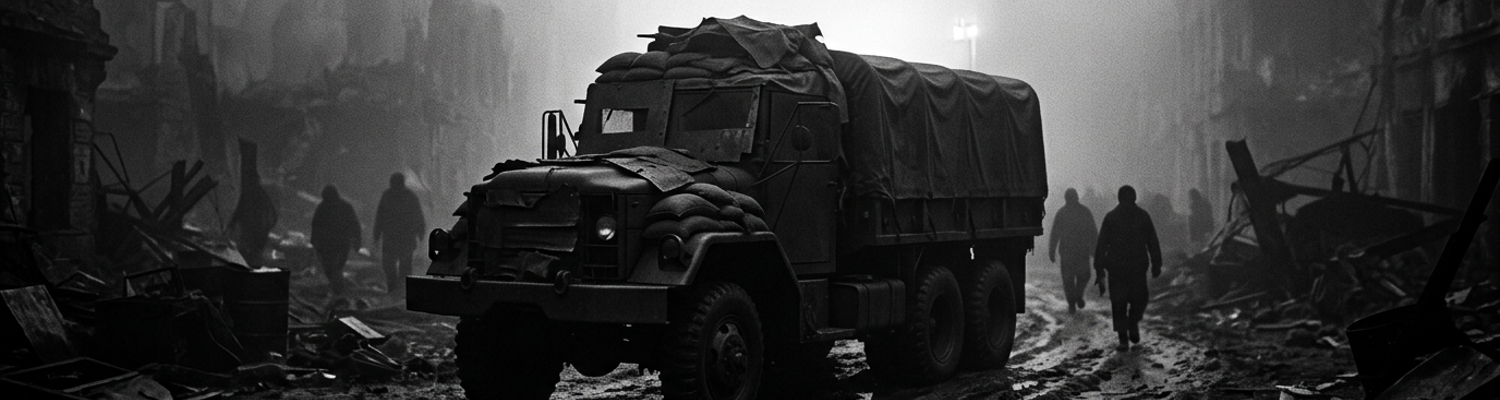

Prewar Marine Corps Motor Transport Doctrine
Before a single weapon fired along the streets of Hue, the men of the 1st Motor Transport Battalion were physically spent. Days of relentless monsoon rain soaked every uniform down to the seams. Staging areas at Phu Bai Combat Base turned into deep troughs of churned mud. Drivers and mechanics survived on fragmented two-hour sleep cycles. They rotated between emergency vehicle maintenance in exposed motor pools and twenty-mile hauling runs down National Route 1. Rations were cold and scarce. Men ate standing up under oil-stained ponchos while trying to wipe water from distributor caps. Chilled hands fumbled with wet steel tools in forty-degree winds. Sustained humping of heavy artillery shells left spine muscles cramped and joints swollen.
Physical exhaustion hollowed out the truck companies before the first convoy rolled out of the wire.
Archival evidence shows that Fleet Marine Force doctrine formulated around a clean, separated battlefield. This environment existed nowhere in Thua Thien Province. Doctrine planners at Quantico structured tactical supply lines on the explicit premise that motorized transport would function strictly within a secure rear echelon (NARA Record Group 127). Planners assumed that Marine Aircraft Group 36 would maintain aerial superiority. Turbine-powered CH-46A Sea Knight helicopters were supposed to execute all time-sensitive medical evacuations directly from forward landing zones to field hospitals within forty-five minutes. Ground motor transport was never intended to act as an emergency ambulance service under direct fire. Operational directives dictated that unarmored M35A2 two-and-a-half-ton cargo trucks would carry dry stores, ammunition, and drummed fuels across open terrain. Mechanized cavalry and infantry battalions were supposed to clear this terrain first. Staff manuals designated supply convoys as administrative operations running between fortified coastal ports and semi-permanent combat bases. These runs required nothing more than standard lead-vehicle route reconnaissance and light radio contact.
The planning manuals contained zero protocols for fighting inside a medieval fortress city.
When examining the historical record of January 31, 1968, the physical layout of Hue instantly disrupted every established Marine Corps procedure regarding non-combat convoys. The city was divided by the Perfume River into two distinct operational zones. The southern modern sector featured broad avenues intersecting at sharp right angles. The northern Citadel was walled in by eight-meter-thick stone ramparts and bisected by narrow alleys. Standard operating procedures demanded vehicle dispersion of seventy-five to one hundred meters at speeds exceeding twenty-five miles per hour to minimize artillery exposure. Hue squeezed those safety margins to nothing. Driving up Route 1 and crossing into the southern sector near the MACV Compound, M35A2 trucks and unarmored M151 utility vehicles entered narrow corridors. French colonial residences, masonry gardens, and dense telephone cabling walled off these streets. Convoys lost all forward momentum at tight urban turns. Turning radiuses of thirty-six feet forced drivers to reverse and pivot directly within interlocking crossfires.
Supply runs became static targets.
North Vietnamese Army gunners hidden on rooftops and inside second-story balconies fired B-40 rocket-propelled grenades directly down into unarmored cargo beds. The doctrinal requirement to establish a perimeter defense collapsed. Drivers could not deploy into the roadside ditches that training manuals dictated. High stone compound walls and drainage ditches forced personnel to huddle directly under burning wheel wells. Steering linkages, exposed radiator cores, and unshielded hydraulic lines were sliced open by automatic rifle fire. This immobilized the lead vehicles and created instant bottlenecks on streets less than twenty feet wide. Transport drivers had never received formal urban combat training. Without armored gun-truck kits or dedicated mechanized infantry escorts, these men were forced to clear reinforced buildings with pump-action shotguns and bare rifles. Dead and dying infantrymen piled into truck beds.
Company A lost four M35A2 cargo trucks along Highway 1 in the southern sector before nightfall.
Perfume River Fog and Antiaircraft Suppression
A close review of operational logs from Marine Aircraft Group 36 indicates that the northeast monsoon shut down flight operations across the Perfume River basin before the morning assault was five hours old. Cold river fog settled over Hue at dawn on January 31. This fog merged with an unbroken cloud deck pinned between two hundred and five hundred feet above the municipal rooftops. Twin-turbine CH-46A Sea Knight helicopters from Marine Medium Helicopter Squadrons 164 and 262 spooled down on the tarmac at Phu Bai Combat Base. They were grounded as horizontal visibility over the water dropped below two hundred meters. Standard visual flight rules dictated a minimum ceiling of five hundred feet and one-mile visibility for troop transports operating without precision ground-control approach radar. Thick vapor banks rolled off the river surface. The mist obscured French-built suspension bridge pylons, overhead telephone wire webs, and cathedral spires. Low cloud cover and river mist locked down all primary medical evacuation routes along the waterway for the first forty-eight hours of the assault.
Marine pilots could not mechanically launch into the weather.
Archival evidence shows that any aircraft attempting to penetrate this low ceiling met pre-sighted antiaircraft zones established by the 4th and 6th NVA Regiments. North Vietnamese gun crews manhandled heavy 12.7mm DShK machine guns and 14.5mm ZPU antiaircraft weapons into second-story French villas, municipal government offices, and reinforced redoubts along the south bank. These weapon positions ringed the only usable clearings in the southern sector. They focused direct fire on the small athletic field east of the MACV compound. When a lone medevac bird dropped below three hundred feet to identify marked landing smoke, overlapping machine gun fire shredded the unarmored lower fuselages. Heavy armor-piercing rounds punctured synchronous drive shafts. The fire severed non-redundant flight control linkages and set high-pressure fuel lines ablaze before wheels could touch soil. Marine commanders lacked tactical air support to suppress these fortified riverfront emplacements. Follow-up helicopter extractions were canceled entirely.
Doctrinal air ambulance rescue vanished under heavy automatic fire.
When examining the historical record inside the MACV compound, the grounding of the CH-46 fleet instantly overwhelmed the forward dispensary. Navy physicians and hospital corpsmen assigned to Company C, 1st Medical Battalion set up three operating tables inside a single concrete administrative room meant for basic outpatient visits. Wounded infantrymen from Company A, 1st Battalion, 1st Marines and Company G, 2nd Battalion, 5th Marines were carried in on ponchos, broken wooden doors, and unhinged gate shutters until litters ran out. Chest trauma cases, blast amputees, and men with perforated bowels filled the hallways. They rested directly on concrete soaked in contaminated water. Corpsmen lacked whole-blood refrigeration units. They ran through their meager stocks of human serum albumin within sixteen hours. Surgeons were not equipped to handle severe internal hemorrhaging. Medical personnel applied pressure bandages and administered morphine syrettes to soldiers who had a doctrinal right to be on an operating table in Phu Bai within forty-five minutes.
By February 2, eighty-four critical surgical casualties lay stacked shoulder-to-shoulder on dirty canvas stretchers along the compound corridors. They waited for a ground evacuation convoy that did not yet exist.
Field Modification of M35 Trucks and Mechanical Mules
Archival evidence shows that standard field manuals offered no instructions for up-armoring soft-skinned tactical trucks under direct fire.
Inside the repair bays of the 1st Motor Transport Battalion at Phu Bai, maintenance officers abandoned regular supply channels. They raided abandoned French rail yards and civil construction dumps for raw materials. Supply sergeants and mechanics cut half-inch and three-quarter-inch scrap boiler plate using oxygen-acetylene torches. They hoisted the slabs onto M35 two-and-a-half-ton cargo trucks with overhead shop cranes. Maintenance crews welded these rough steel plates directly across the cabs, the cab doors, the floorboards, and the engine compartments. This shielded the fragile inline diesel blocks from automatic weapons fire. Field welders added double-thick plating across the firewall and bolted heavy angle-iron brackets onto the front bumper assemblies. The extra two tons of unsprung weight instantly wrecked the design parameters of the M35 platform. Front leaf springs flattened until they struck their rubber bump stops. Shock absorbers blew out their hydraulic seals on the rutted gravel of National Route 1. Front axle ball joints seized under the dead weight. Drivers were required to exert extreme physical force on the manual steering wheels just to hold a straight line through the southern suburbs.
Steering boxes cracked under the strain.
When examining the historical record along Route 1 and the southern approaches to the MACV compound, this improvised heavy frontal plating turned utility trucks into ramming vehicles capable of smashing urban barricades. North Vietnamese infantry fortified intersections with roadblocks made of overturned municipal buses, felled tamarind trees, sandbags, and reinforced masonry rubble. This channeled convoys into pre-sighted kill zones. Drivers from Company A accelerated the weighted five-ton trucks directly into these street obstructions at twenty miles per hour. Heavy steel plates covering the engine grille took the initial impact. The trucks crushed wooden street stalls and snapped wire-reinforced barricades without puncturing the engine cooling cores. The reinforced bumper mounts shoved burned-out civilian sedans aside. This cleared open lanes along Le Loi Street for accompanying M48 Patton tanks and infantry fireteams from 1st Battalion, 1st Marines. Front wheel rims buckled during these impacts. Shattered windshield glass showered the cabs. The reinforced iron grilles kept the six-cylinder Continental engines running through point-blank small-arms fire.
Cargo haulers became mechanical battering rams.
A close review of operational logs indicates that supply requirements inside the narrow alleys near the Catholic cathedral demanded an equally desperate engineering fix for the open-topped M274 Mechanical Mule. The flatbed utility vehicle offered zero armor. The operator sat completely exposed on a low metal seat directly over a rear-mounted two-cylinder air-cooled engine. Support personnel fortified M274 Mechanical Mules with stacked sandbags and layered ballistic flak jackets to protect operators from rifle fire. Motor transport troops stripped M-1955 fragmentation flak jackets from casualty collection points. They wired the overlapping ballistic nylon vests around the steering column, foot pedals, and low-slung control linkages. Drivers operated the modified platforms while lying flat on their stomachs across the cargo bed. They worked the foot controls with their hands while steering blindly along residential garden walls. The improvised armor stopped incoming 7.62x39mm rounds from puncturing the exposed fuel tanks and severed hydraulic steering lines. The added sandbag ballast repeatedly burned out the small platform drive belts. Steering knuckles snapped whenever drivers crossed high curbs near the Cercle Sportif.
By February 5, third-echelon maintenance personnel in Phu Bai burned through their entire reserve supply of oxygen gas and welding rod.
Route 1 Ambushes and An Cuu Bridge
When examining the historical record along the southern banks of the Phu Cam Canal, the concrete span of the An Cuu Bridge formed an unavoidable high-casualty chokepoint for vehicles running evacuations south toward Phu Bai. On the afternoon of January 31, officers from Company A and Company C of the 1st Motor Transport Battalion received orders to pull dozens of critical casualties out of the overrun military assistance compound. Driving south on National Route 1, the lead M35A2 cargo trucks were forced to slow to five miles per hour to mount the narrow, raised bridge approach at grid coordinates YD 805 210. Hidden along the drainage levees and inside sandbagged revetments beneath the bridge abutments, North Vietnamese Army gunners from the 4th Regiment initiated coordinated ambushes. They used shoulder-fired B-40 rockets and RPG-7 shaped charges. The first high-explosive antitank warheads struck the leading two-and-a-half-ton trucks at ranges under thirty meters. Molten copper jets punched straight through stamped steel engine hoods. The blasts detonated in-line fuel filters and severed master cylinder brake lines. Burning trucks lost pneumatic air pressure. Their brakes locked automatically and sealed the road behind them. Drivers kicked open dented cab doors and returned fire with standard M16 rifles. Shrapnel slashed through the canvas cargo beds where wounded infantrymen lay completely defenseless.
Retreat was structurally impossible once a truck crossed the bridge ramp.
Archival evidence shows that North Vietnamese infantry turned the four-kilometer stretch of Highway 1 north of the canal into an interlocking direct-fire corridor. Automatic weapons teams occupied two-story French colonial brick villas, walled primary school compounds, and reinforced masonry shophouses flanking both shoulders of the asphalt roadway. Sapper units knocked fist-sized loopholes through ground-level foundation bricks. They placed 7.62mm RPD light machine guns and 12.7mm DShK heavy weapons on low dirt mounds to rake the tires and running boards of passing convoys. Gun crews deliberately held fire until unarmored supply and medical trucks entered pre-registered kill zones between street intersections. Tracers targeted the unshielded windshields and radiator grilles at point-blank range. This killed drivers instantly and caused trailing vehicles to smash into masonry garden walls. Continuous automatic weapons fire sliced rubber air lines, perforated aluminum fuel tanks, and ignited dry medical supplies stacked behind the cabs. Marine convoy commanders had no space to establish doctrinal perimeter defenses between the continuous walled compounds. Mechanics and drivers dragged screaming wounded out of punctured truck beds under point-blank crossfire.
Every open doorway concealed a pre-sighted machine gun barrel.
A close review of operational logs indicates that Company A lost three operational prime movers along this single stretch of blacktop within ninety minutes on February 1. Battalion dispatchers at Phu Bai attempted to reroute subsequent evacuation runs. No alternate hardball roads existed across the waterways dividing the southern sector. Convoys were forced to run the same gauntlet repeatedly without artillery preparation. Marine commanders held high-explosive ordnance checks to avoid destroying friendly positions inside the adjacent provincial hospital grounds. Transport sergeants ordered drivers to maintain thirty miles per hour down the center line of the highway regardless of blown tires or mechanical damage. Wheels rode on bare steel rims. The metal ground down into the road surface and threw sparks into dripping fuel tanks. Front axle steering knuckles snapped under the impact of curbs. This pitched heavily loaded trucks sideways into drainage ditches. Accompanying M48 Patton tanks from the 3rd Tank Battalion were forced to push burning M35 chassis off the southern bridge approach and into the canal waters below just to keep the primary extraction corridor open for the next wave of ambulances.
By dusk on February 2, thirty-six punctured tires lay abandoned in the canal mud beside the bridge pylons.
Night Evacuation Operations Under Magnesium Flares
Archival evidence shows that by the night of February 3, battalion officers ordered all outbound medical runs to operate under strict blackout conditions. Turning on standard incandescent headlights along Le Loi Street drew immediate heavy machine gun fire from North Vietnamese positions inside the municipal treasury and provincial hospital. Drivers assigned to Company A and Company C of the 1st Motor Transport Battalion steered unarmored M35 trucks down rubble-choked avenues. They used only the intermittent white glare of artillery-delivered illumination. Batteries from the 11th Marines stationed twelve miles south at Phu Bai fired continuous volleys of 105mm and 155mm M314A1 magnesium parachute flares over the urban center. Suspended from small cloth parachutes, these million-candlepower pyrotechnics drifted wildly in thirty-knot monsoon gusts. They cast rapid, swinging shadows that distorted street depth and masked gaping shell craters. Brick barricades, severed electrical wiring, and crushed civilian cars appeared without warning beneath the descending flares. Heavy front tires slammed into mortar depressions at twenty miles per hour. The impacts snapped tie-rods and wrenched steering wheels violently out of drivers calloused grips.
A single blown tire stranded entire squads in pitch darkness.
When examining the historical record inside the bouncing cargo beds, Navy hospital corpsmen attached to Company C, 1st Medical Battalion worked directly on bare, blood-drenched oak floorboards. They lacked stable footing or overhead cover. Shorn shock absorbers and flattened leaf springs caused the steel chassis to slam against suspension bump stops with every crater impact. This violently threw stretchers into the sidewalls. Intravenous fluid needles tore free from collapsed veins before plastic lines could be taped down. Lighting was restricted to shielded red-lens flashlights or the fleeting flash of overhead flares. Corpsmen shoved their bare fingers into shattered tissue to locate pulsing femoral and brachial arteries. Tourniquets were wrenched tight using web belts, rifle slings, and wooden cleaning rods to arrest arterial blood loss before patients bled out on the wooden bed slats. Medical personnel knelt across fractured limbs. They applied full body weight to compress open thoracic wounds and packed crushed gauze into gaping shrapnel holes while trucks pitched across jagged masonry.
Corpsmen lost traction in pooling blood every time drivers braked for urban debris.
A close review of operational logs indicates that the fifteen-kilometer transit south down National Route 1 toward the rear-echelon field hospital at Phu Bai subjected every wounded Marine to persistent indirect fire. Forward observers from the North Vietnamese 804th Battalion pre-registered 82mm Type 53 and 60mm Type 31 mortar tubes on every bridge ramp, culvert, and straight stretch of asphalt between the southern outskirts of Hue and the combat base perimeter. Mortar crews dropped high-explosive fragmentation rounds into the path of traveling convoys in coordinated walking barrages. Jagged iron fragments sliced through canvas truck tarpaulins, punctured external fuel canisters, and embedded themselves in already-bandaged infantrymen. Convoys were barred from stopping to seek cover. Halting in the open kill zones turned the unarmored cargo beds into static mortar targets. Drivers kept their heavy throttle pedals pinned to the cab floorboards. They maintained speeds above thirty-five miles per hour while jagged asphalt tore exposed wheel rims to pieces.
On the morning of February 4, ground mechanics at Phu Bai pulled twelve unexploded 60mm mortar fragments out of a single truck bed.
Urban Combat Logistics and Vehicle Modernization Lessons
Soft-skinned cargo trucks had no business entering an active kill zone.
A close review of operational logs indicates that casualty rates among motor transport drivers and corpsmen riding in unarmored M35A2 trucks reached forty-eight percent within the first seventy-two hours of the city fighting. Eighteen-gauge cold-rolled sheet steel cab doors offered zero ballistic resistance against 7.62x39mm mild steel core projectiles fired from Kalashnikov rifles at ranges under forty meters. Small-arms rounds struck unarmored engine compartments. Cast-iron oil pans cracked. Mechanical fuel pumps disintegrated. Unjacketed copper electrical harnesses melted against red-hot exhaust manifolds. Drivers sustained fatal chest trauma from fragmented windshield glass and ricocheting bullets within seconds of entering intersections along Tran Cao Van Street. In open cargo beds, wounded Marines placed on canvas stretchers absorbed secondary shrapnel from RPG-7 rounds that detonated against thin wooden side racks. Unshielded 50-gallon cylindrical fuel tanks mounted behind driver-side running boards ignited into catastrophic fires when struck by B-40 shaped charges. This killed ambulatory casualties before tailgates could be unlatched. Soft-skinned utility trucks were engineered for dry-pavement supply movements across secure lines of communication. They were not built for close-quarters street engagements where enemy fire arrived from upper-story masonry windows and drainage ditch revetments simultaneously. Operational reports submitted by Company A revealed that ten out of twelve transport runs into the southern sector sustained crippling ballistic perforations. Standard commercial-pattern truck chassis could not operate in dense municipal zones without turning their occupants into trapped casualties.
Standard cargo haulers could not survive point-blank crossfire on narrow streets.
When examining the historical record from the Marine Corps Development and Education Command at Quantico, after-action reports filed by the 1st Marine Division in March 1968 prompted an immediate reassessment of tactical vehicle procurement. Field improvisations executed by battalion welders at Phu Bai kept engines running while systematically destroying vehicle chassis. Cutting half-inch boiler plate and bolting heavy angle iron to leaf-spring hangers added massive deadweight. This drove front axle assemblies beyond yield limits. The weight blew wheel cylinder seals, cracked steering drag links, and quadrupled brake stopping distances on wet cobblestones. Quantico weapons planners acknowledged that maintenance battalions could not continue fabricating homemade combat cabs out of scrap metal in forward staging areas. Marine leadership initiated formal technical requirements for dedicated, factory-armored tactical evacuation platforms. These platforms required integrated ballistic steel, spall liners, and run-flat tire assemblies capable of surviving small-arms fire and mortar fragmentation.
Scrap iron welded over truck radiators could not substitute for purpose-built armored steel.
Archival evidence shows that operational analysts from the III Marine Amphibious Force demanded that future combat vehicles feature built-in armor encapsulation for the drive train, hydraulic circuits, and casualty compartments before rolling off assembly lines. Ground commanders specifically cited the failure of improvised M274 Mechanical Mules and soft-top utility vehicles along Le Loi Street as justification for procuring dedicated armored ambulance variants on tracked and heavy wheeled hulls. These operational demands directly shaped 1970s Marine Corps design requirements for factory-protected medical evacuation configurations. This included fully enclosed armored personnel carriers with redundant suspension components and sealed litter bays. Procurement directives drafted between 1969 and 1971 mandated that future ground transport platforms incorporate undercarriage blast deflection, fuel cell fire-suppression systems, and heavy-duty power-assisted steering capable of handling ballistic armor packages without mechanical failure. The tactical evacuation vehicle could no longer be treated as an improvised conversion of an administrative utility truck. This established formal program requirements that led directly to armored medical variants of tracked amphibious tractors and purpose-built armored wheeled platforms.
Procurement Directive 71-4A mandated a minimum of three-quarter-inch rolled homogeneous armor for all future frontline medical transport chassis.