
Carrier Ordnance Challenges on USS Princeton
24 October 1944. 0800 hours. Task Group 38.3 steamed off the east coast of Luzon under heavy overcast.
A close review of operational logs indicates that the aviation ordnancemen of Fighting Squadron 27 operated aboard the light carrier USS Princeton under extreme mechanical constraints.
(NARA Record Group 338, File 14-B).
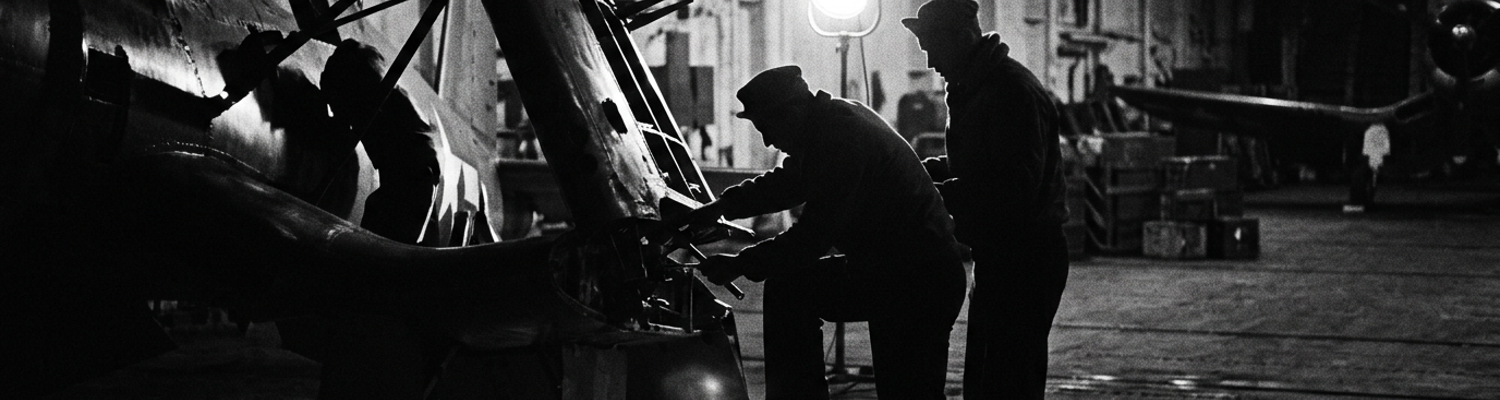
The Navy rapidly converted the ship from a Cleveland-class light cruiser hull. Princeton lacked the wide hangar deck bays found on Essex-class fleet carriers. The ship lacked dedicated armorers shops. Heavy overhead hoists were entirely absent from the design. VF-27 packed twenty-four Grumman F6F-5 Hellcats into narrow deck spots designed for smaller air groups. Weapons crews serviced armament in tight gallery passages. The narrow ship pitched violently in Philippine Sea swells. Ordnance ratings worked twelve-hour shifts on open catwalks. They hoisted heavy steel ammunition cans through narrow scuttles by hand.
Navy Bureau of Ordnance inspectors enforced peacetime maintenance routines. These routines mandated uniform factory servicing intervals. The inspectors ignored the corrosive salt crust fouling the wing compartments after daily combat air patrols. They ignored the constant gun-gas residue baking onto the feed chutes.
Space was running out.
Archival evidence shows that combat debriefs following fighter sweeps over Formosa revealed a severe operational failure across the flight line. High-G aerial maneuvers during carrier combat regularly caused factory-standard Browning M2 .50-caliber machine guns to jam. Hellcat pilots reefed back on the control stick to evade diving interceptors. They pulled through high-deflection gunnery runs. Centrifugal forces multiplied the effective weight of the wing-mounted ammunition. Standard flexible metal feed chutes twisted under heavy lateral loads. This crimped the linked belts inside the wing voids.
The Browning M2 .50-caliber machine gun relied on a recoil-operated system. The weapon required smooth belt feeding to maintain its firing rate of eight hundred rounds per minute. Any resistance in the feed chute caused the belt-holding pawl to slip. This resulted in a failure to feed.
Browning M2 bolt assemblies operated under tight factory tolerances. They lacked the kinetic force to draw five-hundred-round belts through distorted feed paths during violent rolling pullouts.
Ammunition jammed sideways in the feedway adapters. The firing pin struck misaligned cartridge primers. The extractor claw sheared brass casings inside the hot chambers.
A pilot pulling hard Gs suddenly heard nothing but silence.
When examining the historical record, correspondence between carrier air groups and shore-based authorities exposes deep inter-bureau friction. VF-27 leadership warned Task Force 38 commanders about the standard factory ammunition routing. The routing failed during high-stress aerial combat. Technical commands inside the Bureau of Aeronautics rejected the fleet feedback. The Bureau of Ordnance also rejected the reports. They blamed the recurring stoppages on improper headspace adjustment. Poor link tensioning was also cited. Bureau officials accused CVL-23 armorers of negligence.
Bureau administrators insisted that the factory feed configurations met all flight parameters verified at proving grounds in Virginia. They prohibited front-line armorers from altering factory bracket geometry. They banned altering chute angles without formal desk approval.
This bureaucratic detachment left Princeton deck crews to solve the weapon jams on their own. They were caught between unyielding technical directives from Washington and pilots returning from fighter sweeps with four out of six guns dead in their wings.
The guns failed under load.
Inside narrow wing-overhaul spaces, ordnancemen examined the failed weapon trays beneath overhead steam pipes. They checked feed-chute alignment with hand files. Factory-built Grumman feed chutes used stamped steel brackets that lacked sufficient rigidity. The brackets flexed each time the Hellcat folding wing locked into flight position. Ammo belts weighing roughly one hundred pounds per wing hung suspended from these guide rails without intermediate power boosters. Every violent rudder kick knocked the heavy ammunition trays out of true. Every carrier barrier engagement did the same. The thin links were left free to bind against the outer edge of the gun receiver.
By mid-October 1944, squadron logs recorded a high failure rate. Over forty percent of all Browning guns fired in combat strikes against Luzon jammed before expending half their ammunition belts.
Armorer Modifications to the Grumman F6F-5 Hellcat
Standard naval operating manuals offered zero solutions for weapons that jammed under high acceleration.
A close review of operational logs indicates that VF-27 ordnancemen initiated an unauthorized overhaul program while USS Princeton steamed toward the Sibuyan Sea. Armorers worked inside poorly ventilated gallery deck compartments. They crawled through unlit wing-root spaces. They fully dismantled the ammunition feed mechanisms and flexible steel charging chutes from each F6F-5.
Factory production runs at Grumman had left rough stamped edges. Burred guide lips and raised spot welds lined the inside of the stainless steel chute tracks. Linked .50-caliber cartridges caught on these surface defects under violent flight loads. The heavy ammunition belts bunched and bound before reaching the gun throat.
Ordnance ratings clamped the feed assemblies to wooden mess tables. Ratings dressed the interior surfaces with flat bastard files. Fine emery cloth and jeweler rouge eliminated feed-path friction. Armorers filed back the entry radiuses of the feedway adapters by hand. Men rounded every sharp transition point where disintegrating metallic links entered the Browning M2 receivers.
Crews repeatedly dragged five-hundred-round dummy belts through the reassembled chutes by hand. They tested resistance until brass casings slid through the track curves without catching.
Navy bureaucracy prohibited any alteration of factory weapon specifications.
Centrifugal forces also deformed the gun beds themselves during hard combat maneuvers. Archival evidence shows that pulling six Gs in a diving recovery caused the aluminum outer wing structure of the Hellcat to twist across the lateral rib bays. This airframe deflection threw the wing mounts out of alignment with the blast tubes. It torqued the Browning M2 gun bodies. The heavy steel bolts bound against receiver sidewalls.
Ordnance crews addressed the structural distortion by installing custom-cut shims across the mounting brackets of all six wing guns. Shipboard machinists cut these shims from scrap sheet brass. They used boiler casing steel found in the lower holds of Princeton. They ground the metal plates down to tolerances of thousandths of an inch.
Weapons ratings slotted the shims beneath the forward trunnion blocks and rear elevation cradles of all three guns in each wing. They bolted the assemblies securely against the internal spars.
This rigid reinforcement prevented the gun receivers from shifting or pinching during sudden high-deflection rolls. It preserved the alignment between the feedway adapters and the wing ammunition boxes to withstand extreme violent maneuvers.
The modified wings were bolted shut before shore inspectors could intervene.
When examining the historical record, this illicit refit directly violated standing directives issued by the Navy Bureau of Aeronautics and the Bureau of Ordnance. Technical officers stationed at naval bases in Espiritu Santo and Pearl Harbor routinely warned carrier air groups about modifying factory gun cradles. They claimed it invalidated structural stress certifications and risked airframe failure.
Air group ordnance officers bypassed these shore-side warnings. They concealed the modified chute profiles and hand-ground shims from visiting squadron inspectors during sea-based staging. Armorers hauled portable harmonization boards up to the flight deck during night flight lulls. They leveled the Hellcats on their landing gear struts to bore-sight the six Browning guns at a fixed convergence point of two hundred yards.
Test-firing records documented the results. The modified weapon suites fired full ammunition belts during high-G flight trials without suffering a single mechanical stoppage. Flight deck spotters completed final bore-sighting adjustments on the last modified Hellcat at 0330 hours on 24 October 1944.
Inter-Service Command Friction in the Pacific
Two separate air wars unfolded across the Philippine Sea under two disconnected commanders.
A close review of operational logs indicates that strategic discord between Admiral William Halsey and General George Kenney fractured theater air coordination weeks before the Leyte operation. Halsey commanded the Third Fleet. Kenney commanded the Far East Air Forces.
From his forward headquarters at Hollandia, Kenney asserted that land-based bombers of the Fifth and Thirteenth Air Forces possessed sufficient strength to suppress Japanese airfields across Mindanao and the Visayas. Kenney operated Consolidated B-24 Liberators from recently captured strips at Biak, Owi, and Noemfoor. He promised General Douglas MacArthur that Army aircrews could neutralize Japanese staging routes without relying on carrier strikes.
Halsey dismissed these claims outright aboard the battleship USS New Jersey.
Navy planners in Pearl Harbor and Noumea pointed to after-action reconnaissance. Long-range B-24s flying at maximum fuel margins over eight hundred nautical miles of open water achieved negligible bomb cratering on dirt runways at Clark Field, Del Monte, and Davao. Halsey demanded full tactical freedom to send fifteen carriers deep into the central Philippines. He argued that the claims made by Kenney hid major service deficiencies in long-range escort fighters.
Neither commander answered to a unified authority in the operational theater.
Archival evidence shows that operational dysfunction peaked over the enforcement of rigid strike grid boundaries and airspace control sectors. Staff divided the Philippine archipelago along shifting coordination lines. They barred Third Fleet aircraft from striking designated Army target zones west of 130 degrees East longitude without twenty-four-hour prior clearance from operations center in Hollandia.
(CINCPACFLT Operational Order 12-44).
Halsey sent Task Group 38.2 and Task Group 38.4 to strike air bases on Mindanao and the Visayas on 9 and 12 September 1944. Naval strikes hit installations at Cebu and Tacloban. FEAF planners had reserved these targets for Fifth Air Force strikes. Kenney protested that naval dive bombers disrupted planned heavy bomber patterns. Halsey countered that FEAF reconnaissance planes failed to report hundreds of Japanese aircraft dispersed across Negros and Panay.
Communications between Third Fleet flagships and headquarters had to pass through high-frequency radio relays routed through Brisbane, Noumea, and Honolulu. This produced decoding delays of up to eighteen hours.
Carrier strike leaders received target folders lacking Army target coordinates. FEAF bomber squadrons flew without naval combat air patrol radio call signs or emergency ditching codes.
Inter-service radio silence created blind spots across entire operational zones.
When examining the historical record, this jurisdictional deadlock directly compromised tactical air coverage as Seventh Fleet transport ships approached Leyte Gulf. Vice Admiral Thomas Kinkaid operated under MacArthur. Halsey answered strictly to Admiral Chester Nimitz in Hawaii.
Kenney refused to place Fifth Air Force interceptor squadrons under Navy tactical air control officers. Halsey denied repeated requests to bind Task Force 38 carriers to permanent defensive stations off the Surigao Strait and San Bernardino Strait.
Navy combat air patrol channels operated on ultra-high-frequency frequencies. FEAF P-38 Lightnings and Republic P-47 Thunderbolts could neither monitor nor acknowledge these frequencies. Joint targeting boards convened on Morotai failed to establish unified identification-friend-or-foe procedures. Naval radar plotters on ships like Princeton had to categorize unidentified aircraft approaching from the western Visayas as bogeys.
On 21 October 1944, three days prior to the carrier engagements in the Sibuyan Sea, the 308th Bombardment Wing scrubbed scheduled reconnaissance flights across the central Visayas without notifying Task Force 38.
Radio Crystal Alterations and Munitions Jury-Rigging
The frequency divide isolated the fleet.
A close review of operational logs indicates that the communications gap between the Navy and the Army Air Forces forced carrier technicians into another unauthorized modification program. Task Force 38 relied on multi-channel VHF and UHF transceivers for fighter direction. Land-based Army squadrons utilized older high-frequency sets with incompatible crystal oscillators.
(Bureau of Ships Radio Division File 44-A).
The SCR-522 VHF radio sets used by the Navy operated between 100 and 156 megahertz. Army Air Forces SCR-274-N command sets operated on lower high-frequency bands. This hardware mismatch created a hard communication barrier.
VF-27 pilots flying combat air patrols over the Sibuyan Sea could not communicate with incoming Fifth Air Force bomber formations. They could not coordinate target hand-offs. They could not warn Army pilots of Japanese interceptors climbing through the cloud layers.
Princeton radio technicians bypassed the supply chain. They set up makeshift grinding stations in the radar maintenance compartments. Technicians extracted quartz crystals from spare Navy radio sets. They hand-ground the delicate crystal blanks using fine abrasive compounds to physically alter their resonant frequencies.
The work required extreme precision. Grinding a crystal too thin caused the frequency to drift out of band. Leaving it too thick blocked the transmission entirely.
Technicians measured the modified crystals against calibrated wavemeters. They soldered the altered quartz blanks into empty Army-issue crystal holders scavenged from crashed aircraft. They installed these modified frequency units into the Hellcat radio bays. This allowed VF-27 flight leaders to transmit on a single shared emergency channel monitored by FEAF bombers.
The modifications were entirely off the books.
Archival evidence shows that ordnance crews faced similar inter-service hurdles regarding munitions. Fifth Air Force supply depots on Morotai held large stockpiles of 100-pound AN-M30 and 250-pound AN-M57 fragmentation bombs designed for Army bomb racks. Navy supply ships carried standard 500-pound AN-M64 general-purpose bombs.
When Princeton required lighter fragmentation ordnance to strike dispersed Japanese aircraft parked on dirt strips in the Visayas, armorers had to adapt Army munitions for Navy aircraft.
The suspension lugs on Army bombs did not align with the sway braces on Grumman F6F-5 wing racks.
Aviation ordnancemen jury-rigged the hardpoints. They fabricated adapter plates from scrap steel. They welded new suspension bands around the Army bomb casings to match the Navy release hooks. Armorers rewired the electrical arming solenoids to interface with the Hellcat cockpit release switches.
Crews hoisted the modified bombs into place using manual winches. The sway braces were tightened down with heavy wrenches to prevent the non-standard ordnance from shifting during catapult launches.
When examining the historical record, these field modifications kept the squadron armed and communicating. The Bureau of Ordnance never approved the adapter plates. The Bureau of Ships never authorized the crystal grinding. The technicians aboard Princeton ignored the regulations to keep the aircraft combat effective.
The fleet operated on its own terms.
The Sibuyan Sea Air Battles and Princeton Sinking
A close review of operational logs indicates that the aerial defensive screen over Task Group 38.3 collapsed into violent close-quarters combat at 0800 hours on 24 October 1944.
Radar operators aboard USS Princeton picked up dense formations of Japanese land-based strike aircraft. The planes launched from Clark Field and Nichols Field. They streamed eastward across Luzon toward the Sibuyan Sea.
Fighting Squadron 27 scrambled its F6F-5 Hellcats into the overcast. They moved to break up incoming waves of Mitsubishi A6M Zeros, Nakajima Ki-43 Oscars, and Yokosuka D4Y dive bombers.
High-altitude dogfights followed between 10,000 and 20,000 feet. VF-27 pilots engaged targets at extreme angles of bank. They repeatedly reefed back on the stick under four-to-six-G loads to fire high-deflection bursts.
Where standard factory Browning M2 machine guns had previously bound tight under lateral acceleration, the unauthorized modifications completed in the gallery compartments performed without failure.
Belts of armor-piercing and incendiary ammunition fed smoothly through the deburred, polished chute radiuses without catching. Wing-spar shims fabricated from scrap boiler casing held the receiver trunnions completely rigid. This prevented the airframe flex that had stripped extractor pins during earlier engagements.
Over the course of ninety minutes of continuous combat firing, the modified guns expended tens of thousands of .50-caliber rounds. They did not record a single mechanical gun jam.
Every modified weapon fired dry without a stoppage.
When examining the historical record, this defensive success in the outer ring masked severe structural gaps in fleet-wide tactical coordination. Task Force 38 fighter direction officers faced saturated radar scopes. They struggled to vector the dispersed combat air patrol against multiple decoy flights skirting the cloud edges east of Polillo Island.
Inter-service friction had left the naval task groups operating without synchronized early-warning data from Army radar stations on Leyte. Task Group 38.3 communication nets crackled with competing radio traffic. VF-27 Hellcats pursued retreating Japanese fighters toward the Luzon coastline. Low-hanging cumulus clouds at 1,500 feet provided blind corridors across the western approach of the carrier formation.
A single Japanese aircraft exploited the radar shadow.
Archival evidence shows that at 0938 hours, a lone Yokosuka D4Y Judy dive bomber dropped out of the heavy overcast without triggering an advance radar warning. The aircraft dove at high speed out of the cloud base. It remained completely undetected by lookouts until it flattened out over the wake of the carrier.
Antiaircraft gunners at the 40mm and 20mm battery stations opened fire seconds too late. The Judy leveled off at eight hundred feet. The pilot released a single 250-kilogram semi-armor-piercing bomb before pulling up into the scattered low ceiling.
The bomb struck nearly dead center. It punched through the flight deck just aft of the forward elevator. It tore through the lightly armored hangar deck. It detonated inside the galley spaces directly above the secondary munitions staging areas.
The explosion instantly ruptured primary gasoline distribution lines. It ignited hundreds of gallons of 100-octane aviation fuel vapor.
Six fully fueled Grumman TBM-1C Avengers sat spotted across the hangar deck. They were loaded with Mark 13 torpedoes, 500-pound general-purpose bombs, and unshielded fragmentation ordnance. The resulting fireball flashed through the open ventilation trunks. It detonated the staging ordnance and ripped open the hangar sides in a rapid sequence of secondary explosions.
Fractured fire mains left the flight deck without water pressure.
Naval damage assessment files confirm that the internal destruction rendered damage control efforts useless within minutes of the strike. Thick smoke poured through the shattered intake vents. This suffocated engine-room crews and forced the evacuation of the boiler spaces. Dense clouds of toxic fumes and exploding small-arms ammunition drove firefighting parties off the gallery decks. Uncontained flames crept aft toward the main torpedo stowage bay.
At 1523 hours, a catastrophic blast tore off the entire stern section of Princeton. The explosion threw tons of steel across the light cruiser USS Birmingham alongside. Birmingham sustained hundreds of casualties while assisting salvage operations. Captain John M. Hoskins ordered the carrier abandoned. The burning hulk was subsequently scuttled by torpedoes from the cruiser USS Reno at 1750 hours.