
The Terrifying Peak of the Cold War
The world has never been closer to complete destruction than it was in October of 1962. Most history books focus entirely on the events happening in the Caribbean during the Cuban Missile Crisis. We are taught about the naval blockades, the secret meetings in Washington, and the tense standoff between American ships and Soviet submarines. However, one of the most dangerous moments of the entire Cold War happened thousands of miles away from Cuba in the freezing skies above the Arctic Circle.
On October 27, a day that historians and military experts now grimly refer to as Black Saturday, a catastrophic navigational error almost triggered a global nuclear war. A United States Air Force U2 spy plane pilot accidentally flew directly into the heavily guarded airspace of the Soviet Union. This was not a planned espionage mission. It was a complete accident that occurred at the absolute worst possible moment in human history.
At this exact time, the military forces of the Soviet Union and the United States were at their highest states of alert. Radars were constantly scanning the horizons for any sign of a preemptive nuclear strike. Political leaders in both nations were running on zero sleep and high anxiety. Into this incredibly volatile situation flew a lone American aviator named Captain Charles Maultsby. His story is a chilling reminder of how easily human error combined with bad weather could have ended civilization as we know it.
The Forgotten Mission at the Top of the World
To understand how an American U2 spy plane pilot ended up lost in the Soviet Union during the Cuban Missile Crisis, we have to look at what the military was doing in Alaska. While the eyes of the public were glued to the situation in Cuba, the United States Air Force was still conducting its regular global operations. One of the most important operations was monitoring the Soviet Union for unauthorized atomic weapons testing.
The Soviet Union had a massive nuclear testing facility located in the remote Arctic region known as Novaya Zemlya. The United States needed to know exactly what kind of weapons their Cold War rivals were detonating. To gather this intelligence, the military relied on high altitude air sampling missions. They would send aircraft to the North Pole to literally scoop up the air and capture radioactive particles drifting over the polar ice caps.
Captain Charles Maultsby was assigned to one of these routine but dangerous air sampling missions. He was stationed at Eielson Air Force Base in Alaska. His objective was to fly his aircraft directly to the North Pole, collect the necessary atmospheric samples, and return safely to base. It was supposed to be a standard flight that had nothing to do with the intense geopolitical drama unfolding down south over the island of Cuba. But the nature of aviation means that nothing is ever truly routine.
Flying the Famous Dragon Lady
The aircraft chosen for this mission was the legendary U2 spy plane. Often referred to by its affectionate military nickname, the Dragon Lady, the U2 was an incredible piece of aviation engineering. It was designed to fly at altitudes exceeding seventy thousand feet. This was high enough to keep it out of the range of most enemy fighter jets and anti aircraft missiles of the early Cold War era.
Flying the U2 spy plane was an incredibly difficult and physically demanding task. Because the aircraft operated at the very edge of the earth's atmosphere, the pilot had to wear a fully pressurized flight suit that looked exactly like a bulky space suit. The cockpit was cramped and uncomfortable. The plane itself was notoriously difficult to fly because it had long glider wings that made it very sensitive to speed changes. If the pilot flew a little too fast, the wings could rip apart. If the pilot flew a little too slow, the aircraft would stall and fall out of the sky. The margin for error was famously known as the coffin corner.
Captain Maultsby was a highly experienced aviator. He had flown numerous missions and knew exactly how to handle the temperamental aircraft. However, flying a U2 spy plane near the North Pole presented unique challenges that even the best pilots struggled to overcome. The most significant challenge was navigation. Modern pilots rely on sophisticated global positioning systems that tell them exactly where they are at all times. In 1962, military pilots had to navigate using much older and more primitive methods.
Blinded by the Northern Lights
Navigating an aircraft near the North Pole is extremely complicated because magnetic compasses become completely useless. The magnetic fields converge at the pole, causing compass needles to spin wildly and provide no accurate sense of direction. To solve this problem, U2 spy plane pilots flying in the Arctic relied heavily on celestial navigation. They used a special device inside the cockpit called a star tracker. This instrument allowed the pilot to take readings from specific stars in the night sky to calculate their exact geographical position.
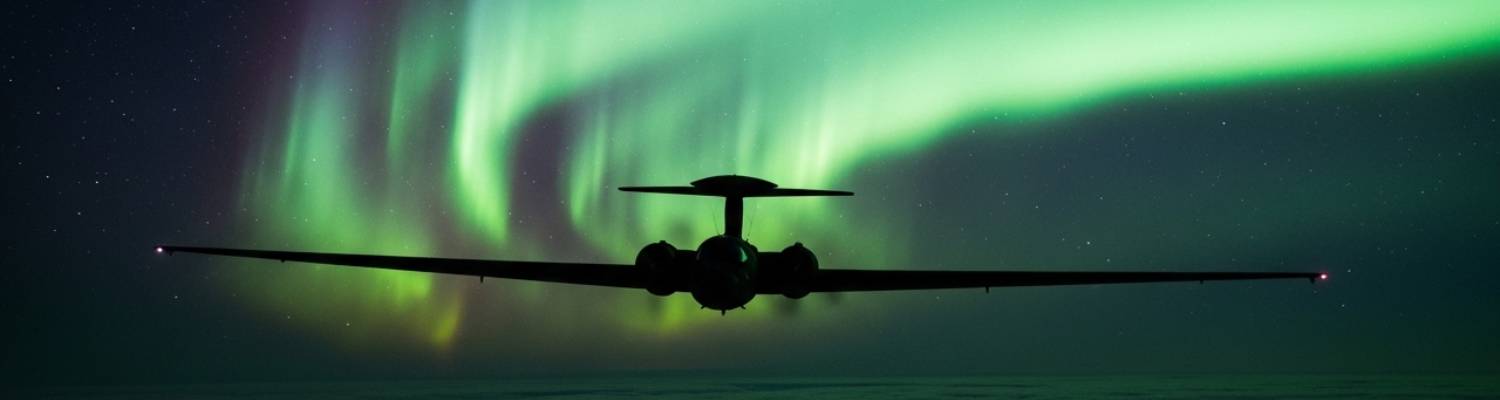
When Captain Maultsby reached the North Pole and turned his aircraft around to head back to Alaska, he encountered an unexpected and beautiful hazard. The sky erupted with a massive display of the aurora borealis. The Northern Lights are a spectacular natural phenomenon caused by solar wind interacting with the magnetic field of the earth. While they are beautiful to look at from the ground, they were an absolute nightmare for a pilot trying to read the stars.
The brilliant flashes of radiation and light from the aurora borealis completely overwhelmed the delicate sensors of the star tracker on the U2 spy plane. Maultsby was suddenly flying blind in the dark arctic sky. Without a functioning compass and without his star tracker, he had to rely entirely on dead reckoning. He tried to maintain his course by estimating his speed and the time he had been flying, but the high altitude winds began to push his aircraft off course.
In the featureless darkness over the frozen ocean, a small navigational error quickly multiplied. Maultsby thought he was flying south straight back toward his base in Alaska. In reality, he had turned slightly too far to the west. With every minute that passed, his high altitude aircraft was speeding closer and closer to the heavily defended borders of the Soviet Union.
Entering Hostile Enemy Airspace
Down on the ground, American radar operators in Alaska realized that the U2 spy plane pilot was wildly off course. They tried desperately to contact Captain Maultsby over the radio. Unfortunately, the same solar activity that was creating the bright aurora borealis was also causing massive interference with the radio communications. The high frequency radio waves were blocked, and Maultsby could only hear a wall of static.
Without anyone to warn him, Maultsby crossed the invisible border into Soviet airspace. He was flying directly over the Chukotka Peninsula. This was not just a random piece of empty tundra. The Chukotka region was a highly sensitive military zone packed with Soviet radar stations, missile silos, and air bases. It was one of the front lines of the Cold War.
Almost immediately, the advanced radar networks of the Soviet Union detected the American aircraft. The radar operators watched the blip on their screens with absolute horror. In the context of the Cuban Missile Crisis, the sudden appearance of an American military aircraft deep inside Soviet territory was interpreted as the possible start of World War Three.
The political and military leadership in Moscow was already extremely paranoid. Nikita Khrushchev, the leader of the Soviet Union, had his forces on maximum alert. The Soviet military doctrine assumed that an American nuclear first strike would be preceded by high altitude reconnaissance planes coming over the Arctic to scout targets. To the Soviet commanders watching the radar, the lost U2 spy plane pilot looked exactly like the beginning of an American nuclear attack.
The Soviet Union Responds with Deadly Force
The Soviet military did not wait to ask questions. The order was immediately given to destroy the intruding aircraft. Sirens blared at Soviet air bases across the frozen peninsula. Pilots rushed to their heavily armed MiG fighter jets and took to the skies. Their mission was simple and brutal. They were ordered to intercept the American spy plane and shoot it out of the sky before it could complete its suspected bombing or reconnaissance run.
Multiple squadrons of MiG fighters climbed aggressively into the stratosphere to hunt down Captain Maultsby. However, the U2 spy plane had one major advantage. It was flying at over seventy thousand feet. The Soviet MiG fighters of that era struggled to reach those extreme altitudes. The Soviet pilots would fly as high as they possibly could, point their noses up toward the U2, and attempt to lock onto the American plane.
Up in the cramped cockpit of his Dragon Lady, Captain Maultsby finally realized he was in terrible danger. He began to pick up faint signals from Soviet radio stations instead of American ones. He then looked out the small window of his pressurized helmet and saw the terrifying sight of condensation trails forming below him. He realized that those white streaks in the dark sky were enemy fighter jets trying to shoot him down. He was totally unarmed, utterly alone, and deeply lost inside the most dangerous airspace on the planet.
American Fighters Scramble with Nuclear Weapons
While the Soviet MiG fighters were hunting Maultsby, the American military command was panicking. Strategic Air Command knew exactly where Maultsby was and they saw the Soviet fighters scrambling on their own long range radar screens. The commanders in Alaska knew they had to protect their U2 spy plane pilot, but their response almost pushed the world over the edge into nuclear annihilation.
The United States Air Force scrambled their own interceptors from Galena Air Force Base in Alaska. A flight of F102 Delta Dagger fighter jets roared down the runway and headed out over the Bering Strait to rescue Maultsby. Under normal circumstances, sending fighter jets to escort a lost plane home would be standard procedure. But Black Saturday was not a normal circumstance.
Because the military was at DEFCON 2, which is the highest state of alert right before actual war, the American F102 fighter jets were not carrying conventional weapons. They were heavily armed with tactical nuclear air to air missiles. These specific weapons were designed to wipe out entire formations of enemy bombers with a single atomic blast. The American pilots had no regular bullets or conventional rockets. If they encountered the Soviet MiG fighters and were forced to engage, their only option was to fire a nuclear weapon.
The situation was a ticking time bomb. You had an American spy plane lost inside the Soviet Union. You had heavily armed Soviet fighters trying to shoot him down. And flying directly toward them were American fighter jets carrying nuclear missiles. If the American pilots fired a nuclear missile to protect Maultsby, the Soviet Union would immediately retaliate with their own nuclear weapons. It would be the spark that ignited a global atomic war, killing hundreds of millions of people in a matter of hours.
A Desperate Glide to Safety
Captain Maultsby had no idea that a nuclear armed rescue party was speeding toward him. He was entirely focused on surviving his current predicament. He finally managed to break through the radio interference and made contact with a friendly voice. An American navigator flying in a completely different aircraft over the Pacific Ocean managed to catch Maultsby on a clear radio frequency. The navigator was able to give Maultsby a rough heading to steer his plane eastward toward the safety of the Alaskan coast.
Maultsby banked his fragile aircraft and pointed its nose toward home. But his nightmare was far from over. Because he had been flying in the wrong direction for so long, his fuel gauges were dropping dangerously low. The U2 spy plane was incredibly efficient, but it was not designed to fly massive extra detours over hostile territory.
High above the freezing waters of the Bering Strait, the engine of the U2 spy plane sputtered and died. Maultsby was completely out of fuel. He was still in the sky, but he was losing altitude. Fortunately, the massive wingspan of the U2 allowed it to act like a giant glider. Maultsby entered a long, silent, and incredibly tense glide toward American territory.
He knew that as his altitude dropped, he would fall right into the optimal fighting range of the Soviet MiG jets still chasing him. He had to maintain the perfect glide ratio. If he pushed the nose down too far, he would lose altitude too fast and be caught. If he pulled the nose up too high, he would stall and crash into the icy ocean below.
Slowly and steadily, the silent spy plane glided across the international border. The Soviet radar operators watched the blip leave their airspace. Not wanting to trigger a war themselves by shooting down a plane over American territory, the Soviet commanders ordered their MiG pilots to break off the pursuit and return to base. The nuclear armed American F102 fighters escorted Maultsby as he silently glided all the way back to an airstrip in Alaska. He landed safely, completely exhausted, having survived the most dangerous navigational error in aviation history.
The Reactions of World Leaders
When the news of the accidental border incursion reached Washington and Moscow, the political leaders were absolutely horrified. President John F Kennedy was sitting in the White House dealing with the intense pressure of the Cuban Missile Crisis when he received the briefing about the lost U2 spy plane pilot. He was reportedly furious and terrified in equal measure. Kennedy knew how delicate the negotiations with the Soviets were at that exact moment.
President Kennedy famously remarked about the incident with a mixture of dark humor and sheer frustration. He told his advisors that there is always some pilot who does not get the word. Kennedy understood that he could control the ships and the missiles, but he could not control every single individual soldier or pilot in the military machine. The incident proved to the President that the massive military bureaucracies were too large and unwieldy to manage safely during a crisis. Events were clearly spiraling out of his control.
Over in Moscow, Premier Nikita Khrushchev had a very similar reaction. The Soviet leader had been receiving reports all day about aggressive American military maneuvers. When he got the report that an American spy plane had penetrated deep into Soviet territory, he wrote an urgent and highly emotional letter directly to President Kennedy.
Khrushchev demanded to know if this flight was a mistake or an intentional provocation. He pointed out the terrifying reality of the situation. He asked Kennedy how a normal person was supposed to interpret such an aggressive action at the height of a military crisis. Khrushchev warned that an accidental clash of fighter jets over the Arctic could easily lead to a fatal irreversible step for the whole world. The Soviet leader realized that a single mistake by one pilot could start the nuclear war that neither side actually wanted to fight.
How the Lost Pilot Changed the Cuban Missile Crisis
Historians now believe that the accidental flight of Charles Maultsby played a massive role in ending the Cuban Missile Crisis. Before Black Saturday, both Kennedy and Khrushchev were trying to play a tough game of geopolitical chess. They were testing each other to see who would back down first. They both thought they had total control over their military forces.
The incident with the lost U2 spy plane pilot shattered that illusion of control. It forced both leaders to confront the terrifying reality of accidental war. They realized that they were not playing a game of chess. They were sitting in a room filled with gasoline and people were accidentally throwing matches.
The fear generated by Maultsby getting lost in the Soviet Union directly motivated both leaders to seek a rapid diplomatic solution. Just one day after the incident on Black Saturday, the United States and the Soviet Union reached a secret agreement. The Soviets agreed to remove their nuclear missiles from Cuba, and the Americans secretly agreed to remove their obsolete Jupiter nuclear missiles from Turkey and Italy. The crisis was officially over.
Many experts argue that if the U2 incident had not happened, the political posturing might have continued for several more days. And if the standoff had lasted longer, the chances of a deadly military confrontation in Cuba would have increased dramatically. In a very strange and ironic way, the near disaster over the Arctic Circle provided the exact psychological shock that the world leaders needed to pull back from the brink of total destruction.
The Legacy of a Near World War
Captain Charles Maultsby never intended to become a major figure in the history of the Cold War. He was just a dedicated pilot trying to complete a difficult scientific mission in terrible weather conditions. Yet his accidental journey over the Soviet Union remains one of the most studied events in modern military history.
The incident changed how the military operates. Immediately after the Cuban Missile Crisis, the United States Air Force completely changed the way they armed their interceptor jets during peacetime alerts. They realized that sending fighter jets armed exclusively with nuclear weapons to perform a standard escort mission was a recipe for global suicide. The military implemented strict new protocols to ensure that conventional weapons were always available to give pilots options that did not involve starting World War Three.
Furthermore, the communication breakdowns experienced during Black Saturday led directly to the creation of the famous Moscow Washington hotline. Both nations recognized that they needed a direct, secure, and instant way for the President and the Premier to talk to each other to explain accidental military movements. If Maultsby had gotten lost a year later, Kennedy could have simply picked up the phone and told Khrushchev exactly what was happening before the MiG fighters ever took off.
Today, the story of the lost U2 spy plane pilot serves as a powerful reminder of the extreme dangers of the nuclear age. It shows us that no matter how sophisticated our technology becomes or how smart our political leaders think they are, human error will always exist. A simple mistake with a navigation compass and a sudden flash of the Northern Lights was almost enough to end the modern world. It is a vital piece of Cold War history that deserves to be remembered just as much as the dramatic events that took place in the waters around Cuba.