
Submerged Silence Off Kaiyo Island
Freezing rain battered the black swells of the Sea of Okhotsk. Thick mud choked the coastal roads of Kaiyo Island. The Japanese garrison defensive positions flooded. Below the churning surface, the atmosphere inside a submerged steel cylinder was suffocatingly hot.
The submarine descended to a depth of 150 feet.
Archival evidence shows the USS Barb (SS-220) slipped beneath a distinct thermal layer. Commander Eugene Fluckey ordered silent running protocols instantly. The final 127mm rocket cleared the launcher rail. The crew maintained strict acoustic discipline off Kaiyo. This required shutting down all non-essential mechanical systems. Main ventilation blowers were secured. Air conditioning units went offline. Temperatures in the aft engine room rapidly climbed past 115 degrees Fahrenheit. Men stood motionless. They listened to the heavy thud of distant depth charges echoing through the water column. Auxiliary machinery was disabled. Only the slow rotation of the electric motors drew power from the forward lead-acid battery cells. Condensation formed on the cold steel bulkheads. It dripped constantly onto the rubberized matting below. Yeomen and junior officers crouched under dim red battle lanterns. They frantically scribbled notes in wet logbooks. They recorded the exact trajectory data and the misfire rates of the 127mm rockets. The specific burn times of the solid-propellant motors were logged while the operational data was still fresh. Sonar operators pressed their headsets tight against their ears. They isolated the propeller cavitation of Japanese coastal defense vessels searching the surface above.
The acoustic signature of a Type D escort vessel faded toward the north.
A close review of operational logs indicates exactly why the Barb was conducting unconventional shore bombardments in late July 1945. Primary torpedo inventories had been fully exhausted. Over the preceding three weeks, the submarine had systematically hunted along the coastlines of Karafuto and Hokkaido. The crew expended every single Mark 14 steam-powered torpedo. Every Mark 18 electric torpedo was gone. A standard Gato-class submarine carried twenty-four torpedoes on a war patrol. The Barb had fired them all. They targeted heavily guarded convoys. They sank coastal freighters and troop transports in shallow anchorages. Maintaining the Mark 18s required daily extraction from the tubes. Torpedomen had to ventilate highly explosive hydrogen gas emitted by their internal batteries. Now, the forward torpedo room sat entirely empty of primary ordnance. The heavy brass loading skids held nothing. Torpedomen repurposed the vacant storage racks to hold surplus dry provisions.
Empty torpedo racks forced a complete tactical shift.
Without a single remaining torpedo, the Barb was functionally disarmed against heavy naval surface targets. The decision to remain on station hinged entirely on the experimental Mark 51 rocket launcher welded to the forward deck. Fluckey determined that the remaining 130-pound unguided rockets provided enough offensive capability to strike fixed shore installations. The submarine lingered in the dark waters off Kaiyo. The men in the conning tower tracked the oxygen depletion rates using chemical analyzers. Standard operating procedure dictated a maximum submerged time of forty-eight hours. Chief petty officers monitored the pressure hull for any signs of structural fatigue. A single drop of hydraulic fluid leaked from the steering gear housing. It hit the deck plates.
Forward Deck Casing Launcher Modifications
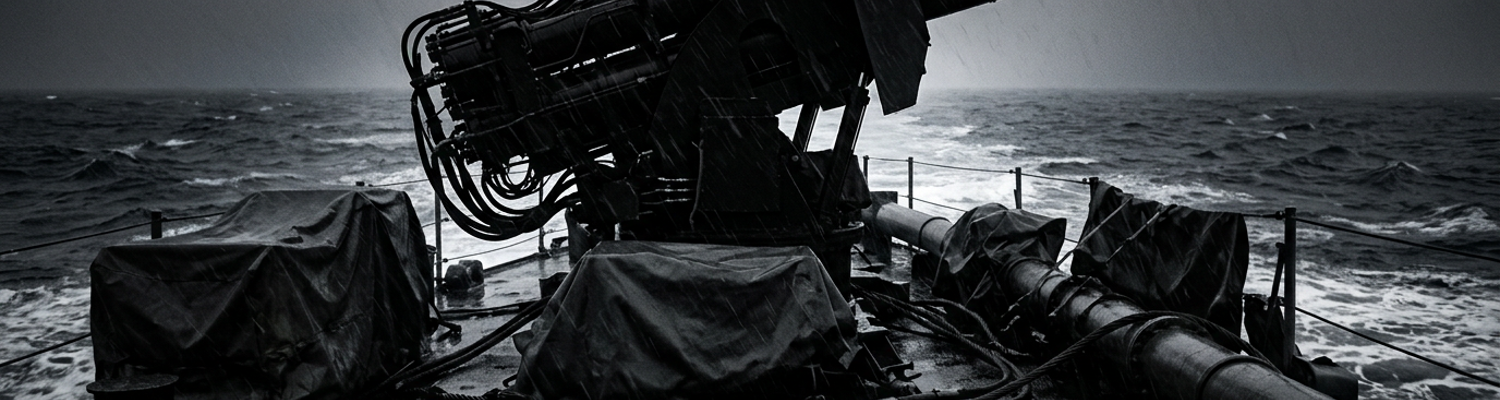
Archival evidence shows the mechanical refit of the USS Barb began at the submarine base on Midway Atoll in early July 1945. Submarine squadron engineers requisitioned a standard Mark 51 127mm rocket launcher directly from an Army ordnance depot. This specific weapon system was originally manufactured for ground-based infantry units. It was not a naval weapon. Adapting a field artillery piece for a fleet submarine required heavy structural modifications to the forward deck casing. Welders cut away sections of the standard teak decking exactly twenty feet forward of the conning tower. They fused a heavy steel baseplate directly to the submarine superstructure. This distributed the violent recoil and exhaust backblast of the solid-propellant motors. The deck gang constructed a custom blast deflector shield out of half-inch steel plating. This prevented the rocket exhaust from burning through the wooden deck planks. The 127mm unguided spin-stabilized rockets measured five inches in diameter. They weighed 130 pounds each. Submarine mechanics bolted the Mark 51 launcher frame onto the new baseplate using hardened steel mounting studs and heavy-duty locking nuts.
The installation required boring directly through the outer structural casing of the forward deck.
A close review of operational logs indicates the primary engineering hurdle involved protecting the electrical firing circuits from the crushing pressure of deep ocean dives. Ground-based launchers possessed absolutely no factory waterproofing. The Mark 51 frame and its internal electronic components were never engineered to survive saltwater submersion. The external frame could not easily withstand the severe hydrodynamic drag of underwater transit. Water rushing over the bow created massive fluid resistance against the vertical rails. Shipyard workers fabricated specialized waterproof rigging. Electricians coated every exposed wire terminal and contact point in thick layers of heavy cosmoline grease. They wrapped the primary electrical connections in heavy vulcanized rubber tape. They sealed the exterior joints with marine-grade epoxy. The firing circuit required a direct electrical line running from the external launcher down into the internal control room. Mechanics drilled a small penetration hole through the solid high-tensile steel of the main pressure hull. They packed the penetration gland with heavy rubber gaskets. They tightly torqued brass compression fittings to create a completely watertight seal against ambient ocean pressure.
A ruptured pressure hull seal would instantly blast seawater into the forward battery compartment.
When examining the historical record of the July patrols, the structural mounting proved highly resilient against the physical stresses of the Sea of Okhotsk. Heavy steel brackets held the launcher rail perfectly rigid. Unfired rockets could not be stored outside. Torpedomen kept the wooden crates of five-inch rockets deep inside the forward torpedo room. During surface attacks, deck crews manually hauled the 130-pound projectiles up the narrow forward torpedo loading hatch in complete darkness. It was exhausting labor. Men wearing heavy foul-weather gear carried the munitions across the wet deck. They slid the mounting lugs onto the modified Mark 51 guide rails. Gunners locked the manual elevation cranks into place using heavy steel pins. The waterproof rigging worked. Direct current from the submarine batteries flowed through the 12-volt system to the rocket ignition primers without a single short circuit. The firing sequence initiated an instantaneous solid-propellant burn reaching temperatures of 4,000 degrees Fahrenheit.
Improvised Periscope Reticles and Radar Rewiring
A close review of operational logs indicates the immediate hours following the rocket strikes were consumed by frantic data collection deep inside the submerged control room. Fire control technicians huddled beneath dim red battle lamps. They sweated profusely while disassembling the main display unit of the SJ surface search radar. Standard naval doctrine dictated that this microwave radar system exist solely to detect enemy shipping profiles at ranges up to eight miles. The equipment possessed absolutely no factory settings for computing indirect ballistic arcs against stationary land masses. Stripping the heavy steel casing off the receiver cabinet, the radar operators manually rewired the internal synchro-transmitters. They fed raw ranging data directly to a makeshift plotting board. They bypassed the primary Torpedo Data Computer entirely. The TDC was mechanically programmed to solve moving-target intercepts for steam torpedoes running at zero elevation. It could not process the 45-degree launch angle of a 127mm rocket. Technicians spliced standard copper communication wire into the Plan Position Indicator circuit. They tapped the raw telemetry returns bouncing off the steep Karafuto coastline. They rerouted the high-voltage power supply to stabilize the display against the heavy electrical draw of the forward battery compartment.
This field modification routed shore elevation echoes directly into the hands of the plotting party.
Archival evidence shows the crew had to invent an entirely new mathematical framework for naval rocket bombardment. The radar operators stared at the glowing green A-scope. They isolated the specific waveform spikes representing the Japanese coastal rail yards at Shikuka. They manually calculated the time-delay of the microwave pulses returning from the shoreline. They translated those microsecond intervals into precise yardage. Plotting officers then applied newly drafted ballistic tables to this raw distance data. They determined the exact moment the submarine needed to fire its unguided munitions while drifting on the surface. A single miscalculation in the rewired telemetry loop would drop the entire rocket salvo harmlessly into the Sea of Okhotsk. Chief electricians recorded the exact resistance values of the spliced wires onto damp graph paper.
The radar modifications solved the nighttime targeting problem.
Daylight attacks demanded a completely different mechanical solution from the navigation party. When examining the historical record of the Karafuto coastline operations, standard visual targeting equipment proved entirely useless against land-based architecture. The primary attack periscope housed a complex internal stadimeter designed to calculate range by measuring the angle between a target ship waterline and its masthead. Submariners relied on standardized Japanese naval mast heights published in recognition manuals. Warehouses and coastal defense batteries possessed no standardized heights. Quartermasters dismantled the lower eyepiece assembly of the Type 4 attack periscope directly on the control room deck. They removed the primary optical prism. Using hardened steel scribers and precision calipers, the men physically etched improvised reticle lines directly into the expensive optical glass. The quartermasters worked in absolute silence.
These custom hash marks corresponded to specific mil-radian measurements.
Navigation officers calibrated the newly scratched reticles against known geographic elevations mapped along the Karafuto shoreline. By matching a specific mountain peak to the improvised horizontal lines in the periscope viewfinder, the approach officer could instantly gauge the distance to the beach. The process required intense physical precision. A scratch placed a fraction of a millimeter too high on the glass would throw off the visual range calculation by hundreds of yards. The quartermasters wiped away the microscopic glass dust using soft lens cloths. They reassembled the brass housing. They sealed the eyepiece with heavy vacuum grease to prevent internal fogging. They logged the exact millimeter spacing of the new reticles in the engineering ledger. The periscope optics now permanently carried the crude targeting grid.
Post Strike Telemetry and Ballistic Calculations
A close review of operational logs indicates the immediate hours following the rocket launch were spent in total acoustic isolation at a depth of 150 feet. Gunnery officers and yeomen huddled over the small wardroom table. The men frantically recorded raw fire-control data into the official ship ledger. They documented the exact azimuths and the specific voltage drops across the 12-volt firing circuit. Sweat dripped continuously from their foreheads onto the heavy paper stock. The ambient temperature inside the compartment exceeded 115 degrees Fahrenheit. The 5-inch rocket motors were highly sensitive to the ambient humidity of the sea air prior to ignition. The chief fire controlman logged the exact atmospheric pressure and surface temperature at the moment of launch. Every misfire was sequentially numbered. The crew cross-referenced the physical condition of the firing wires with the exact lot numbers stamped onto the wooden munition crates.
The unguided projectiles possessed absolutely no internal telemetry systems to broadcast their flight paths back to the submarine.
Archival evidence shows the plotting party had to mathematically reverse-engineer the entire bombardment using only stopwatch timings and visual radar flashes. Executive officers spread heavy canvas nautical charts across the navigation table. They mapped the precise geographical coordinates of the Kaiyo Island coastal defense batteries. Using Keuffel and Esser slide rules, the men calculated the exact dispersion patterns of the 127mm rockets. The 130-pound warheads were subject to severe crosswinds blowing off the Karafuto landmass. A twenty-knot gust at an altitude of five hundred feet would push a spin-stabilized rocket hundreds of yards off its intended flight vector. The officers calculated the terminal velocity of the falling munitions to determine the exact angle of descent. They drafted specific impact vectors against the target installations based on the fragmentation characteristics of the high-explosive payloads. A steep impact vector would drive the blast energy directly down into the mud. A shallow angle would cast a wide net of lethal shrapnel across the above-ground barracks.
The officers drew overlapping blast radiuses over the Japanese oil storage tanks.
When examining the historical record of this specific patrol, the raw fire-control data required immediate documentation before the crew lost the exact sequence of events to physical exhaustion. Men operating on less than four hours of sleep over a three-day period forced themselves to cross-reference the radar ranges against the optical periscope bearings. The primary gyrocompass heading at the exact millisecond of the launch was factored against the known tidal drift of the Sea of Okhotsk. The local current pushed the 1,500-ton submarine laterally across the firing line at a rate of two knots during the attack. Plotting officers mathematically subtracted this drift from the final flight path of the rockets. The plotting officers identified a specific structural flaw in the Mark 51 launcher rails caused by the rapid rate of fire. The heavy steel baseplate had warped fractionally under the 4,000-degree exhaust backblast.
This deformation altered the elevation angle of the final four rockets by exactly two degrees.
A two-degree elevation shift translated to a 400-yard overshoot at maximum range.
Junior officers recorded this mechanical deviation in the engineering ledger using waterproof black ink. They adjusted the standard ballistic tables. They drafted a new set of elevation cross-hairs for the next surface attack to compensate for the warped steel. The men calculated exactly how many pounds of thrust were lost to the cold air of the northern latitudes. The damp logbooks were sealed inside canvas satchels. The air conditioning compressors remained completely secured to maintain silent running protocols.
Mapping Japanese Coastal Artillery Networks
Archival evidence shows the immediate response from the Karafuto Fortress Garrison provided unexpected tactical intelligence for the fleeing American submarine. Before Commander Eugene Fluckey ordered the crash dive, bridge lookouts manned the Mark 4 Target Bearing Transmitters on the open shears. The unguided 127mm rockets had detonated across the coastal rail yards at Shikuka. Seconds later, retaliatory muzzle flashes erupted from the darkened hillsides. The Japanese defenders fired blindly into the black swells of the Sea of Okhotsk. Gun crews on the beach operated Type 3 120mm coastal defense guns and heavy 75mm anti-aircraft batteries. Bright yellow propellant flashes briefly illuminated the concrete emplacements against the dense pine forests. Quartermasters on the bridge depressed the firing keys on their heavy naval binoculars. They sent raw electrical bearing data directly down the wiring conduits to the control room plotting party. They shouted relative bearings down the open conning tower hatch over the deafening roar of incoming artillery shells splashing into the ocean surface. The submarine deck tilted forward at a steep ten-degree down angle as the main vents opened to flood the external ballast tanks. The bridge crew rode the submarine down to the last possible second. They secured the heavy steel upper hatch just as the frigid ocean swept over the cigarette deck.
The violent evasive maneuver trapped a wealth of fresh targeting data inside the submerged pressure hull.
A close review of operational logs indicates the navigation party immediately began converting those hastily shouted bearings into fixed geographical coordinates. The submarine leveled off at a depth of 150 feet. Inside the stifling 115-degree control room, Executive Officer Everett H. Stein spread a damp United States Navy Hydrographic Office chart across the main plotting table. He wiped sweat from his face using a grease-stained rag. Yeomen read back the exact gyrocompass headings recorded during the brief surface engagement. Stein utilized heavy brass parallel rulers and a set of steel drafting compasses to draw intersecting lines of position radiating outward from the estimated firing point. By triangulating the visual bearings of the Japanese muzzle flashes against the fixed radar returns of a prominent 400-foot coastal cliff, the plotting party isolated the exact locations of the enemy artillery. They identified three distinct battery emplacements arranged in a crescent formation guarding the northern approach to the Shikuka anchorage.
The mathematical triangulation bypassed the physical Japanese camouflage netting entirely.
When examining the historical record of this patrol, the exact latitude and longitude of these newly discovered shore installations were permanently logged for higher-level analysis. Navigators recorded the primary battery position at exactly 49 degrees 13 minutes North, 144 degrees 03 minutes East. They noted the secondary anti-aircraft emplacements sitting two hundred yards further inland at an elevation of fifty feet above sea level. The communications officer manually encrypted this specific coordinate data using the ECM Mark II cipher machine. He aligned the internal rotor wiring to the daily setting. This translated the geographical coordinates into a block of scrambled text. Radiomen prepared a high-priority message for transmission to Submarine Force Pacific Fleet headquarters at Pearl Harbor. Fleet intelligence officers relied entirely on these raw coordinate logs to update their classified grid maps of the Karafuto coastline for future offensive operations.
Enemy shell splashes provided the final data point for the intelligence report.
Plotting officers calculated the maximum effective range of the Japanese 120mm guns by measuring the distance between the beach and the water columns of the incoming shells observed by the lookouts. Submarine officers determined the enemy artillery was firing high-explosive fragmentation rounds set with contact fuzes. Chief petty officers transcribed this ballistic analysis directly into the official patrol report using a heavy black fountain pen. They recorded the exact time of the retaliatory fire at 0214 hours. The documentation included a hand-drawn sketch of the shoreline. The ink bled slightly into the humid paper fibers of the official ledger.
Tokyo War Crimes Tribunal Intelligence Files
A close review of operational logs indicates the data collection process did not end when the USS Barb moored alongside the submarine tender USS Proteus at Midway Atoll on August 2, 1945. Commander Eugene Fluckey and his executive officers immediately carried three canvas satchels down the gangway. These bags contained the official patrol ledgers, raw fire-control telemetry, and the improvised ballistic tables drafted during the 115-degree submerged evasion off Kaiyo Island. Naval intelligence officers assigned to the Joint Intelligence Center Pacific Ocean Areas waited on the concrete pier to take physical custody of the documents. The yeomen handed over heavy paper stock that was permanently warped by high humidity and stained with sweat, hydraulic fluid, and graphite dust. JICPOA analysts immediately transported the materials to a secure debriefing room to extract the Karafuto coastal target data. They cataloged the exact coordinates of the Shikuka rail yards at 49 degrees 13 minutes North, 144 degrees 03 minutes East. The intelligence team cross-referenced the hand-drawn radar plotting sheets against classified aerial reconnaissance photographs of the Shiritoru lumber mills and Kashiho manufacturing plants.
The damp pages smelled heavily of diesel fuel and ozone.
Archival evidence shows the intelligence officers spent forty-eight consecutive hours analyzing the mechanical failures documented in the rocket bombardment logs. The JICPOA analysts recorded the specific structural deformation of the Mark 51 launcher rails into official Pacific Fleet engineering reports. They noted how the 4,000-degree exhaust backblast warped the steel baseplate. This altered the final flight arcs by exactly two degrees. The officers transcribed the 400-yard overshoot at maximum range into a new set of standardized naval bombardment tables. This data provided the Pacific Fleet with the first mathematically verified dispersion patterns for 127mm spin-stabilized rockets fired from a floating platform against fixed shore installations. The intelligence officers mapped the exact blind spots in the Japanese Type 3 120mm coastal defense batteries identified by the navigation party. Draftsmen at Midway used the newly etched periscope reticle measurements. They updated the topographical elevations on all Pacific Fleet nautical charts of the Sea of Okhotsk.
The raw fire-control ledgers were classified top secret and locked inside a steel vault.
When examining the historical record of the post-war period, these specific patrol documents resurfaced in a completely different operational theater. In late 1946, attorneys working for the International Prosecution Section at the International Military Tribunal for the Far East requisitioned the original fire-control logs from naval archives. Prosecutors in Tokyo needed highly accurate chronological data. They sought to dismantle the defense narratives of Japanese Fifth Area Army commanders. The Imperial Japanese Army garrison on Karafuto claimed their coastal rail networks and industrial manufacturing centers were strictly civilian infrastructure. The International Prosecution Section entered the raw telemetry into the official court record at the Ichigaya war ministry building. The American attorneys used the precise radar ranging data and visual bearings collected off Kaiyo Island. They proved the existence of heavily armed military emplacements hidden within the civilian rail yards. The logs detailed the exact time of the Japanese retaliatory fire at 0214 hours.
Court stenographers typed the 12-volt firing circuit voltage drops directly into the trial transcripts.
The physical evidence files contained the hand-drawn sketches of the shoreline and the specific atmospheric pressure readings taken inside the stifling control room. Prosecutors cross-referenced the exact millisecond launch timings against the captured Japanese garrison communications logs. The mathematical triangulation of the three distinct battery emplacements arranged in a crescent formation provided irrefutable proof of a coordinated military defense network. The tribunal judges examined the waterproof black ink entries. These pages detailed the high-explosive fragmentation rounds fired by the Japanese defenders. The precise yardage calculations derived from the rewired SJ surface search radar dismantled the testimony of Japanese officers. The garrison commanders previously denied placing anti-aircraft batteries two hundred yards inland from the Shikuka anchorage. The prosecution entered the specific slide-rule calculations of the rocket dispersion patterns as Exhibit 412. The trial exhibits retained the faint red pencil marks of the plotting party.
Postwar Doctrine and Littoral Submarine Warfare
Archival evidence shows the raw framework for postwar littoral submarine warfare was drafted on sweat-soaked paper in the immediate hours following the Kaiyo Island bombardment. Commander Eugene Fluckey and his executive officers sat in the stifling 115-degree control room. The submarine sat entirely blind beneath the thermal layer. Operating under strict silent running protocols, the men frantically documented the exact tactical parameters of the shallow-water strike while Japanese depth charges detonated miles away. The USS Barb had successfully executed a surface attack in a restricted coastal shelf measuring less than ten fathoms deep. Standard naval doctrine previously classified such shallow littoral zones as entirely unnavigable for 1,500-ton fleet submarines. The success of these improvised rocket strikes explicitly proved that submarines could project offensive power directly onto enemy shores without relying on heavy surface fleets. The plotting party recorded the specific acoustic conditions of the coastal mudflats. They noted exactly how the shallow bottom topography distorted the sonar returns of searching Japanese patrol craft. Officers logged the precise time required to maneuver the submarine through the treacherous offshore shoals, fire the unguided rockets, and execute a crash dive before enemy coastal batteries could return fire. Yeomen transcribed the specific tidal drift rates and cross-currents of the Sea of Okhotsk directly into the official patrol ledger using heavy black fountain pens.
The crew mapped the exact bottom contours of the Karafuto coastline to establish safe evasion routes for future shallow-water operations.
A close review of operational logs indicates the mechanical failures observed during the rocket launch directly informed the early development of dedicated guided missile submarines. Fire control technicians huddled beneath dim red battle lanterns to analyze the physical degradation of the modified Mark 51 launcher. The 4,000-degree solid-propellant exhaust had severely warped the half-inch steel deflector shield bolted to the forward deck casing. The steel was permanently deformed. Mechanics documented the extreme vulnerability of the external 12-volt firing circuit to saltwater intrusion. The heavy layers of cosmoline grease were rapidly degrading under the hydrodynamic friction of submerged transit. The men wrote specific engineering recommendations into their damp notebooks. They detailed the absolute necessity for integrated, environmentally sealed weapon housings capable of withstanding ambient ocean pressure at test depths of 300 feet. Plotting officers mathematically calculated the severe dispersion patterns caused by coastal crosswinds acting upon the spin-stabilized 127mm rockets. They explicitly outlined the requirement for internal gyroscopic guidance systems in future submarine-launched projectiles to correct mid-flight aerodynamic deviations.
Quartermasters recorded the exact millisecond delays in the electrical firing primers.
When examining the historical record, the specific telemetry data collected during these July patrols formed the baseline engineering metrics for the Navy postwar Regulus missile program. The yeomen logged the precise duration between the submarine breaking the surface, deck crews manually hauling the 130-pound rockets up the narrow forward hatch, and the radar operators achieving a firing solution. The physical loading process was dangerously slow. This exact surface-exposure time became the primary survival metric for engineers designing the USS Tunny and other early SSG guided missile submarines in the late 1940s. The crew recorded the massive structural stress exerted on the forward teak decking by the violent recoil of the rocket motors. Submarine Bureau draftsmen later used these exact stress calculations to design heavily reinforced missile hangars capable of housing large-scale aerodynamic cruise missiles on the upper decks. Chief electricians drafted a highly detailed schematic of the makeshift penetration gland they had drilled through the high-tensile steel pressure hull. The drawing specified the exact torque applied to the brass compression fittings holding back the ocean pressure.