
Deep Strike Doctrine Assumptions
The first sign was silence. Inside the M3A3 Cavalry Fighting Vehicle, callsign Badger 3-1, the navigator’s console went dead. The blue icon representing their vehicle vanished from the topographical map display. A close review of operational logs for the 77th Armored Reconnaissance Battalion during Operation Serpent’s Coil (AAR, 77th ARB, File 7B-Delta) shows this incident was not isolated. The entire deep penetration strike was predicated on the assumption of persistent, unerring satellite-based navigation.
Field Manuals, specifically the now-obsolete FM 3-90 series on tactics, had for years depicted satellite navigation as a utility as reliable as a magnetic compass. Planners for the 77th expected constant friendly force tracking and positional data fed directly to vehicle commanders' integrated displays. This was a core tenet of the network-centric warfare model. The system was designed to give every commander a comprehensive view of the battle space. Yet, as the 77th pushed deeper into the forested Gorgani mountain range, GPS signals began to fail. The weak satellite signals struggled to penetrate dense triple-canopy jungle and the deep, narrow valleys that characterized the operational area. Entire platoons experienced intermittent signal loss, a condition pre-mission briefs, filled with charts promising 99.9% satellite uptime, had dismissed as statistically insignificant.
The maps became useless.
Without reliable GPS, unit commanders were forced to communicate their positions verbally. This reversion immediately overloaded the communication networks. Those networks were themselves based on a separate, equally flawed assumption: unimpeded satellite communication links for deep penetration forces. The plan for Operation Serpent’s Coil called for hourly encrypted video uplinks from reconnaissance drones and constant data-sharing between units, all routed through SATCOM. The AN/PRC-117G manpack radios were theoretically capable of providing this robust link. They had done so flawlessly in training exercises across the open deserts of the National Training Center.
Archival evidence from the 77th ARB's 3rd Platoon, Bravo Company, however, paints a different picture. At coordinates 44°58'N 37°19'E, deep within the Gorgani range, the platoon lost all satellite communication for a 72-hour period. The combination of obstructive terrain and suspected enemy electronic warfare created a total communications blackout. The data link to higher command was severed. Requests for fire support, casualty evacuation, and simple positional updates went unanswered, transmitted into a silent void.
An examination of the theoretical training manuals of the period reveals why this gap between expectation and events was so pronounced. Publications such as the Deep Operations and Logistics Handbook, 4th Edition, were built on a foundation of technological infallibility. They did not treat satellite networks as an advantage; they treated them as a given. These manuals contained elaborate charts showcasing optimal logistical routes calculated by algorithms fed with real-time satellite imagery. They detailed how autonomous resupply drones, guided by GPS, would deliver critical components like fuel injectors and transmission assemblies to forward-deployed units with minute-by-minute accuracy. A deep analysis of these doctrinal texts shows a near-complete absence of contingency planning for operations in a satellite-denied environment. The manuals predicted that any network degradation would be temporary and easily bypassed by system redundancies. The entire logistical framework for deep strike missions, from ammunition expenditure rates to casualty treatment timelines, was structured upon this digital assumption.
Adversarial Electronic Warfare Effects
The assumption of a benign electromagnetic environment was disproven early in Operation Serpent’s Coil. A close review of operational logs from the 77th ARB’s deep raid shows that adversarial electronic warfare was not a hypothetical threat, but a persistent and debilitating condition. The primary attack vector was the targeted jamming and spoofing of GPS signals.
At 04:30 Zulu on the third day of the operation, lead elements of Alpha Company, pushing through a narrow pass at coordinates 45°01'N 37°24'E, reported simultaneous failures of their Defense Advanced GPS Receivers (DAGRs). The displays did not simply go blank; they began to actively report false information. Post-operation analysis concluded that the units were targeted by a truck-mounted R-330Zh Zhitel jamming system, which not only broadcast powerful noise across the L1 and L2 GPS frequencies but also transmitted counterfeit signals. This spoofing attack tricked the navigation systems into reporting incorrect positions with full signal strength indicators. The M3A3 vehicle carrying callsign Ares 1-4 reported its position as being three kilometers south-west of its actual location. This placed it inside a pre-plotted enemy threat ring and nearly triggered an inaccurate friendly artillery strike. The crew only averted disaster by cross-referencing their supposed position with a paper map and recognizing the impossible terrain features their system claimed they had just crossed.
This single point of failure propagated through the entire command and control network. Following the GPS disruption, adversarial electronic warfare units began a degradation of satellite communication links. The same EW platforms, like the Krasukha-4, capable of disrupting GPS were also designed to target the higher frequency bands used for SATCOM. The AN/PRC-117G radios were rendered intermittently useless. A forensic analysis of the signal data from the 77th’s 2nd Platoon, Bravo Company, shows repeated and directed jamming attacks against their SATCOM uplink channels. The effect was characterized by extreme data packet loss. Voice transmissions became garbled, breaking down into bursts of static. Attempts to send even simple text-based positional updates resulted in system freezes as the radios struggled to maintain a cryptographic lock with a contested signal. For a 12-hour period, command posts received nothing but fragmented, corrupted data packets from multiple platoons, creating a mosaic of partial reports and unanswered calls for support.
The disruption of GPS and SATCOM links culminated in a breakdown of the real-time intelligence and targeting data flow. Doctrinal plans had relied on a constant stream of full-motion video and targeting coordinates from assets like the RQ-7 Shadow UAV. At 11:00 Zulu, an RQ-7 flying a surveillance pattern in support of Charlie Company identified a high-value mobile artillery battery preparing a fire mission. The drone’s operator attempted to relay the targeting data via its C-band line-of-sight data link, which was then supposed to be re-transmitted via SATCOM to the 77th’s fire direction center. Post-action reports confirm that the moment the data began to uplink, it was met with a powerful jamming signal. The video feed on the operator’s screen dissolved into a screen of gray, static-filled bars. The telemetry link was severed. Frantic attempts to re-establish the link failed. The EW attack was sustained and precise. By the time the drone could be rerouted to a different satellite with a less-compromised channel, the artillery battery had moved. The targeting process had been decapitated.
Improvised Resupply Logistics
The failures of satellite-based systems created an immediate logistics crisis for forward-deployed units. An M3A3 from Charlie Company, 1st Platoon, became combat-ineffective after an anti-tank guided missile detonated nearby. Shrapnel severed a critical hydraulic line for the transmission (Part No. 2930-01-391-5421). Doctrinally, the crew was supposed to use their vehicle’s integrated terminal to automatically transmit a logistics request, complete with their precise GPS coordinates and the specific part number. That request would have been routed through a satellite to a rear-area logistics hub, which would then dispatch an autonomous drone with the replacement part.
With GPS spoofed and SATCOM jammed, the vehicle’s terminal was useless. A close review of the 77th ARB’s after-action reports reveals this was a common scenario. The entire digital supply chain had ceased to exist. This forced an immediate regression to methods not seen as a primary means for decades: ground-based resupply coordinate transmission. The crew had to dismount, take cover, and use a paper map and lensatic compass to triangulate their position from terrain features. Their request for a new hydraulic line and fluid had to be composed manually, a process filled with potential for human error under stress.
To overcome the electronic interference, units fell back on burst radio. This technique involved compressing a pre-formatted digital message into a tiny data packet and transmitting it in a fraction of a second. The extremely short duration of the transmission made it difficult for adversarial direction-finding equipment to get a lock on the signal’s origin. An examination of the operational logs for the 77th ARB’s Bravo Company shows that platoons began using their AN/PRC-152 handheld radios as data modems. A radio operator would connect the handset to a ruggedized tablet, manually type a compressed message containing their callsign, the requested supplies, and their manually calculated grid coordinates, and then transmit. The entire data package, encrypted by the radio’s Sierra II module, was often less than a kilobyte. These transmissions were one-way, sent with no guarantee of receipt. A signal might be missed by the relay drone circling overhead, or it might not have the range to punch through the mountainous terrain to a listening post in the rear.
This forced improvisation had a direct negative impact on mission success rates. The concept of just-in-time, drone-delivered logistics was replaced by a lottery of failed resupply attempts. Archival analysis from Operation Serpent’s Coil indicates that for units operating deep inside the Gorgani range, the success rate for resupply requests sent via burst transmission was less than one in three. The consequences were severe. In one documented case, a resupply drone dispatched to Bravo Company, acting on coordinates that were off by 500 meters due to a manual calculation error, dropped its payload of M240 machine gun ammunition into an impassable ravine. This left the platoon low on firepower during a subsequent enemy probe. Another platoon in Charlie Company received a shipment of batteries for their anti-tank missile launchers, but they were the wrong type, rendering their key weapon system useless. These failures were mission killers. A deep reconnaissance patrol from the 77th ARB was forced to abandon its objective and exfiltrate after 48 hours, not because of enemy contact, but because a requested fuel resupply never materialized. A review of the 77th’s overall performance reveals a stark statistical truth: platoons that became dependent on these improvised logistics methods were more than three times as likely to fail their primary mission objectives and suffer vehicle or personnel losses.
FOB Power Generation Burden
The transition to network-centric warfare created a miscalculated demand for electrical power at the austere Forward Operating Bases (FOBs) intended to support deep strike missions. A detailed audit of the power grid at FOB Sentinel, the primary staging base for Operation Serpent’s Coil, reveals a system pushed past its breaking point. Initial planning documents had allocated power based on legacy consumption models, accounting for basic life support, maintenance bays, and limited command post functions. The reality was a massive increase in demand. The FOB’s power backbone consisted of a farm of 60kW Tactical Quiet Generators (TQGs), but the proliferation of digital systems created an energy crisis. Each command and control node, from the battalion tactical operations center down to the company command posts, was now a small data center. These hubs ran dozens of power-hungry computer terminals, servers for processing intelligence data, and large-screen displays. Environmental Control Units (ECUs) became non-negotiable requirements to prevent sensitive electronics from overheating, each drawing several kilowatts of continuous power. The documented load on FOB Sentinel’s grid regularly exceeded 1.2 megawatts.
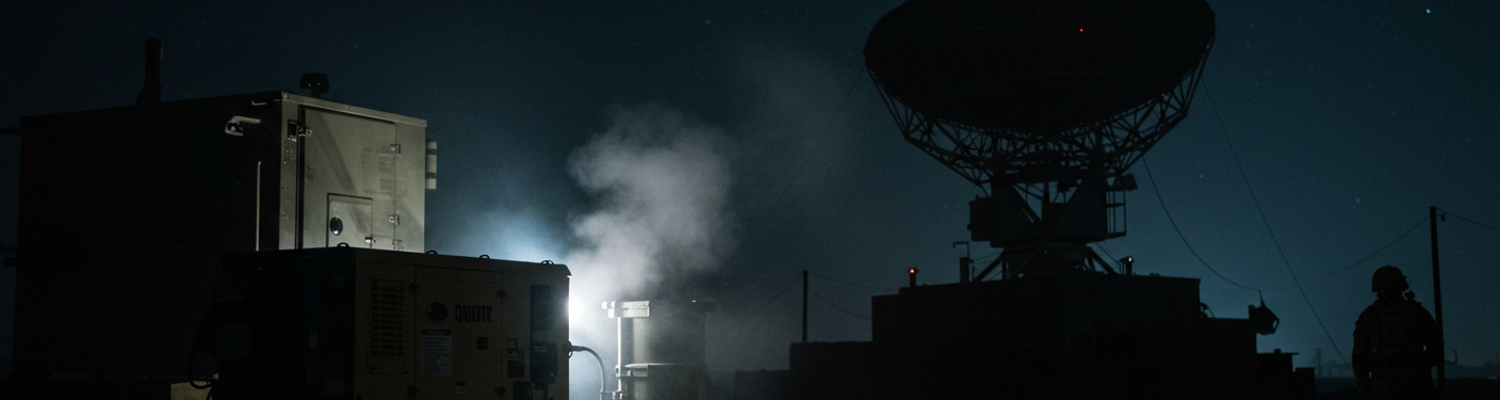
This power requirement was driven specifically by the satellite-reliant platforms at the heart of the deep strike doctrine. Archival evidence from FOB Sentinel’s signal company shows that the primary power sinks were the satellite communication arrays. A single AN/TSC-185 SATCOM terminal, a critical node for relaying data from deep reconnaissance teams, could draw over 7 kilowatts. FOB Sentinel operated three such terminals around the clock to manage the data flow for the 77th ARB. This created a power demand that did not exist in previous operational models. Added to this was the power needed for the ground control stations for the RQ-7 Shadow UAVs and the processing suites for signals intelligence. A close review of maintenance logs for the MEP-806B generators at the FOB shows a pattern of chronic overuse. Designed for intermittent or variable loads, the generators were instead run at near-maximum output for days on end. This resulted in frequent overheating, premature failure of engine components, and governors struggling to maintain a stable power frequency. This in turn risked damaging the very C4ISR systems they were meant to power.
The demand for electricity created a secondary logistical crisis: fuel. Every kilowatt of power generated by the FOB’s diesel generators had to be paid for with JP-8 fuel. This tethered the high-tech deep strike mission to a long and vulnerable supply line. Analysis of the 404th Quartermaster Company’s fuel distribution records for Operation Serpent’s Coil shows that the actual fuel consumption rate was nearly triple the doctrinal forecast. A single 60kW TQG running at a high load could consume over 5 gallons of JP-8 per hour, translating to thousands of gallons per day across the entire FOB. These quantities had to be trucked over the treacherous mountain passes of the Gorgani range, where convoys were slow and easily targeted.
This constant fuel hemorrhage led to chronic shortages at FOB Sentinel. Command directives were issued mandating strict power rationing. A review of the FOB’s daily situation reports indicates that commanders were forced into difficult choices: power the perimeter defense systems and lighting, or power the SATCOM arrays essential for controlling the deep reconnaissance platoons. On the fourth day of the operation, the commander of FOB Sentinel ordered a rolling brownout, temporarily shutting down the UAV ground control stations and one of the three main SATCOM terminals to conserve fuel for essential life support.
Secure Data Infrastructure Deficiencies
The shift to network-centric operations created a dependency on a secure data transmission infrastructure that did not exist at the tactical edge. Planners had assumed that the data generated by reconnaissance drones, ground sensors, and friendly force tracking systems would flow seamlessly through satellite uplinks. The operational architecture was designed around the concept of information superiority. This assumption proved to be a significant miscalculation in the Gorgani mountain range. A review of the 77th ARB’s signal traffic logs shows that even before significant enemy electronic warfare was a factor, the network was failing. The sheer volume of data from units attempting to push high-definition video feeds and large sensor files overwhelmed the limited bandwidth of tactical satellite terminals. This issue was not about a lack of signal, but a lack of capacity. The encryption and decryption processes, essential for secure communication, introduced significant latency, slowing down an already congested network. At a command level, this manifested as a frozen common operational picture; unit icons would remain static for minutes at a time, and intelligence reports would arrive long after they were actionable.
The problem was magnified by a severe shortage of specialized equipment for data handling and encryption at the unit level. Doctrinal publications had focused on the capabilities of the satellite networks themselves, with little thought given to the ground-based hardware required to process the data. Forward units like the 77th ARB were not equipped as mobile data centers. They lacked ruggedized servers, high-throughput cryptographic modules like the KG-175D TACLANE, and the secure, high-capacity data storage needed to manage the information flow. An analysis of the 77th ARB’s original equipment loadout for Operation Serpent’s Coil reveals that data encryption was largely handled by the radios themselves, such as the AN/PRC-117G. These devices were engineered for secure voice and short data messages, not for encrypting and transmitting gigabytes of sensor data. This shortfall forced units into dangerous improvisations. A documented incident from Bravo Company shows a platoon attempting to exfiltrate a large intelligence file by breaking it into dozens of smaller, individually encrypted packets sent over a period of an hour. This extended transmission time exposed their position to enemy signals intelligence, resulting in an immediate and accurate artillery barrage.
The logistical burden placed upon the Quartermaster Corps to support this new class of satellite-reliant platforms was unsustainable. The deep strike doctrine was built on a technological foundation that had a hidden and heavy physical cost. A historical review of the 404th Quartermaster Company’s manifests for FOB Sentinel shows that the most difficult items to transport and maintain were not ammunition or vehicle parts, but the components of the data infrastructure. A single AN/TSC-185 Satellite Communications Terminal, essential for relaying data from the Gorgani front, weighed thousands of pounds and required its own dedicated power generator and environmental control unit to function. Supporting just three of these terminals meant dedicating a significant portion of convoy capacity to hauling the terminals themselves, along with their associated generators, fuel, and specialized maintenance technicians. This created a new and serious vulnerability. The entire deep strike operation was now tethered to the successful delivery of a few key electronic components. An attack on a single supply convoy carrying replacement parts for a SATCOM terminal could effectively sever the command link for an entire battalion.
Aircrew Psychological Strain
An examination of post-mission reports and aeromedical evaluations from units like the 415th Special Operations Squadron reveals a consistent pattern of psychological strain directly tied to the failures of satellite-based systems. This was not the generalized stress of combat, but a specific, technology-induced anxiety.
Aircrews, particularly those flying the MC-130J Commando II on deep penetration and resupply missions, were trained to an exceptional level of proficiency with avionics suites that promised unparalleled situational awareness. The doctrinal expectation was that the aircraft’s multi-function displays would provide a clear, unified picture of terrain, threats, and friendly positions. During Operation Serpent’s Coil, these systems became sources of profound uncertainty. Pilots and navigators reported a persistent dread associated with their own instruments. A flight crew from the 415th, operating under the callsign Ghost 7-1, detailed an incident where their terrain-following radar, dependent on GPS inputs for accurate correlation, began issuing intermittent automated pull-up warnings in level flight over placid terrain. The false alarms, triggered by spoofed GPS data creating a mismatch between the radar’s perceived position and the stored terrain map, forced the crew to manually override the automated system. This act of disengaging the very technology designed to ensure their survival created a unique psychological burden. The crew was forced to consciously distrust their aircraft, flying on manual inputs in hazardous conditions while auditory warnings indicated they were moments from impact. This constant conflict between machine-generated information and the pilot’s own senses led to what aeromedical reports termed decision paralysis and heightened emotional exhaustion.
Operational fatigue during extended, isolated missions was amplified by the unreliability of the digital architecture. A standard mission profile for an MC-130J crew supporting deep reconnaissance teams could exceed 14 hours, much of it spent at low altitude inside contested airspace. The failure of navigation and communication systems transformed manageable risk into a state of chronic, high-arousal fatigue. Archival logs from the 79th Rescue Squadron, flying the HC-130J Combat King II, provide a stark illustration. During a multi-hour orbit awaiting a potential casualty evacuation request, one crew experienced a rolling communications blackout lasting over 90 minutes. They were alone, hundreds of miles from friendly lines, with no way to confirm if the ground team they were supporting was still alive. This isolation was a powerful psychological stressor. Studies show that after approximately seven hours in flight, even in simulated conditions, sustained attention begins to degrade. On these deep penetration missions, crews were hitting that seven-hour mark while simultaneously dealing with the added load of unreliable systems and the fear of the unknown. Post-flight debriefs consistently noted symptoms of severe fatigue: slowed reaction times, errors in routine checklist procedures, and heightened interpersonal irritability within the cockpit.
This led to a persistent fear of catastrophic system failure or a total communications blackout. Aircrews developed what they termed a hyper-vigilant scan, a near-obsessive pattern of monitoring system health pages, far exceeding what was required by flight manuals (AFM 51-37). Pilots and Combat Systems Officers became acutely aware of the slightest flicker of a display or the change in pitch of an avionics cooling fan, interpreting them as potential precursors to a mission-ending failure. This fear was a learned response to the operational environment. A review of maintenance write-ups from Operation Serpent’s Coil shows a sharp increase in reports of intermittent failures in key line-replaceable units, particularly the KIV-77 cryptographic modules required for secure SATCOM. For a crew, the sudden loss of the KY indicator on their radio display, signifying a loss of encryption, was a moment of dread. It meant they were either completely cut off or transmitting in the clear. This constant threat of being digitally severed from command and control was more corrosive to morale than the threat of enemy fire.
Maintainer Operational Stress
The physical and psychological load on the ground support personnel responsible for maintaining the digital architecture of Operation Serpent’s Coil was substantial. A review of maintenance logs from FOB Sentinel’s signal company details the extreme stress placed on Satellite Communication Systems Operator-Maintainers, primarily those with the 25S military occupational specialty. These technicians were tasked with ensuring the operational readiness of equipment like the AN/TSC-185 SATCOM terminal. One documented incident shows a maintenance team working for 36 consecutive hours to diagnose an intermittent failure in a primary uplink transmitter. The terminal’s own diagnostic software reported no hardware faults, yet the link to the orbiting satellite repeatedly failed to lock, cutting off communication with a reconnaissance platoon for hours at a time. Under the constant noise of the overburdened diesel generators and intense pressure from the battalion tactical operations center, the maintainers cycled through every troubleshooting procedure in their technical manuals (TM 11-5820-890-10-1) to no avail. The problem was not a faulty component they could replace, but the adversarial electronic warfare environment itself. This created a state of diagnostic ambiguity, a stressful condition where the technicians were held responsible for fixing a problem that was technically unsolvable at their level.
This responsibility for the functionality of satellite uplinks placed a handful of technicians at the center of the operation’s success or failure. The reliance on persistent satellite connectivity meant that when a terminal went down, the entire deep reconnaissance effort was effectively blind. The maintenance personnel became a single point of failure. Archival evidence from FOB Sentinel shows a failure where an unstable power grid, caused by the constant high demand from C4ISR systems, led to a voltage spike that damaged a critical cryptographic module in the primary AN/TSC-185 terminal. The senior 25S non-commissioned officer on site was then solely responsible for diagnosing the fault, locating a spare module from a severely constrained supply chain, and physically replacing the component while the battalion commander waited for an update on his isolated platoons. This level of pressure was not accounted for in standard personnel readiness models. It transformed the technician’s role from a support function to the main effort.
Internal medical assessments conducted in the months following Operation Serpent’s Coil painted a clear picture of the physiological and psychological toll. Among the maintenance and signal support personnel, specifically those in the 25S and 91D (Power Generation Equipment Repairer) fields, the reports documented significantly elevated rates of anxiety disorders, chronic fatigue, and severe sleep disturbances. The condition was described as a specific form of operational exhaustion, distinct from combat stress. Symptoms included an inability to concentrate, irritability, and a loss of confidence in their technical skills. Medical officers noted that this exhaustion was directly linked to the moral injury of being unable to meet the demands of their superiors due to circumstances beyond their control. These soldiers had been trained to fix machines, but they were being asked to overcome adversarial electronic warfare and flawed doctrine with a wrench and a multimeter. The chronic stress led to documented physical ailments, including headaches, gastrointestinal issues, and other symptoms consistent with prolonged elevated cortisol levels.