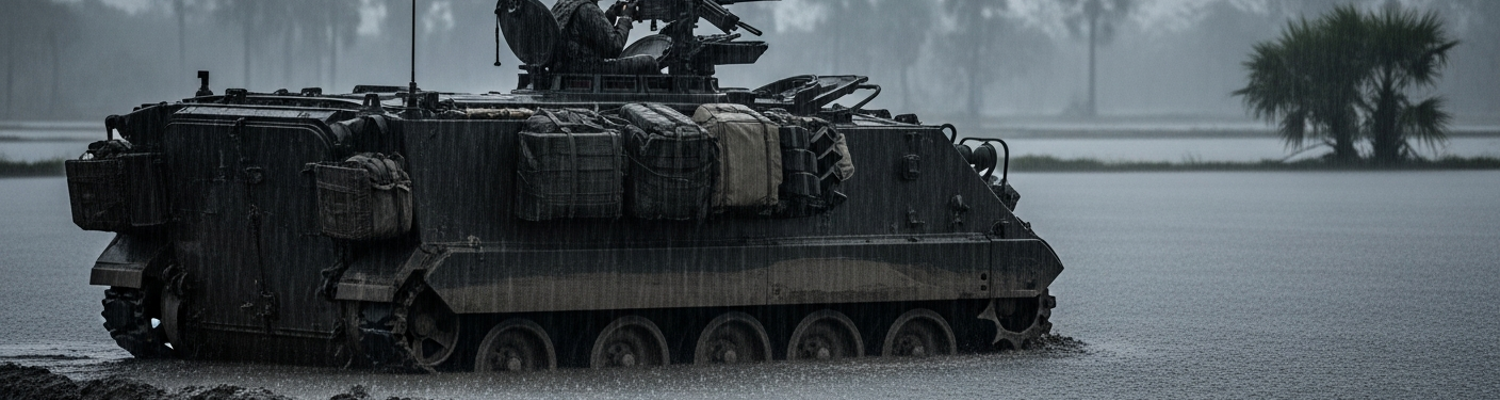

Mekong Delta Operational Environment
The field manuals were fiction. They promised mechanized dominance, a new war where armored columns would bring overwhelming firepower to bear with speed. The reality for the 9th Infantry Division in the Mekong Delta during 1968 was a world of water and mud that swallowed machines and suffocated plans. The division’s 2nd Brigade was the Army component of the Mobile Riverine Force, a joint Army-Navy concept designed to project power into the Delta’s thousands of miles of interconnected waterways. This strategy acknowledged that conventional land warfare was impossible where roads dissolved and the Viet Cong used rivers as highways. The division’s main base at Đồng Tâm, dredged from the My Tho River’s muck, was an monument to the environmental challenge.
Troops arriving for this novel riverine mission were thrust into a battle against the earth itself.
The environment was an implacable enemy.
The southwest monsoon, striking from May through October, transformed the landscape into a near-impassable swamp. Dry rice paddies became vast, shallow lakes. Placid canals swelled into churning brown torrents. The soil, a dense alluvial silt, became a glutinous paste. A review of operational logs (NARA Record Group 472) indicates this mud was a relentless threat. It clogged the cooling vents of M113 Armored Personnel Carrier engines, causing them to overheat. The abrasive material worked its way into drive sprockets and road wheel bearings, grinding them down. For the individual soldier, conditions were debilitating. Constant immersion in warm, polluted water led to severe skin diseases. Dermatological issues accounted for over half of all non-combat man-days lost during the monsoon season. In October 1968, skin diseases were responsible for 70% of medical evacuations from maneuver battalions.
The terrain nullified American technological advantages.
The 9th Division’s doctrine relied on motorized patrols using the M113 APC to project force. The M113, a 12-ton aluminum-hulled vehicle, was theoretically perfect. It was amphibious and air-transportable, offered protection from small arms, and mounted heavy machine guns. During the dry season, the vehicles moved with relative ease. The monsoon rendered this doctrine ineffective. The vehicle’s amphibious capability was negated as its low freeboard was easily swamped by the fast-moving currents. More critically, the saturated soil could not support the vehicle’s weight. M113s frequently sank to their hulls in the mud, their tracks spinning uselessly. They became static, vulnerable targets.
Viet Cong tactics were adapted to exploit these weaknesses. Patrols were forced to stick to the few dikes and canal banks that remained passable. This made their movements predictable and created ideal ambush sites. A bogged-down M113 was a magnet for rocket-propelled grenades. Recovering a single trapped vehicle was a hazardous, hours-long operation that often required another M113 or an M88 recovery vehicle to navigate the same treacherous ground, risking a chain of immobilized assets. Units like the 3rd Battalions of the 47th and 60th Infantry, operating with River Assault Squadron NINE, found their armored movements channeled and slowed. Speed and shock, the entire point of mechanized patrols, were gone. They were replaced by a slow, predictable, and highly vulnerable crawl through a landscape that fought back.
Standard Patrol Vehicle Limitations
The M113 Armored Personnel Carrier, the supposed mechanized backbone of the 9th Infantry Division, proved unsuited for the Mekong Delta’s monsoon environment. After-action reports from the 2nd Brigade detail a consistent pattern of failure. The vehicle’s advertised amphibious capabilities were a fiction in the swollen canals. Its low freeboard meant churning currents could swamp the machine. The water-saturated alluvial silt, lacking the density to support the vehicle’s weight, would suck M113s down to their hulls. This glutinous mud became an abrasive paste, packing into road wheels, grinding away at drive sprockets, and choking engine cooling vents. A thrown track, a routine annoyance on solid ground, became a mission-killing event in a flooded paddy. It required hours of perilous recovery work under constant threat.
The M113 was reduced to a slow, predictable, and easily targeted piece of static equipment.
Even less effective was the M151 Military Utility Tactical Truck. While designed with independent suspension for superior off-road agility, this quarter-ton vehicle was completely outmatched. Photographic evidence from 1969 shows M151s of the 101st Airborne Division hopelessly mired, requiring other vehicles for extrication. Its wheeled design, low ground clearance, and light frame offered none of the advantages of a tracked platform. In the monsoon season, the M151 was relegated almost exclusively to use on the few paved or hard-packed surfaces within major base camps like Đồng Tâm. For the infantry patrols of the Mobile Riverine Force, operating deep in the waterlogged countryside, the jeep was functionally useless.
Vehicle availability was crippled before patrols even began.
A review of operational logs reveals a flawed maintenance support system. The Army relied heavily on a civilian contractor, Pacific Architects and Engineers (PA&E), for facilities engineering and maintenance. By 1968, PA&E had expanded to over 24,000 workers across Vietnam. The contract stipulated that PA&E would provide labor and management, while the government was responsible for furnishing equipment, tools, and repair parts. This division of responsibility created a bureaucratic bottleneck. A 9th Infantry Division report from July 1968 highlights the non-availability of repair parts from the continental United States as the single largest problem. Vehicles needing anything beyond minor field repairs were often deadlined for weeks, waiting for components to navigate the complex supply chain from depots like Long Binh.
The tactical consequences were immediate. A unit’s forward momentum was dictated not by opportunity, but by the most treacherous patch of mud it had to cross. This slow, predictable movement along the few passable canal banks made patrols easy targets. A bogged-down M113 became an instant crisis. The mission shifted from searching for the enemy to a desperate recovery effort. This process was a massive vulnerability. It drew in other vehicles, like another M113 or a dedicated M88 recovery vehicle, which were forced to traverse the same hazardous ground. A single stuck vehicle could paralyze an entire platoon. On April 4, 1968, elements of River Assault Squadron NINE, carrying troops of the 3/47th Infantry, were ambushed while proceeding along the Song Ba Lai. The assault craft took numerous rocket hits, resulting in thirty-five wounded sailors and three killed in action, demonstrating the lethal cost of being caught in a predictable channel.
Isolated Patrol Communication Failure
A late 1968 after-action report from the 9th Infantry Division’s 1st Brigade details a near-catastrophic incident involving a reconnaissance patrol from the 2nd Battalion, 39th Infantry in Long An Province. The patrol, a standard twelve-man squad, was on a three-day reconnaissance-in-force mission west of the Vàm Cỏ Đông River. Their movement began under the typical duress of the late monsoon season. The terrain was a patchwork of flooded rice paddies, dense nipa palm groves, and elevated dikes that served as the only footpaths. The patrol carried the standard AN/PRC-25 radio, the 25-pound backpack unit that was the lifeline for every isolated infantry element.
On the second day, the situation deteriorated. A sudden, violent downpour transformed the saturated landscape. Within hours, canals overflowed, and low-lying areas were submerged under several feet of fast-moving water. This was a flash flood that erased the subtle terrain features used for navigation. The dike they were following dissolved, leaving the squad stranded on a small, shrinking hummock of ground. They were trapped on a temporary island, cut off from their planned extraction route.
The environmental crisis was compounded by a total systems failure in communications. The patrol’s primary AN/PRC-25 radio, already operating at the edge of its range, went dead. The torrential rain was a known vulnerability. While the radio transceiver itself was reasonably water-resistant, the H-189 handset was notoriously susceptible to moisture, which could short its internal components. Radio Telephone Operators routinely wrapped their handsets in plastic battery bags, but in the chaos of the flood, this precaution may have failed. The squad attempted to use the weaker AN/PRT-4/PRR-9 squad radios, but their low power was insufficient to penetrate the atmospheric interference and jungle. For the command element at the battalion fire support base, the squad simply vanished from the net.
They were an icon on a map, now silent.
Without a working radio, the patrol was severed from the American war machine. They could not report their position. They could not call for artillery fire support, which was impossible to adjust accurately without direct communication. Launching a helicopter search was suicidal in the storm’s high winds and zero visibility. A ground-based reaction force was equally infeasible; no vehicle or group of soldiers could navigate the flood. The command structure, for all its technological superiority, was rendered impotent. The isolated squad was left to its own devices, its survival dependent not on the massive support system of the U.S. Army, but on its own immediate resources.
Inter-Service Rescue Protocol Conflicts
When a 9th Infantry Division patrol made contact, the first call over the radio net was often for a medical evacuation helicopter under the Dustoff callsign. The Army’s own UH-1 Huey ambulance helicopters represented the first link in a chain of survival. Yet, in the waterlogged terrain of the 1968 monsoon, this promise frequently fractured under the weight of inter-service friction. An Army Dustoff crew, bound by operational limits, might be unable to attempt a rescue under heavy fire or in poor weather. The ground commander’s only other option was to request assets from the U.S. Air Force, specifically the Aerospace Rescue and Recovery Service (ARRS). This single decision plunged the urgent needs of an infantry squad into a bureaucratic maze of conflicting procedures and command structures.
The request went into a procedural void.
An Army company commander’s plea for an Air Force rescue helicopter initiated a complex, time-consuming journey up the Army’s battalion and brigade chain, then across service boundaries to the appropriate Air Force controlling agency, often the Direct Air Support Center (DASC). Here, the request became one of many competing priorities. A fundamental conflict in doctrine became apparent. The Army ground commander’s primary concern was the immediate extraction of his wounded. The Air Force, conversely, operated under a more deliberate set of protocols. An examination of ARRS procedures reveals a structured, checklist-driven approach. Before launching a specialized rescue asset like an HH-3E Jolly Green Giant, the Air Force often required a far more sanitized operational picture. This included mandatory fighter escort, typically A-1 Skyraiders with the Sandy callsign, to suppress ground fire, a sanitized landing zone of a specific size, and clear authentication of the isolated troops. Each requirement added another layer of coordination and another block of time.
Minutes on the radio translated to lifetimes in the mud.
The bureaucratic delays had direct tactical consequences. While staff officers at a DASC tried to deconflict airspace and assemble a rescue package, the isolated Army patrol remained pinned down. The arrival of the Air Force package was not instantaneous. The HH-3E Jolly Green Giant, though heavily armed and equipped with a rescue hoist, was a large and valuable aircraft. Launching it, along with its Sandy escorts, required time for crew briefings, fueling, and arming. Research from the era shows the chances of a successful rescue dropped precipitously within the first two hours. The process designed to ensure a low-risk rescue often took so long it negated the purpose. By the time the Jolly Green Giant and its escorts arrived, the enemy might have massed forces or overrun the patrol’s position.
Ad-Hoc Vehicle Recovery Solutions
When an M113 bogged down, standard doctrine called for an M88 recovery vehicle. In the saturated monsoon terrain, the M88, designed for firmer ground, was often just as likely to become mired itself. This left the crews of the 9th Infantry Division to engineer their own solutions. A review of operational logs reveals a common tactic: the daisy chain. This involved linking two or three M113s together with tow cables to combine their horsepower. The strain on the rescuing vehicles was immense. The Detroit Diesel 6V53 engines would scream as track commanders pushed them to their limits. The abrasive muck would work its way into the drive sprockets and road wheels of the recovery tracks. There was a high probability that a rescuing vehicle would throw a track under the torque. When brute force failed, crews turned to leverage. Soldiers would dismount into chest-deep water to shove felled palm logs or pierced steel planking (PSP) mats under the tracks of the stuck vehicle to provide traction.
Success was a matter of inches, paid for by hours of punishing physical labor.
With the primary AN/PRC-25 radio often useless, a stranded squad was electronically invisible. The first line of action fell to the Radio Telephone Operator (RTO). Field manuals offered no procedure for repairing a waterlogged H-189 handset, but RTOs developed their own. A common technique involved carefully prying open the plastic casing to expose the internal contacts and using a dry cloth to evaporate the moisture. If this failed, some attempted to bypass the handset entirely, trying to tap out Morse code by manipulating the pins in the audio connector port, a move that could destroy the entire radio. When all attempts at electronic communication failed, patrols resorted to non-standard visual signals. A green star cluster followed by a red one was a non-doctrinal, but widely understood, unit-level signal for a dire emergency.
In these circumstances, the immobilized M113 transformed from a failed transport into a static fortress. Combat experience led to a host of modifications. Troops learned to use the vehicle’s own components to enhance its defense. Heavy steel ammunition cans for the .50 caliber M2 machine gun would be emptied, filled with mud, and stacked around the commander’s cupola. Sections of chain-link fence were sometimes attached to the hull sides as makeshift standoff armor, intended to detonate a rocket round before it could penetrate the M113’s thin aluminum skin. The resourcefulness extended to basic survival. Fuel was siphoned from the tanks to create incendiary traps. Spent brass casings were strung together with tripwires to serve as audible early-warning systems. Every part of the vehicle was re-evaluated for its immediate utility in keeping the crew alive.
Reliance on Local Support
With their technology nullified by mud and water, isolated patrols of the 9th Infantry Division were forced to fall back on the most basic source of battlefield intelligence: the local population. This was not a structured Civil Affairs initiative. These engagements were born of desperation. A patrol leader, cut off by floodwaters with a useless map, had to approach villagers for simple directions through a landscape that changed daily. These interactions were fraught with peril. The language barrier was absolute, often reduced to hand signals. Every civilian was a potential Viet Cong informant. Every piece of advice could be a lure into an ambush. A request for drinking water could bring kindness or a poisoned well. Operational logs from the 2nd Brigade detail instances where patrols, seeking shelter in a village hut, found themselves surrounded after their position was reported by civilians they had just passed. The American soldiers had to place their survival in the hands of people who had every reason to distrust them.
Reliance on human intelligence became institutionalized through irregular forces.
The most effective of these were the Kit Carson Scouts. These were former Viet Cong or North Vietnamese Army soldiers who had defected and were now employed by U.S. combat units. A single scout attached to a 9th Division patrol was an intelligence-gathering asset of the highest order. His knowledge was practical and life-saving. After-action reports show that scouts were consistently credited with identifying Viet Cong booby traps, deciphering trail markings invisible to American eyes, and recognizing subtle changes in a village’s routine that signaled enemy presence. They could distinguish the sound of an approaching sampan from miles away. More important, they could speak the local dialect, allowing them to question villagers with a fluency no American could replicate. This created a complicated dependency. The scout, a former enemy, often held more tactical authority than the platoon’s own officers. A scout’s warning to avoid a certain dike, based on intuition, would be heeded over a planned route on a map. The scout’s value was measured in the number of Bouncing Betty triggers he spotted before a soldier stepped on one.
This forced reliance on local civilians and defected enemy soldiers was the clearest symptom of a complete failure of conventional American military doctrine. The 9th Infantry Division’s operational concept was built on mechanized speed, superior firepower, and secure communications. When the M113s sank, the radios went dead, and the helicopters were grounded, that system collapsed. Doctrine provided no answer for a squad leader standing in chest-deep water, miles from support. The field manual offered no procedure for interrogating a farmer about the depth of a flooded canal or for trusting a former enemy to lead the patrol through a booby-trapped mangrove forest. The entire edifice of American combined arms warfare was designed to minimize uncertainty. The monsoon reversed that equation. It stripped away the machines and forced soldiers to confront the war in its most elemental form, where survival depended entirely on human factors: intuition, trust, betrayal, and a granular understanding of the local terrain that American forces did not possess.
Inter-Service Friction Legacy
The operational failures born from inter-service friction in Vietnam scarred an entire generation of military leaders and directly triggered a significant restructuring of the U.S. military. The experiences of 1968, of Army patrols waiting for Air Force rescue packages or of Army and Navy commanders with divided authority, became a driving force behind major post-war reforms. These were not abstract policy debates; they were fueled by the memory of specific failures. The disjointed command and control structure that plagued joint operations was a recurring theme in after-action reviews. The lessons learned in the Delta’s mud eventually culminated, nearly two decades later, in the Goldwater-Nichols Department of Defense Reorganization Act of 1986. This legislation was a direct response to the operational paralysis witnessed in Vietnam and later debacles like the failed Iran hostage rescue mission. It sought to remove the sources of friction, strengthening the power of the Chairman of the Joint Chiefs of Staff and creating unified combatant commands where a single commander was given clear authority over all service branches.
A deep analysis of doctrinal changes reveals a military attempting to build an immune system against its own worst tendencies. The establishment of the U.S. Army Training and Doctrine Command (TRADOC) in 1973 was a key part of this recovery, creating an organization with the authority to ensure that new doctrines and equipment were integrated across the force. The core lesson was that joint operations could not be improvised during combat. The separate services, each with its own budget and culture, would not naturally align under pressure. The Air Force’s risk-averse, checklist-driven approach to launching a Combat Search and Rescue (CSAR) mission was logical for preserving high-value aircraft. To an Army platoon commander under fire, this deliberate process was a death sentence. The friction was a direct result of institutions with different priorities operating without a single, overriding tactical authority.
This institutional inertia proved as dangerous as enemy action.
In the Mobile Riverine Force, the Army brigade commander and the Navy task force commander each reported up a separate service chain of command, with the first common superior being the theater commander. While field reports mention a harmonious relationship, the structure itself was flawed, creating the potential for devastating gaps in coordination. A Navy captain’s primary duty was the safety of his ships; an Army colonel’s was the accomplishment of the ground mission. When a mission required risking a naval asset to support an infantry objective, these two priorities could come into direct conflict. This systemic dysfunction was the same bureaucratic friction that left M113s deadlined for weeks waiting for spare parts. The operational failures of the 9th Infantry Division were not simply the result of bad weather or faulty equipment; they were the predictable outcome of a system where internal bureaucratic boundaries were as formidable as any physical obstacle on the battlefield.