
The Paper Labyrinth of DoD Directive 5025.1
A close review of operational archives reveals a vulnerability that had nothing to do with armor thickness or missile range. The problem was paper. By 1985, the Department of Defense Directives System, established under the authority of DoD Directive 5025.1, had expanded into a dense thicket of regulations. The system’s annual index, a document known as DoD 5025.1-I, listed over 1,300 separate issuances. These documents were not organized for battlefield clarity. They were sorted into broad subject groups identified by four-digit numerical codes, a system designed for Pentagon filing cabinets, not foxholes. The 1000 series covered personnel, the 3000 series handled planning, and the 4000 series dictated logistics. Medical procedures fell into their own separate domain. Each directive was further identified by a decimal and a sequential number, creating designations like DoD 5025.01 that offered no immediate clue to tactical relevance. A soldier in the field found the answer to a single urgent question scattered across multiple volumes. It was a system built for peacetime administrative control, not rapid decision-making under chemical fire.
This structure was a maze for Chemical, Biological, Radiological, and Nuclear (CBRN) defense protocols. Doctrine for reacting to a chemical attack was not a single, coherent manual. It was shattered into pieces and scattered across the entire directive system. A unit leader attempting to understand his responsibilities had to become an archivist. Directives in the 4000-series detailed specifications for decontamination solutions, but a separate Field Manual, FM 8-285, governed medical treatment for chemical casualties. A 3000-series directive on operational planning would dictate the channels for reporting the CBRN incident up the chain of command. The rules for handling contaminated equipment were isolated from the rules for handling contaminated people. Medical evacuation procedures in one set of documents existed in direct tension with contamination avoidance principles in another. A medic, a supply sergeant, and a platoon leader could all consult their respective rulebooks for the same event and arrive at three different, conflicting sets of priorities.
This bureaucratic friction had a measurable impact. After-action reports from major exercises like REFORGER ‘85 show how this played out. A platoon from the 11th Armored Cavalry Regiment on patrol near the Fulda Gap during the exercise’s Central Guardian phase. A simulated artillery barrage includes a nerve agent. An umpire declares a soldier a casualty. The platoon lieutenant now faces a cascade of conflicting requirements. Medical directives demand immediate evacuation. Operational directives forbid moving a contaminated casualty in an uncontaminated vehicle, as it would take the medevac unit out of action. Logistics directives specify a multi-step decontamination process requiring specific equipment that might not be available. Time spent trying to reconcile these instructions, flipping through binders in the back of an M113 Armored Personnel Carrier, was time the notional casualty did not have.
The Contradiction of CBRN Evacuation
The doctrinal framework governing medical response to a chemical attack in 1985 was a study in contradictions. On paper, found within documents like Field Manual FM 8-10-7, the process was linear. The system was built around a three-tiered concept of decontamination: immediate, operational, and thorough. Immediate decontamination was a buddy-aid procedure at the point of injury. Following this, the plan called for operational decontamination, a more detailed wipe-down intended to make the casualty safe enough for transport in a designated contaminated vehicle. Only then could the soldier be moved to a location where medical personnel would supervise non-medical teams in performing thorough decontamination before the patient could enter a clean medical treatment facility. This entire process was envisioned to take place in a structured environment, feeding casualties into specialized facilities like the M51 Collective Protection Shelter, an inflatable, trailer-mounted clean room with a special litter airlock. The directives assumed a world of checklists.
A close review of the technical specifications of the equipment reveals how this doctrine would have collapsed. The core conflict was between contamination control and the medical necessity of rapid evacuation. Field Manual FM 8-10-7 explicitly stated that patient decontamination should be accomplished as far forward as possible and was not to be performed by medical personnel. This created a fatal time gap. A medic’s first priority is treating trauma; the directive forced them to wait for a separate, non-medical team to conduct decontamination before evacuation could even begin. The very concept of designated contaminated and uncontaminated vehicles created a logistical nightmare. An M113 armored ambulance, a limited asset, could be rendered unusable for hours if it transported a contaminated casualty, forcing it into its own decontamination cycle. This left platoon leaders with an impossible choice: use a standard M113 to get a dying soldier to the aid station, thereby contaminating it, or wait for a designated contaminated vehicle that might be miles away. The framework was predicated on having ample time, space, and dedicated equipment.
Combat offers no such luxuries.
The contrast between intended response and ground-level implementation was apparent in exercises like REFORGER ‘85. For a unit like the 11th Armored Cavalry Regiment in the Fulda Gap, the doctrine was a recipe for paralysis. A simulated Soviet nerve agent attack would generate dozens of casualties in minutes. According to the manuals, each one required a multi-step decontamination process before they could be moved. The M51 shelter, the doctrinal solution for clean treatment, was a cumbersome, trailer-mounted system that took significant time to deploy. The reality for a platoon under chemical fire was a chaotic scene of soldiers in bulky MOPP gear, their dexterity and vision impaired, trying to manage casualties while maintaining security. Time spent trying to establish a decontamination point and coordinate for transport was time a nerve agent casualty did not have.
REFORGER 1985: Rehearsal for War
The annual Return of Forces to Germany exercises were a physical manifestation of NATO’s core strategic purpose. Conceived in 1967, REFORGER was a massive logistical undertaking designed to solve a fundamental problem of Cold War geography. The bulk of the Warsaw Pact’s armored divisions were hours from the West German border, while a significant portion of America’s heavy divisions were an ocean away. Each year, tens of thousands of US-based soldiers would fly across the Atlantic, land at bases like Ramstein, and move to sprawling depots known as POMCUS sites, Prepositioning of Materiel Configured to Unit Sets. There, they would draw a complete set of combat equipment, from M1 Abrams tanks to rifles, all stored in climate-controlled readiness. From there, they would pour into the German countryside to conduct large-scale war games.
It was a full-dress rehearsal for World War III.
The January 1985 iteration, named Central Guardian, involved over 72,000 troops and nearly 7,000 tracked vehicles. The concept was to test the ability of US-based reinforcements to link up with forward-deployed units and blunt a simulated attack in harsh winter conditions. The defending Blue Force was composed of Germany-based units like V Corps and the 11th Armored Cavalry Regiment. They were reinforced by US-based divisions making up part of the opposing Orange Force. A review of exercise planning documents (NARA Record Group 338) shows Central Guardian integrated a significant chemical warfare component. The scenario anticipated that Warsaw Pact forces would use persistent chemical agents to disrupt NATO command, contaminate terrain, and create mass casualties to overwhelm the medical system. For the soldiers of the 11th ACR, this meant the ever-present threat of an umpire in a white armband declaring their position inside a notional chemical strike zone.
On paper, the US Army entered Central Guardian with confidence in its CBRN defensive posture. Doctrine centered on a mantra: avoid, protect, and decontaminate. The protect phase relied on the individual soldier’s MOPP (Mission Oriented Protective Posture) gear. It was assumed that soldiers could continue to fight with minimal degradation while wearing this bulky equipment. The decontaminate portion was a highly structured, multi-echeloned process. The system was designed to shield the larger force from contamination by carefully processing casualties and equipment through designated points. Specialized units were equipped with systems like the M12A1 Power Driven Decontamination Apparatus for vehicles and the M51 Collective Protection Shelter for medical stations. The expectation was that these procedures and pieces of equipment would function as a seamless system.
System Overload at the Triage Point
After-action reports from REFORGER 1985’s Central Guardian phase reveal a system choked by its own complexity. The volume of regulations governing chemical decontamination created a state of near-paralysis. A platoon leader from the 11th ACR, faced with a simulated nerve agent strike, was caught in a web of conflicting documents. The procedures for treating the casualty were in FM 8-285, which prioritized speed. The rules for decontaminating the soldier’s equipment were in FM 3-5, which demanded a slow, methodical process. A single chemical event triggered a cascade of separate, often contradictory, checklists that had to be reconciled under extreme duress, all while soldiers in MOPP gear struggled with impaired vision.
Standard NATO triage protocols, designed for conventional wounds, shattered. The established system sorted casualties into four categories: Immediate, Delayed, Minimal, and Expectant. A chemical attack rendered these categories almost meaningless. A soldier with minor shrapnel who would normally be tagged Minimal became an Immediate problem if he was also covered in a nerve agent, not because of his wound, but because he was a contamination vector. Conversely, a soldier suffering from severe nerve agent exposure might be triaged as Expectant, yet decontamination procedures still demanded this dying soldier pass through the entire resource-intensive cleaning process. This created impossible choices at the Casualty Collection Point. Medics were forced to decide between treating a savable patient with a gunshot wound or spending time processing a contaminated, expectant casualty through a decontamination line, consuming precious time and resources like hypochlorite solution. The flow of all casualties ground to a halt as the system struggled to decontaminate everyone.
This doctrinal collapse led directly to failures in the medical extraction process. The linchpin of the clean treatment doctrine was the M51 Collective Protection Shelter. Archival reviews show the M51 was deeply flawed; it was heavy, took up to an hour for a trained team to erect, and required a dedicated vehicle to tow it. Its litter airlock could process only one patient at a time. The second point of failure was the evacuation vehicles themselves. An M113 armored ambulance used to transport a contaminated soldier was itself rendered a casualty. Doctrinally, it had to be taken out of service for a full decontamination with equipment like the M12A1 Power Driven Decontamination Apparatus. This process could sideline an ambulance for hours. A commander during Central Guardian therefore faced a dilemma: follow directives and allow soldiers to die while waiting for the slow decontamination of a single ambulance, or break protocol, use an uncontaminated vehicle for a contaminated patient, and risk spreading the chemical agent to the battalion aid station.
Rust and Ruin: Equipment Failures
Operational logs from REFORGER ‘85’s Central Guardian phase reveal the outcome of a doctrine colliding with reality. When the established system for chemical casualty evacuation failed, soldiers on the ground invented their own. The rigid, multi-stage decontamination process was a fantasy in a simulated mass casualty event. For a platoon leader in the 11th ACR, the choice became simple: watch a soldier die while adhering to a non-functional protocol, or break every rule. This led to a wave of dangerous, unapproved field-expedient measures. Units reported using vehicle antifreeze and rags to wipe down contaminated suits. Others used water from personal canteens. The most common breach was the decision by junior leaders to load a contaminated casualty into a clean M113, accepting the certainty of contaminating the vehicle to get a dying soldier to an aid station.
These were not acts of rebellion.
They were logical choices made by soldiers whose rulebooks had failed them.
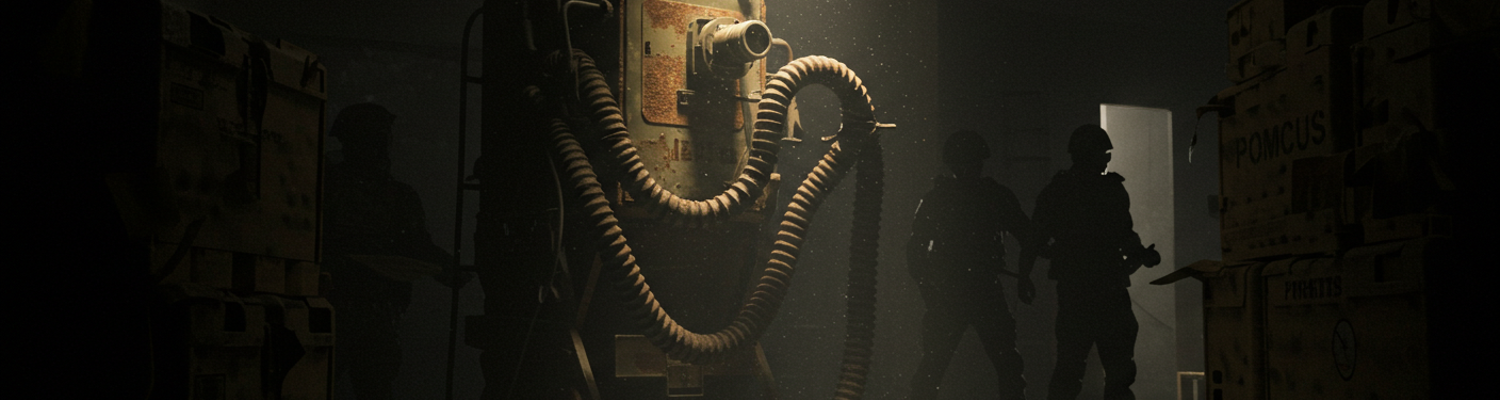
The doctrinal reliance on specialized equipment crumbled when that equipment was drawn from long-term storage. Archival evidence from unit maintenance reports following REFORGER points to a systemic problem with the materiel held in POMCUS depots. An infantry company drawing an M12A1 Power Driven Decontamination Apparatus would often uncrate a machine that was operationally useless. Inspection teams noted rubber hoses that were cracked and brittle from dry rot, rendering them unable to hold pressure. The small gasoline engines that powered the water pumps were frequently seized or had carburetors gummed up with old fuel residue. The brass spray nozzles were often corroded shut from moisture that had penetrated storage bags. The M51 Collective Protection Shelter fared no better. After-action reports mention shelter bladders so brittle from age that they would tear along the seams during their first inflation. The blower motors required to keep them pressurized failed, and the complex seals of the litter-pass-through airlocks were often warped.
This widespread equipment failure had cascading tactical implications. A non-functional M12A1 decontaminator meant that the M113 ambulance, deliberately sacrificed to evacuate a nerve agent casualty, could not be cleaned. It was now out of the fight indefinitely. The failure of an M51 shelter was even more severe. Without the ability to establish a clean treatment space, the entire Battalion Aid Station was forced to operate in the highest level of protective gear, MOPP 4. Medical personnel found their dexterity and stamina plummeting as they tried to perform complex procedures while wearing thick rubber gloves and looking through the fogged lens of a gas mask. The speed of all medical care slowed to a crawl. An ad-hoc solution at the front line created a crisis in the rear. A single soldier, improperly decontaminated, became a vector, threatening to carry persistent chemical agents all the way back to a field hospital.
The Fulda Gap Incident
After-action reports from Central Guardian paint a granular picture of systemic failure. The incident began with a four-vehicle scout platoon from the 11th ACR conducting a screen line patrol. Their position was a muddy track overlooking a frozen stream bed several kilometers west of the inter-German border. At 0930 hours on a Tuesday in late January, an exercise umpire declared the platoon’s position hit with a simulated 152mm artillery barrage firing persistent nerve agent. The platoon’s reaction was immediate. Soldiers donned their MOPP gear in the cramped confines of their M113 and M901 ITV armored vehicles. Within minutes, another umpire tapped a driver on the shoulder, handing him a casualty tag. The soldier was now notionally convulsing, a textbook casualty of nerve agent exposure requiring immediate atropine injection and evacuation.
The platoon leader, a first lieutenant, now faced a crisis of American regulations. His medic, following FM 8-285, administered a practice auto-injector and declared the casualty Immediate, demanding swift transport. The lieutenant got on the radio to request a medevac. The response from his troop headquarters was a direct reflection of doctrine. An armored ambulance could not be dispatched to a contaminated zone. The platoon first had to move the casualty to a designated decontamination point. No such point existed. The platoon was expected to establish one themselves, using equipment they did not have. The alternative was to wait for a designated contaminated evacuation vehicle, an asset that troop command confirmed was currently engaged on the other side of the sector, an hour away at best.
The directive-based medevac chain had collapsed in less than ten minutes.
For thirty minutes, the platoon remained static, the notional casualty’s condition worsening. The medic was forbidden from placing the casualty in a standard M113, as doing so would contaminate the vehicle and its crew. The M51 Collective Protection Shelter was miles away with the battalion support elements. The lieutenant stood at the intersection of two irreconcilable orders. The medical directive demanded he save his soldier. The operational directive demanded he preserve the clean status of the force’s evacuation assets. He ordered two soldiers to drag the casualty onto the ramp of his own command vehicle. He was choosing to save the man by contaminating his own small part of the war.
This single decision, multiplied across a dozen similar simulated incidents, created a cascading failure that threatened to bring V Corps’ medical response to a complete halt.
Triage by Desperation
A close examination of after-action logs from REFORGER ‘85 shows that when doctrine collapsed, medics and junior leaders invented their own procedures. The official triage system proved inadequate for a chemical environment. Medics at the casualty collection points faced an impossible decision: treat a savable soldier with a conventional wound or expend precious minutes trying to decontaminate an expectant casualty who was also a chemical hazard. This doctrinal friction forced them to create a new, unwritten triage category: contaminated but potentially savable. They began ignoring official tags, making gut decisions based on who they thought they could get to a clean area fastest.
The most significant breach of doctrine involved the use of non-standard vehicles. With designated contaminated ambulances often unavailable and the use of clean M113 armored ambulances strictly forbidden for contaminated patients, platoon leaders made a pragmatic choice. They chose the soldier over the regulation. Unit reports from the 11th ACR repeatedly describe M113 Armored Personnel Carriers being used to rush contaminated casualties rearward. In some documented cases, even unarmored M1008 CUCV cargo trucks were used. A lieutenant would order his men to load a notionally contaminated soldier onto the ramp of a standard APC, fully aware that this act rendered the vehicle a toxic hazard. The vehicle’s crew, now operating in a contaminated space, would have to remain in full MOPP gear for hours. The alternative was to follow the rules and let the umpire declare the soldier dead.
These improvised transport methods created a second-order crisis. The problem was not just the individual soldier’s MOPP suit, but the support equipment designed to decontaminate personnel and vehicles. Equipment drawn from prepositioned POMCUS stocks was frequently unserviceable. Maintenance logs note M12A1 Power Driven Decontamination Apparatus with cracked rubber hoses and corroded nozzles. M51 Collective Protection Shelter bladders tearing along aged seams during inflation and blower motors failing made it impossible to establish a clean treatment area. A medic’s personal protective gear was only the last line of defense; the systemic failure of the decontamination and shelter equipment meant there was no clean area to fall back to. The aid station itself had to operate in MOPP 4, with surgeons trying to work in thick rubber gloves, their vision obscured by fogging mask lenses.
The ad-hoc decision to use a clean vehicle for a dirty casualty now threatened to vector contamination directly into a medical system that had lost its ability to protect itself.
The Strategic Ripple Effect
After-action reports from REFORGER ‘85 reveal how ad-hoc medical responses created a new threat. The decision by a lieutenant to load a contaminated soldier into a clean M113 personnel carrier initiated a chain reaction. This single act transformed a rescue asset into a mobile contamination vector. The persistent nerve agent, VX, coating the casualty’s MOPP suit would off-gas within the enclosed space of the armored vehicle, creating a low-level vapor hazard for the entire crew. The vehicle itself became a toxic object, its interior surfaces adsorbing the chemical agent. Every piece of equipment inside was now compromised. The improvised solution had effectively weaponized a piece of US Army equipment against its own forces, carrying a persistent chemical threat from the front line toward the secure rear echelons.
The arrival of this contaminated M113 at a Battalion Aid Station (BAS) represented the catastrophic failure of the entire tiered decontamination concept. The system was designed to prevent this exact scenario. Specialized decontamination lines and patient airlocks on M51 shelters were meant to be impermeable barriers. But with that equipment proving non-functional, the contaminated vehicle presented the Battalion Surgeon with an impossible choice. Allowing the vehicle to approach the BAS risked introducing the agent into the medical treatment area, potentially shutting the entire facility down. A single contaminated soldier walking into a tent could contaminate the medical staff, sterile supplies, and dozens of other conventionally wounded patients. The alternative was to refuse them entry. The Warsaw Pact’s objective of overwhelming NATO’s medical system was achieved not by the sheer number of casualties, but by exploiting the brittleness of NATO’s own procedures. A single platoon’s failure to decontaminate one soldier had cascaded upward, threatening to neutralize the medical capacity of an entire battalion.
The long-term consequences exposed by Central Guardian were profound. Analysis of the exercise’s failures demonstrated that the Army’s CBRN doctrine, with its rigid insistence on contamination avoidance, was fundamentally broken. The concept of maintaining a sterile boundary between clean and contaminated areas in the face of a large-scale chemical attack was a fiction. The after-action reports from 1985 became a catalyst for change. By the late 1980s, a doctrinal shift began, moving away from avoidance and toward contamination tolerance. New concepts emerged for hardened medical facilities and vehicles designed to operate within a contaminated environment. The widespread failures of gear drawn from POMCUS depots led to urgent changes in maintenance and storage protocols. The Army recognized the need for simpler, more robust decontamination systems. Training exercises after 1985 began to incorporate cascading failure scenarios, forcing commanders to wargame responses for when the doctrine had already collapsed. This led directly to the development of new systems like the M93 Fox NBC Reconnaissance Vehicle and a fundamental rewriting of field manuals like FM 3-4 and FM 3-5, all in an effort to ensure that the lessons of a frozen German winter were not forgotten.