
A Rude Awakening in Steel
On June 25, 1950, the North Korean People's Army (KPA) stormed across the 38th Parallel. Their offensive was spearheaded by approximately 150 Soviet-supplied T-34-85 medium tanks, a weapon that had proven its worth against German armor on the Eastern Front of World War II. The United States Army, hollowed out by severe post-war demobilization and budget cuts, was caught completely unprepared. The Eighth Army, the primary American force occupying Japan under General Douglas MacArthur, was an organization accustomed to garrison duty, not high-intensity combat. Its four infantry divisions possessed only a skeleton of their authorized armored strength. Post-war doctrine called for each infantry division to have an organic heavy tank battalion, but this existed only on paper. In reality, each division had but a single company equipped with the M24 Chaffee light tank. This was a logistical decision born of convenience. Military planners, concerned with preserving Japan's fragile infrastructure, feared that heavier tanks like the 33-ton M4 Sherman or the 46-ton M26 Pershing would damage the nation's roads and bridges. The lightweight, 20-ton Chaffee was deemed sufficient for occupation duties.
That decision proved catastrophic on the battlefield. The first American ground unit to see action, the ill-fated Task Force Smith, arrived in Korea on July 1 and had no tanks whatsoever. Its anti-tank capability was limited to a few 75mm recoilless rifles and obsolete 2.36-inch M9 bazookas. On July 5, near Osan, the task force's infantrymen watched in horror as their bazooka rockets, designed to defeat the thinner armor of the previous war, failed to penetrate the T-34's thick, well-sloped hull. The KPA tanks rolled through their positions with impunity. The first real test for American armor came on July 10, when A Company of the 78th Tank Battalion, attached to the 24th Infantry Division, engaged KPA tanks near Chonui. The results were grim. The M24’s low-velocity 75mm gun, designed for reconnaissance and infantry support, could not defeat the T-34-85's sloped 45mm frontal armor, which had an effective thickness far greater. Conversely, the Chaffee’s thin 38mm of maximum armor offered almost no protection against the T-34’s powerful 85mm cannon or even North Korean anti-tank rifles. In that first encounter, two M24s were lost for one disabled T-34. Many of the tanks rushed from Japan were also in a poor state of repair, suffering frequent mechanical failures of their guns and turrets during combat.
The disparity became a pattern of devastating losses and panicked retreats. American tankers watched their 75mm shells ricochet harmlessly off the enemy’s hull, a demoralizing experience that quickly earned the enemy vehicle the nickname 'T-34 shock'. A Company, 78th Tank Battalion, which arrived with 14 tanks, had only two operational vehicles left by early August. The ordeal of the 24th Infantry Division culminated at the Battle of Taejon from July 19 to 20. Major General William F. Dean’s exhausted division, with its few remaining M24s in support, fought a desperate delaying action in the burning city. In bitter street fighting, the American forces were overwhelmed. The battle cost the division over 1,100 casualties and resulted in the capture of General Dean himself, but the stand bought precious time. It was a tactical defeat that enabled a strategic possibility, the chance to form a final defensive line at the southeastern tip of the peninsula.
The Pusan Lifeline
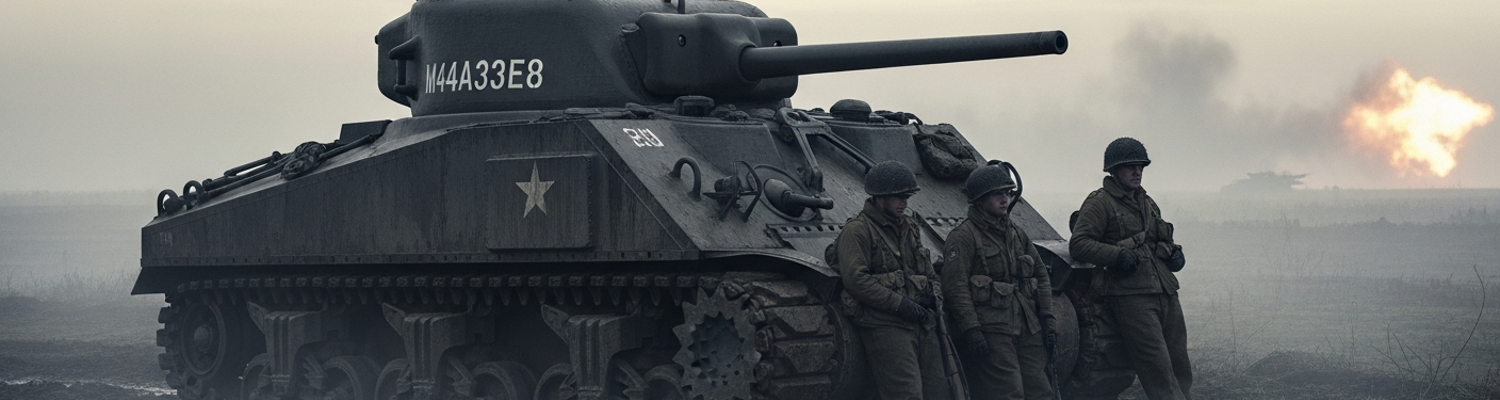
The shock of the KPA's armored spearhead triggered a massive logistical response from the Pentagon. The effort was a frantic race against time. The United States had no new tanks in production, so vehicles had to be pulled from stateside reserve units, training schools, and vast storage depots like the Anniston Army Depot in Alabama. In Japan, ordnance personnel worked around the clock to de-mothball and rebuild M4A3E8 Sherman tanks, forming the provisional 8072nd Tank Battalion on July 17 under Lieutenant Colonel Welborn G. Dolvin to rush them to the front. The first three M26 Pershing tanks, rebuilt from ordnance depot stock in Tokyo, reached Korea in late July, though their initial deployment was plagued by mechanical problems stemming from incorrect fan belts and other parts scavenged during their hurried reactivation.
The true turning point came in August as the port of Pusan became the UN’s lifeline. On August 2, the US 1st Marine Tank Battalion disembarked with their M26 Pershings, bringing a significant boost in both firepower and morale. They were followed by a steady stream of US Army tank battalions: the 6th, 70th, 72d, 73d, and 89th, equipped with a mix of M26 Pershings and M4A3E8 Shermans. By the end of August, over 500 American medium tanks were inside the Pusan Perimeter, giving UN forces a five-to-one numerical superiority in armor over the KPA, whose own tank force had been attrited by air attacks and mechanical breakdowns. The balance of power in steel had finally shifted.
This new armor was the key to Lieutenant General Walton H. Walker’s 'stand or die' defense of the perimeter. Walker, commander of the Eighth Army, faced determined KPA attacks along a 140-mile front. He masterfully used his new tank battalions as mobile 'fire brigades'. Taking advantage of the perimeter’s interior lines of communication, its roads and railways, Walker shuttled his armor to whichever sector was most threatened, staging powerful counterattacks to blunt KPA penetrations. The 1st Provisional Marine Brigade, with its M26s, proved decisive in the brutal fighting at the Naktong Bulge, a vulnerable salient in the UN line. In their first major engagement on August 17 near Obong-ni, Marine Pershings from B Company, 1st Marine Tank Battalion, destroyed a column of four advancing T-34s with their 90mm guns. The high-velocity 90mm cannon was more than a match for the North Korean tank, and the psychological effect on both sides was immediate. American forces had finally found an answer to the T-34.
Doctrine Forged Under Fire
The arrival of adequate equipment was only half the battle. The US Army also had to rapidly unlearn its peacetime doctrine and adapt to the unique realities of the Korean battlefield. The pre-war assumption that Korea’s mountainous terrain was unsuitable for tanks was proven false by the KPA’s initial success. American tankers had to develop new tactics for fighting on narrow mountain roads, in confined valleys, and in the sodden rice paddies that could easily mire a 46-ton vehicle.
World War II combined arms doctrine, which stressed the close cooperation of infantry and armor, had atrophied badly during the occupation of Japan. The initial deployment saw infantry divisions thrown into combat without their organic tank support, leading to disasters like Task Force Smith. Inside the Pusan Perimeter, this integration was rebuilt out of sheer necessity. Infantrymen began riding on tanks to keep pace during counterattacks and to provide crucial close-in security. North Korean and later Chinese forces employed infantry-heavy tactics, often using night attacks and infiltration to get close enough to assault tanks with explosives and satchel charges. The presence of friendly infantry riding on the tanks, communicating with the crew via rear-mounted field telephones, provided a vital screen against these ambush teams. In return, the tanks offered devastating mobile firepower against enemy troop concentrations, with crews making frequent use of high-explosive and anti-personnel 'beehive' rounds.
Tankers also innovated with their equipment. When direct line-of-sight was blocked by the rugged terrain, M26 crews learned to use their high-velocity 90mm guns for indirect fire. By elevating their cannons to maximum angles, they could function as makeshift artillery, lobbing shells at enemy positions far beyond the range of standard howitzers. The fighting also provided a stark, practical comparison between the two mainstays of the new armored force. While the M26 Pershing had the superior gun and armor, its WWII-era Ford GAF V-8 engine and transmission were underpowered for its weight, making it slow and mechanically unreliable in Korea’s steep hills. In contrast, the M4A3E8 'Easy Eight' Sherman, while having a less powerful 76mm gun, was faster, more agile, and far more dependable. Its reliability made it a workhorse, proving that mobility and availability could often trump raw power. This practical experience directly informed future American tank design, leading to the development of the M46 Patton, which was essentially a Pershing re-engined for better performance.
The summer of 1950 was a crucible for America’s armored forces. It began with a humiliating and costly miscalculation, sending light tanks into a fight they could not win. The subsequent logistical effort to rush medium armor to the Pusan Perimeter stabilized a desperate situation at the eleventh hour. The experience forced a rapid, brutal, and effective re-education in combined arms warfare, forging new tactics on the ground. The defense of the Pusan Perimeter, orchestrated by Walker and executed by tankers and infantrymen learning to fight together again, halted the invasion and set the stage for the UN counter-offensive at Inchon. The price was high, but the lessons learned in steel and blood would redefine American armored doctrine and tank development for the next generation.