
A Predatory Sea
The Mediterranean Sea, for the nascent United States, was a killing field for commerce. After the Revolution severed the protective tether of Britain's Royal Navy, American merchant vessels became high-value targets for the corsairs of the Barbary States—the semi-autonomous Ottoman regencies of Tripoli, Algiers, Tunis, and the independent Sultanate of Morocco. These states prosecuted a state-sponsored piracy enterprise, capturing ships and enslaving crews as a primary source of national revenue. Their swift xebecs and galleys, perfectly suited for the coastal waters, easily overwhelmed the lightly armed merchantmen. In 1785, Algerian pirates seized the schooner Maria and, a week later, the Dauphin, condemning their crews to more than a decade of hard labor and brutal captivity. Letters from enslaved sailors, describing horrific conditions and pleading for their government to pay the ransom, inflamed public opinion back home.
The practice of paying tribute—protection money—to prevent such attacks grated against the young republic's foundational principles of free trade and national honor. This dilemma exposed a deep political fissure. Federalists, led by figures like John Adams, argued for a standing navy, a projection of power capable of defending American interests abroad. They saw the payments as a national disgrace. Democratic-Republicans, under Thomas Jefferson, were deeply suspicious of standing armies and costly naval establishments, preferring diplomacy and, if necessary, limited, targeted action. Yet the reality of the situation forced a compromise. A 1793 rampage by Algerine corsairs resulted in the capture of eleven more American ships and over 100 sailors. The mounting crisis and public outcry led a reluctant Congress to pass the Naval Act of 1794. This act authorized the construction of six powerful frigates: the USS Constitution, President, United States, Chesapeake, Congress, and Constellation. These ships were not merely copies of European designs; they were purpose-built killers, larger and more heavily armed than any frigate of their class, designed to out-sail and out-fight anything they could not outrun. By the turn of the century, tribute and ransom payments to the Barbary States consumed nearly a fifth of the entire U.S. federal budget. The breaking point came in 1800 when Yusuf Karamanli, the Pasha of Tripoli, demanded a new tribute of $225,000 from the incoming Jefferson administration. Jefferson, now President, refused. On May 14, 1801, Karamanli’s men chopped down the flagpole at the American consulate in Tripoli, a direct and unmistakable declaration of war. The time for appeasement had ended.
Fire in the Harbor
The American war effort faced a strategic catastrophe on October 31, 1803. The USS Philadelphia, a formidable 36-gun frigate under the command of Captain William Bainbridge, was pursuing a Tripolitan vessel when it ran hard aground on an uncharted reef in Tripoli's harbor. The crew's desperate attempts to free the ship—casting cannons and anchors overboard, even sawing off the foremast—proved futile. A rising tide only wedged the frigate more firmly onto the shoal, canting it at an angle that made its own guns useless. Surrounded by swarming Tripolitan gunboats, Bainbridge had no choice but to surrender. He and his 307 officers and men were taken prisoner. The Tripolitans, with engineering skill, later refloated the captured frigate and anchored it in the harbor, its guns now aimed outward. The Philadelphia had become the enemy's most powerful fortress. For Commodore Edward Preble, commander of the Mediterranean Squadron, this was an unacceptable reality. The frigate could not be allowed to remain in enemy hands.
Preble sanctioned a plan of breathtaking audacity: a surgical strike to destroy the Philadelphia where she lay. The mission fell to a young, ambitious officer: Lieutenant Stephen Decatur. The operation hinged on stealth. Decatur and a handpicked crew of 75 volunteers would use a captured 64-ton Tripolitan ketch, the Mastico, which they renamed USS Intrepid. Its appearance was the perfect disguise to penetrate the heavily defended harbor. Preble gave Decatur his pick of the squadron, and Decatur assembled a team of young, unmarried men, fully aware it was likely a one-way mission. On the moonless night of February 16, 1804, the Intrepid sailed silently into the lion's den. A Sicilian pilot, Salvador Catalano, hailed the guards on the Philadelphia, claiming in Arabic that they were a Maltese merchant that had lost its anchors in a storm and needed to tie up alongside the frigate for the night. The ruse held. As the Intrepid bumped against the frigate's hull, Decatur’s quiet order, "Board!", unleashed the Americans. They swarmed over the rails with swords and axes. The fighting was swift, brutal, and silent, a flurry of close-quarters combat that overwhelmed the Tripolitan guards in under 20 minutes without a single American firearm being discharged. Decatur’s men then moved with disciplined haste, placing combustibles in the ship's storerooms, gun deck, and berth deck. With the fire set, Decatur was the last man to leap back onto the Intrepid. The Philadelphia erupted in a colossal pyre, illuminating the entire harbor. Its own cannons, cooked off by the intense heat, began firing into the city and its forts. Under a hail of cannonballs from the now-alerted shore batteries, the Intrepid made its escape with only one man slightly wounded. News of the raid electrified the American public and stunned European observers. British Vice Admiral Horatio Nelson famously called it "the most bold and daring act of the age."
Eaton's Desert Gambit
Decatur's raid was a spectacular tactical victory and a massive morale boost, but it did not end the war. The stalemate continued, with Bainbridge and his crew still held hostage. A new, unconventional front was about to open, championed by William Eaton, the former U.S. Consul to Tunis. Eaton was a volatile, driven, and deeply patriotic figure who had long advocated for regime change. He devised a plan to overthrow Yusuf Karamanli by installing his exiled older brother, Hamet Karamanli, on the throne. The plan required an overland invasion, a concept of power projection utterly alien to the young United States. The target was Derna, Tripoli's easternmost provincial capital.
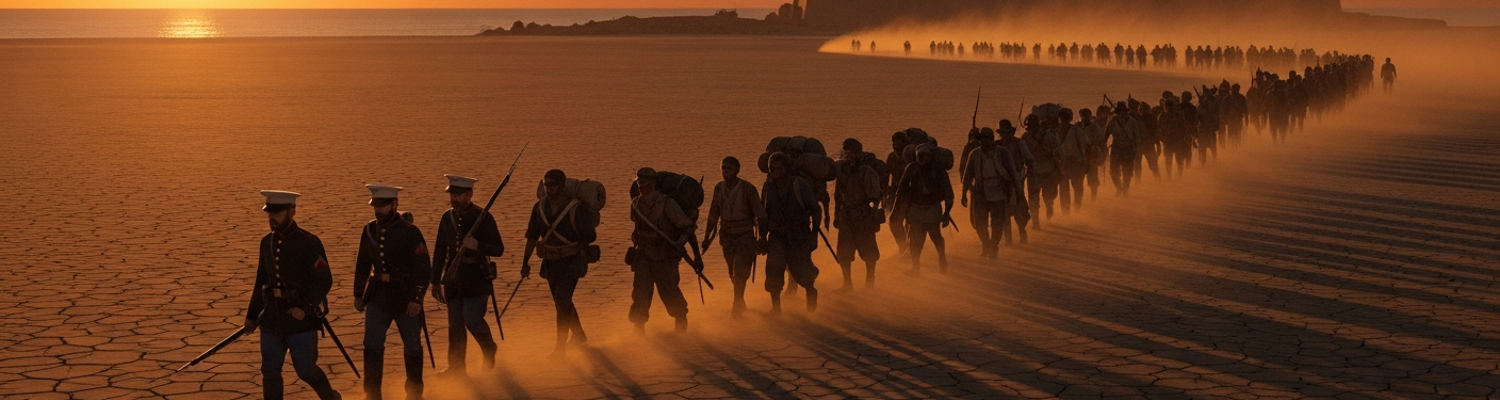
In Alexandria, Egypt, Eaton assembled one of history's more improbable expeditionary forces. The American contingent consisted of First Lieutenant Presley O'Bannon, seven other U.S. Marines, and a midshipman. This tiny professional core was to lead a mercenary army of around 400 men—a volatile mix of Greek artillerymen, Arab cavalry, and European soldiers of fortune, supplemented by Hamet's own followers. On March 8, 1805, this motley force began a grueling 500-mile march across the Libyan Desert. The 50-day trek was a logistical and leadership nightmare. The column was wracked by hunger, thirst, sandstorms, and constant infighting between the Christian mercenaries and Muslim camel drivers. Eaton, styling himself "General," held the expedition together through sheer force of will, facing down mutinies and renegotiating pay for his mercenaries on the move.
On April 25, the exhausted force arrived before Derna. Eaton demanded the city's surrender; the governor's reply was blunt: "My head or yours." The assault commenced on April 27, a coordinated land and sea attack. The American warships USS Argus, USS Hornet, and USS Nautilus commenced a precise naval bombardment of the city's fortifications. On the ground, Eaton split his forces. Under the covering fire from the ships, Lieutenant O'Bannon and his handful of Marines led a desperate charge against the main harbor battery. They stormed the enemy guns in a rush of bayonets and determination. By 4:00 PM, O'Bannon had raised the American flag over the fort, the first time the Stars and Stripes would fly in victory over foreign soil. The city's defenders broke, and Derna fell to Eaton's army.
A Contentious Peace
The capture of Derna was a shocking strategic blow to Yusuf Karamanli. The threat of Eaton's force, now reinforced and poised to march on Tripoli itself, combined with the continued pressure of the naval blockade, forced the Pasha to the negotiating table. On June 4, 1805, diplomat Tobias Lear, operating from the deck of the USS Constitution, signed the Treaty of Peace and Amity. The treaty secured the release of the Philadelphia's crew, but it came at a cost: a final payment of $60,000, which was explicitly termed a ransom, not tribute. A key term was the American withdrawal from Derna and the abandonment of Hamet Karamanli's cause. Eaton was furious, believing Lear had squandered a total victory. He had promised Hamet a throne and instead had to deliver news of his betrayal. Yet, the war was over. The systematic demand for annual tribute from the United States had been broken. The First Barbary War, forged in the crucible of national humiliation, Decatur's fire, and Eaton's march, established the United States Navy as a credible fighting force on the world stage and demonstrated the nation's newfound willingness to project power far beyond its own shores.