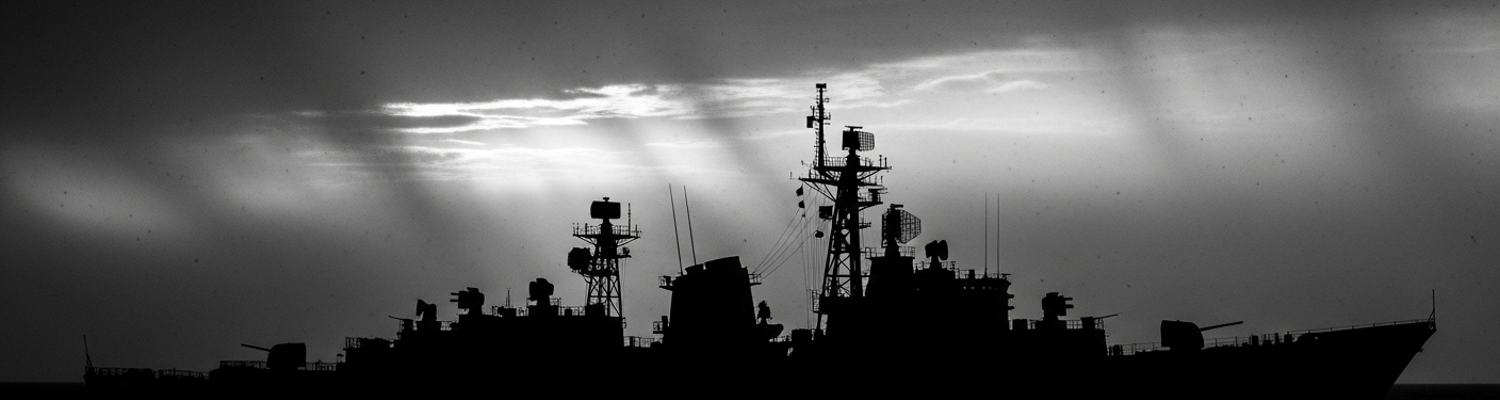

The Cold War’s defining tension manifested not only in the nuclear standoff but in a silent, unseen conflict waged in the crushing depths of the world’s oceans. As the Soviet Union invested heavily in a submarine fleet designed to sever Atlantic lifelines and threaten American shores with nuclear annihilation, the United States Navy instigated a technological and doctrinal revolution in anti-submarine warfare (ASW). This contest was not one of open battles, but of relentless innovation, surveillance, and strategic chess played across millions of square miles of unforgiving water. Three pillars formed the foundation of this American ASW transformation: a clandestine network of undersea ears spanning entire oceans, the wholesale reconstruction of its destroyer fleet, and a new doctrine integrating air, surface, and sub-surface assets into potent hunter-killer teams.
Wiring the Ocean Basins
In the early 1950s, the U.S. Navy grappled with the alarming growth of the Soviet submarine force, which had absorbed advanced German Type XXI U-boat technology. The vastness of the ocean made finding these submerged threats seem impossible. The answer emerged from research conducted by scientists like Maurice Ewing at Columbia University, who had explored the deep sound channel, or SOFAR channel. This was a specific layer in the water column, typically a few thousand feet deep, where temperature and pressure conditions created a duct that trapped low-frequency sound, allowing it to travel for hundreds, even thousands, of miles with minimal signal loss. This scientific understanding formed the basis for one of the Cold War’s most secretive and impactful programs: the Sound Surveillance System (SOSUS).
Under the unclassified cover name Project Caesar, the Navy began deploying vast arrays of underwater hydrophones cabled back to shore. Development began in earnest around 1950, with Bell Telephone Laboratories and Western Electric applying their commercial telephone and undersea cable expertise to the immense challenge. The effort was managed with singular focus by Captain Joseph P. Kelly, a recalled Westinghouse engineer whose career became synonymous with the program. The technical challenge was immense, requiring the AT&T cable ship Long Lines and other vessels to lay thousands of miles of armored cable on the seabed, connecting hydrophone arrays to newly constructed shore stations. An initial test array laid off Eleuthera in the Bahamas in 1951 proved so effective at detecting a target submarine that admirals who witnessed the lofargram readouts were instantly convinced, fast-tracking the project’s expansion.
Shore-based Naval Facilities (NAVFACs), their true purpose hidden under the guise of “oceanographic research,” sprung up in remote locations from Nova Scotia to Barbados and across the Pacific. Inside these secure buildings, teams of Oceanographic Technicians, or OTs, spent grueling shifts in dimly lit rooms, staring at scrolling paper charts that displayed the ocean's acoustic energy. They learned to filter out the noise of whales, shrimp, and distant storms to find their quarry. These operators became masters of acoustic intelligence, compiling libraries of sound signatures that allowed them to distinguish the unique low-frequency hum of a Soviet November-class nuclear submarine's machinery from that of a diesel-electric Foxtrot-class boat. The system’s strategic power lay in its ability to provide persistent, wide-area surveillance of key maritime chokepoints. The most critical of these was the Greenland-Iceland-United Kingdom (GIUK) gap, the primary transit route for Soviet submarines entering the North Atlantic. On July 6, 1962, a SOSUS array provided the first detection of a Soviet nuclear submarine passing through the gap, a landmark event that validated the entire concept.
SOSUS was not a silver bullet. It provided initial detection and a line of bearing, but localization was often imprecise, requiring triangulation between multiple arrays to generate a rough position for air or surface assets to investigate. As Soviet submarine designs became progressively quieter through the 1970s and 1980s, the Navy had to continually upgrade the system with more sensitive hydrophones and advanced computer processing to maintain its edge. Yet, its impact was profound. SOSUS turned the vast, opaque oceans into a translucent battlespace. This vast, invisible network provided a powerful deterrent, signaling to the Soviets that their submarine fleet was under constant watch. The immense cost of the program was justified by the strategic stability it offered. Knowing that ballistic missile submarines could be tracked from the moment they left port had a chilling effect on Soviet military planning and became a crucial, unspoken factor in arms control negotiations like SALT.
Old Hulls, New Teeth
While SOSUS listened from the abyss, the surface fleet required a radical upgrade to act on its intelligence. In the late 1950s, Chief of Naval Operations Admiral Arleigh Burke initiated the Fleet Rehabilitation and Modernization (FRAM) program to counter the sheer number of modern Soviet submarines. The Navy could not afford to build new ASW escorts fast enough, so it chose a pragmatic path: rebuilding its massive fleet of World War II-era destroyers. The FRAM II program was specifically tailored for Allen M. Sumner and some Gearing-class destroyers, ships that needed a life-extension and a complete mission shift from surface combat to submarine hunting.
The FRAM II conversion was a less extensive, but still transformative, overhaul compared to the top-to-bottom FRAM I rebuild. Ships were stripped down and fitted with the powerful AN/SQS-23 sonar, a long-range active system whose extensive electronics required significant internal space. This new sonar provided destroyers with a much-improved detection range, the essential first step in any engagement. The real leap in capability came from a new generation of standoff weapons. While the larger FRAM I destroyers received the RUR-5 ASROC (Anti-Submarine Rocket), a system that could launch a homing torpedo or a nuclear depth charge on a ballistic trajectory, the more constrained FRAM II refits received an even more futuristic system: the QH-50C Drone Anti-Submarine Helicopter (DASH). This small, unmanned, coaxial-rotor drone was operated by remote control from the ship's combat information center. A small hangar and flight deck replaced a rear gun mount, allowing the destroyer to carry and operate two DASH drones. Each drone could carry a pair of Mk 44 acoustic homing torpedoes out to a range of over 20 nautical miles. This was a radical departure from World War II tactics, which required a destroyer to pass directly over a submarine to drop depth charges. With DASH, a destroyer could remain at a safe distance and attack a submerged contact detected by its own sonar or cued by other assets. The program also added two triple-tube launchers for the same Mk 44 torpedoes for close-in defense.
The FRAM II program was a cost-effective solution that converted aging but still-capable hulls into modern ASW platforms, extending their service lives by at least five years. The operational doctrine for these ships changed completely. A destroyer captain now commanded a multi-layered weapon system, capable of detecting a submarine with his SQS-23 sonar and engaging it miles away. The DASH drone's operational record was troubled. The technology was ahead of its time, and controlling a drone from a pitching deck with 1960s-era electronics led to a high loss rate. The system was withdrawn from service by 1970, but the concept it pioneered, over-the-horizon engagement from a small surface combatant, became a permanent fixture of naval warfare, paving the way for today's helicopter-equipped frigates and destroyers.
The Coordinated Kill Chain
The true revolution in Cold War ASW came from the synthesis of these new technologies into a cohesive, multi-platform doctrine. The U.S. Navy moved away from single-platform operations and embraced the concept of the integrated hunter-killer group. This doctrine recognized that no single asset could manage the entire ASW problem. Success required a team approach, combining the strengths of different platforms to cover the search, detection, localization, and attack phases of an engagement.
A typical operation in the North Atlantic would begin with a quiet alert from a NAVFAC. A SOSUS array had detected the faint signature of a Soviet submarine slipping through the GIUK Gap. The hunt was on. The critical link in this chain was the Lockheed P-3 Orion, the Navy’s premier land-based maritime patrol aircraft. Introduced in the 1960s, the P-3 was a long-range, four-engine turboprop designed specifically for ASW. With an endurance of over 12 hours, it could patrol vast areas of the ocean. Dispatched to the area cued by SOSUS, the P-3 crew would begin laying patterns of sonobuoys, expendable acoustic sensors dropped into the water to listen for the submarine. Inside the Orion's fuselage, sensor operators monitored the acoustic data, searching for the contact. Once the P-3 gained a solid track, it would coordinate via data link with a nearby surface hunter-killer group, often centered on a carrier but always including modernized FRAM destroyers. A destroyer, guided by the aircraft, could close in. The destroyer’s own powerful SQS-23 sonar and its embarked ASW helicopter would then take over the final localization. The attack could come from the P-3’s own payload of torpedoes, the destroyer's DASH-delivered weapons, or its deck-mounted torpedo tubes.
These integrated operations proved their value during the October 1962 Cuban Missile Crisis. As the U.S. established a naval quarantine around the island, SOSUS provided the first indication that four Soviet Foxtrot-class submarines were approaching the line. Navy hunter-killer groups, built around the carrier USS Essex and supported by P-3s, relentlessly tracked these submarines for days. In a series of tense encounters, the U.S. forces used practice depth charges to signal the submarines to surface and identify themselves. The American crews did not know that at least one of the submarines, the B-59, was armed with a nuclear-tipped torpedo and had authorization to use it if its hull was breached. The pressure of the hunt nearly brought the submarine's captain to the breaking point, a decision to launch being averted only by the dissent of another officer onboard. The successful tracking and surfacing of these submarines demonstrated the power of the new integrated ASW doctrine on a global stage. This fusion of a strategic surveillance network, modernized surface combatants, and long-range patrol aircraft created a layered, resilient, and lethal ASW capability. It projected American power across the globe, ensuring control of the seas and providing a powerful counter to the Soviet Union’s strategic submarine forces, ultimately shaping the geopolitical landscape of the latter half of the 20th century.