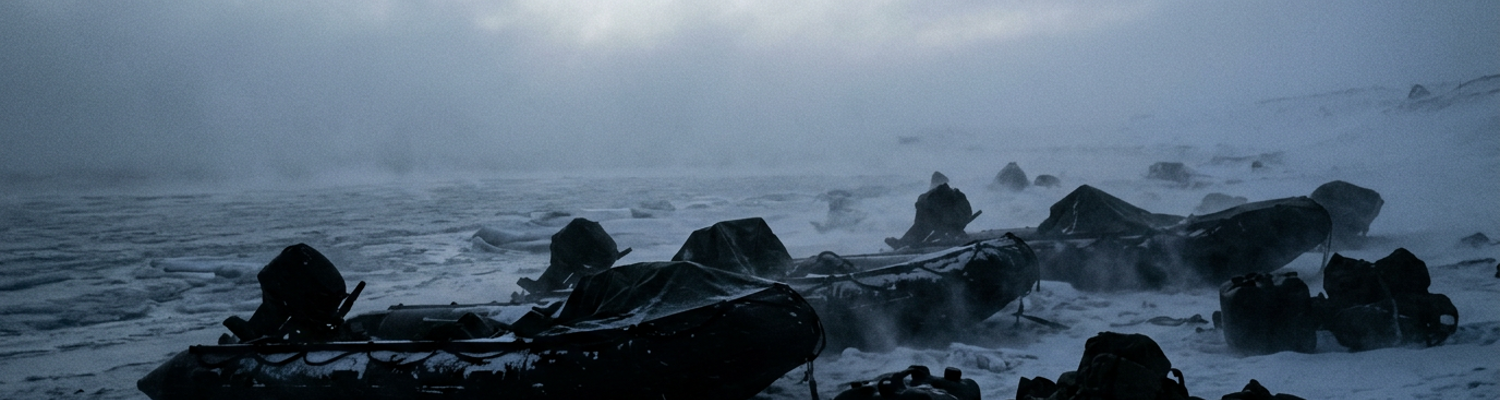

Cold War Arctic Doctrine and Staging
Soviet war plans for northern Scandinavia rested on an overwhelming numerical advantage. The objective centered on crushing NATO Allied Forces Northern Europe within seventy-two hours of mobilization. Across the borders of the Kola Peninsula, the Red Army marshaled two full motorized rifle divisions. They were backed by the 61st Naval Infantry Brigade at Sputnik and roughly five hundred strike aircraft from the Soviet Air Defense Forces. Submerged along the Polyarny bastions, more than one hundred nuclear-powered attack submarines stood ready to break through the Norwegian Sea.
The Norwegian Army maintained only the single active-duty Brigade Nord.
This unit numbered fewer than five thousand men stationed in Troms county. Archival evidence shows that Soviet theater doctrine calculated a localized superiority ratio of eight to one in heavy artillery tubes along the primary littoral invasion corridors.
Ratios of that scale left zero margin for operational error.
Alliance strategy focused almost entirely on delaying Soviet advances down western littoral corridors. NATO planners under Allied Command Europe recognized that whoever controlled the coastal waters between North Cape and the Lofoten Islands held the North Atlantic. If Soviet naval infantry seized Norwegian airfields at Bardufoss and Bodoe, land-based Tu-22M Backfire bombers could push their missile-engagement envelopes past the Greenland-Iceland-United Kingdom Gap. Allied doctrine mandated immediate maritime reinforcement through the Norwegian Amphibious Brigade. Supply officers quickly identified catastrophic maintenance hurdles in these restricted coastal passages. Saltwater spray constantly froze over deck gear. Hydraulic winches on replenishment ships locked solid when temperatures dropped below minus fifteen degrees. Standard military-grade diesel fuel congealed into waxy sludge inside shipboard intake manifolds.
Cold metal broke steel winches long before troops encountered hostile fire.
A close review of operational logs indicates that the United States Navy selected the northern Troms region specifically because its coastal geography pushed mechanical gear past known tolerance thresholds. Operating primarily out of the Royal Norwegian Navy base at Ramsund, elements of SEAL Team Two established winter evaluation deployments around the 68th parallel north. The region offered deep fjords surrounded by sheer granite walls and ocean water hovering at twenty-nine degrees Fahrenheit. Field evaluations quickly exposed crippling mechanical faults in standard special warfare equipment. Heavy seas in the Andfjorden fractured the fiberglass transoms on combat rubber raiding craft. The impact ripped sixty-horsepower Johnson outboard motors directly from their mounts. Sub-zero air caused synthetic rubber drysuit gaskets to stiffen and tear at the neck. This let near-freezing seawater flood into diving garments.
In December 1984, freezing temperatures split forty percent of the unit neoprene dive seals during staging at Ramsund.
Not a single combat swimmer had entered the water yet.
Little Creek to Bardufoss Supply Bottlenecks
Moving expeditionary freight out of Naval Amphibious Base Little Creek broke down the moment pallets entered the Military Airlift Command system.
When elements of SEAL Team Two staged for northern littoral deployment in late 1984, supply officers packed winterized communications sets and drysuit maintenance spares into standard 463L aluminum pallets. Flight plans designated these pallets for direct transport via C-141B Starlifter to Bardufoss Air Station. Dispatchers at Scott Air Force Base repeatedly bumped these loads down the manifest ladder. Air transport space belonged to higher-priority European reinforcement schemes. These schemes assigned urgent transit codes to tank engines and mechanized infantry parts destined for Central Army Group in West Germany. Special warfare cargo held lowest-tier operational movement designations. Pallets bound for Troms county sat parked on freezing tarmac at Dover Air Force Base.
Airlift wings pushed heavy armor across the Atlantic instead.
Flights departing the United States did not travel directly to Norway. Transport manifests were broken down and re-sorted at intermediate continental staging bases. Ground crews at Rhein-Main Air Base systematically pushed small naval detachments into backwater holding yards. Pallets containing specialized neoprene repair adhesives and cold-soak ignition harnesses sat unsheltered on wet concrete aprons for eleven consecutive days. Sub-zero temperatures cracked the chemical compounds in the vulcanizing glue. All adhesive containers were rendered completely useless before they crossed the Norwegian Sea. Forward transit from Central Europe to Bardufoss depended on Royal Norwegian Air Force C-130H aircraft.
Cold tarmac ruined rubber seals faster than Arctic seawater.
Field records demonstrate that the collapse of the supply bridge left combat swimmers without survival equipment at Bardufoss throughout January 1985. Four tons of specialized personal cold-weather clothing sat locked inside staging warehouses at Rhein-Main. This included dual-vapor-barrier rubber boots and specialized snowshoe harnesses. Arriving in northern Norway without these cold-weather uniforms, operators had to conduct coastal patrols wearing standard leather combat footwear. The leather froze solid within minutes of walking through wet coastal slush. High-calorie Arctic ration packs met the same fate. Troops operating in littoral fjords consumed over five thousand calories per day dragging sleds across coastal ice. The unit received standard Meal Ready-to-Eat pouches instead. The water inside these standard meals froze into solid ice blocks within two hours of pack carry. Platoon members had to carry the hard plastic envelopes inside their combat coats against their bare chests for forty minutes simply to soften the rations enough to swallow them.
Twenty-four thousand Arctic ration packets sat untouched in an unheated depot outside Frankfurt.
Combat divers in Bardufoss thawed frozen meat paste against their ribs.
Forward Shelters and Arctic Staging Conditions
Upon arrival at Bardufoss Air Station in mid-January 1985, SEAL Team Two platoons found their operational schedule brought to an immediate halt inside unheated ten-man Arctic hex-tents.
The detachment M-1941 liquid-fuel tent stoves failed almost immediately. Brass fuel-control valves cracked across multiple burner assemblies when exposed to minus thirty-two degree Fahrenheit ambient ground temperatures. Military-specification Arctic diesel congealed into thick gel inside external gravity-feed lines. Without functional heaters, ambient indoor temperatures matched the outside tundra conditions. Internal condensation from exhalations froze against canvas walls before showering sleeping bags in fine ice needles. Forward commanders at the staging area had to cancel scheduled field rehearsals across the surrounding terrain.
Operational movement halted completely across the snow-covered airfield apron.
Detachment leadership refused to risk severe core-temp drop in personnel while waiting for heating replacement kits. Combat swimmers could not dry neoprene exposure gear inside tents where interior air hovered twenty degrees below freezing. Wet dive gloves and neoprene face masks froze into brittle solids within ten minutes of removal from storage boxes. Equipment maintenance turned into a direct pathway to soft-tissue freezing. For five consecutive days, twenty-eight operators remained confined to dual-layer modular sleeping systems. They used their own body heat to keep canteen water from freezing. Scheduled reconnaissance patrols along the approaches to Malangen fjord were repeatedly scrubbed from Allied Command Europe duty rosters.
Shelters functioned as deep-freeze storage lockers rather than staging hubs.
Operational medical logs demonstrate that the complete absence of backlogged extreme-cold boots forced unit corpsmen into aggressive field improvisations. Platoon members had landed at Bardufoss wearing standard-issue black leather wet-weather combat boots. Specialized vapor-barrier footwear remained stranded in continental transit depots. The leather absorbed wet slush during perimeter duties and froze into rigid shells that restricted capillary blood flow across the feet. To arrest an outbreak of second-degree frostbite, operators cut up closed-cell polyethylene ensolite sleeping pads with utility knives. They hand-carved replacement insoles to insert beneath thick wool socks. Platoon personnel stripped heavy plastic wrapping from air-dropped crate frames. They taped the clear sheets directly around sock layers to trap foot sweat and mimic dual-vapor-barrier boot liners. In the Norwegian motor pool bays, team members gathered discarded automotive grease to rub into exterior boot leather.
Improvised sleeping-pad insoles and grease coatings halted the spread of gangrene across the platoon.
Small arms demanded similar crude modifications. Standard-issue cleaner congealed inside firearm receivers. Firing pins froze inside CAR-15 carbines. Platoons stripped these weapons down to bare steel by boiling bolt assemblies inside metal mess kits using degreasing solvent borrowed from Norwegian BV-202 snowcat crews. They subsequently dusted internal friction surfaces with dry graphite scraped from issue pencils. Combat swimmers lacking proper thermal drysuit underwear sliced apart surplus wool blankets. They hand-stitched torso vests using inner strands of 550 parachute cord. Transport planes carrying proper Arctic cold-weather kits were still delayed at Mildenhall when the first four-man reconnaissance element finally moved out toward the freezing waters of the Barduelva river on January 24.
Outdated Cartography Along Balsfjorden Navigational Routes
Naval Special Warfare Group Two mission planners at Little Creek mapped tactical routes into Balsfjorden using coastal navigation charts issued by the Defense Mapping Agency Hydrographic Topographic Center.
These charts were fundamentally obsolete.
They were direct reproductions of British Admiralty charts and Royal Norwegian Hydrographic Service coastal surveys conducted between 1948 and 1954. Post-World War II survey vessels had relied on primitive single-beam echo sounders and weighted hand-lead soundings taken along broad transit tracks spaced hundreds of meters apart. Shallow coastal shelves inside Balsfjorden contained vast data gaps where hydrographers had simply run out of sounding lines. Position coordinates on the charts referenced the European Datum 1950 geodetic standard. This produced horizontal map-shift errors of up to two hundred meters when compared to actual shoreline features. Bathymetric contour lines terminated abruptly at the five-fathom mark. The littoral zones within two hundred yards of the granite shoreline were devoid of depth data or indications of submerged glacial boulder fields.
Lead-line depth readings compiled during the early Cold War governed littoral movement inside the Arctic circle thirty years later.
Detachment leadership launched four Combat Rubber Raiding Craft into Balsfjorden on the night of January 28 without accurate depth profiles. Traveling in total blackout conditions at speeds exceeding twelve knots, the Zodiac F470 inflatable boats moved along the dark silhouette of the western fjord wall. Handheld magnetic compasses and mechanical dead reckoning served as the only guidance tools. Man-portable global positioning systems were not yet fielded to tactical boat crews. Three miles south of Andersdal, the lead craft struck an uncharted granite reef lying less than eighteen inches beneath the surface at low tide. The violent deceleration shattered the cast-aluminum lower gearcase of the fifty-five horsepower Johnson outboard motor. The impact sheared the brass propeller hub pin and ejected drive gears through the housing. Forward kinetic force drove the multi-chambered hypalon hull directly over jagged rock spines. This slashed the fabric floor and flooded the boat deck with twenty-nine-degree saltwater.
Snapping propeller drive pins immobilized two raiding craft within thirty minutes of departure.
Dynamic coastal ice sheets compounded the damage inflicted by the submerged rock shoals. Balsfjorden experienced semi-diurnal tides with vertical swings approaching three meters. Falling tides fractured shelf ice along the shoreline and released free-floating shelves of rafted pack ice that drifted across tactical extraction lanes. As the remaining craft attempted to skirt the boulder shoals, floating shelves of hard freshwater ice collided with the inflatable sponsons. Sharp edges on the shifting ice plates tore the vulcanized outer skin along the port side of a second Zodiac. Two independent buoyancy chambers deflated instantly. Simultaneously, frazil ice crystals and slush accumulated inside the raw-water intake grates of the remaining outboard engines. Without water flow, powerheads overheated within three minutes. Piston rings fused to cylinder walls. The raiding element was left stranded beneath the sheer rock faces of the fjord with four disabled boats.
Norwegian patrol craft dispatched to recover the stranded platoon found forty percent of the unit suffering from second-degree trench foot after standing six hours in bilge water.
Raiding Craft Propulsion Failures in Pack Ice
During the opening hours of February 2, 1985, SEAL Team Two attempted a simulated coastal insertion through the outer mouth of Malangen.
They operated five nautical miles northwest of Tennskjaer at latitude 69 degrees 31 minutes North. Ambient air temperatures had plunged to minus twenty-four degrees Fahrenheit. Thick accumulations of freshwater frazil ice and hard brash floes drove out from the Malselva river delta into the saltwater channel. Advancing in trace-line formation, three Combat Rubber Raiding Craft met floating sheets of seasonal pack ice that measured between four and eight inches thick. The tactical problem centered on propulsion. When the three-blade bronze propellers of the detachment fifty-five-horsepower Johnson commercial outboard engines struck the submerged edges of these ice floes, the rotational resistance overwhelmed the shear tolerance of the drive pins. Designed as mechanical circuit breakers to protect the internal propeller shaft from catastrophic torque spikes, the soft brass drive pins snapped instantly upon impact. Propellers uncoupled from drive shafts. They spun loosely on the hubs while outboard engines redlined into violent over-rev cycles.
Cold sea water instantly stripped every craft of forward headway.
Detachment mechanics faced continuous pin failures every three to five hundred yards along the Malangen approach. Each failure required crew members to cut engine throttles and unlatch the freezing engine cowlings. They tilted forty-kilogram outboard assemblies manually out of the water while standing in unstable hypalon hulls tossed by three-foot swells. Salt spray immediately flash-froze across exposed lower units. Glazed ice rinds jammed cotter keys and seized propeller retaining nuts. Operators had to extract fractured pin fragments using steel drift punches and small ball-peen hammers. They worked with bare fingers in twenty-nine-degree sea water because standard cold-weather mittens lacked the dexterity needed to manipulate two-inch brass dowels. Tactical timers recorded repair cycles taking up to twenty-five minutes per craft under total light-discipline blackout. Over a four-hour advance toward the inner sound, the detachment logged seventeen consecutive drive pin failures across three craft.
Ice broke machinery faster than men could drive drift punches through seized propeller hubs.
Acute supply deficits turned these mechanical breaks into an operational halt. Supply manifests from Naval Amphibious Base Little Creek had provisioned only twenty replacement brass drive pins for the entire twelve-boat evaluation detachment. By dawn on February 3, the unit had exhausted its entire onboard stock of factory-specification brass pins. Platoon leaders faced an absolute supply cutoff because emergency replacement requisitions submitted through the supply pipeline at Bardufoss remained backlogged at Rhein-Main Air Base. Detachment engineers initiated aggressive mechanical cannibalization across the staging line. Out of six craft assigned to the primary Malangen assault element, mechanics systematically stripped the lower drive housings and unbent drive pins from four engines to keep two operational craft fueled and rotating. Unit mechanics attempted to fabricate improvised shear pins by cutting structural wire and steel nails with hacksaws. The unhardened carbon steel either deformed under standard operating load or refused to shear during subsequent ice collisions. This warped the hardened steel propeller shafts and cracked the main transmission gearcases.
Cannibalization protocols left four raiding craft permanently stripped down to unserviceable hulls inside the staging compound.
On February 4, detachment commanders canceled the coordinated amphibious raid against coastal radar installations along the southern shore of Senja.
Neoprene Drysuit Material Failures in Sub-Zero Waters
Naval Special Warfare Group Two deployed to northern Norway equipped with standard-issue MIL-S-29177 military-specification neoprene drysuits.
These three-quarter-inch closed-cell gas-blown chloroprene garments were engineered for operational theaters where water temperatures rarely dipped below forty-five degrees Fahrenheit. When SEAL Team Two divers entered the twenty-nine-degree waters of Ofotfjorden near the Ramsund Naval Base, the chemical composition of the synthetic rubber experienced rapid crystallization. Below thirty-two degrees Fahrenheit, the polymer chains hardened. This stripped the neoprene of structural flexibility. Flexion points across the shoulders and knees seized up under the mechanical strain of standard combat swimming strokes. Seams joined by factory vulcanizing tape separated under tension. Micro-fractures split into jagged tears across the armpit gussets within eight minutes of surface transit. Diving technicians had treated the suits with standard silicone lubricants prior to deployment. The chemical agent froze into a waxy residue that accelerated material shear across high-friction joint areas.
Sub-zero water temperatures reduced the polymer mechanical elasticity by more than seventy percent within fifteen minutes.
The failure of these neoprene barriers caused immediate seawater infiltration during tactical swim profiles. Freezing saltwater entered torn groin and shoulder seams at rates exceeding two liters per minute. This thoroughly saturated the wool and synthetic pile thermal liners worn beneath the drysuits. Rapid flooding destroyed the boundary layer of trapped air that insulated the body. Divers experienced precipitous drops in core body temperature. Readings tumbled from ninety-eight point six degrees down toward ninety-four degrees within twelve minutes of water immersion. As mild hypothermia progressed into moderate and severe stages, combat swimmers lost the manual dexterity required to operate Draeger LAR V underwater breathing apparatus bypass valves. Shivering spasms disrupted buoyancy control. Swim pairs conducting simulated reconnaissance swims against submerged harbor defenses off Ramsund could not maintain compass bearings. They veered off designated approach corridors within three hundred yards of their launch points. Dive safety officers recorded rectal core readings below ninety-three degrees Fahrenheit upon emergency recovery.
Support craft pulled freezing combat swimmers from the water long before teams approached their tactical targets.
Field repairs failed to restore material integrity to the ruined diving suits. SEAL Team Two supply personnel attempted to mend torn neoprene using standard-issue black neoprene cement and heat-activated patch tape inside unheated boat sheds at Ramsund. Ambient air temperatures hovering at minus fifteen degrees Fahrenheit prevented the solvent in the adhesives from evaporating properly. The glue remained gummy and incapable of forming a vulcanized bond with the frozen neoprene. Detachment mechanics attempted to warm damaged suit panels using pressurized gasoline lanterns and kerosene space heaters. Uneven heat distribution melted the surrounding cellular foam. This blistered the exterior nylon lining and opened larger holes along the seams. By February 8, 1985, sixteen of the platoon twenty drysuits were classified as completely unserviceable due to seam blowout and uncontrolled water leakage. Unit leadership halted all deep-water combat swimmer training in the Norwegian fjords.
Dive teams grounded at the shoreline while waiting for replacement exposure suits that never cleared the logistics backlog at Dover Air Force Base.
Small Arms Malfunctions and Lubricant Freezing
Weapon malfunctions escalated to high levels during littoral infiltration exercises conducted along the western shores of Malangen between February 10 and February 14, 1985.
Detachment armory inventories relied exclusively on MIL-L-46000. This was the standard military-issue cleaner, lubricant, and protectant distributed throughout Naval Special Warfare units. Synthetic base oils inside this fluid were rated for moderate temperate climates. They lacked the viscosity stability required for coastal Scandinavia at minus twenty-eight degrees Fahrenheit. When combat rubber raiding craft pounded through three-foot chop, fine airborne salt spray blew directly across the ejection port covers and forward receiver gaps of the unit CAR-15 carbines and M60 light machine guns. Saltwater aerosol penetrated the upper receivers and emulsified with the liquid lubricant film. Within fifty minutes of sustained sea-spray exposure, the water-and-oil emulsion separated. The chemical carriers flashed off in the Arctic wind. A thick precipitate formed along the bolt carrier guide rails, inside the cam pin tracks, and throughout the firing pin channels.
The chemical suspension turned from a low-friction barrier into an adhesive paste inside one hour.
This solidifying paste eliminated the kinetic energy required to cycle gas-operated small arms. During live-fire beach assault drills staged at the naval firing range near Ramsund, every individual weapon carried by the lead four-man reconnaissance element failed on the initial trigger pull. In Colt Model 653 carbines, direct-impingement gas tubes vented expanding combustion gases into bolt carrier keys packed with congealed grease. Bolt assemblies failed to travel rearward with enough velocity to contact the buffer assembly. Spent 5.56-millimeter brass casings wedged across chamber mouths. Firing pins lost axial velocity, cushioned by hardened lubricant rings built up inside the bolt channel. This resulted in seventy consecutive light primer strikes during a thirty-round suppression drill. On heavy M60 machine guns, operating rods seized inside receiver tracks before the bolt could lock into the barrel extension.
Guns seized without firing a single complete magazine.
SEAL Team Two platoon officers ordered personnel to strip all standard-issue lubricants completely out of their weapon systems. Mechanics and operators hauled disassembled carbines, machine guns, and service sidearms into unheated metal maintenance shacks at the Ramsund boat depot. Using industrial trichloroethane degreasing solvents acquired from Royal Norwegian Navy maintenance bays, small-arms specialists washed every trace of MIL-L-46000 from receivers, bolts, and spring assemblies. Platoons were forbidden from applying any fluid lubricant, petroleum distillate, or gun oil to metal friction surfaces. Every small arm had to operate bone-dry. Stripping the metal bare removed the viscous substance that trapped Arctic ice crystals. This allowed direct-impingement gas pressure to blow freezing brine clear of the receiver cavity instead of locking it against moving steel parts.
Bare steel ground against bare steel.
Running weapons completely bare prevented immediate cycling seizure but inflicted rapid mechanical erosion across friction points. Steel bolt cam pins cut deep gouges into aluminum upper receiver tracks within three hundred rounds of dry cycling. Extractors chipped along hardened bevel edges as dry casing rims dragged through unlubricated chambers. Buffer springs lost tempered tension after repeated cold-soak cycles without protective moisture barriers. Salt spray rapidly drove bare-metal oxidation. Red surface rust bloomed across internal bolt faces within six hours of exposure to fjord mist. To slow down parts destruction without using oil, operators rubbed lead graphite from standard drafting pencils across the bolt carrier bearing surfaces. This created a microscopic dry carbon layer that did not coagulate at minus thirty degrees. By February 18, armory inspection records revealed that sixty-two percent of platoon carbines showed measurable receiver-wall thinning.
Twenty-four bolt carrier replacement groups had to be requisitioned from supply depots in the United Kingdom.
Naval Special Warfare Cold Weather Aftermath
By late March 1985, Naval Special Warfare Group Two compiled exhaustive after-action files at Naval Amphibious Base Little Creek detailing the total breakdown of standard inventory during northern Norwegian operations.
Staff officers assembled casualty figures, mechanical abort statistics, and material consumption rates from the eight-week deployment across Troms county. These formal operational evaluations documented that baseline maritime equipment engineered for temperate environments could not function north of the Arctic Circle. Every primary combat system evaluated between Ramsund and Balsfjorden had suffered acute mechanical degradation. Neoprene diving suits had fractured at seam welds. Standard MIL-L-46000 cleaner had congealed into an adhesive paste inside rifle actions. Commercial brass shear pins on outboard motors had shattered upon contact with sea ice. The documentation delivered to Commander Naval Surface Forces Atlantic established that deploying standard naval inventory into high-latitude maritime environments created an immediate operational halt without enemy action.
The failure rate across standard inventory reached seventy percent before combat swimmers cleared the staging bays.
Detachment findings forced immediate rewrites of naval procurement specifications for weapons maintenance in sub-zero littoral zones. Naval Sea Systems Command initiated rapid acquisition pipelines to replace liquid petroleum lubricants with specialized dry-film coatings. Planners drafted new supply standards requiring small arms deployed in Arctic theaters to receive factory-applied molybdenum disulfide and polytetrafluoroethylene solid-film bonding agents under military specification MIL-L-23398. These bonded dry lubricants formed an inert micron-thin carbon lattice directly over bolt carriers, receiver tracks, and firing pin recesses. The chemical layer cured to the raw metal at four hundred degrees Fahrenheit during depot maintenance. This created a surface that operated without liquid oil at ambient temperatures plummeting to minus sixty degrees. Small arms technicians eliminated liquid solvent cleaning regimes in favor of pressurized degreasing flushes followed by direct dry-film burnishing.
The Navy discarded the MIL-S-29177 chloroprene drysuit in favor of heavy-duty membrane drysuit architectures.
Procurement officers bypassed standard stock numbers to purchase vulcanized rubber garments manufactured by Viking alongside three-ply butyl-rubber trilaminate exposure suits. Unlike closed-cell gas-blown neoprene, the new non-cellular rubber membranes retained their mechanical elasticity down to minus forty degrees Fahrenheit. Thermal insulation was separated entirely from the suit outer waterproof envelope. The revised equipment roster paired these rugged shells with thick interior thermal undergarments fabricated from high-loft Thinsulate fibers and hydrophobic micro-pile wool. These modular inner suits maintained thermal dead-air boundaries even when exterior hydrostatic pressure mounted during deep fjord descents.
Flexible butyl membranes ended the era of frozen chloroprene suits.
The mechanical destruction of assault boats in Balsfjorden triggered emergency revisions in high-latitude maritime cartography and reconnaissance planning. Naval Special Warfare Command entered joint cartographic protocols with the Defense Mapping Agency and the Norwegian Hydrographic Service to replace outdated coastal charts dating from the early post-war era. Survey teams mounted high-frequency side-scan sonar arrays and automated shallow-water bathymetric sensors onto Norwegian coastal vessels. They systematically charted the zero-to-five-fathom littoral bands along inner fjords between the 68th and 70th parallels north. Hydrographers plotted uncharted glacial rock pinnacles and submerged boulder flats around Malangen, Balsfjorden, and the perimeter of Senja. The resulting navigation packets discarded the European Datum 1950 geodetic grid. All tactical littoral waypoints were converted to the newly standardized World Geodetic System 1984. Littoral insertion routes received precise digital soundings spaced at twenty-meter intervals.
Tactical boat coxswains finally received calibrated approach channels that cleared jagged fjord bottom features at minimum low-tide conditions.