
The Unseen Front
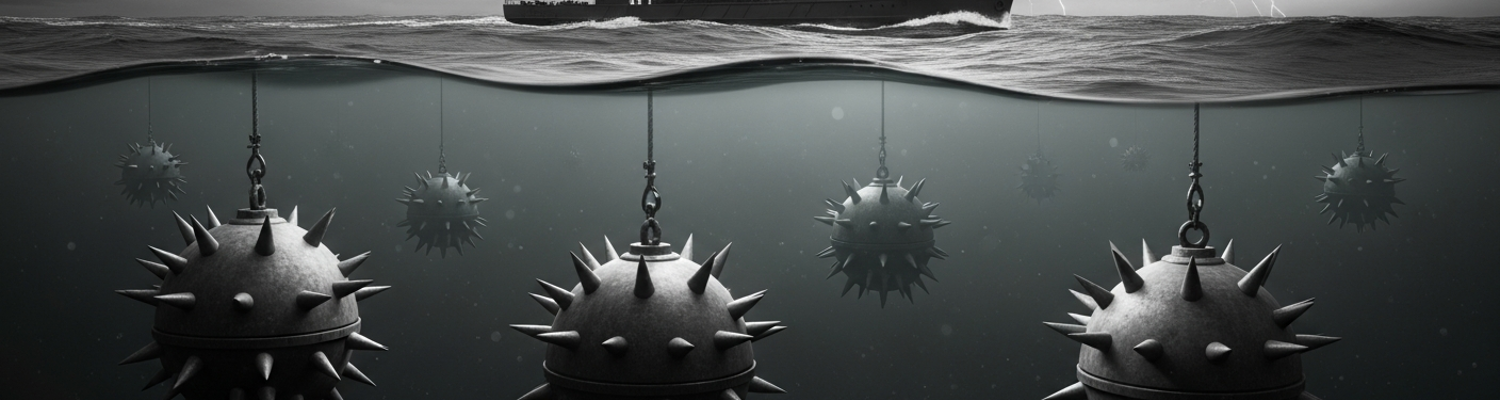
Below the steel-gray waves of the North Sea, a silent, indiscriminate war unfolded. While the world focused on the mud-choked trenches of the Western Front, the maritime arteries that supplied the Allied war machine faced a persistent and lethal threat. German U-boats, the original stealth weapon, were strangling Great Britain. By April 1917, they were sinking nearly 900,000 tons of shipping a month, a loss rate that threatened to starve the island nation into submission. In response, Allied naval planners, particularly within the increasingly influential United States Navy, pushed for an audacious and monumental engineering project. The goal was not merely to hunt the U-boats in the vast expanse of the Atlantic but to fence them in, to bar their transit from their home ports to the open ocean. This strategic gambit would rely on an industrial-scale deployment of one of the oldest and most psychologically potent weapons in the naval arsenal: the mine. The Great War at sea would become a conflict defined as much by these submerged sentinels as by the grandeur of battleship fleets.
Closing the Gate
The idea was simple in concept, staggering in scale. A massive minefield, a true barrage, would be laid across the 230-mile gap of the North Sea, stretching from the Orkney Islands off Scotland to the coast of neutral Norway. This 'Northern Barrage' was intended to close the main transit route for German U-boats heading to the Atlantic, forcing them into a deadly lottery. The concept first emerged in 1916 but was initially met with skepticism. The logistical requirements were immense, and the available technology was questionable. Early estimates suggested that closing the gap, with waters up to 900 feet deep, would require some 400,000 conventional contact mines, a production and deployment feat far beyond Allied capabilities at the time.
The entry of the United States into the war in April 1917, and a corresponding American impatience with what some leaders saw as a passive British anti-submarine strategy, resurrected the plan. The plan, championed vigorously by the U.S. Navy's commander in London, Admiral William Sims, met initial resistance from the Royal Navy's Grand Fleet commander, Admiral David Beatty. The British, bearing the brunt of the naval war for three years, were wary of the immense logistical commitment and doubted its effectiveness. American naval leadership, however, saw it as a way to apply the nation's industrial power directly and decisively. The U.S. Navy's Bureau of Ordnance, under Rear Admiral Ralph Earle, had perfected the Mark 6 mine, turning a strategic wish into a feasible engineering problem. At the Allied Naval Conference on September 5, 1917, the plan was formally agreed upon. The Americans, brimming with industrial might, would provide the mines and the majority of the laying force.
U.S. Rear Admiral Joseph Strauss was appointed to command the American mining operations, establishing his headquarters and assembly bases in the Scottish towns of Inverness and Invergordon. The logistics were a transatlantic behemoth. A staggering $40 million in contracts were dispersed across American industry to manufacture the complex components of the Mark 6 mines. These parts were shipped to a dedicated plant near Norfolk, Virginia, loaded with their 300-pound TNT charges, and then transported by a fleet of 24 dedicated cargo ships across the hazardous Atlantic. At the Scottish bases, U.S. Navy personnel worked relentlessly, assembling as many as 1,000 mines per day.
Mine Squadron One, under Commander Reginald R. Belknap, was a unique formation. It comprised two older cruisers, the flagship USS San Francisco and USS Baltimore, alongside eight converted coastal steamers. These ships, often screened by British destroyers, sailed in precise formations through seas still actively hunted by U-boats. The work was perilous. Foul North Sea weather was a constant companion, and the risk of a single faulty mine detonating on the rails during a laying operation was a fear every crewman lived with. Over five months and thirteen separate missions, these ships steamed in precise formations, dropping their deadly cargo. In one excursion, the squadron planted 5,520 mines in just under four hours. The barrage was laid in 18 rows at staggered depths, with some mines set just 45 feet below the surface to catch surfaced U-boats, while others were moored as deep as 240 feet to snag them running submerged. By the time the final mine was laid on October 26, 1918, a total of 70,263 mines had been planted. The United States had laid 56,611 of them. The barrage was a brute-force instrument of area denial, the largest project of its kind in history.
The Galvanic Sting
The North Sea Mine Barrage was only possible because of a fundamental leap in mine technology. For decades, the standard naval mine was a contact weapon. Its effectiveness was limited by its own dimensions. A ship’s hull had to physically strike one of the protruding 'Hertz horns', crushing a glass vial of acid that would then energize a battery and fire the detonator. This meant minefields had to be incredibly dense to ensure a hit. The German navy had perfected these contact mines and deployed them with ruthless efficiency using a new generation of minelaying submarines, the UC-class boats, which could covertly deposit their deadly payload in Allied shipping channels.
The American Mark 6 mine, which made the Northern Barrage feasible, was a different animal. Its genius lay in what was called the 'antenna' trigger. Instead of relying solely on a direct strike against the mine’s casing, the Mark 6 featured a long copper wire that extended upwards from the mine towards the surface, held taut by a small float. Another copper wire trailed down from the mine itself. When the steel hull of a submarine made contact with the upper antenna wire, the hull, the copper wire, and the conductive seawater formed a galvanic battery. This generated a small electrical current that, amplified by a sensitive relay in the detonator mechanism, was sufficient to fire the 300-pound TNT charge. The Mark 6 also incorporated a vital safety feature: a small salt washer that separated the battery components. Only after being submerged for a set time would the salt dissolve, allowing the battery to connect and arm the mine. This prevented catastrophic accidents on the decks of the minelayers.
This innovation dramatically increased the weapon’s effective kill radius. A single mine no longer covered just its own three-foot diameter sphere, it now controlled a lethal vertical column of water defined by the length of its antenna, which could be up to 70 feet long. A submarine did not have to hit the mine, it merely had to brush against a thin, almost invisible wire. This meant far fewer mines were needed to create an effective barrier. The initial Royal Navy estimate of 400,000 mines for the North Sea gap was reduced to a more achievable target of 100,000 with the advent of the Mark 6. While the barrage sank a confirmed number of U-boats often cited between four and six, its psychological impact and the disruption it caused to U-boat operations were significant.
While the antenna mine was the war’s most impactful innovation, other concepts were emerging. The British, whose own standard naval mines were notoriously unreliable at the war’s outset, began experimenting with influence triggers. In 1918, the Royal Navy deployed the first magnetic bottom mines off the Belgian coast. These early designs were intended to detonate when they detected the magnetic field of a ship passing overhead. The technology was in its infancy. The mines proved highly unstable, with a high rate of premature detonation reported by the crews laying them. Acoustic triggers were also being conceptually explored, but it would take another war for these influence mechanisms to mature into the effective weapons that defined the mine warfare of World War II.
Forging the Tools of Counter-Warfare
The proliferation of German minefields, particularly those laid by submarines in the approaches to critical ports, created an urgent demand for a new type of naval warfare: mine countermeasures. Before the war, the practice was rudimentary, often involving dragging chains between two vessels. The Royal Navy began the war with only a handful of converted torpedo gunboats for the task. The immediate solution was improvisation on a massive scale. The Admiralty requisitioned hundreds of civilian fishing trawlers. These sturdy, seaworthy vessels, crewed by fishermen experienced in handling heavy nets and wires in rough seas, formed the backbone of the new Minesweeping Service. These civilian sailors, many part of the Royal Naval Reserve's Trawler Section, became the unsung masters of this new warfare. Their work was a grinding, constant battle against an unseen enemy in all weather conditions. The loss of a trawler to a mine was a frequent occurrence, often with no survivors.
Sweeping for moored contact mines was perilous work. The primary method involved two trawlers steaming in parallel, towing a heavy, serrated wire between them designed to snag the mooring cables of mines. Once snagged, the tension from the sweep wire would saw through the mooring cable, causing the buoyant mine to pop to the surface where it could be destroyed by rifle or cannon fire. This was a hazardous process, placing the sweepers themselves in constant danger within the minefield.
A critical invention that improved both safety and efficiency was the paravane. Developed between 1914 and 1916 by Lieutenant Dennis Burney and Commander C. Vivian Usborne, a paravane was a towed, winged underwater body. When deployed from a ship’s bow, one on each side, the hydrodynamic forces on the wings would pull the paravanes and their attached tow-wires away from the hull. This created a protective V-shape of wire moving ahead of the ship. If a mooring cable was encountered, it would be deflected down the wire to the paravane, where a hardened steel cutter would sever it. Paravanes became standard defensive equipment for larger warships and many merchant vessels, acting as a personal minesweep. They were also adapted for offensive sweeping, allowing a single, faster vessel to clear a path.
As the war progressed, the need for purpose-built minesweepers became clear. This led the Royal Navy to commission the Flower-class sloops, starting in 1915. Built in merchant shipyards to avoid burdening naval yards, the initial batches (the Acacia, Azalea, and Arabis classes) were designed as fleet minesweepers, featuring triple-layered hulls at the bow for extra protection against mine detonations. These ships, nicknamed the 'herbaceous borders,' proved to be versatile workhorses. As the U-boat threat intensified, many were repurposed for convoy escort duty, armed with guns and depth charges, demonstrating the close operational link between anti-mine and anti-submarine warfare. The armistice of November 11, 1918, did not end the mine war. It began its most dangerous phase: the cleanup. Clearing the North Sea Mine Barrage was a massive task assigned largely to the men who had laid it. An international force of 82 ships and over 4,000 men, primarily American and British, spent seven months, from the spring to the fall of 1919, sweeping the area. They located and destroyed over 25,000 mines. The work was arguably more dangerous than laying them. Mines had broken from their moorings, their depths were now unpredictable, and their mechanisms were corroded and unstable. Dozens of ships were damaged and several sunk, with significant loss of life, a final, lethal postscript to the Great War's unseen front.