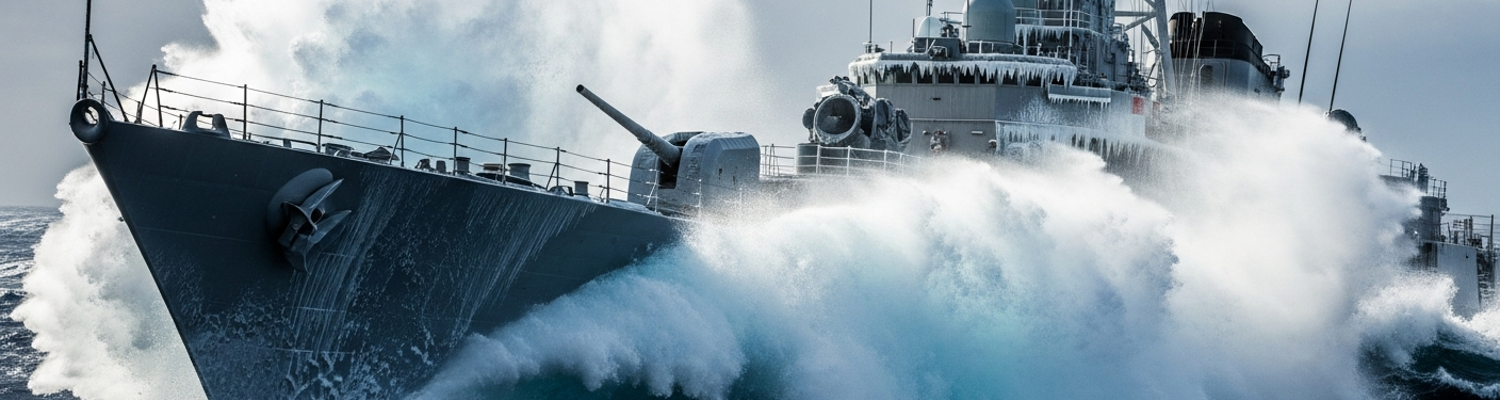

The GIUK Gap SIGINT Environment
The Greenland-Iceland-United Kingdom gap was the primary theater of an undeclared war. Archival evidence shows this series of maritime chokepoints was the only path for Soviet naval forces from the Kola Peninsula to reach the open Atlantic. It was the main artery for NATO's reinforcement and resupply. Convoys from the United States to Europe would pass through these lanes. This made them a priority target for the Soviet Northern Fleet’s submarine force. Allied naval strategy centered on controlling this gap. The effort was multi-layered. It involved anti-submarine warfare (ASW) patrols by surface ships, maritime patrol aircraft like the P-3 Orion, and hunter-killer submarines. All worked to track and contain the Soviet threat. The operational area was a dense network of sensors, from SOSUS arrays on the seafloor to orbiting satellites, creating a constant state of electronic surveillance and counter-surveillance.
Superior intelligence was the only way to win this contest. Naval signals intelligence (SIGINT) collection units were the lead element. Manned by specialized ratings like the U.S. Navy’s Communications Technicians (CTs), these small detachments had a mission of significant strategic weight. Their objective was the interception, analysis, and exploitation of Soviet military emissions, a practice known as Electronic Intelligence (ELINT). These teams were hunting for everything from the high-frequency communications of Soviet fleet command to the specific radar emissions of a Tupolev Tu-142 maritime patrol aircraft. They sought the unique electronic signature of a particular class of submarine. This information provided NATO commanders with an electronic order of battle. It allowed them to track the location, disposition, and potential intent of Soviet naval forces with a precision that sonar or visual reconnaissance alone could not match. The work was painstaking. It demanded intense focus inside cramped, windowless compartments packed with sensitive receivers.
Early platforms for this mission were often ill-suited for the task. In the 1950s and 60s, the U.S. Navy began modifying World War II-era destroyers for ELINT duties. Ships of the Gearing class were a common choice. These were not purpose-built. They were aging combatants retrofitted with new, power-hungry, and often unreliable electronic systems. Operational logs from this period (NARA Record Group 38, CNO files) detail the strain placed on these early ELINT destroyers. They had to perform a dual role. They operated as fully functional warships ready for anti-submarine or anti-aircraft duties while sailing provocatively close to Soviet naval formations to collect faint signals. Early receiver suites like the AN/WLR-1, while sensitive, were manually intensive, tube-based systems. They generated enormous heat and were prone to frequent failure. An operator had to be on the right frequency band at the exact right moment to catch a fleeting transmission. The additional antennas and electronic gear added top-weight to the destroyers, impacting their seakeeping. The specialized CTs often worked in spaces originally designed for ammunition or supplies, running a constant battle against equipment malfunctions and the relentless motion of the ship in heavy North Atlantic seas.
The Impact of Personnel Integration Directives
A distant, top-down mandate was about to collide with the closed-off world of naval signals intelligence. On July 26, 1948, President Harry S. Truman signed Executive Order 9981. It stated a new policy of equality of treatment and opportunity for all persons in the armed services without regard to race, color, religion or national origin. This was framed as a matter of military efficiency and national security. To oversee this directive, the President’s Committee on Equality of Treatment and Opportunity in the Armed Services, known as the Fahy Committee, was established. Its final report, Freedom to Serve, published in May 1950, argued that segregation was a direct impediment to the military’s effectiveness. The committee’s recommendations were accepted. The policy was set. The order was absolute. For the highly specialized and almost entirely white domain of the Navy’s Communications Technicians, this policy would trigger a period of intense operational disruption. The directive was not a request. It was an order to integrate, to be carried out as rapidly as possible without impairing efficiency or morale.
The policy’s execution created immediate administrative friction. The Communications Technician rating, established in 1948, was one of the most sensitive communities in the Navy. It required extensive background checks for a Top Secret security clearance. The process of clearing the first Black sailors for entry into the CT rating was fraught with bureaucratic obstacles that went far beyond standard procedure. The Single Scope Background Investigation (SSBI) was an intrusive and exhaustive process. Applying it to candidates from communities that had been systematically marginalized created unforeseen challenges for investigators. Unit logs and personnel action requests from the period show a sharp increase in administrative churn. A sailor identified for conversion to the CT rating would be pulled from his existing duties, creating a manning gap on his ship. He would then enter a protracted administrative limbo while his clearance was adjudicated. On the receiving end, SIGINT units aboard destroyers, already chronically short-handed, had to account for trainees who existed on paper but were not yet cleared to enter the sensitive compartmented information facility (SCIF) where the work was done. This created phantom manning charts, where a unit was technically fully staffed but operationally deficient.
Beyond the bureaucratic snarls, the integration mandate met deep-seated cultural resistance. The early CTs were a unique fraternity. They were born from the radiomen and yeomen of World War II who had proven a specific aptitude for the clandestine work of signals interception. They viewed themselves as a technical elite, defined by a shared, rigorous training pipeline and a common, homogenous background. A review of anecdotal records from the era reveals a culture of intense gate-keeping. The arrival of the first Black CTs into these cramped, isolated SIGINT spaces aboard destroyers in the GIUK gap was a profound disruption. This resistance was rarely documented as overt insubordination. It manifested in the daily operational rhythm. A seasoned Chief Petty Officer might sideline a new Black CT3 from a primary watch station, citing a lack of intuitive grasp for the material. Training and mentorship, traditionally handled informally within the division, became rigidly formal. Minority sailors were often the last to be qualified on new equipment or briefed on evolving Soviet electronic tactics. This subtle but persistent social and professional isolation damaged the very unit cohesion essential for a mission where operators had to implicitly trust the instincts and skills of the man sitting next to them.
A North Atlantic ELINT Destroyer Patrol
Operational logs from the period detail the physical trial of a winter patrol in the Denmark Strait. For a Gearing-class destroyer, even one lengthened to improve fuel capacity and seakeeping, the environment was a relentless adversary. The ships were not designed for the sustained battering of Force 10 gales. Green water would crash over the bow and freeze instantly on the superstructure. Deck plating, chilled to well below freezing, became brittle. Archival maintenance records show a sharp increase in stress fractures and metal fatigue on these patrols. The constant, violent motion of the ship, a sickening corkscrew roll and pitch, made even the most basic tasks a trial of endurance. Ice was a direct threat to the mission. A heavy accumulation of frozen spray on the mast and the newly installed arrays of ELINT antennas made the destroyers dangerously top-heavy. This threatened to capsize them. Chipping parties, working on icy, pitching decks in numbing cold, were a constant feature of life. This was a low-tech solution to a high-tech problem. The very air, thick with salt and freezing moisture, worked its way into the sensitive, tube-based electronics that were the ship’s entire reason for being there. It caused short circuits and equipment failures that could render a whole patrol useless.
These destroyers were conducting Tattletale patrols. This was a tense form of electronic shadowing. Their task was to close on a Soviet naval task force, often centered on a prized asset like a Sverdlov-class cruiser, and remain just outside of visual range. Inside a cramped, windowless compartment, a small team of Communications Technicians huddled over the glowing screens and dials of their intercept receivers. Their primary tool was often the AN/WLR-1, a manually operated system that required an operator with a deep, intuitive feel for the radio-frequency spectrum. They were hunting for the fleeting electronic signatures of Soviet hardware. This included the specific pulse repetition frequency of a Top Trough air search radar or the unique electronic fingerprint of a fire control system. This data was strategically priceless. It allowed NATO to build a detailed electronic order of battle, tracking not just the location of Soviet ships, but their operational readiness, their tactics, and their technological capabilities. Each successful intercept was a small piece of a much larger puzzle.
The human element was the most unpredictable variable. It was here that the unintended consequences of high-level policy began to manifest. The process of integrating the CT rating was not seamless. Within the tight confines of the ELINT space, the arrival of the first Black sailors created a new and undocumented form of internal friction. A review of anecdotal evidence from the period reveals a pattern of subtle professional isolation. A newly assigned Black CT3, fresh from training, might find himself consistently assigned to log-keeping or equipment maintenance, rather than a primary intercept watch station. The informal, on-the-job training that was the lifeblood of the community was often withheld. A white watch supervisor, under pressure to identify a new, low-probability-of-intercept signal, might second-guess the analysis of a Black operator. This lost valuable seconds as he sought confirmation from another white technician. This hesitation was not born of explicit orders. It was born of a breakdown in the implicit trust that elite technical teams rely on. The system was designed for the rapid acquisition and analysis of data, but the social friction acted as a lag, a moment of doubt that could allow a Soviet transmission to be missed entirely.
The Impact of Crew Skill Disparities
The accelerated push to integrate the Communications Technician rating produced manning charts that were misleading. A Gearing-class destroyer departing Norfolk for a patrol might show a full complement of CTs on paper, but the operational effectiveness of that team was an unknown. The Navy’s formal training schools could teach a sailor the basic functions of an AN/WLR-1 intercept receiver or the theory of signal analysis. They could not replicate the deep, intuitive knowledge passed down informally within the SIGINT community. A review of training records reveals a pattern of professional ostracization. A seasoned Chief Petty Officer, himself a product of the old, homogenous rating, would frequently sideline a new Black sailor from a primary watch station. The justification was often a stated lack of intuitive grasp of the complex equipment. This was a self-fulfilling prophecy. The on-the-job mentorship, the quiet word about a new Soviet radar modulation, the shared trick for tuning a receiver to catch a faint signal, was deliberately withheld. This created an operator who could physically occupy the seat, but who lacked the nuanced skill set required for the mission. The skill disparity was not one of aptitude, but of access.
This manufactured deficit in skill directly compromised cohesion within the ship’s SIGINT van. In the cramped, windowless steel box where the CTs worked, implicit trust was a tactical requirement. A watch supervisor needed absolute faith that his operators could instantly recognize the subtle electronic signature of a Soviet submarine’s brief, high-frequency Z-gram transmission. They needed to spot the shift in a Top Trough radar’s pulse repetition frequency that indicated it was moving from search to a target-acquisition mode. Historical records detail a breakdown of this essential trust. A Black CT3, correctly identifying a fleeting, low-probability-of-intercept signal, might have his report actively questioned by his white supervisor. The supervisor, instead of immediately acting on the intelligence, would lose seconds, and possibly the signal itself, by turning to a white operator on a different console for verification. This hesitation injected a lag into the intelligence cycle. The entire system, from the antennas on the mast to the destroyer’s combat information center, was built for speed. Social friction acted as a brake, slowing the process at its most critical human junction.
The internal fracturing occurred against an external threat of growing complexity. The Soviet Northern Fleet did not present a simple, static electronic picture. NATO intelligence assessments from the period show a constant, deliberate effort by Soviet planners to saturate and confuse the radio-frequency spectrum. For every genuine warship transmission, there were layers of decoys, ghost signals, and sophisticated jamming patterns designed to exhaust Allied collection efforts. A single Soviet naval group could emit hundreds of unique electronic signals across a vast range of frequencies. The mission of the destroyer’s CTs was to sift through this electronic blizzard, find the one decisive signal, and report it in seconds. The combination of skill gaps and shattered cohesion meant the unit’s capacity to manage this data flow was severely degraded. An operator unsure of his equipment or whose findings were consistently second-guessed was far more likely to misclassify a threat or dismiss a faint, unfamiliar signal as atmospheric noise. The load on the few experienced, trusted operators became unsustainable as they were forced to perform their own duties while double-checking the work of the marginalized sailors. This led to burnout and an intelligence picture that was dangerously incomplete. A new radar signature from a Tupolev Tu-95 Bear maritime patrol aircraft, a system NATO had never before encountered, could be intercepted, correctly logged by a new operator, and then dismissed by a biased supervisor, leaving the entire carrier group it was shadowing exposed.
The Improvised SIGINT Antenna Array
Operational logs from ELINT-configured Gearing-class destroyers on patrol in the GIUK gap reveal a consistent frustration with the standard antenna suites. The primary mast-mounted arrays, like the AS-571, were designed for broad-spectrum surveillance. They were effective for general collection but tactically inadequate for new challenges presented by Soviet electronic warfare doctrine. Soviet naval groups were beginning to employ low-power, line-of-sight VHF and UHF communications for tactical maneuvering. These signals were often buried in the destroyer’s own electronic noise floor or physically blocked by the ship’s superstructure. Watch-to-watch turnover notes from CT detachments describe the repeated loss of signals as the destroyer changed course. An operator would be tracking a faint Soviet transmission, only to have it disappear entirely when the target vessel moved into a bearing where the destroyer’s own mast or exhaust stacks were in the way. This physical obstruction, combined with the corrosive effects of salt spray and ice, created a collection environment where the multi-million-dollar ship was frequently deaf in the most important directions.
The breaking point occurred aboard the USS Epperson (DD-719) during a winter patrol in 1961. Maintenance records from the ship show that a team, led by a Chief Communications Technician and a First Class Electronics Technician, decided to circumvent the problem. Their solution was entirely unauthorized. Using scrounged materials from the ship’s electronics workshop, they constructed a non-standard antenna array. The core of their device consisted of two Yagi-Uda antennas, simple directional antennas normally used for ship-to-shore television reception, which they had acquired through unofficial channels. They mounted these two antennas horizontally on a custom-built wooden frame, separated by a precisely measured distance of three meters. This fragile assembly was then lashed with communications wire and canvas straps to the 02-level deckhouse, just forward of the bridge. The location was chosen for its clear fields of view and its relative distance from the main mast’s electronic interference. The coaxial cables from the antennas were not routed through the ship’s official pathways. They were run directly through an open porthole into the SIGINT van, a flagrant violation of all electronic security and watertight integrity protocols.
The physical construction was only the first part of the innovation. A single directional antenna could tell an operator the general direction of a signal. The team aboard the Epperson was aiming for something far more precise. Their two-antenna setup was a crude but effective radio-frequency interferometer. The novel signal processing method they implemented required no new computer systems. None were available. Instead, they fed the inputs from the two parallel Yagi antennas into the separate channels of a standard dual-trace oscilloscope. When a targeted Soviet UHF signal was received, it would appear as two distinct sine waves on the oscilloscope’s screen. Because the antennas were separated by a known distance, the signal would arrive at one antenna a few nanoseconds before the other. This created a measurable phase difference between the two waves. A skilled operator, observing the degree to which the peaks and troughs of the two sine waves were out of alignment, could use a pre-calculated chart taped to the oscilloscope to translate that visual phase difference into a precise numerical bearing to the Soviet emitter, accurate to within one or two degrees. This manual, cognitive process changed the tactical geometry of the North Atlantic. For the first time, a single destroyer could generate its own high-confidence direction-finding fix on a low-power, line-of-sight transmission without relying on a network of other ships.
Detection of a Critical Soviet Deployment
Operational logs from the USS Epperson reveal the moment the strategic calculus of the North Atlantic shifted. The destroyer’s SIGINT team was fixated on a large Soviet surface action group, a predictable formation executing standard maneuvers. The primary collection systems, tied to the ship’s powerful mast-mounted antennas, were fully dedicated to this main effort, logging familiar radar and communication emissions. Inside the cramped SIGINT van, a parallel and unintentional experiment was underway. A newly assigned Black CT3, professionally isolated from the primary watch team, had been assigned to the improvised Yagi antenna interferometer. He was instructed to use the jury-rigged system for practice, a task designed to keep him occupied and away from the main task of monitoring the surface group. This isolation, a direct consequence of the social and professional friction that defined the integration process, provided him with the freedom to explore the periphery of the electronic spectrum. He was far from the high-traffic frequencies used by the main Soviet force.
He was looking where no one else was. He began to log a series of extremely faint, sporadic UHF transmissions. These signals were too weak and intermittent for the ship’s main AN/WLR-1 receivers to reliably acquire. They were dismissed by the primary operators as atmospheric noise or random interference. The improvised Yagi array, with its narrow, directional focus, could hold onto them. The interferometer setup allowed the operator to generate a precise bearing for each burst. The young technician’s log showed a disturbing pattern. The transmissions were all originating from the same quadrant, but from slightly different locations, far from the main Soviet task force. When he reported his findings, the watch supervisor dismissed the data. It was only when the operator used the oscilloscope display to visually demonstrate the consistent phase-shift on the incoming signals that the supervisor was forced to take notice. The data from the practice system was undeniable.
The discovery was a complete repudiation of established Soviet naval doctrine. A detailed plot of the bearings revealed not one, but at least four separate emitters moving in a coordinated pattern. These were not surface ships. The signal characteristics, low power, ultra-high frequency, and short duration, pointed to submarine periscope antennas. Soviet submarine doctrine, as understood by NATO, was rigid. Submarines ran silent, using VLF or ELF transmissions for infrequent, one-way communication from command authorities. They were expected to operate as lone hunters or in loosely associated patrols. This new behavior was something else entirely. It suggested a pack of submarines using high-bandwidth UHF datalinks to actively coordinate their movements in near real-time. It was a tactic that sacrificed ultimate stealth for tactical cohesion. It was the electronic signature of a coordinated wolfpack, a tactic NATO believed the Soviets did not practice, preparing to stage a swarm attack.
This single intelligence breakthrough was a direct, unintended positive consequence of the command’s dysfunctional approach to integration. The very act of marginalizing the new sailor, by assigning him to a non-standard, experimental piece of equipment and isolating him from the primary mission, created an independent sensor. This parallel collection effort, born from social friction, was completely decoupled from the main team’s cognitive biases. The primary watch standers were looking for known threats on established systems. The ostracized operator, with his toy, had no such preconceptions. He was free to meticulously track anomalies the main team was conditioned to ignore. The flawed social dynamic had accidentally created a perfect filter for discovering a novel threat. The intelligence was a tactical bombshell, forcing an immediate re-evaluation of the entire anti-submarine warfare posture in the North Atlantic.