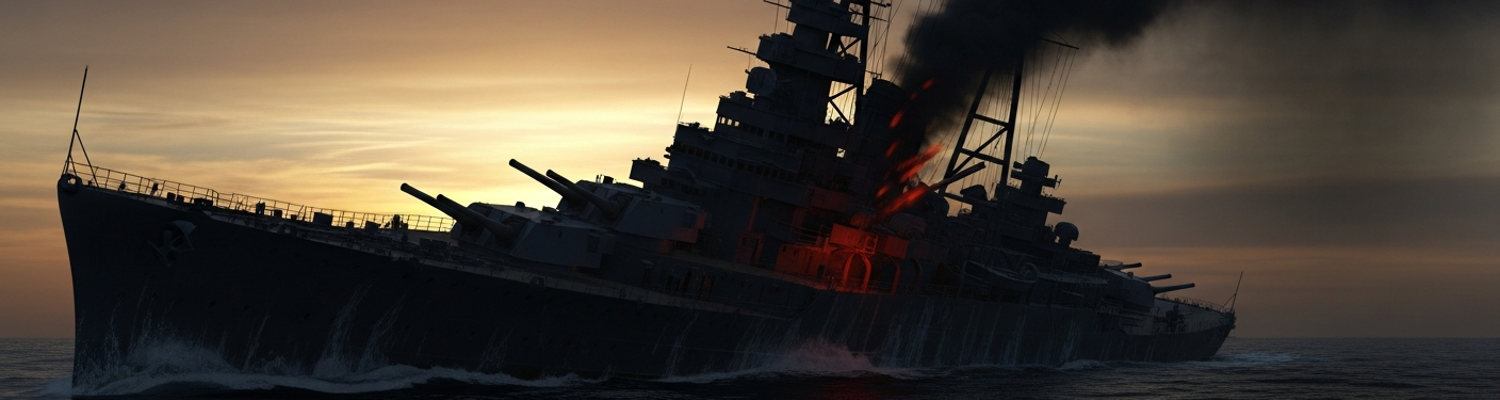

The Battle of Savo Island: A Failure of Awareness
The naval arsenal assembled in the South Pacific in late summer 1942 was formidable. Task Force 61 and its escorts brought dozens of 5-inch, 6-inch, and 8-inch guns to the Solomon Islands. The heavy cruisers USS Astoria, Quincy, and Vincennes contributed forty-five 8-inch guns alone. These were augmented by the rapid-fire 6-inch batteries of anti-aircraft cruisers and the dual-purpose 5-inch guns of more than a dozen destroyers. Below decks, magazines held thousands of tons of explosives. The standard surface-launched torpedo for American destroyers was the 21-inch Mark 15, a weapon carrying over 800 pounds of high explosive. Its operational history would soon reveal deep flaws.
The waters between Guadalcanal, Savo Island, and Florida Island earned the name Ironbottom Sound for the quantity of steel that would settle on its floor. The first major contribution occurred during the Battle of Savo Island on the night of August 9, 1942.
Operational logs show a near-complete collapse of Allied command, control, and situational awareness. A Japanese force of seven cruisers and one destroyer under Vice Admiral Gunichi Mikawa, using superior night-optics and well-rehearsed night combat doctrine, achieved total surprise. The Allied force was divided into two cruising groups. Picket destroyers USS Blue and USS Ralph Talbot failed to detect the approaching enemy column. Japanese scout planes dropped flares, silhouetting the Allied ships against the dark landmass of Guadalcanal. The action that followed was a one-sided destruction.
HMAS Canberra was hit 24 times in less than two minutes and was later scuttled. USS Astoria sustained at least 65 hits. The fires grew so uncontrollable that her crew abandoned ship before she sank twelve hours later. The cruisers USS Quincy and USS Vincennes were caught in a crossfire between the two halves of Mikawa’s column, illuminated by searchlights, and systematically destroyed by shellfire and torpedoes. Both sank within an hour. The confined channel prevented evasive maneuvering and turned the engagement into a point-blank fight.
The Battle of Tassafaronga: A Failure of Technology
Months later, some lessons from Savo Island had been absorbed, but the tactical realities of Ironbottom Sound remained lethal. On the night of November 30, 1942, a new American formation, Task Force 67 under Rear Admiral Carleton H. Wright, attempted to intercept a Japanese destroyer reinforcement run at the Battle of Tassafaronga. This time, American cruisers were equipped with superior SG surface-search radar. They detected the Japanese column under Rear Admiral Raizo Tanaka first.
Wright’s plan was for his destroyers to launch a surprise torpedo attack. The cruisers would then open fire from beyond the range of Japanese torpedoes.
The plan failed immediately.
The destroyer torpedoes, faulty Mark 15s, were launched but mostly missed. Almost at once, the cruiser commanders, including Wright aboard his flagship USS Minneapolis, ordered their ships to open fire. The muzzle flashes from their own 8-inch guns illuminated the American cruisers perfectly for the Japanese destroyers.
Tanaka’s ships, though burdened with supply drums for the Guadalcanal garrison, reacted with speed and precision. They jettisoned their cargo, turned, and launched a spread of their Type 93 “Long Lance” torpedoes. These weapons were faster, had a longer range, and carried a heavier warhead than their American counterparts. Their oxygen-fuelled propulsion system left a nearly invisible wake. A single torpedo hit blew the bow completely off the USS New Orleans. The USS Minneapolis was struck by two torpedoes; one tore her bow off and the other hit a fireroom, leaving the ship crippled and without power. The USS Pensacola, maneuvering to avoid the damaged ships ahead, was caught in the glare of the burning vessels and hit by a torpedo below the mainmast, which flooded her engine room and turned the aft of the ship into an inferno. The USS Northampton was hit by two Long Lances and sank after three hours of damage control efforts. In exchange for the mauling of four American heavy cruisers, the Japanese lost only the single destroyer Takanami.
Damage Control at Tulagi: Improvised Engineering
When a Japanese Type 93 torpedo struck the USS New Orleans, it detonated the forward magazines. The explosion obliterated the forward 150 feet of the cruiser, severing the bow forward of Turret Number 2. This entire section, containing three 8-inch guns and weighing 1,800 tons, twisted off and scraped down the port side of the ship, punching additional holes in the hull before sinking. The blast and flooding killed 183 men. Aboard the USS Minneapolis, two torpedoes hit almost at the same time. The first struck the port bow, causing it to buckle and fold down, acting as a scoop that forced the ship’s nose underwater. The second torpedo tore into the number two fireroom, extinguishing boilers and causing a near-total loss of electrical power.
Once the crippled cruisers reached the relative safety of Tulagi Harbor, the real work began. It was defined by resourcefulness in a primitive forward base. There were no dry docks and no heavy cranes, only the limited tools of the ship’s own machine shops and help from repair crews on ships like the USS Vestal. Damage control parties on the New Orleans worked for 11 days on a desperate solution. With the forward bulkheads straining, they constructed a jury-rigged bow out of coconut palm logs, creating a rough, temporary structure to provide some seaworthiness. To protect the damaged ships from Japanese air attack, crews covered the decks and superstructures with palm fronds and camouflage netting, hoping to blend the warships into the shoreline of Florida Island.
Saving the ships required navigating them across thousands of miles of open ocean. The Pensacola’s crew fought their oil-fueled fire for twelve straight hours after reaching Tulagi, using bucket brigades and submersible pumps to dewater compartments. The crew of the Minneapolis kept their ship afloat despite the bow being almost entirely submerged. The most difficult journey was that of the New Orleans. To prevent the weak, log-built bow from collapsing, the ship had to sail stern-first. For 1,800 miles to Sydney, Australia, the cruiser traveled backwards. All three cruisers were saved. The New Orleans and Minneapolis would spend until August 1943 undergoing reconstruction. The Pensacola did not return to the fleet until November 1943, a full year after the battle.
Gunnery Systems: Manual Overrides Under Fire
American pre-war naval gunnery doctrine relied on advanced optical directors and the Ford Mark I analog fire-control computer. Doctrine called for centralized control, where an officer in the main battery director would spot a target, feed data to the computer, and fire all main guns in a coordinated salvo. In the close-range, nocturnal fights of the Solomons campaign, this system was frequently useless. Director crews were often blind, unable to distinguish friend from foe in the confusing melee. The glare from a ship’s own guns could temporarily night-blind the spotters. Thick cordite smoke from rapid-firing 5-inch and 6-inch batteries would drift across the line of sight, obscuring the target. Early surface-search radar was a new technology whose operators were often inexperienced, flooding the command team with raw data that was difficult to interpret.
These systems were also mechanically fragile. The shock from a near-miss could knock a delicate analog computer offline. A direct hit could sever the electrical and hydraulic lines that powered the turrets. The Battle of Cape Esperance on the night of October 11-12, 1942, provided a case study in systems failure for the light cruiser USS Boise. An 8-inch Japanese shell struck the armored barbette of Turret I, jamming it. A more damaging hit occurred when a shell penetrated the hull below the waterline and detonated near the forward magazines for Turrets I and II. The explosion and powder fire cooked off ammunition and burned out the lower handling rooms for the three forward 6-inch turrets, killing 107 sailors and knocking all three out of action. Powder hoists were found with the charred remains of cartridges still inside (per Philadelphia Navy Yard damage analysis). The fire severed the ammunition supply chain.
In the face of such breakdowns, combat effectiveness fell to the gun crews. When a turret lost power, it became a mass of inert steel that had to be moved by muscle. Naval regulations and training accounted for this. Crews resorted to hand cranks and manual gear to wrestle the immense weight of the guns and turret. This was a physically punishing task in a cramped, smoke-filled steel box. When shell and powder hoists failed, the only solution was a human chain. Sailors manhandled 100-pound 8-inch shells and bulky powder bags up ladders and through hatches, from the magazines to the breech of the gun. This slow, exhausting process drastically reduced a weapon’s rate of fire. When centralized fire control was lost, individual gun captains reverted to local control, peering through telescopic sights mounted directly to the gun, attempting to aim by spotting the splash of their own shells. It was a regression to the gunnery of a previous era.
Civilian Impact: The Unrecorded Cost on Guadalcanal
U.S. Navy operational orders from the Guadalcanal campaign reveal a complete absence of protocols for tracking civilian casualties. The administrative machinery of war had no columns in its ledgers for the Melanesian population caught between naval guns and their targets. After-action reports from cruisers and destroyers meticulously logged rounds expended and observed damage to enemy military assets. The destruction of a village or the displacement of its inhabitants was not a required reporting metric. The doctrine of the era, conceived for fleet-on-fleet engagements, treated land bombardment as a tool for destroying the enemy’s capacity to fight. The primary targets were military: the airfield at Lunga Point, Japanese supply dumps, and suspected troop concentrations. Any damage outside these target boxes was, from an administrative standpoint, non-existent.
This administrative vacuum was compounded by the impossibility of distinguishing combatants from non-combatants. From the deck of a warship several miles offshore, often at night, the reality on the ground was invisible. Japanese forces frequently operated from within native villages. At the same time, Allied forces heavily relied on indigenous Solomon Islanders as scouts, laborers, and guides. The Solomon Islands Labour Corps, formally established in November 1942, eventually comprised thousands of islanders providing logistical support. A group of figures moving along a coastal track could be a Japanese patrol, an Allied scouting party, or a family foraging for food. For a gun crew with only a range and bearing, every person on the island was a potential enemy.
Initial reports on civilian displacement were sporadic and anecdotal. The most significant records came from on-the-ground observers like the British District Officer Martin Clemens. His diaries noted the abandonment of coastal villages as the incessant shelling. The destruction was comprehensive. Entire villages along the northern coast were obliterated. The bombardments destroyed the subsistence economy of the islanders. Coastal gardens, which provided the primary food source of yams and taro, were turned into cratered wastelands. The loss of canoes, essential for fishing and transport, severed communities from their livelihoods. While no formal tallies of dead were kept, Allied administrators later had to contend with a displaced, malnourished population. The destruction of their homes was a direct consequence of naval actions, even if it was a consequence the fleets firing the guns never had to formally document.
Medical Triage: Casualty Overload in Night Actions
Medical doctrine collapsed under the pressures of close-quarters naval combat. On an undamaged vessel, medical care was a structured process centered on a sick bay, managed by a ship’s surgeon and pharmacist’s mates. In a night action like Tassafaronga, this system disintegrated. When a torpedo struck the USS Pensacola, the impact ruptured fuel oil tanks, turning the aft section of the ship into a torch. The ship’s designated medical spaces became unusable. Damage control parties fought fires while medical personnel established casualty collection points on crowded mess decks or in darkened passageways, often without power or adequate light.
The nature of the injuries was overwhelming. Naval gunnery produced high-velocity shrapnel wounds. Flash fires from exploding shells and ignited fuel caused horrific burns. On the USS San Francisco during the Naval Battle of Guadalcanal, a single aircraft crash killed 24 men and wounded 45. Shellfire from the main engagement left another 85 wounded. A cruiser’s medical staff, often just one physician and a handful of corpsmen, was saturated by such numbers. They were forced into a brutal triage, using limited supplies of morphine, plasma, and bandages to stabilize the most critical patients under impossible conditions. This practice would later be termed damage control surgery.
The system was not built for this.
Personnel Accounting: The Collapse of Paper Systems
The U.S. Navy’s personnel accountability procedure was a paper-based system designed for an orderly war. Each man’s status was to be tracked. Emergency Medical Tags (EMTs) were to be filled out for each casualty detailing the injury and initial treatment. These records were the foundation of the casualty reporting system, informing everything from after-action analysis to the notification of next of kin. When ships like the USS Quincy and USS Vincennes sank in under an hour at the Battle of Savo Island, this system vanished.
There was no time to compile lists or fill out tags. Survivors were scattered in oil-slicked water for hours. Many were picked up by different destroyers or transports. Others made it to shore on Guadalcanal. A destroyer’s crew might pull men from three different sunken cruisers out of the water, none of whom had records. These sailors were now administratively ghosts. They received emergency care but were untethered to any official ship’s roster. Reconciling these impromptu lists of survivors with the last known muster rolls of sunken vessels became a massive bureaucratic challenge. It delayed official notifications and created gaps in the data collected by the Bureau of Medicine and Surgery (BuMed).
The result was a vast, unrecorded shadow system of medical care. A sailor from the USS Northampton, sunk at Tassafaronga, might be pulled aboard a destroyer with severe burns. He would be treated by that destroyer’s pharmacist’s mate, using its limited medical supplies. This treatment would often go undocumented. The sailor had no EMT, and his own ship’s medical logs were at the bottom of Ironbottom Sound. Navy survivors who washed ashore on Guadalcanal were frequently treated at Marine or Army aid stations, which had their own incompatible record-keeping systems. Medical personnel focused on life-saving intervention, not inter-service paperwork. This created a discrepancy between the number of men physically treated for wounds and the number officially logged as combat casualties for a specific vessel. The care was real, but from an administrative perspective, it was invisible.