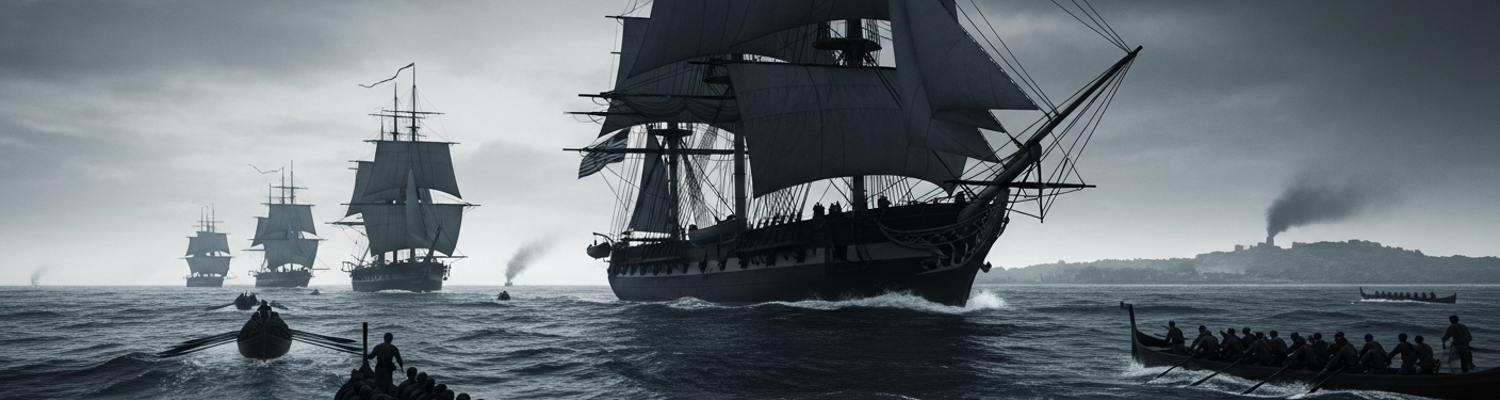

In the decades after the War of 1812, the United States Navy shed its skin as a coastal defense force and began projecting American will across the globe. Its duels with the Royal Navy had forged an identity, but the crucible for its expeditionary doctrine lay half a world away. The lucrative but lawless waters of Southeast Asia, particularly the pepper-rich coast of Sumatra and the strategic Malacca Strait, became the proving ground for America’s nascent power projection. The era was defined by a brutal, pragmatic cycle of trade, piracy, and violent retribution. For American merchantmen sailing from ports like Salem, Massachusetts, the pepper trade promised immense wealth. The voyage, however, was a gamble against monsoons, disease, and violence. Local Malay polities, operating from fortified coastal villages known as kotas, viewed heavily laden Western ships as sources of revenue, whether through trade or plunder. In a maritime frontier where force was the primary arbiter, these actions were less random piracy and more a violent form of local taxation and resistance against encroaching foreign influence. This reality forced Washington to confront a new strategic challenge: how to protect American commercial interests thousands of miles from its shores. The answer came not from a single grand strategy, but through a series of reactive, escalating engagements. The Navy’s response evolved from isolated punitive strikes to a more sophisticated combination of sustained naval presence and forward-thinking diplomacy. The expeditions to Sumatra and the subsequent diplomatic overtures in China were the first, bloody steps in establishing the United States as a Pacific power, a process built on gunpowder, cannon, and the hard-won experience of sailors and Marines.
Potomac's Retribution: Quallah Battoo, 1832
The catalyst for America’s first armed intervention in Asia was an act of brazen violence. In February 1831, the Salem merchant ship Friendship, under Captain Charles Endicott, was trading for pepper off the Sumatran village of Quallah Battoo (modern Kuala Batee). While Endicott was ashore negotiating, pirates disguised as traders boarded the vessel, killing the first officer and two crewmen before plundering its cargo of opium and Spanish dollars. Endicott and his shore party escaped, enlisted the help of other American merchant captains in the area, and managed to retake the battered ship, eventually sailing it back to Massachusetts. The news sparked public outrage. President Andrew Jackson, a man defined by his preference for decisive action over diplomatic patience, ordered an immediate response. The frigate USS Potomac, a powerful 44-gun warship launched just a decade prior, was dispatched under the command of Commodore John Downes. His orders were blunt: secure restitution if possible, but if not, inflict a chastisement so severe it would deter any future attacks on American shipping. The Potomac arrived off Quallah Battoo on February 5, 1832, cleverly disguised as a Danish merchantman to maintain the element of surprise. After a brief and fruitless attempt at negotiation where local chieftains feigned ignorance, Downes unleashed his forces. Before dawn the next day, a landing party of 282 sailors and Marines, the latter under First Lieutenant Alvin Edson, stormed the shore in landing boats. The fighting was savage. The Americans, armed with muskets and cutlasses, assaulted a series of fortified stockades. The Malay warriors, though outgunned, fought fiercely with spears and Kris knives in brutal hand-to-hand combat. As the ground forces methodically captured and destroyed four of the five forts, the Potomac moved closer, unleashing its 32-pounder carronades and long 24-pounders to suppress the defenders and ultimately bombard the town itself. The toll was staggering. An estimated 150 Malay warriors, including one of the local chieftains, were killed in the initial assault, with some accounts suggesting another 300 casualties from the subsequent naval bombardment. American losses were just two killed and around a dozen wounded. The punitive action was a brutal success. The town was devastated, its defensive structures obliterated, and a clear message was sent along the pirate-infested coast. The attack temporarily suppressed local piracy, securing American trade for a time. However, the action also generated controversy at home. Critics in the press and Congress questioned the extreme violence against a native population and the lack of a formal declaration of war, arguing Downes had exceeded his authority. The mission nonetheless established a critical precedent: the United States was willing and able to project lethal force across the globe to defend its economic lifelines.
A Second Dose of Gunpowder
The shock of the Potomac’s assault did not last forever. By 1838, the memory had faded, and the temptation of another American prize proved too great. In August, pirates attacked the merchant ship Eclipse of Salem off the village of Terbangan, Sumatra, massacring the crew. This time, the American response was quicker and demonstrated a strategic evolution from a one-off punitive strike to a policy of sustained presence. Commodore George C. Read, commanding the East India Squadron, was already on station, circumnavigating the globe with his flagship, the frigate USS Columbia, and the sloop-of-war USS John Adams. Upon receiving news of the attack, he diverted his powerful two-ship squadron to Sumatra. This was no longer about a single frigate seeking vengeance; it was a squadron executing a deliberate campaign to enforce maritime order. In January 1839, Read's squadron arrived off the coast. Their first target was Quallah Battoo, the site of the original offense. The American warships formed a line of battle and systematically bombarded the village’s rebuilt fortifications, reducing them to rubble within an hour and forcing the local chief’s surrender. Read then proceeded to Muckie (modern Mukki), another known pirate haven implicated in the Eclipse attack. There, he landed a force of 360 sailors and Marines who, under the cover of naval gunfire from both the Columbia and John Adams, silenced the defenders and burned the village to the ground. The inhabitants fled, offering little resistance against the overwhelming and coordinated force. American casualties were negligible, while Malay losses were again significant. The Second Sumatra Expedition was clinical and decisive. It demonstrated that the United States viewed the security of the Malacca Strait not as an issue to be addressed by isolated reactions, but as a standing commitment requiring a persistent naval presence. Commodore Read’s campaign showed an institutional learning curve, applying superior, combined-arms firepower to swiftly neutralize threats and reinforce the consequences of attacking American assets. There were no further significant attacks on U.S. shipping in the region for years, proving the grim effectiveness of gunboat diplomacy.
Kearny's Eastern Diplomacy: Forging Pacific Precedents
While the expeditions to Sumatra showcased the hard edge of American power, a concurrent and equally significant effort was underway to shape the strategic environment through diplomacy. The conclusion of the First Opium War in 1842, which saw Great Britain extract massive concessions from China via the Treaty of Nanking, radically altered the geopolitical landscape of the Far East. American merchants, fearing they would be shut out by exclusive British privileges, demanded government action. Enter Commodore Lawrence Kearny, commander of the East India Squadron. Arriving in Chinese waters aboard his flagship, the frigate USS Constellation, in March 1842, Kearny proved himself a master of naval statecraft. His mission was not to fight battles but to secure American commercial interests in the wake of the British victory. He understood that long-term maritime security depended not just on punishing pirates but on establishing a stable, rules-based system for trade. He engaged directly with Chinese officials, including the Viceroy of Liangguang, Qiying. He skillfully protested discriminatory trade practices and asserted that the United States expected the same trading privileges granted to the British. His firm but respectful diplomatic pressure, backed by the implicit threat of his frigate's guns, laid the crucial groundwork for what was to come. While Kearny himself did not have the authority to sign a treaty, his initiative prompted the Chinese to offer equal treatment. This diplomatic opening was formalized two years later. In July 1844, American diplomat Caleb Cushing negotiated the Treaty of Wanghia with the Qing Empire. The cornerstone of this agreement was the 'Most Favored Nation' clause, which guaranteed the United States any rights and privileges granted to other powers. This treaty, a direct result of Kearny’s initial efforts, was a strategic masterstroke. It secured American access to Chinese markets without firing a shot, embedding U.S. interests within a legal and diplomatic framework. By promoting legitimate trade and establishing official channels, the treaty helped reduce the lawlessness and commercial friction that fueled regional piracy. Kearny’s mission demonstrated a sophisticated understanding that true sea control is achieved through a combination of naval presence and the establishment of a predictable international order. His actions provided a template for American foreign policy in Asia, one that shrewdly leveraged the imperial trailblazing of European powers for its own commercial advantage.