
The Soviet Union's collapse did not eliminate advanced threats. It decentralized them. The vast Soviet military-industrial complex, starved of state orders, began seeking foreign buyers. Its most advanced hardware was now on the open market. For nations with sufficient capital, the 1990s offered an opportunity to acquire capabilities that could alter regional power balances. Archival evidence shows that by 1998, the adversary in this case had leveraged this new market. They completed the purchase and clandestine installation of the 'T-100' integrated air defense system.
This was not a legacy SA-2 or SA-6. A close review of operational logs and intelligence summaries from the period details the T-100's sophistication. Its acquisition was an effective and covert logistical operation. Key components, including the 54K6E2 command post and 64N6E2 acquisition radar, were shipped in containers marked as oil drilling equipment. These components were offloaded at night over three months and transported to pre-prepared revetments deep within the adversary’s mountainous eastern provinces. The system’s core, a battery of eight 5P85TE transporter-erector-launchers, was kept separate. They only joined the main components after foreign technicians, flown in on civilian airliners, completed the initial integration. By the time NATO satellite imagery (File Ref: SAT-IM-98-7B4) confirmed the presence of the T-100’s distinctive radar arrays, the system was operational. It was manned by the adversary’s newly-formed 101st Air Defense Regiment and fully networked.
Intelligence from the international arms market provided an incomplete technical profile. The T-100 was understood to be an export derivative of the S-300PMU-2 'Favorit' system, a platform first displayed publicly in 1997. Unlike older Soviet systems which operated in isolation, the T-100 was networked. Its command and control could integrate data from its own organic radars and from older, dispersed early-warning radars, creating a comprehensive air picture. The system was capable of engaging up to six targets at once, guiding two missiles to each. The missiles, a variant of the 48N6E2, had a range approaching 200 kilometers and could intercept targets from extremely low altitudes up to 27 kilometers. This created a massive area of denial where a porous defense network previously existed.
The most concerning aspect detailed in intelligence briefings was the T-100’s rumored enhanced Electronic Counter-Countermeasures (ECCM). Reports suggested its 30N6E2 engagement radar operated with an advanced digital processing core. This system was believed to employ rapid, pseudo-random frequency hopping across a wide band. The technique was designed specifically to defeat the AGM-88 HARM missile’s seeker head by preventing it from getting a stable lock. There was also information about its ability to 'burn through' jamming by sheer power and its software’s ability to filter noise from an F-16CJ’s jamming pod. For the Wild Weasel pilots of Operation IRON SKIMMER, their primary weapon and survival tactics were being pitted against a system designed to make them obsolete.
The F-16CJ Block 50 was built for one purpose. Suppression of Enemy Air Defenses. Its effectiveness stemmed from a sophisticated and integrated suite of electronics. The core of this capability was the AN/ASQ-213 HARM Targeting System (HTS), a pod affixed to the F-16’s engine inlet hardpoint. This system represented a generational leap beyond older Wild Weasel aircraft like the F-4G. Where previous platforms could only provide a general bearing to a threat emitter, the HTS used a sensitive receiver and an interferometric antenna array to provide a precise geographical location. It could detect, classify, and range a hostile radar.
Operational logs show how this system functioned. The HTS pod would scan the electromagnetic spectrum for pre-programmed threat frequencies. Once a signal was detected, the pod’s internal processors would analyze the transmission, comparing it to a library of known enemy radar signatures to identify it. This allowed the pilot to employ the aircraft’s primary weapon, the AGM-88 High-speed Anti-Radiation Missile (HARM), in its most lethal mode: Pre-Briefed (PB) or Range-Known. By feeding the precise coordinates from the HTS directly to the AGM-88 before launch, the missile could fly a more efficient, high-altitude profile toward the target’s location. It preserved energy for terminal maneuvering even if the enemy radar shut down. This stood in contrast to older Target of Opportunity (TOO) modes, which required the missile’s own smaller seeker to find the target from the rail. The entire system was designed to allow a single pilot to manage the intense workload of finding, identifying, and prosecuting multiple targets in a hostile electronic environment.
This technical capability served a singular strategic purpose. Securing air superiority is not achieved by winning dogfights; it is achieved by guaranteeing friendly air assets can operate without prohibitive losses. A modern Integrated Air Defense System (IADS), like the adversary’s T-100 network, is designed to make this impossible. Such systems create vast A2/AD (anti-access/area denial) zones. Sending conventional strike aircraft like F-15Es into such a zone without first dealing with the IADS would result in unsustainable attrition. The Wild Weasel mission was to act as the key to unlocking this defense. They were the first in, last out, tasked with opening the corridor for everyone else.
The strategic imperative of the F-16CJ’s mission was to create temporary corridors of safety through enemy defenses. This was accomplished through a combination of destruction and suppression. A direct hit on a T-100’s engagement radar with an AGM-88 constituted destruction, a hard kill that permanently removed the asset. Equally important was suppression, forcing an enemy radar operator to cease transmitting out of fear of an imminent HARM impact. A silent radar is a blind radar. By forcing enemy operators to make the choice between seeing the incoming strike package and risking their own destruction, the F-16CJs could paralyze the IADS for a few minutes. This created the window needed for the main strike force to ingress, release munitions, and egress. Every moment a SAM operator kept their radar active, they knew they were a target for a Weasel pilot.
Mission orders designated the operation IRON SKIMMER. It was not a routine sortie. The designation communicated the core components of the high-risk undertaking: a Manned Destructive Suppression of Enemy Air Defenses mission, or MDSEAD. The 'IRON' component referred to the explicit objective of physical, permanent destruction of the adversary's T-100 IADS through direct kinetic strikes. The goal was to hunt with AGM-88 HARM missiles and achieve hard kills on the 30N6E2 engagement radars and 54K6E2 command posts. The 'SKIMMER' portion of the name alluded to the ingress profile, a high-speed, low-altitude approach designed to delay detection by enemy early-warning search radars. This was a night strike, scheduled for 0200 local time. The assigned assets were F-16CJ Block 50 aircraft from the 77th Fighter Squadron, flying out of a forward-deployed location. These specific airframes were equipped with the AN/ASQ-213 HARM Targeting System, the electronic heart of the Weasel mission. The briefing emphasized that the Weasels were responsible for creating a safe corridor for the follow-on strike package.
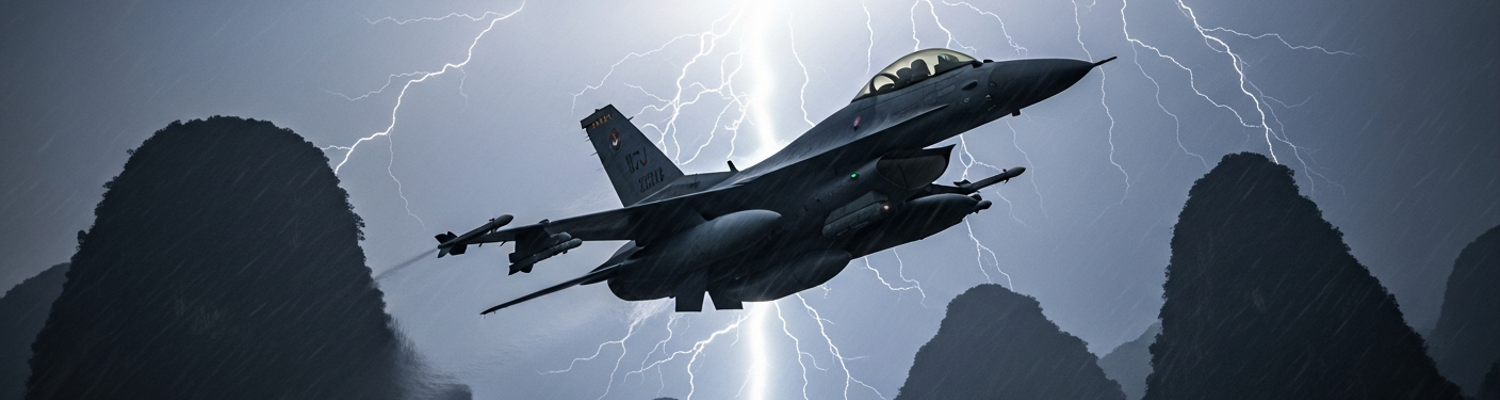
Their target lay deep within a specific karst mountainous region. The geography of the designated target area was a tactical problem. Mission planners had identified the 101st Air Defense Regiment’s primary operating boxes within the Dinaric Karst, a region of soluble limestone rock formations with deep sinkholes and blind valleys. This terrain was an active component of the enemy’s defensive strategy. The sharp peaks and deep valleys created significant radar shadows, allowing the T-100’s mobile launchers to move between pre-surveyed firing positions with impunity from overhead observation. A line-of-sight dependent radar system, like the F-16CJ’s HTS pod, is degraded in such an environment. An enemy emitter could appear, lock a target, and then move behind a ridge, breaking the HARM’s ability to track. The porous limestone could create unpredictable multi-path effects, scattering and distorting radar signals in ways that could confuse the HTS’s sensitive receivers. The enemy used the terrain’s natural features, placing their radar systems in revetments on hillsides where they possessed a clear view of anticipated allied ingress routes while remaining masked from other angles.
This tactical problem was made worse by a severe weather front. Declassified meteorological data (METAR Log 48-A9) from the 48-hour period preceding the mission shows a rapidly developing low-pressure system moving eastward. It generated a powerful squall line with embedded thunderstorms. The front was forecast to arrive over the target area at approximately the same time as the F-16CJs. The implications were severe. The primary tanker track for pre-strike refueling had to be moved 100 nautical miles further south. This cut the available on-station time for the Weasels from a planned 25 minutes to a marginal 15. Heavy precipitation would cause significant signal attenuation, degrading the HTS pod's ability to detect the T-100’s frequency-agile radar emissions. The dense cloud layers, while offering some concealment, would prevent any visual identification or battle damage assessment. They also introduced the risk of severe airframe icing and lightning strikes. The go/no-go decision became the final focal point of the brief, with command weighing the extreme risks against the strategic need to neutralize the T-100 system.
The low-level ingress route through the Dinaric Karst inflicted severe mechanical stress on the F-16 airframes. It was not ordinary turbulence. Post-mission analysis of flight recorder data showed the aircraft experienced sustained vertical currents generated by the mountainous terrain and the squall line, subjecting the pilots to chaotic, high-frequency oscillations. The physical toll was high, as pilots fought their own controls, their bodies strained against harnesses by abrupt changes in attitude. The violent shaking degraded the functionality of key systems. The LANTIRN navigation pod, essential for the high-speed, low-altitude flight profile in darkness, struggled to maintain a stable image. The infrared picture frequently became a blurred mess. On at least two occasions, the vibrations were severe enough to trigger false 'break-lock' warnings on the terrain-following radar display, forcing the pilot to manually override. This constant battle against the environment increased the workload, forcing pilots to divide their attention between flying the aircraft, managing their own physical state, and interpreting data from unreliable sensors.
A storm of electromagnetic interference (EMI) threatened to blind the Weasels. This interference was a mix of natural and man-made signals. The electrical energy within the nearby thunderstorm cells created a background of intense static and generated high-voltage surges. This natural EMI was layered with interference from the F-16s’ own powerful AN/ALQ-184 ECM pods, which produced some electromagnetic bleed-over. The adversary’s T-100 system, with its advanced digital processing and rapid frequency-hopping, seemed to exploit this chaotic environment. Technical debriefs noted that the AN/ASQ-213 HARM Targeting System began displaying dozens of spurious, or 'ghost,' signals. These phantom threats would appear on the display for a few seconds before vanishing, forcing the pilot to waste cycles attempting to differentiate them from the T-100’s real emissions. The entire electromagnetic spectrum became a contested space.
This electronic chaos pushed the F-16CJ’s Block 50 avionics to their limit. The Modular Mission Computer, the central brain of the F-16’s combat systems, was tasked with processing an overwhelming volume of data. It had to filter the environmental EMI, deconflict signals from the formation’s own jamming pods, and simultaneously attempt to build a coherent track file on the T-100’s shifting radar emissions. Archival logs from the 77th Fighter Squadron show that the HTS processor became saturated. The system began to lag. Threat symbols on the multifunction display would flicker, and the range and bearing information would update slowly. In the lead aircraft, the HTS required a full manual reboot mid-ingress, a 45-second process during which the pilot was effectively blind to the electronic order of battle. This forced the Weasel pilots to revert to older tactics, relying on the HARM’s less precise Target of Opportunity mode. The technological edge the F-16CJ was built to provide was being eroded by an enemy that had turned the environment into part of its defensive network.
A review of operational logs from the lead F-16CJ, callsign 'Weasel 11,' pinpoints the crisis to 02:17:32 local time. For the preceding ninety seconds, the pilot had been grappling with the AN/ASQ-213 HTS as it struggled to make sense of the electronic chaos. The multifunction display dedicated to the HTS was a shower of transient symbols. Amidst this, one symbol remained constant: a diamond, designated 'T-100,' representing the 30N6E2 engagement radar. The pod’s interferometric processors had fixed its location with enough confidence to generate a weapon-quality track. At 02:17:31, the system was stable. One second later, the diamond symbol for the T-100 flickered. It turned yellow. Then it vanished. The pod had lost its lock. Post-mission analysis determined the cause was a cascading failure. The violent, high-frequency turbulence exceeded the design tolerances of the pod’s vibration dampeners, introducing a minute, chaotic misalignment in the sensitive antenna array. This physical corruption of incoming signal data, layered on top of the already-saturated electromagnetic environment, finally overwhelmed the pod’s processor. It could not reconcile the conflicting data streams and, as a failsafe, purged the very track that was the objective of the mission.
This specific technical failure was directly worsened by the operating environment. Flight recorder data shows the F-16 was being subjected to powerful, alternating vertical drafts, a product of mountain wave effect within the karst valleys. This created a shearing force that physically shook the aircraft and its externally mounted pods. Inside the AN/ASQ-213 HTS, the interferometric receiver depends on antennas spaced at precise distances to triangulate a signal’s origin. The severe, oscillating vibrations were enough to momentarily warp the alignment of these antennas relative to each other, corrupting the phase-difference measurements needed for accurate geolocation. The T-100 system was deliberately hiding its signal amidst the background EMI of the thunderstorm and the electronic noise from the F-16’s own AN/ALQ-184 ECM pod. The HTS processor, already straining to filter this environmental clutter, was then fed corrupted positional data from its own shaken antennas. This contradiction forced the system into a cycle of attempting to re-calculate a solution, consuming processing power until it could no longer maintain the track file.
A new transmission from an airborne command and control asset escalated the situation. Intelligence intercepts had confirmed the T-100’s 30N6E2 engagement radar was not merely active; it was entering the final phase of a targeting cycle. Its specific target was not an aircraft. A six-man U.S. Army Long Range Surveillance (LRS) team, callsign 'Pathfinder 3,' was operating from a hide site deep within the Skocjan Valley. The adversary’s battle plan was to use the T-100 system to eliminate this reconnaissance asset. The radar’s activation was a precursor to launching a missile into the valley. With the HTS pod having lost lock, Weasel 11 was suddenly blind. The pilot could no longer provide the precise coordinates required for the AGM-88 HARM’s most effective Pre-Briefed launch mode. His only remaining option was to employ the missile in the far less accurate Target of Opportunity mode. The probability of a kill in this mode, especially against a frequency-agile radar in mountainous terrain, dropped precipitously. The five-minute window for the strike had collapsed into a 60-second race to prevent the destruction of Pathfinder 3.
The automated systems were useless. The pilot of Weasel 11 initiated a manual override. The cascade of failures had erased his technological advantage. The urgent transmission confirming the T-100 was actively targeting the Pathfinder 3 LRS team meant there was no time to reboot the HTS or wait for the system to reacquire a lock. The engagement had to happen now. The pilot was no longer a systems manager. He was now a manual hunter, reliant on older data streams and his own training.
A review of cockpit voice and data recorder logs shows the pilot’s precise actions. He immediately deselected the HTS from his primary multifunction display. His attention shifted to the raw output of the aircraft’s AN/ALR-56M Radar Warning Receiver (RWR). Unlike the HTS, the RWR provides no precise geographic location, only a general bearing and signal strength for a detected emission. It was a compass pointing into the storm. On his controls, the pilot’s thumb moved to the small cursor/enable switch on the throttle, the manual interface for the AGM-88 HARM. He was now in Target of Opportunity mode. With the T-100’s bearing indicated on the RWR, the pilot slewed the HARM’s seeker in the general direction of the Skocjan Valley, hoping it would catch a fleeting glimpse of the T-100’s frequency-hopping radar.
At 02:18:04, with no positive lock indication, the pilot launched. The AGM-88 leaped from the rail, not on a precise trajectory to a known coordinate, but on a lofted, ballistic arc toward a general area. This 'maddog' shot was a low-probability gamble, but its true purpose was suppression. The T-100’s command post would detect the HARM launch within seconds. The enemy operators now faced the classic Wild Weasel dilemma: keep their radar active to guide a missile at the LRS team and guarantee the HARM would find and kill them, or shut down and go blind. Archival analysis indicates the 30N6E2 radar ceased all transmissions at 02:18:15. Eleven seconds after Weasel 11’s launch. The pilot’s action had suppressed the T-100’s radar.
That single manual engagement defined the entire operation. The HTS failure at 02:17:32 started the clock. The launch at 02:18:04 and the enemy shutdown at 02:18:15 created a temporary corridor of safety. The AGM-88, now flying blind, would continue on its last known inertial heading for another 90 seconds before impacting harmlessly in an empty section of the valley. That 90 seconds of suppression, however, was everything. It was the window during which Pathfinder 3 could confirm the immediate threat was gone and the follow-on strike package of F-15Es could push through the T-100’s engagement zone without being targeted. The outcome of Operation IRON SKIMMER no longer hinged on the destruction of the T-100 battery. It pivoted entirely on that brief moment of forced silence, initiated by a single pilot who, stripped of his advanced systems, fell back on fundamental SEAD tactics.
The immediate outcome of Weasel 11’s manual engagement was the survival of the six-man LRS team. Pathfinder 3 was safe. A review of after-action reports confirms the T-100 system’s 30N6E2 engagement radar ceased its transmission eleven seconds after detecting the AGM-88 launch. This act of suppression was the single most important event of the operation. The enemy radar operator, faced with the choice of completing the targeting sequence on the ground team or saving his own equipment, chose self-preservation. This decision provided Pathfinder 3 with a window of just under 90 seconds to confirm the threat had abated and break down their observation post. The missile, without a signal to home on, impacted harmlessly against a limestone cliff face 1.2 kilometers away from the LRS team’s position. The primary objective of physical destruction was a failure. The T-100 was not destroyed. The secondary effect of suppression, however, directly saved friendly lives and allowed the follow-on strike package to transit the Skocjan Valley without being engaged.
Operation IRON SKIMMER became a foundational case study in the dangers of over-reliance on automated systems in complex electronic warfare environments. Analysis of the mission revealed that while the F-16CJ’s HTS pod was revolutionary, its failure modes in a high-clutter, physically demanding environment had not been fully anticipated. Archival training documents from the period show a rapid and direct shift in pilot training protocols. The curriculum for the Wild Weasel course was immediately amended to include simulator time dedicated to 'degraded mode' SEAD. These new scenarios specifically replicated the conditions of IRON SKIMMER: a combination of severe turbulence, heavy EMI, and a frequency-agile threat designed to confuse the HTS. Pilots were now rigorously drilled on reversionary tactics, forced to practice transitioning from the HTS display back to the raw, bearing-only data of the legacy RWR and prosecuting targets with low-probability HARM shots in TOO mode. The ethos that pilot situational awareness and aggression were the ultimate backstop to technological failure was forcefully re-instilled into SEAD doctrine.