
The directive from Secretary of War John C. Calhoun’s office arrived in February 1819. The order was absolute. It demanded a permanent American military presence at the confluence of the St. Peters and Mississippi Rivers. The timeline was punishing.
Lieutenant Colonel Henry Leavenworth and the 5th Infantry Regiment had to push more than 200 miles upriver from Prairie du Chien, their nearest support base. They had to establish a defensible position and prepare for a northern winter before the river froze solid. This was a logistical ordeal, dragging keelboats through shallowing waters with hundreds of personnel, including women and children, trekking into territory where American authority was purely theoretical. The expedition arrived in late August 1819. The chill of autumn was already in the air. They hastily constructed a temporary settlement named Cantonment New Hope.
That first winter was a disaster. Rampant scurvy killed dozens of soldiers, a direct result of a standard army ration that lacked any source of Vitamin C. It was a brutal introduction to the gap between the War Department’s continental strategy and the ground-level fight for survival.
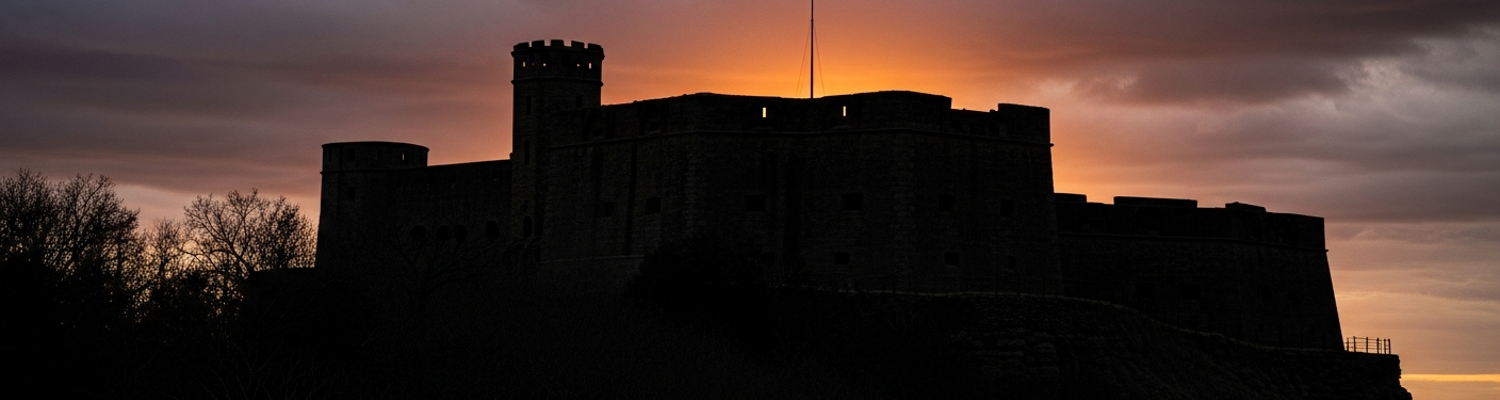
The fort’s location was no accident. The bluff overlooking the confluence, known to the Dakota as Bdote, is a natural choke point. It commands a sweeping view of both the Minnesota River valley to the west and the Mississippi channel from the north. Any vessel, from a Dakota canoe to a British fur trader’s bateau, had to pass under the fort’s gaze. A review of operational directives reveals the fort was intended to function as a valve, regulating commerce, enforcing American trade laws passed in 1816, and projecting power deep into the interior. The structure itself, first a temporary camp and later a formidable stone fortress under Colonel Josiah Snelling, was the tangible assertion of American sovereignty over a region it did not understand.
This aggressive push was a direct consequence of the War of 1812. The Treaty of Ghent had ended the conflict on paper, but it did little to erase British influence among the Native nations of the Upper Mississippi. Fort Snelling was conceived as the anchor of a new frontier defense system, a bulwark to sever those British connections and secure the region’s fur resources for American interests, chiefly John Jacob Astor’s American Fur Company. The garrison was tasked with policing the territory and mediating the complex, often volatile relationship between the Dakota and Ojibwe.
The entire enterprise rested on a shaky legal claim. The U.S. claim to the 100,000 acres of land was based on an 1805 agreement negotiated by Lieutenant Zebulon Pike. Archival evidence shows this treaty was deeply flawed. Pike was not officially authorized to negotiate it, only two of seven Dakota leaders present signed the document, and the space for the payment amount was left blank. Pike valued the land at $200,000 in his journal. The U.S. Senate later unilaterally inserted a payment of just $2,000. Leavenworth’s arrival in 1819 was the moment this dubious paper claim was hammered into the landscape with military force.
Strategic directives handed to the 5th Infantry Regiment demanded a continuous, aggressive projection of force far beyond the fort’s stone walls. This was not a static defense garrison. Operational logs indicate that small-unit patrols were the primary tool for enforcing American policy. These patrols, often just a dozen men led by a lieutenant, were tasked with intercepting unauthorized British traders and enforcing the fragile, invisible lines between Dakota and Ojibwe territories established by the 1825 Treaty of Prairie du Chien.
Authority was not established by a flag over a distant fort. It was established by the physical presence of armed soldiers.
The environment itself became the primary adversary. Archival weather data logged at the post provides a blunt record of the conditions. A detachment leaving the fort in January 1820 would have marched into temperatures recorded at -30 degrees Fahrenheit. The standard-issue wool greatcoat, when soaked by melting snow and then frozen by plummeting temperatures, became a rigid, abrasive shell offering little insulation. Frostbite was a constant threat. Snow blindness could incapacitate an entire patrol. A soldier’s primary weapon, the U.S. Model 1816 flintlock musket, was acutely vulnerable to damp and cold. A fouled pan or a frozen frizzen spring would render the weapon useless.
Official maps were virtually nonexistent or based on crude, inaccurate sketches from Pike’s 1805 expedition. Patrols were forced to navigate by following the winding courses of rivers, a time-consuming and predictable method. Overland travel was a disorienting ordeal through thick, unblazed forests, tamarack swamps, and across vast prairies offering few landmarks. This forced a heavy, uncomfortable reliance on local Dakota or Ojibwe guides. These were men from the very populations the army was attempting to control, creating a dynamic of profound mistrust. Getting lost was a near-certain death sentence. A patrol that missed a rendezvous would not be found. It would be consumed by the wilderness.
The American soldier of the 5th Infantry Regiment was an instrument of European warfare. A close review of the era’s military manuals, specifically Baron von Steuben’s “Regulations for the Order and Discipline of the Troops of the United States,” shows a force steeped in the traditions of Frederician Prussia. This system was designed decades earlier to meet British regulars on an open field. For the men at Fort Snelling, this meant hours on the parade ground mastering the twelve separate commands to load and fire a musket. They drilled in platoon volleys. They practiced wheeling marches and forming squares to repel cavalry charges.
This entire system was a fatal liability in the dense, broken terrain of the Upper Mississippi.
A soldier trained to stand bolt upright while executing a complex loading sequence was a stationary, exposed target in a forest. The tight formations that offered security and massed firepower on a manicured field became a deathtrap in a woodland ambush, where cover and concealment were supreme.
The tactical extension of this drill-ground training was a rigid adherence to linear formations. Upon making contact, the textbook response was to form a line of battle, two ranks deep, men shoulder-to-shoulder. The geography made this concept an absurdity. There were no open fields. A patrol attempting to push through the thick, tangled forest locally known as the Big Woods could not maintain a coherent line. Deadfall and thickets would instantly fragment the formation, leaving small, isolated clusters of men unable to support one another. An attempt to deliver a massed volley would result in half the musket balls striking trees only feet away, while the grouped soldiers presented a perfect target for an unseen enemy. The command-and-control system, dependent on bugle calls and shouted orders, became a confusing beacon, broadcasting the unit’s location and disarray.
Archival evidence shows a complete institutional failure to incorporate the lessons of previous frontier conflicts into regular army doctrine. There was no instruction in what would later be formalized as light infantry tactics. Soldiers were not trained as individual marksmen; the smoothbore musket was notoriously inaccurate beyond eighty yards, and doctrine prioritized massed, unaimed volleys. The training manuals contained no sections on silent movement, use of natural terrain for cover, or the skills of tracking. Counter-ambush drills were nonexistent. The standard response to being fired upon was to halt and form a line, a suicidal act against a foe who fought from cover and valued fluid movement. The soldier was an expert at parade ground maneuvers but an amateur in the art of survival and combat in the very environment he was sent to control.
A review of garrison orders from the 1820s reveals a command structure attempting to impose rigid control over a chaotic environment. The protocols for engagement were inflexible. A patrol encountering a suspected illegal trader was to issue a challenge, inspect papers, and confiscate goods. When intervening in an inter-tribal clash, orders were to separate the belligerents and demand they disperse. Both scenarios were predicated on the assumption that American military authority would be recognized and obeyed. The system was reactive. Soldiers acted as a police force responding to violations of abstract legal boundaries.
This was a system of rules designed for a courtroom, not a wilderness.
The disconnect between this protocol and the tactics of indigenous warriors was absolute. Dakota and Ojibwe warfare was not about holding territory. Theirs was a war of raids and ambushes designed to inflict casualties with minimal risk. They fired from behind trees, from the cover of riverbanks, and then vanished. The American response of halting and forming a line made the soldiers a stationary, predictable, and highly visible target.
The entire American enterprise was crippled by a near-total failure of communication. Official interactions were filtered through a tiny handful of interpreters, often men of mixed ancestry with their own agendas tied to the fur trade. Beyond language, there was an unbridgeable gulf in cultural concepts. The American idea of land ownership, defined by deeds and invisible lines on a map, was alien to the Dakota, for whom the land around the fort was a sacred center of creation. An American officer demanding a murder suspect be handed over for trial was met with incomprehension by Dakota leaders, whose own system of justice demanded a retaliatory killing to balance the scales, not an abstract legal process. Each interaction was a potential flashpoint.
Post medical returns reveal that for the soldiers of the 5th Infantry, the greatest threat was not combat but disease and environment. The first winter’s scurvy outbreak was a predictable disaster. Overcrowding and primitive sanitation led to constant outbreaks of dysentery, a brutal intestinal infection that spread through contaminated food and water. Even the fort’s commander, Colonel Josiah Snelling, suffered from chronic dysentery that contributed to his death. Gunshot wounds were particularly devastating. The low-velocity, large-caliber soft lead balls from muskets created massive tissue damage and frequently carried unsterilized clothing deep into the wound, guaranteeing infection.
The post surgeon worked in a state of constant crisis.
The post hospital was one of the first in the territory, but it was likely a drafty, poorly lit log structure with no concept of a sterile field. A surgeon operated with un-disinfected hands and instruments. The first step in treating a gunshot wound was to probe for the lead ball with a finger or metal instrument, further introducing bacteria. For a shattered limb, amputation was often the only recourse. The procedure was performed without effective anesthesia. The soldier was given whiskey or laudanum and held down as the surgeon used a large amputation knife and a capital saw to sever the bone. The stump was then cauterized with a heated iron. Post-operative infections like gangrene were common and almost always fatal.
The medical apparatus was crippled by scarcity. Fort Snelling was authorized one, perhaps two, medical officers for a garrison of over three hundred. Medical supplies were critically limited. The standard army medical chest contained calomel, quinine, and opium tinctures. These supplies, along with bandages and instruments, had to be transported up the Mississippi from St. Louis, a journey that took months by keelboat. The loss of a single supply boat could leave the fort medically destitute for an entire season.
The military’s attempts to enforce a foreign legal framework produced unintended, violent escalations. A sharp example occurred in May 1827. A party of Ojibwe visiting the fort were attacked by Dakota warriors. In response, the garrison was dispatched to the nearest Dakota village. The soldiers did not identify specific assailants; they rounded up thirty Dakota men as prisoners. This act of collective punishment was followed by a measure that demonstrated a complete failure to comprehend local norms. The American commander released the captured Dakota onto an open plain, inviting the aggrieved Ojibwe to exact their revenge. Two of the Dakota were killed. The incident, intended as a demonstration of American authority, was perceived by the Dakota as the United States taking a side in their conflict, destroying the fort’s credibility as a neutral arbiter.
A fundamental disconnect existed between the military garrison and the civilian Indian Agency. The Indian Agent, Lawrence Taliaferro, was tasked with diplomacy, while the military command was focused on enforcement. This created two competing centers of American power. Taliaferro’s journals document his constant struggle against the influence of the American Fur Company, whose traders used alcohol and debt to exploit Native trappers. Military commanders, however, were often more concerned with order than with trade regulations. The United States presented a fractured and unreliable face to Native leaders.
The cumulative effect of these military and civil missteps was the erosion of trust and the creation of deep, long-lasting societal damage. The fort, conceived as a guarantor of peace, became the primary instrument of dispossession. Its presence provided the security for fur traders and later for treaty commissioners. The land cession treaties of 1837, which stripped the Dakota and Ojibwe of their lands east of the Mississippi, were negotiated under the fort’s shadow. This cycle of coercion and economic exploitation, backed by the military power of the fort, directly fueled the desperation that exploded in the U.S.-Dakota War of 1862.
The fort’s role came full circle. In the winter of 1862-1863, the river bottom below the bluff was transformed into a concentration camp where 1,600 Dakota non-combatants, mostly women, children, and the elderly, were imprisoned in a wooden stockade. Subjected to disease and attacks, an estimated 130 to 300 died before the survivors were forcibly exiled from Minnesota in the spring.