
In the last week of November 1950, the U.S. Eighth Army in western Korea was functionally broken. The Chinese People’s Volunteer Army (PVA) Second Phase Offensive had shattered its front. The assault mauled the U.S. 2nd Infantry Division at the Ch’ongch’on River and sent the entire command into a headlong retreat. This withdrawal would not stop until the Eighth Army was south of the 38th Parallel, having surrendered all of North Korea to the advancing Chinese forces.
It was a rout.
The physical environment of the Korean peninsula in winter constituted an enemy as formidable as the PVA. Temperatures plummeted to -30°F (-34°C). Siberian winds created wind chills that were far more severe. A review of operational logs (NARA Record Group 407) indicates that standard-issue lubricants for rifles and machine guns gelled, rendering automatic fire impossible. Soldiers discovered they had to urinate on their weapons to thaw the mechanisms. Vehicle batteries lost their charge, engine blocks cracked, and rubber components like hoses and tires became brittle and failed. Field artillery units found that the cold altered the propellant properties of their gunpowder, forcing gun crews to recalculate firing solutions on the fly. The physiological toll was just as severe. Frostbite was rampant. The standard leather combat boot offered insufficient insulation, and many soldiers suffered from debilitating foot injuries. The environment crippled both men and machines, turning survival into the primary tactical concern.
Lieutenant General Walton Walker’s Eighth Army faced a dire strategic situation. Following the collapse of the army's right flank, held by the Republic of Korea (ROK) II Corps, the Eighth Army was in full retreat southwards. The Chinese offensive, which began on November 25th, had hit with overwhelming force. The U.S. 2nd Infantry Division fought a rearguard action at Kunu-ri and was nearly destroyed as it tried to hold the line. By December 5th, the Eighth Army had abandoned the North Korean capital of Pyongyang and continued its retreat, crossing back over the 38th Parallel by mid-December. The army was demoralized, its cohesion shattered.
This crisis was not confined to the Eighth Army in the west. Across the peninsula, the U.S. X Corps, operating independently under the direct command of General Douglas MacArthur, was also in a perilous position. Attacked by numerically superior Chinese forces around the Chosin Reservoir, its units were forced into a fighting withdrawal to the coast. This broader UN withdrawal necessitated a massive sealift evacuation. From the port of Hungnam, between December 15th and 24th, a vast armada of naval vessels evacuated over 105,000 troops, including the 1st Marine Division, 7th Infantry Division, and 3rd Infantry Division. They also evacuated some 91,000 to 100,000 North Korean refugees. The logistical scale was enormous, involving the removal of 17,500 vehicles and 350,000 tons of cargo. While the Hungnam evacuation was a success in saving the men of X Corps, it represented the complete abandonment of northeastern Korea. The influx of evacuated units and material at southern ports like Pusan initially overwhelmed their capacity, creating new logistical challenges. The death of General Walker in a jeep accident on December 23rd only deepened the sense of crisis that gripped the UN command.
The system for evacuating and treating the wounded of the Eighth Army did not bend during the great retreat of November and December 1950. It shattered. At the core of this failure was the complete inadequacy of the road network for any form of motorized transport. The primary north-south arteries were little more than unpaved, frozen tracks. This condition made wheeled evacuation slow and punishing even before the Chinese intervention. Operational logs show that the standard Dodge WC54 3/4-ton ambulances were mechanically unequal to the task. Axles snapped and transmissions failed on the cratered, ice-slicked surfaces. The severe cold congealed lubricants and caused rubber hoses to crack, immobilizing columns of vehicles. For the wounded, a journey in the back of these trucks was an agonizing ordeal that often exacerbated their injuries. The situation was made worse by the Chinese tactic of establishing roadblocks on critical routes, such as the five-mile-long gauntlet north of Sunchon that trapped elements of the 2nd Infantry Division. These chokepoints became kill zones where stationary ambulances were obvious targets. The roads were also clogged with tens of thousands of civilian refugees, turning the main supply routes into impassable choke points of human and mechanical misery. Ground evacuation by vehicle ceased to be a reliable option.
This paralysis of movement coincided with the systematic destruction of forward medical infrastructure. Mobile Army Surgical Hospitals (MASH) were positioned just miles behind the front lines. Units like the 8055th and 8076th MASH were staffed to provide life-saving surgery within hours of injury. The speed of the UN collapse, however, outpaced their ability to displace. The standard procedure to break down, move, and re-establish a MASH unit took at least 24 hours under ideal conditions. During the chaotic retreat from the Ch’ongch’on River, these units were given mere hours to move out. Archival evidence shows that in the rush to escape encirclement, entire hospitals were abandoned. Tents, surgical tables, generators, and delicate diagnostic equipment were left behind for the advancing Chinese. On one occasion, a windstorm tore down the tents of the 8076th MASH in the middle of a rain-soaked night, forcing staff to use trucks as temporary supports in deep mud. The loss was not just of equipment, but of organized treatment capacity. One clearing station of the 25th Medical Battalion found itself with 750 patients just as the retreat began. With established hospitals in cities like Pyongyang now overrun, the medical chain of evacuation had no destination. Wounded men were simply loaded onto retreating trucks or tanks, often without medics, in a desperate attempt to move them south.
The breakdown of evacuation routes and forward hospitals was compounded by the complete fracture of the medical supply chain. The system was designed to push supplies forward to units in static or advancing positions. The headlong retreat reversed this flow, leaving units isolated from their depots. Ammunition and fuel took precedence in the few air-supply drops that could be attempted in the poor weather, leaving medical supplies a lower priority. The loss of specific items had a devastating impact. Whole blood, essential for treating shock from massive trauma and with a short shelf life, could no longer reach the casualties who needed it most. Field medics ran out of morphine syrettes, leaving the severely wounded to be transported in agony. Stocks of penicillin and bandages were rapidly depleted. Medicines that were available often became useless; archival accounts note that medics had to carry vials of penicillin in their pockets to keep them from freezing solid. The complex logistical network required to procure and deliver 119 different essential drugs and dressings, a system that stretched from depots in Japan to the front, had ceased to function. For the soldier wounded in the last week of November, the intricate system of care that had produced a 97% survival rate for those who reached a MASH had evaporated.
Doctrinal medical evacuation procedures were instantly obsolete. In the face of overwhelming Chinese numbers and the near-total disintegration of the ROK II Corps on its right flank, forward medical units were forced into unorthodox measures. Archival evidence from units like the 2nd Medical Battalion, attached to the hard-pressed 2nd Infantry Division, illustrates a command structure breaking down under extreme pressure. Standard operating procedures, which called for a clear chain of evacuation from battalion aid stations to clearing companies and then to MASH units, completely dissolved. A clearing station of the 25th Medical Battalion suddenly found itself holding 750 patients as the retreat began. With MASH units like the 8055th and 8076th forced into chaotic, rapid relocations, there was often no higher-echelon hospital to send patients to. This forced surgeons and even corpsmen to make life-or-death decisions on the spot, decisions that fell far outside their prescribed roles. Triage became a calculus of who was stable enough to even attempt a perilous journey south. Many gravely wounded men who, just weeks before, would have been candidates for life-saving surgery were instead made as comfortable as possible and left behind.
This was a direct violation of established medical ethics and doctrine, but it was a choice forced by the tactical situation.
The most immediate improvisation was the conversion of standard supply trucks for mass casualty transport. With dedicated Dodge WC54 ambulances lost, destroyed, or immobilized, the workhorse of the retreat became the GMC CCKW 2.5-ton cargo truck, known as the deuce-and-a-half. These vehicles, designed to haul ammunition, became makeshift ambulances out of sheer necessity. The conversion was crude. There were no racks for litters; wounded men were simply laid on the steel bed of the truck, often without insulation from the freezing metal. Sometimes a layer of straw, if it could be found, was thrown down. Into these open-topped trucks, medics would load dozens of casualties, mixing the lightly wounded with the unconscious and the dying. There was no in-transit care. The violent, jarring ride over frozen, cratered roads frequently induced shock, reopened wounds, and compounded fractures. Operational logs from the 2nd Infantry Division’s retreat through the Kunu-ri gauntlet detail convoys of these trucks being caught in Chinese roadblocks. They became static, indefensible targets for mortar and machine-gun fire. The canvas covers offered no protection, and a single well-placed grenade could inflict horrific carnage inside the packed cargo bay. For the wounded, a ride in the back of a deuce-and-a-half was a terrifying gamble.
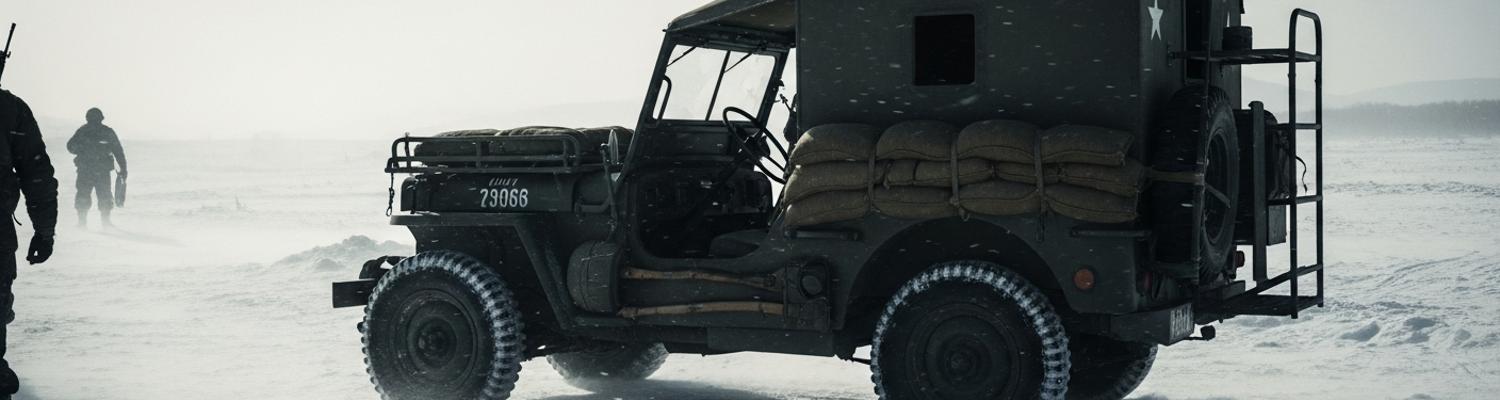
In the fight to extract casualties from the front lines, the Willys MB jeep was transformed into a nimble, makeshift armored ambulance. Unlike the lumbering cargo trucks, the jeep could navigate narrow tracks and bypass the clogged main supply routes. Medics and drivers began improvising armor for these vehicles. They piled sandbags on the hood, floor, and even in the passenger seats to provide some measure of protection against small-arms fire and shrapnel. Photographic evidence shows jeeps with litter racks mounted across the rear of the vehicle, sometimes carrying two stretchers, one above the other. This Holden-style modification, a legacy from World War II, was crucial for evacuating individual high-priority casualties from battalion aid stations directly threatened with being overrun. Drivers of these jury-rigged ambulances performed heroic feats. They raced through contested territory to deliver a single wounded man to a clearing station or a functioning airstrip. They were often alone, acting as both driver and medic, and were priority targets for Chinese forces seeking to disrupt any organized retreat. The armor was entirely non-standard and field-expedient, but it represented a calculated risk, trading the jeep’s speed for a marginal increase in survivability.
The institutional collapse of wheeled evacuation forced a turn to battlefield expediency. Vehicle crews and medics fabricated armor from any material at hand. This was not a centralized program. It was a unit-by-unit response to the lethal inadequacy of standard-issue vehicles. A review of operational logs shows that the primary materials were sandbags and scavenged steel. Sandbags, often filled with frozen earth, were piled on the floors of truck beds to provide protection from mine blasts and on vehicle hoods to shield engine blocks from shrapnel. When frozen solid, their protective qualities increased substantially. The most sought-after material was steel plate, stripped from destroyed rolling stock, factories in captured cities like Pyongyang, and wrecked civilian vehicles. Maintenance crews, using basic welding torches, would attach these plates to the cabs of GMC CCKW trucks and the thinly protected sides of M3 half-tracks. The quality of this improvised armor varied wildly. Yet, it represented a gamble, trading vehicle performance for a slight increase in crew and patient survivability.
This ad-hoc up-armoring blurred the lines between combat vehicles and medical transport. An M4 Sherman or M26 Pershing tank became an impromptu ambulance of last resort. The rear engine decks of these tanks were frequently loaded with litters carrying the most critical casualties, who were simply strapped to the vehicle’s exterior. This created an immediate tactical dilemma. A tank commander could not fully traverse the turret without endangering the wounded tied to the hull, severely limiting the vehicle’s combat effectiveness. The vehicle’s mission was now split; it was simultaneously a frontline weapons platform and a non-combatant evacuation transport. Chinese forces quickly learned to target these overburdened machines. They knew a single successful hit with an anti-tank weapon would not only eliminate a combat threat but also inflict devastating losses on the helpless wounded. The soldiers riding on these tanks were completely exposed to the elements and enemy fire.
Specific military vehicles never intended for medical use were adapted on a wide scale. The M3 half-track, originally an armored personnel carrier, became a workhorse of the improvised evacuation system. Though it offered better cross-country performance than wheeled trucks, its armor was thin and its open-topped configuration left occupants vulnerable to mortar and artillery air bursts. Field modifications often involved removing its .30 or .50 caliber machine guns to create more space for litters. While official kits existed to convert half-tracks into ambulances, the speed of the retreat meant most conversions were crude, with litter brackets welded directly to the interior walls. Even more desperate were the adaptations of civilian vehicles. Korean buses and commercial trucks were commandeered along the retreat routes. These vehicles were mechanically unreliable and possessed no armor whatsoever. They were often driven by their civilian owners, who had little understanding of military convoy discipline, making them a liability. Their flimsy construction meant they broke down constantly on the frozen, rutted roads. They became easy targets for Chinese patrols, their occupants, both civilian and military wounded, defenseless.
The disintegration of a formal medical evacuation chain forced improvisation at the lowest tactical level. A review of operational logs from medical battalions attached to the U.S. 2nd and 25th Infantry Divisions reveals the spontaneous emergence of what were termed mobile triage points. These were not hospitals. They were often little more than a single medical officer or an experienced NCO with a handful of corpsmen, operating out of one or two M35 trucks or jeeps parked in the frozen mud just off a main supply route. Their location was dictated by necessity. They were deliberately established in exposed, non-secure forward positions, sometimes less than a thousand yards behind the last coherent rearguard action. The logic was simple. The sheer volume of casualties and the immobility of standard ambulances meant that the wounded had to be stabilized as close to the point of injury as physically possible. To move them any significant distance without initial care was a death sentence. These points were set up in the dubious shelter of shallow ravines, behind the wreckage of knocked-out tanks, or in the frozen courtyards of abandoned Korean farmhouses. These places offered concealment from ground-level observation but provided no protection from plunging artillery or mortar fire.
These sites operated with no established perimeter defense.
The manpower for a dedicated security element did not exist. Every soldier capable of holding a rifle was either already engaged in the rearguard actions at places like the Kunu-ri gauntlet or was needed to drive trucks. Unit morning reports from December 1950 show medical detachments stripped of their assigned security personnel, who were re-tasked to infantry line companies. The defense of a mobile triage point therefore fell to the medical staff themselves and any walking wounded capable of firing a weapon. Their defensive posture was a fiction. A few medics with M1 carbines or Colt M1911 pistols positioned behind a frozen stream bank constituted their entire protection. Their true defense was the thin line of exhausted infantry fighting just up the road. The medical personnel understood that their survival was measured in the minutes they bought while the rearguard held. The entire concept of a secure rear area had evaporated.
This lack of security made the mobile triage points vulnerable to direct attack. Chinese People’s Volunteer Army doctrine emphasized infiltration and bypassing pockets of heavy resistance to strike at command and support elements. These lightly defended medical collection points were precisely the type of soft target their tactics were designed to annihilate. After-action reports are filled with accounts of aid stations being suddenly swarmed by PVA infantry who had slipped past the American front. For the medics and the wounded, the attack was a whirlwind of chaos. Small arms fire would erupt from a nearby ridge, followed by a wave of grenade-throwing soldiers charging their position. The medics, bound by their duty of care, faced an impossible choice: abandon the critically wounded who could not be moved and attempt to escape with those who could walk, or stay and face near-certain death or capture alongside their patients. In the confusion of these close-quarters fights, the protections afforded by the Geneva Convention were often meaningless. Wounded men were killed on their litters, and medical personnel were shot down as they tended to casualties.
The communications architecture supporting the Eighth Army’s medical evacuation chain was never designed for a chaotic retreat. It shattered. In the vacuum left by disintegrating command structures, radio became the sole medium for coordinating the defense of improvised medical positions. Archival evidence shows that as formal security detachments were stripped from medical units and thrown into the line as infantry replacements, the defense of mobile triage points fell to an ad-hoc collection of personnel. Medics, walking wounded, and drivers became the de facto perimeter guards. Their survival depended entirely on a functioning radio link to any semblance of higher command or, more pressingly, to the nearest artillery fire direction center.
The airwaves became a cacophony of overlapping calls. A review of operational logs from the Signal Corps elements attached to the 2nd and 25th Infantry Divisions reveals a near-total breakdown of radio discipline. The primary voice radios of the period, such as the backpack-mounted SCR-300 and the more powerful, vehicle-mounted AN/GRC-9, were robust for their time but highly susceptible to the operating conditions. The extreme cold slashed battery life, forcing operators to keep spare BA-70 batteries inside their clothing to preserve a charge. The mountainous Korean terrain severely limited the range of these line-of-sight FM radios, creating dead zones where units were completely cut off. Transmissions from a triage point being probed by a PVA patrol would bleed over calls from a half-track ambulance trying to find a route south. Medics, untrained as radio operators, would broadcast frantic requests for artillery fire on their own positions, often using improper procedures that made it impossible for fire direction centers to plot a safe fire mission. The constant displacement of battalion and regimental headquarters meant that call signs and frequencies were in a continuous state of flux. A radio operator at a forward aid station had no way of knowing if his calls were being received or were simply being broadcast into an empty net.
This electronic chaos was a direct reflection of the tactical disintegration on the ground. The very nature of the Chinese offensive, which emphasized deep infiltration to establish roadblocks and attack command posts, was designed to sever communications. A forward observer with an infantry platoon, the link for directing artillery, could be eliminated, and the entire artillery net for that sector would go blind. Fifth Air Force after-action reports noted the frequent loss of their Tactical Air Control Parties (TACPs), who were overrun along with the ground units they supported, severing the link for emergency air support. The radio became a liability. Chinese forces, many equipped with captured American radios, could monitor the uncoded transmissions, giving them a clear picture of the locations and state of American units. A medical officer pleading for evacuation support was simultaneously pinpointing his vulnerable position for enemy mortar crews.
The immediate effect of these improvised evacuation methods on casualty survival is a statistical paradox. A precise, verifiable casualty survival rate for the men wounded during the Eighth Army’s withdrawal in late 1950 does not exist. The very collapse that necessitated the gamble also destroyed the capacity for accurate record-keeping. What archival evidence does show is a trade-off. For a soldier who was wounded and could not be moved, the chance of survival was near zero. The non-doctrinal decision to load these men onto the steel beds of open deuce-and-a-half trucks or strap them to the engine decks of tanks was a decision to exchange certain death for a slim possibility of life.
It was a terrible wager.
The journey south in these makeshift ambulances often inflicted new injuries, but it also represented the only path to the aid stations and, eventually, the hospitals in Japan. The true impact was not a neatly calculated percentage point but the raw number of men who, against all odds, completed that journey. For every man who succumbed to shock or exposure in the back of a truck, another was successfully delivered to a surgeon. The gamble was that some would be saved, where doctrinal paralysis would have saved none.
The institutional shock of the 1950 winter retreat directly forced a revolution in military medical doctrine. The failure of ground-based evacuation, with its reliance on roads that were either impassable or lethal kill zones, provided an undeniable justification for a new approach.
This came in the form of the helicopter.
The 2nd Helicopter Detachment arrived in Korea with four Bell H-13 Sioux aircraft in November 1950, just as the crisis was unfolding. Initially tasked with utility and liaison missions, their potential was quickly realized. By January 1951, the first dedicated Army aerial medical evacuation missions were flown. This was a direct response to the lessons being learned in blood along the frozen roads south of the Ch’ongch’on River. The H-13, with external litters attached to its skids, could bypass the shattered road network entirely. It plucked casualties from forward aid stations and delivered them directly to MASH units in a fraction of the time a truck would have taken. This single innovation fundamentally altered the calculus of survival. The death rate for evacuated patients dropped from 4.5 percent in World War II to 2.5 percent in Korea, a change largely attributed to the speed of helicopter transport. The H-13 became the icon of a new doctrine built on air mobility, a legacy that would lead directly to the ubiquitous use of the UH-1 Huey in Vietnam and shape all subsequent military medical planning.
The high-risk, non-doctrinal decisions made during the retreat found their ultimate justification in the person of Lieutenant General Matthew B. Ridgway. When Ridgway took command of a demoralized Eighth Army on December 26, 1950, he found an organization focused only on escape. His leadership was essential in transforming the army’s mindset, but the improvised efforts to save the wounded had already laid a critical foundation. A review of Ridgway’s initial actions reveals a deep understanding of soldier psychology; he knew that to ask men to fight, he first had to show them their lives were valued. The measures taken by medics, drivers, and commanders to evacuate their comrades, however crude and costly, sent a powerful message: the organization would not abandon its own. This ethos, born of necessity, was something Ridgway could build upon. By ordering commanders out of their bunkers and demonstrating a willingness to create tactical plans that did not needlessly sacrifice his soldiers, he validated the very risks they had taken to save each other. The justification for strapping a man to a tank was not that it was a good idea, but that it was the only idea, and it demonstrated a collective will to survive that became the bedrock for the Eighth Army’s later recovery and successful counter-offensives in 1951.