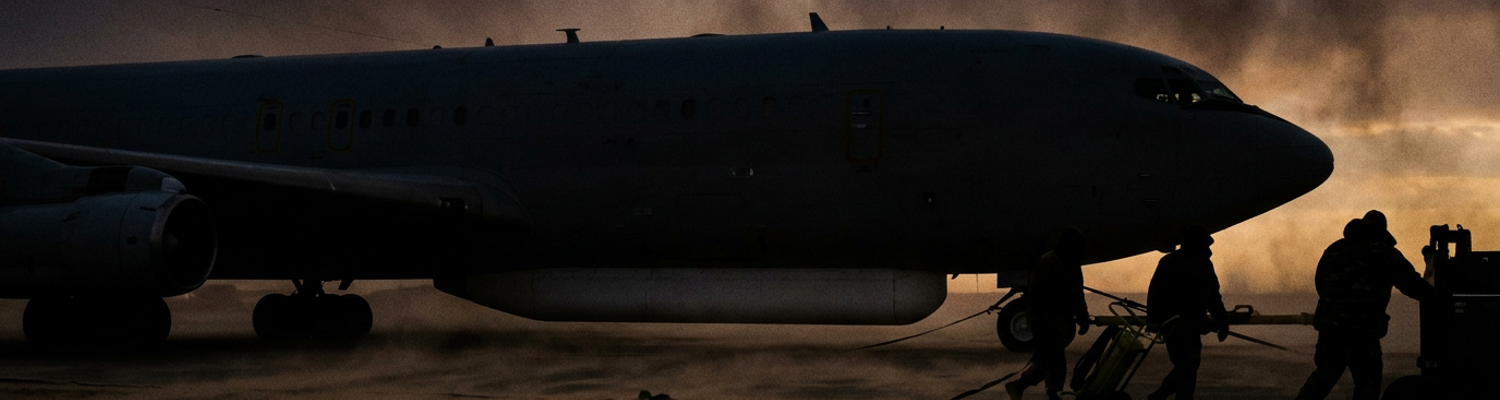

Prototype Airframe Deployment and Supply Chain Friction
Central Command issued an emergency deployment directive in December 1990. The Joint Surveillance Target Attack Radar System was still locked in full-scale engineering development at Grumman facilities in Melbourne, Florida. Military planners demanded an operational capability that peacetime acquisition protocols projected would take another three years to deliver. The Pentagon possessed exactly two developmental aircraft to send into the combat theater.
A close review of operational logs indicates that the two airframes were vintage Boeing 707-321C passenger airliners. They bore tail numbers 86-00416 and 86-00417. Mechanics stripped down and rebuilt these commercial jets as developmental E-8A testbeds. These two airframes operated under the newly formed 4411th Joint STARS Squadron Provisional. They landed at King Khalid International Airport near Riyadh on January 11, 1991. This arrival occurred just six days before coalition air operations commenced.
Standard military supply chains carried no inventory for the custom experimental equipment.
Defense contractors from Grumman, Motorola, and Norden Systems deployed directly alongside Air Force aircrews. They hauled commercial diagnostic gear, uncataloged circuit boards, and prototype hand tools into open desert hangars. Ambient ramp heat exceeding thirty-eight degrees Celsius immediately triggered environmental cooling failures inside tail 416. The DEC VAX 8600 computers generated massive heat loads during data processing. Line mechanics kept these units from melting. They ran commercial air-conditioning ducting directly through open emergency hatchways. Tape secured the lines to the avionics bays.
Civilian programmers wrote flight-ready software updates directly onto magnetic cassette tapes on the Saudi flight line.
When examining the historical record, the experimental AN/APY-3 multimode side-looking phased array airborne radar functioned as the operational core of both airframes. A twenty-four-foot fiberglass canoe radome bolted to the belly of the fuselage encased the unproven X-band transmitter. Engineers designed the system to sweep a 120-degree sector across occupied Kuwait and southern Iraq. The antenna mechanically adjusted its elevation while steering electronically in azimuth. Operators toggled between high-resolution Synthetic Aperture Radar for mapping fixed geography and Ground Moving Target Indicator modes for tracking moving vehicles.
Initial engineering tests had barely begun at Robins Air Force Base when flight crews received orders to test the sensor over active combat sectors along border orbit Canadian.
Radar phase shifters repeatedly drifted out of calibration under high electrical draw. The AN/APY-3 required stable voltage to maintain beam coherence across the X-band spectrum. Voltage drops produced false target clusters over shifting sand dunes. Technicians unbolted receiver-exciter access panels mid-flight. They replaced scorched components at thirty thousand feet while pilots circled in holding patterns over northern Saudi airspace. The ambient temperature inside the unpressurized equipment bays dropped to minus ten degrees Celsius during these high-altitude repairs.
Archival evidence shows that the 4411th flew grueling eleven-hour nighttime sorties through late January. The aircraft transmitted raw target tracks via secure digital broadcast links to AN/TSQ-132 Ground Station Modules. Army corps commanders operated these modules. Inside the aircraft, operators sat before green phosphor displays. They manually filtered radar returns to track Iraqi supply vehicles heading toward the frontline outpost of Khafji. The crew accomplished this without a single standard technical order manual on board.
AN/APY-3 Transmitter Overheating and Particulate Contamination
Fine desert powder destroyed hardware faster than enemy fire.
A close review of operational logs indicates that airborne operations encountered catastrophic particulate contamination across northern Saudi patrol tracks during the run-up to the engagement at Khafji on January 29, 1991. Ground crews at King Khalid International Airport had already discovered that the Arabian desert floor consisted largely of silicates ground down to particles smaller than twenty micrometers. Tail number 86-00417 descended into boundary-layer holding patterns at twelve thousand feet. Engine bleed air systems pulled this abrasive dust directly through structural intake valves.
Below the fuselage, the twenty-four-foot radome housed the primary heat exchanger for the liquid-cooled antenna assembly.
Ambient air forced through the ventral scoop hit cooling fins coated in residual hydraulic film. The dry dust transformed into a dense paste that baked solid against aluminum radiator coils. Polyalphaolefin coolant cycling through the internal piping could no longer shed heat into the slipstream. The system required a flow rate of twelve gallons per minute to maintain thermal equilibrium. Fluid temperatures inside the closed loop spiked from a normal operating limit of sixty degrees Celsius to over ninety degrees in under twelve minutes of continuous orbit.
Dust coated every mechanical surface inside the unpressurized lower bays.
When examining the historical record, this sudden thermal insulation crippled the AN/APY-3 multi-mode radar at the exact moment Iraqi armored columns advanced south across the Kuwaiti border. The transmitter relied on high-power traveling-wave tubes requiring continuous high-voltage electrical current to generate X-band radio frequency pulses across broad azimuth sweeps. Coolant lines choked with heat. Embedded thermal sensors detected junction temperatures approaching component failure thresholds. Automated thermal throttling protocols integrated into the transmitter control unit triggered defensive software routines.
The system began shedding load without aircrew consent to prevent permanent cathode burnout and melting of circuit traces.
The processor slashed the transmitter duty cycle by fifty percent. It cut pulse repetition frequency and dropped the radar beam dwell time across broad surveillance swaths. Ground Moving Target Indicator sweeps previously refreshed vehicle coordinates every sixty seconds. These sweeps slowed to sluggish intervals exceeding four minutes. Massive temporal gaps appeared on workstation displays.
Internal telemetry screens flashed warning code yellow-sixteen across the radar operator console at 21:47 local time.
Archival evidence shows that this automated throttling blinded the 4411th Joint STARS crew to the lead battalions of the Iraqi 5th Mechanized Division rolling toward the border berm. Inside the Boeing cabin, radar technicians faced an immediate operational trade-off. They had to choose between frying the only operational transmitter in the theater or losing radar contact with advancing T-55 tanks. Technicians worked beside civilian contractor specialists to bypass the automated shutdown sequence.
The crew unbolted the lower cabin decking to inspect the closed-circuit cooling lines. They monitored analog pressure gauges while the pilot banked the converted airliner into sharp thirty-degree turns. This maneuver forced high-speed freezing air through the clogged intake duct. Sensor operators restricted the transmitter from broad sixty-degree wide-area sweeps down to localized five-degree spotlight sectors. They concentrated the remaining allowable radio frequency energy on a single highway junction outside al-Zabr.
The heat exchanger core continued to register ninety-three degrees Celsius as the radar beam acquired the first moving metal targets along the coastal road.
The Five-Minute Tactical Interruption over Khafji
Every workstation display went completely dark at 22:18 local time.
A close review of operational logs indicates that the sudden drop in surveillance occurred when the AN/APY-3 radar operator initiated an emergency thermal reset on the primary transmitter assembly. Inside the unpressurized lower bay of tail number 86-00417, internal heat exchanger sensors registered junction temperatures exceeding ninety-six degrees Celsius. This tripped the high-voltage safety interlocks on the traveling-wave tubes.
The Grumman technical specialist aboard feared catastrophic cathode destruction. He ordered the radar system operator to dump electrical bus power to the antenna.
Killing the primary power switch cut off all radio-frequency output across the entire X-band phased array. Restoring the system demanded a sequential hard reboot of the liquid-cooled polyalphaolefin circulation loop. A manual cycle of the circuit breakers located on avionics rack four followed. Digital processors inside the cabin required a mandatory three-hundred-second diagnostic purge to flush volatile memory caches before the high-voltage power supplies could be re-energized.
For precisely five minutes, between 22:18 and 22:23, the prototype aircraft transmitted zero Ground Moving Target Indicator data to the AN/TSQ-132 ground station modules waiting at Saudi tactical command posts.
The screen lost sixty distinct radar tracks in one sweep.
Archival evidence shows that elements of the Iraqi 5th Mechanized Division used this unmonitored window to push deep into Saudi territory along the coastal corridor. The lead elements of the 26th Armored Brigade and 15th Mechanized Brigade advanced out of Kuwaiti assembly staging areas south of Al-Wafrah. They operated under explicit blackout drive orders. Drivers in T-55 tanks and BMP-1 combat vehicles navigated along the two-lane paved coastal highway near 28 degrees 26 minutes North, 48 degrees 31 minutes East. They kept their headlights switched off across the open coastal sabkha.
Coalition airborne controllers were suddenly unable to generate real-time moving target pings. The armored lead vehicles accelerated from fifteen to thirty-five kilometers per hour.
Two motorized infantry battalions slipped through the unguarded sand berms unobserved by airborne radar. They covered nearly three kilometers of road before reaching the northern checkpoint outside the town of Khafji. US Marine forward air controllers situated inside an observation post atop an apartment complex within the town had no incoming telemetry. Nothing warned them that hostile armor was already passing the northern water desalination plant.
No thermal warnings reached the frontline scouts.
When examining the historical record, flight crew logs demonstrate that technical specialists inside the converted Boeing 707 worked entirely in darkness to complete the reset procedure. The onboard flight technician manually released the stuck thermal bypass valve on the coolant manifold using an insulated breaker bar. This vented boiling polyalphaolefin vapor away from the electrical leads.
At 22:23 local time, the digital displays rebooted.
The phased array pushed twelve kilowatts of radio-frequency energy back across the coastal quadrant. Workstation monitors painted forty fresh ground-moving target pings clustered four kilometers farther south than their last confirmed positions. These targets were situated directly at the intersection of the coastal highway and the Khafji perimeter bypass. An airborne strike coordinator immediately vectored a section of two AV-8B Harriers directly toward the newly plotted grid coordinates at 28 degrees 23 minutes North, 48 degrees 29 minutes East. The Harriers carried Mk 82 five-hundred-pound unguided bombs.
Surveillance of Iraqi Mechanized Division Columns
A violent winter shamal reduced surface visibility across northern Saudi Arabia to absolute zero on the night of January 30, 1991.
Archival evidence shows that gale-force winds exceeding forty knots lofted tons of fine desert silt up to twelve thousand feet. This blinded coalition airborne forward air controllers, satellite optics, and thermal imaging pods on strike fighters. Forward observation posts manned by US Marines south of Khafji could not spot targets past twenty meters. The AN/APY-3 radar aboard tail number 86-00417 operated high above the weather at thirty-two thousand feet. It penetrated the dense cloud of airborne dust using its 10-gigahertz X-band frequency.
Airborne operators manually adjusted Doppler filter threshold settings inside the signal processor. They eliminated atmospheric backscatter generated by the suspended particulate matter.
As the phase shifters stabilized along the lower canoe antenna, digital signal processors re-acquired the lost electronic returns of the Iraqi 5th Mechanized Division. Intermittent blips stabilized into continuous track histories across screens in the main cabin. Operators isolated distinct returns showing advancing T-55 main battle tanks, BMP-1 infantry fighting vehicles, and BTR-60 personnel carriers belonging to the 15th and 20th Mechanized Brigades. These formations had vanished from coalition tactical maps during the initial onset of the storm.
Coalition ground commanders were fighting blind without the radar.
A close review of operational logs indicates that radar operators systematically mapped every vehicular moving target indicator along the primary coastal transit corridor between 23:00 on January 30 and 03:00 on January 31. This paved two-lane asphalt route ran south from the Kuwaiti border down through Ras al-Khafji toward Coalition defensive screens established by Saudi, Qatari, and US Marine forces at Ras al-Mishab. Radar workstations displayed each vehicle return as a distinct green dot accompanied by a directional velocity vector.
Tracking computers recorded columns stretching over twelve kilometers in length. They moved at twenty-two kilometers per hour along the coastal highway near coordinates 28 degrees 31 minutes North, 48 degrees 30 minutes East.
The spatial density of these Ground Moving Target Indicator clusters revealed exact military convoy spacing. The vehicles maintained roughly fifty to seventy meters between armored units. Analysts differentiated tracked combat armor from soft-skinned supply trucks based on target radar cross-section and average transit speed over broken sabkha shoulders.
The radar screens registered eighty distinct targets moving south in single file.
When examining the historical record, flight specialists transmitted these synthetic aperture coordinates directly down to AN/TSQ-132 Ground Station Modules tied to the Tactical Air Control Center and Marine direct air support centers. Targeteers used the uninterrupted telemetry stream to plot kill boxes along the coastal road network. Tactical air directors vectored A-10 Thunderbolt IIs, AC-130 gunships, and AV-8B Harriers directly onto exact highway kilometer markers instead of launching blind armed reconnaissance patrols into zero-visibility dust clouds.
Lead aircraft dropped precision cluster munitions through the blowing sand onto coordinates provided by the E-8A less than ninety seconds after acquisition. Strike aircraft destroyed the lead vehicles near 28 degrees 28 minutes North, 48 degrees 32 minutes East. This trapped following battalions on the narrow roadway between coastal marshes and elevated sand berms. The 4411th kept the radar beam locked on the stalling Iraqi columns until 04:15. They charted secondary explosions and burning vehicles as stationary ground clutter returns.
Command Latency and Tactical Strike Coordination
Raw radar coordinates meant nothing without administrative clearance through the basement of the Royal Saudi Air Force headquarters.
Archival evidence shows that downlinked sensor data stalled immediately once it reached the Tactical Air Control Center in Riyadh. E-8A tail number 86-00417 beamed continuous digital tracks down to AN/TSQ-132 Ground Station Modules. Moving armor could not be attacked until staff officers manually processed the returns. The advancing Iraqi columns operated near the border berm. This placed targets right along the Fire Support Coordination Line.
Ground liaison officers attached to the 1st Marine Expeditionary Force and Central Command ground components had to verify that no friendly reconnaissance teams were inside the impact grid. Elements of the 3rd Reconnaissance Battalion operated around observation posts four and six. The 2nd Light Armored Infantry Battalion maintained mobile screening screens near the Kuwaiti border. Staff personnel verified coordinates by dialing secure STU-III telephones and transcribing numbers onto paper acetate maps with grease pencils. This manual transcription process introduced severe latency into the kill chain.
Transmission errors between radio operators and ground desks repeatedly scrambled six-digit Universal Transverse Mercator coordinates.
Moving Iraqi T-55s tracked at coordinates 28 degrees 32 minutes North, 48 degrees 27 minutes East traveled at twenty kilometers per hour. A forty-minute verification backlog rendered airborne data completely obsolete before strike authorizations left the operations floor.
Paper routing slips moved slower than Iraqi armor.
A close review of operational logs indicates that this administrative delay crippled the airborne strike arm orbiting overhead. Flight packages assigned to hit the approaching armor were pushed into holding stacks over the Persian Gulf and south of Ras al-Mishab. Sections of US Navy A-6E Intruders from the carrier USS John F. Kennedy circled in rigid racetrack patterns between twelve and twenty thousand feet. Air Force A-10A Thunderbolts from King Fahd International Airport joined them. Pratt and Whitney TF30 and General Electric TF34 engines burned thousands of pounds of aviation fuel per hour while flight leads waited for target clearance.
Heavy external loads increased aerodynamic drag. Aircraft carried Mk 20 Rockeye cluster bombs and AGM-65 Maverick missiles. The A-10s carried full loads of thirty-millimeter depleted uranium ammunition for their GAU-8/A rotary cannons. This accelerated JP-4 fuel consumption past planned reserve thresholds. Tanker tracks along the northern coast clogged as flight sections hit bingo fuel status simultaneously. KC-135 Stratotankers operating out of Seeb Air Base could not cycle through the refueling queues fast enough to service the loitering strike packages.
Four A-10s from the 23rd Tactical Fighter Wing were forced to abandon their assigned strike boxes near the coastal highway entirely. They dumped excess fuel and diverted to secondary recovery fields at Jubail without dropping a single bomb.
Flight leads watched cockpit fuel totalizers drop below minimum recovery limits while staff officers debated target grid ownership.
When examining the historical record, this validation breakdown triggered sharp disputes between airborne sensor technicians and central staff authorities between 01:00 and 03:00 on January 31. Mission directors inside the converted Boeing 707 used secure HAVE QUICK UHF channels. They broadcasted vehicle convoy coordinates directly to orbiting strike leads. Duty directors at the Tactical Air Control Center intervened. They ordered radar crews to cease direct targeting broadcasts and route all track histories through centralized filtering channels.
This demand inserted an additional fifteen-minute delay into the targeting cycle.
Strike aircraft circling over the coastal marshlands burned another thousand pounds of kerosene while flight commanders cross-checked map coordinates with Marine forward controllers stationed on the roof of the Khafji desalination plant. Two sections of Marine AV-8B Harriers had to jettison their laser-guided ordnance into the open gulf waters to reach safe landing weights. They ran out of fuel while waiting for clearance to engage a stationary column of BMP-1s stalled at kilometer marker seventy-four. The administrative procedures of modern warfare proved more restrictive than the physical limitations of the experimental radar. The final flight of A-6E Intruders diverted to Bahrain at 04:30 local time with full bomb racks. The radar screens aboard tail number 86-00417 continued to track the surviving Iraqi armor retreating north toward the Kuwaiti border unmolested.