
East Gulf Blockading Squadron Assembly and Planning
Machinist Patrick Kelly wrestled a heavy iron wrench around a stripped brass bolt on the main steam pipe of the flagship Proteus as boiling vapor hissed into the stifling hold. Sweat stung his salt caked eyes and his calloused hands shook violently after forty eight hours of continuous work in the suffocating heat below deck. Weeks of tedious coastal patrolling had abruptly turned into a frantic mobilization that pushed men past the limits of human endurance. Sixteen vessels of the East Gulf Blockading Squadron concentrated off the St. Marks Lighthouse in early March 1865 to sever regional Confederate supply lines. Urgent orders from Key West drove the fleet to gather gunboats, schooners, and armed transports for a massive strike against the Florida coast.
Schooners and armed propeller steamers pushed blindly toward the Florida coast as dense coastal fog and treacherous, unmapped oyster bars obstructed the flotilla across the shallow approaches of Apalachee Bay. Exhausted leadsmen stood perched in the bow chains of each vessel, repeatedly hurling heavy lead weights into the gray water and calling out soundings until their throats were stripped raw. Pilots who had gone without sleep for two straight days rubbed their bloodshot eyes, unable to locate the winding channel of the St. Marks River through the thick vapor that completely hid the distant shoreline. Helmsmen fought the steering wheels with trembling, blistered hands, knowing that a drift of just a few yards meant running their fragile hulls onto razor sharp shell banks. Nerves frayed under the agonizing strain of crawling forward at half speed, as every officer and sailor feared the violent impact that would signal a hull meeting solid rock or oyster shells beneath the waves. Soundings suddenly plunged from three fathoms to less than six feet within the span of a single ship length, giving the steam engineers no time to vent their boilers or reverse their engines.
Navigational Groundings and Apalachee Bay Obstructions
USS Honduras crashed into a hidden oyster bar with a loud screech of grinding timber, throwing crewmen off their feet across the wet deck. Sailors scrambled through the darkness to drop heavy kedge anchors and turn the iron capstans, but bone deep fatigue rapidly drained their physical strength and made their hands slip from the wooden bars. USS Spirea drove forward through the murky water to pass a heavy towline, yet the rescue vessel quickly strayed from the narrow channel and drove its own keel hard onto the same bank of shells. Steam whistles sounded across the water as engineers reversed their paddle wheels at maximum pressure, filling the foggy air with smoke, steam, and the harsh noise of overstressed metal. Men worked the manual bilge pumps until their lungs burned and their knees buckled, watching helplessly as the falling tide trapped both gunboats fast in the mud. Exhausted sailors dropped their thick hemp ropes onto the wet deck as they realized neither warship possessed the engine power to break free from the suction of the mud.
Mud and crushed oyster reefs held the trapped hulls fast, and the grounding of key gunboats deprived the expedition of direct naval gunfire support before operations commenced. Gun crews sat slumped against the hot bulkheads of their grounded ships, staring in deep frustration at their heavy rifled cannons and smoothbores that were now tilted uselessly away from the channel. Commander Robert Shufeldt confronted the reality that his primary strike vessels were entirely immobilized miles away from the Confederate river batteries they were meant to destroy. Sustained combat fatigue and despair swept through the squadron as officer after officer reported that no deeper passage existed through the interlocking reefs to bring the remaining ships upstream. Naval dispatch boats churned through the grey shallows toward the troop transports to deliver the urgent message that the army would receive no artillery fire from the river.
Brigadier General John Newton received the naval dispatches with mounting dread on the flagship, recognizing that his joint operational plan had collapsed before his men fired a single shot. Infantrymen of the Second and Ninety Ninth United States Colored Troops peered over the wooden railings of their transports, watching the tilted masts of the stranded gunboats and feeling the sudden weight of an isolated mission. Staff officers discarded their original invasion charts and scrambled to draft new march routes across unfamiliar, swampy terrain without any waterborne resupply. Newton issued immediate orders for the landing craft to ferry the regiments ashore at the St. Marks Lighthouse rather than landing them upriver under naval gun protection. Soldiers strapped on heavy cartridge boxes and stepped into the waist deep surf to begin a grueling overland march into the hostile Florida interior without naval cannons to protect their flanks.
Amphibious Marsh Landings and Heavy Artillery Hauling
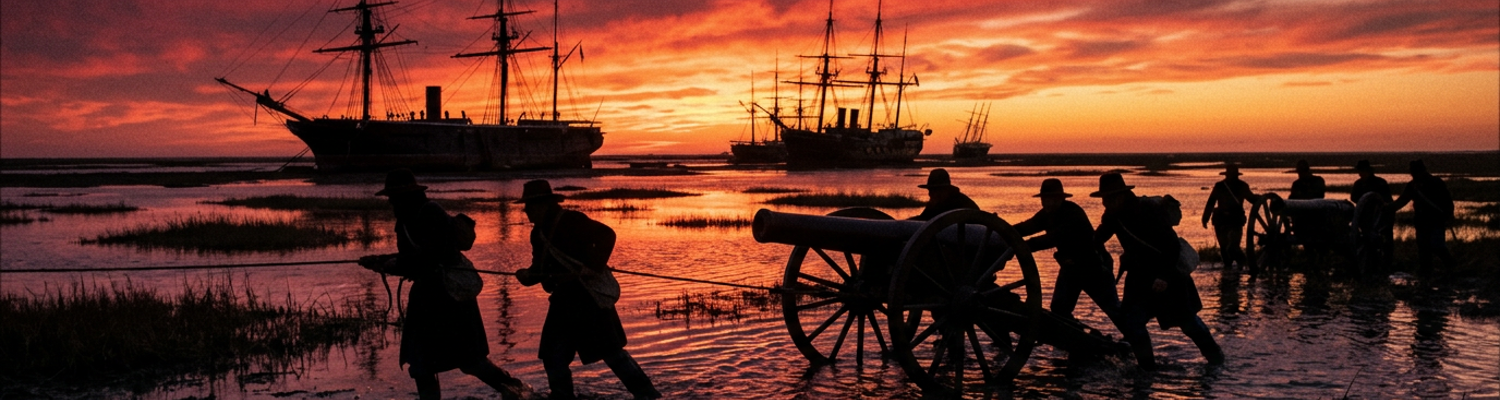
Infantrymen of the Second and Ninety Ninth United States Colored Troops plunged into the cold water alongside Navy bluejackets at Spanish Hole to push the stalled offensive ashore. Black soldiers who had endured days of seasickness in crowded holds felt their wool trousers fill with icy brine that restricted their movement. Sailors steadied the pitching cutters against the incoming tide, shouting warnings as sudden drop offs swallowed heavily laden men up to their armpits. Gunpowder supplies and paper cartridges had to be held high above their heads in the pitch blackness while their bare feet searched for firm footing along the unseen bottom. Sustained tension eroded the mental stamina of the regiments, who expected Confederate pickets to open fire from the tree line with every step they took through the surf. Landing craft dropped their heavy wooden tailgates into the black shallows, forcing the sailors and infantrymen to manhandle the expedition artillery directly into the sucking coastal mud.
Dahlgren boat howitzers sank to their iron wheel hubs the moment landing parties rolled the heavy carriages off the grounded barges. Landing parties lacked draft animals, leaving officers no choice but to order sailors and infantrymen to haul the weapons forward by raw human strength alone. Bluejackets and soldiers knotted wet hemp drag ropes to the axles and manually hauled the heavy twelve pounder Dahlgren boat howitzers through miles of freezing salt marsh in complete darkness. Bitter cold and waist deep slime sucked the footwear from their feet, causing severe muscle cramps that brought dozens of shivering men to their knees in the black tide. Exhaustion broke down the physical discipline of the haulers, who suffered painful friction burns across their palms and shoulders while struggling to keep the iron gun barrels above the water. Straining teams shouted through clenched teeth to coordinate their heaves, desperate to keep the half ton guns from disappearing completely beneath the quagmire.
Iron carriage wheels scraped violently against submerged oyster reefs as the crews lunged forward to keep the artillery moving. Shell fragments sliced through wet socks and bare skin, leaving trails of blood in the black water that added sickening physical pain to their overwhelming fatigue. Hallucinations began to plague the men after three continuous nights without sleep, making haulers drop their drag ropes to swat at imaginary obstacles in the foggy dark. Officers struggled against their own heavy lethargy, repeatedly checking compasses by shaded lanterns and ordering silent marches to avoid alerting enemy cavalry patrols. Fear of sudden ambush mounted among the soldiers of the Second and Ninety Ninth United States Colored Infantry, who knew that capture by Confederate forces meant execution or re enslavement rather than treatment as prisoners of war. Mental exhaustion reached a critical breaking point along the column, but the men kept their boots moving forward because stopping in the freezing mud meant freezing to death.
Sand and pine needles finally provided solid footing beneath their bleeding feet as the vanguard cleared the tidal flats. Gun crews wrestled the dripping howitzers up the low sandy embankment, collapsing beside the carriages with chests heaving and muscles locked in agonizing spasms. Newton rode along the dispersed companies to assess his battered force, finding over one thousand men shivering uncontrollably in waterlogged uniforms without blankets or dry rations. Surgeons bound lacerated hands and feet with coarse bandages while sergeants checked wet cartridge boxes to salvage whatever gunpowder remained dry. Infantrymen checked the percussion caps on their Enfield rifles and formed ranks along the dirt trail to begin the march inland toward the East River Bridge.
Psychological Strain Along the Newport Plank Road
Carbine bullets cracked through the dark pine branches, striking the dirt trail around the marching soldiers before the column could even secure the crossing at East River Bridge. Mounted pickets from the Fifth Florida Cavalry Battalion fired and fell back, maintaining constant contact with the advance guard and denying the exhausted men any chance to halt. Deprived of naval gunfire after their primary warships ran aground on the coastal oyster bars, the Union columns had to push forward without heavy artillery to sweep the dense brush ahead of them. Severe sleep deprivation quickly degraded the physical coordination of the Second and Ninety Ninth United States Colored Infantry, whose men had worked for days without rest during the rough sea voyage and the landing. Soldiers began falling asleep on their feet, their knees buckling under the weight of their wet cartridge boxes and knapsacks. File closers jabbed rifle barrels into the ribs of staggering infantrymen to shake men awake while they marched and prevent entire squads from wandering off into the pitch black woods.
Wooden planks groaned and splintered under hundreds of iron shod boots, sending hollow echoes into the dark forest that gave Confederate cavalrymen clear targets for their hit and run ambushes. Flash pan smoke from enemy carbines lit up the tree line at irregular intervals, keeping the Union soldiers in a state of nervous tension that drained their remaining mental stamina. Men stumbled over broken timbers and dropped into the roadside ditches from sheer muscle failure, unable to lift their Enfield rifles without trembling uncontrollably. Skirmishers from the Second United States Colored Infantry deployed repeatedly into the thick scrub to drive off the snipers, burning through their dry paper cartridges until the vanguard finally emerged onto the cleared riverbank and sighted the wooden bridge spanning the St. Marks River at Newport.
Flames erupted along the heavy pine timbers of the crossing as Confederate defenders torched the Newport bridge to block the Federal advance. Confederate soldiers stationed on the western bank also ignited an old iron foundry and nearby wooden buildings, spreading intense heat and thick black smoke that blew directly across the water. Federal infantrymen rushed toward the riverbank to extinguish the blaze, but the rising heat and concentrated rifle fire from entrenched Confederate militia drove them back into the brush. Union officers brought up their light howitzers to return fire, but solid shot could not put out the burning span or bridge the deep, swift current of the St. Marks River. Dense smoke blinded the artillery crews and choked the infantrymen, leaving the Federal expedition trapped on the eastern bank under accurate rifle and artillery fire.
General John Newton ordered his regiments to disengage from the smoking riverbank and immediately begin a grueling flanking march toward Natural Bridge. This sudden change in direction forced over one thousand physically exhausted soldiers onto an unmapped, eight mile detour through muddy pine flatwoods and cypress swamps in the middle of the night. Men who had not slept in three days discarded their wet blankets, haversacks, and heavy coats along the trail because their legs could no longer carry the extra weight through the deep mud. Severe fatigue caused hallucinations among the rear ranks, where soldiers swatted at imagined horsemen in the darkness and collapsed into the standing swamp water without the strength to stand back up. Regimental officers dragged fallen soldiers to their feet by their collar bands, forcing the disorganized regiments into line as the vanguard reached the tangled approaches to Natural Bridge just before dawn.
Entrenched Fire and Collapse at Natural Bridge
Bayonets clicked into place along the front rank as the exhausted men looked across a narrow bottleneck of dry ground flanked by flooded sinkholes and stagnant water. Entrenched Confederate regulars and home guards halted Union assaults across flooded sinkholes and narrow causeways on March 6, 1865, by pouring continuous rifle volleys from behind breastworks made of earth and felled timber. Mud caked the trembling legs of the Federal soldiers as they struggled to maintain their footing on the slick ground while hostile bullets hissed through the tangled palmettos. Sleeplessness dulled the senses of the attackers, who moved forward in a daze after three days of constant marching and hauling heavy boats through coastal muck. Confederate defenders, including reserve militia and schoolboys from the nearby military seminary, held the high bank with loaded muskets and field cannons aimed directly down the approach. Confederate artillerists depressed their smoothbore cannon barrels and aimed directly down the narrow approach.
Canister iron shredded the Union advance the moment the charging soldiers reached the center of the open causeway. Repeated frontal attacks by the Second and Ninety Ninth United States Colored Infantry disintegrated under heavy artillery canister and enfilading musket fire that raked the trapped formations from hidden positions in the trees. Whistling metal balls and lead buckshot cut down entire squads in seconds, splashing blood across the men behind them who could neither advance through the barrage nor find cover in the waist deep water of the surrounding sinkholes. Panic seized the surviving infantrymen as the concussive blasts from the guns shattered their nerves, leaving men crying out for water or standing frozen in shock as their officers shouted orders over the roar of battle. Wounded soldiers slid backward down the slick embankments into the dark sinkholes, their heavy equipment dragging them beneath the surface while the uninjured scrambled desperately to reload their fouling muskets.
Powder smoke choked the line, blinding the soldiers as ramrods jammed inside overheated barrels and trembling fingers dropped percussion caps into the mud. Regimental commanders attempted to rally their shattered companies for a second and third charge, but severe combat fatigue had completely worn away the physical ability of the men to obey. Shaking hands refused to hold rifle stocks, and soldiers dropped their weapons to cover their ears against the unending detonations of artillery fire that exploded directly in their faces. Fear of capture pushed the Black regiments to the absolute edge of human endurance, because every man knew that Confederate troops rarely spared captured African American soldiers in uniform. Terror combined with days of total physical depletion produced a sudden breakdown along the front, where soldiers huddled behind tree stumps and the corpses of their comrades while enemy bullets clipped the bark inches above their heads.
Bullets hammered the Federal line from three sides until General John Newton recognized that his men could not break the Confederate defenses. Newton ordered his buglers to sound the signal for retreat, pulling his exhausted forces back from the causeway before Confederate reinforcements could encircle their exposed flanks. Staggering soldiers dragged their wounded comrades backward along the trail, leaning on one another for support as muscle failure dropped scores of men into the dirt every few hundred yards. Rearguard units from the Second United States Colored Infantry deployed across the woods to beat back pursuing Confederate cavalry, firing blind volleys through the trees while the main column began the twenty mile march back to the safety of the gunboats at the coast.
Nocturnal Swamp Retreat and Tactical Disorganization
Troopers of the Fifth Florida Cavalry Battalion galloped around both Union flanks, threatening to sever the road back to the coast and trap the expedition. General John Newton recognized that his exhausted formations could not hold under the pressure of these mounted probes. Newton ordered a disorganized nighttime retreat through blackwater swamps to escape Confederate flanking maneuvers and complete encirclement before enemy reinforcements could seal off the roads. Panic spread rapidly through the ranks as company officers shouted conflicting commands into the darkness, destroying what remained of regimental formations. Black water rose to the waists of soldiers who had gone without sleep for three straight days, dragging heavily laden men down into unseen sinkholes and thick mud. Infantrymen stumbled over submerged cypress roots and lost their boots in the deep muck, while files became hopelessly entangled in the dense underbrush.
Mud clogged the wheels of the artillery carriages, forcing gun crews to fight for every yard through the stagnant mire. Troops suffering from severe combat fatigue and disorientation struggled to haul damaged field equipment and howitzers along the withdrawal route after heavy wooden spokes cracked against submerged cypress roots. Exhausted gunners strained against their hemp drag ropes in the black water, desperately levering the twelve pounder howitzers out of the deep mud with their bare hands. Soldiers threw aside heavy knapsacks, bent bayonets, and wet cartridge boxes because their failing muscles could no longer carry full combat loads. Hallucinations swept through the ranks of the Second and Ninety Ninth United States Colored Infantry, where sleep deprived men swung their rifle barrels at tree branches, mistaking them for enemy ambushers. Men dropped onto the wet ground by the dozen, paralyzed by muscle failure and the physical strain of days of nonstop marching.
Officers pulled fallen infantrymen to their feet by their jackets, but hundreds of men lacked the strength to stand against the sucking mud. Darkness separated entire squads from their parent companies, scattering lost soldiers across unfamiliar creek beds and tangled briar patches. Confederate skirmishers tracked the noisy retreat through the woods by listening to the shouts of lost men and the splashing of panicked soldiers crossing deep sloughs. Desperate soldiers threw their fouled Enfield rifles into the weeds to keep their heads above the surface when sudden drop offs plunged them into waist deep water. Fear of capture drove the men past rational thought, as rumors spread through the dark that Confederate cavalry were executing prisoners taken in the swamp. Sergeants lost control of their squads in the blackness, leaving frightened individuals to scramble south toward the sound of coastal surf on their own.
Soldiers reached the East River Bridge in small clusters just before dawn, collapsing onto the wooden planks from absolute physical exhaustion. General Newton established a temporary rally point along the riverbank, ordering engineers to prepare the bridge timbers for demolition to halt the Confederate pursuit. Working parties used axes and pry bars to tear up the wooden spans behind the retreating column, cutting off the immediate cavalry pursuit across the river. Surviving artillerymen and infantrymen slumped against the pine trees along the trail, trembling from hypothermia, lack of food, and severe psychological shock. Field officers took roll calls in the gray morning light, discovering that dozens of men had vanished into the cypress swamps during the night. Newton ordered the battered regiments to reform their ranks and continue the withdrawal south toward the protective cannons of the fleet at the St. Marks Lighthouse.
Fleet Evacuation and Long Term Blockade Trauma
Sailors standing guard along the sandy dunes raised their carbines as the forward files of the column emerged from the pine scrub. The retreating column re established contact with naval pickets near the St. Marks Lighthouse and evacuated onto transports under fleet protection. Gunboat crews on the anchored steamers trained their thirty two pounder cannons inland, keeping loaded shell charges ready in case Confederate cavalry burst through the tree line. Naval boat crews launched heavy wooden cutters through the breaking surf to ferry the sick and wounded out to the deep water anchorage. Exhausted infantrymen threw themselves onto the warm sand at the water line, splashing seawater over their blistered feet while boat crews hauled the wooden craft onto the beach. Soldiers helped one another hoist stretcher cases into the pitching surfboats, wading waist deep into the breakers to steady the gunwales against the tidal surge.
Oarsmen pulled hard against the coastal current to ferry each load of soldiers across Apalachee Bay to the waiting transports. Transport decks quickly filled with shivering men whose waterlogged uniforms tore apart as sailors hauled them up wooden boarding ladders. Ship surgeons set up triage stations on the open quarterdecks, cutting away bloodstained wool and treating gangrenous foot rot brought on by days of slogging through saltwater and cypress bogs. Steam winches rattled continuously as crews hoisted the remaining brass boat howitzers from the cutters and lashed the weapons firmly against the deck bulwarks. Engineers stoked the transport boilers to maintain full steam pressure, ensuring the vessels could weigh anchor and clear the shoals before falling tides trapped them again.
Firemen raked glowing coal into the furnace boxes as the transports swung their bows toward the open gulf. The failure at Natural Bridge exposed the extreme psychological strain and physical degradation suffered by crews engaged in isolated littoral combat. Sailors and soldiers alike stared blankly at the receding Florida shoreline, unable to sleep despite their total physical exhaustion as concussive battle shock left their hands shaking and their minds fixated on the slaughter along the causeway. Weeks of grueling naval blockade duty combined with days of continuous marching, grounding on oyster shoals, and taking heavy artillery fire had shattered the endurance of both naval landing parties and infantry regiments. Naval surgeons recorded cases of acute nervous collapse, noting that men startled violently at the clatter of anchor chains on deck.
Surgeons distributed dry rations, fresh water, and doses of quinine to the collapsed soldiers huddled between the deck guns. Naval commanders ordered the transport captains to form a tight convoy under the escort of the surviving shallow draft gunboats for the return passage south to Key West and Punta Rassa. Ship deckhands swabbed dried mud, salt crust, and blood from the wooden planks, working around rows of sleeping men who lay motionless where they had dropped. Flagship signal officers raised coded flags to coordinate the redeployment of the flotilla, sending the battered vessels back to their designated blockade stations along the Florida reefs. Steamer helmsmen turned their spoked wheels into the sea swells, steering the convoy out of the treacherous bay waters toward the deep channels of the Gulf of Mexico.