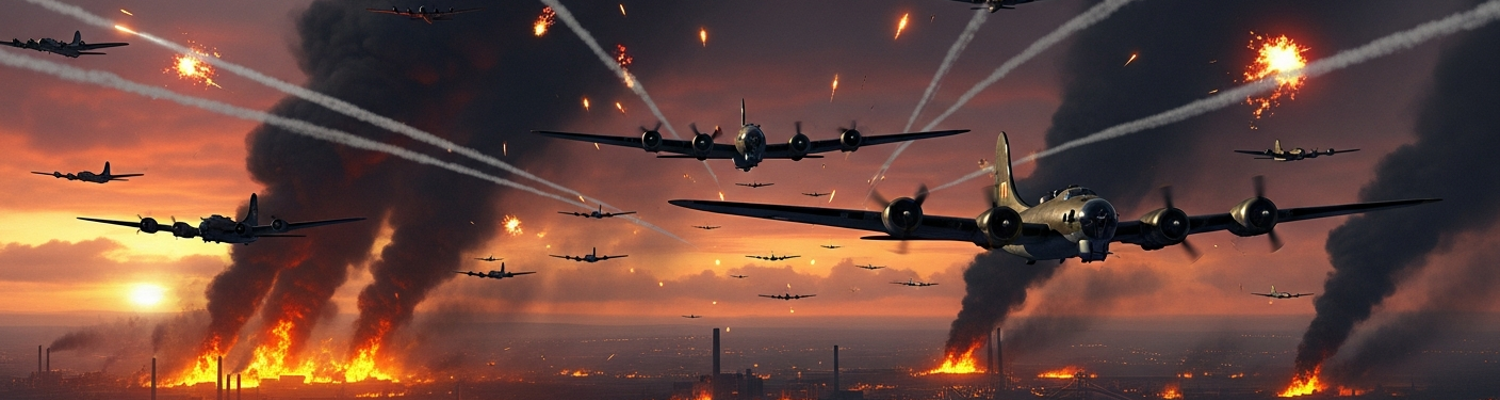

Foundations of Air Power Theory
In the quiet decades that followed the Great War, a revolutionary and potent theory of warfare captured the minds of ambitious aviators. Its prophets, men like the American General Billy Mitchell, the Italian General Giulio Douhet, and influential instructors at the U.S. Army’s Air Corps Tactical School (ACTS), preached a new gospel of air power. They argued that massed formations of heavy bombers could deliver a decisive victory entirely from the air. This new form of war would bypass the bloody, static attrition of trench warfare that had consumed a generation. Instead of armies clashing on a battlefield, bombers would strike directly at an enemy nation’s industrial heart. By targeting factories, rail networks, power plants, and government centers, they believed they could shatter an enemy’s capacity and will to fight, forcing a swift surrender.
Billy Mitchell, a charismatic and relentless advocate, brought this idea to the American public through dramatic demonstrations, like sinking the captured German battleship Ostfriesland in 1921. His vocal criticism of the military establishment led to a highly publicized court-martial, a platform he used to further champion the cause of an independent air force. Across the Atlantic, Douhet's seminal work, The Command of the Air, laid out an even more radical vision. He argued that civilian morale was a fragile center of gravity and that there was no effective defense against a determined bomber offensive. His famous dictum, "the bomber will always get through," became a core tenet of this new faith. This doctrine, refined at ACTS into the "industrial web theory," was intellectually seductive. Theorists at Maxwell Field, Alabama, led by figures like Haywood S. Hansell, meticulously mapped hypothetical enemy economies. They identified critical nodes whose destruction would cause cascading failures. They reasoned that destroying a few key ball-bearing factories would halt the production of all machines requiring them, from tanks to aircraft. This concept drove the development of aircraft like the Boeing B-17 Flying Fortress and Consolidated B-24 Liberator, bombers designed for high-altitude flight and bristling with defensive machine guns. The bomber would not merely support the army on the ground, it would win the war on its own.
Technological Impediments to Precision
The elegant promise of surgical, high-altitude daylight bombing quickly collided with the brutal realities of technology and combat. The doctrine rested on two critical and ultimately flawed assumptions: the defensive capability of the heavy bomber and the accuracy of its bombsight. The centerpiece of this technological faith was the Norden M-series bombsight. Treated with a level of secrecy that rivaled the Manhattan Project, the Norden was a sophisticated mechanical analog computer. Propaganda, eagerly consumed by the public and many military planners, claimed it could "drop a bomb in a pickle barrel from 20,000 feet." This powerful myth suggested a level of accuracy that simply did not exist outside of carefully controlled tests in the clear desert skies of the American Southwest.
Operational reality over the hostile, cloud-covered skies of Northern Europe proved far different. Navigation to the target area was the first hurdle. Aircrews relied on dead reckoning, celestial navigation, and rudimentary radio aids, all of which were difficult to use under pressure, in poor weather, and while facing German jamming. Once over the target, the bombardier faced an immense challenge. Using the Norden required the bomber to lock into a long, straight, and level run controlled by the bombsight's link to the autopilot, a period of 30 to 60 seconds where the aircraft was a predictable, non-maneuvering target for anti-aircraft flak. The complex device was fragile and difficult to operate while being buffeted by explosions and harassed by enemy fighters. Persistent cloud cover, industrial haze, or smoke from previous bomb hits could obscure the aiming point entirely. Post-raid analysis by the Eighth Air Force revealed the harsh truth. In 1943, fewer than 20 percent of bombs aimed at specific targets landed within 1,000 feet of their aiming point. The theoretical "pickle barrel" was a fantasy. The operational target was a city block.
Compounding these accuracy problems was a critical, and fatal, strategic vulnerability: the absence of long-range escort fighters. The B-17, armed with up to thirteen .50-caliber machine guns and flying in tight "combat box" formations for mutual fire support, was not the self-defending fortress its name suggested. Luftwaffe pilots in Focke-Wulf Fw 190s and Messerschmitt Bf 109s quickly developed tactics to defeat the formations. The preferred method was a high-speed, head-on pass, attacking from twelve o'clock high. This exploited the relatively lighter forward-facing armament of the bombers and gave American gunners only seconds to react to a target with a closing speed over 500 miles per hour. German twin-engine Bf 110 Zerstörer heavy fighters armed with air-to-air rockets could attack from outside the effective range of the bombers' machine guns. Early American fighters like the Republic P-47 Thunderbolt and the Lockheed P-38 Lightning lacked the fuel capacity to accompany the bombers on deep penetration raids into Germany. They were forced to turn back near the German border, an event bomber crews dreaded, leaving the bomber streams to fend for themselves for hours over enemy territory. The consequences were devastating, resulting in unsustainable losses of aircraft and their highly trained ten-man crews.
The Shift to Area Bombing
The collision between the precision doctrine and operational reality reached its bloody climax in a series of missions during the summer and fall of 1943. The Schweinfurt-Regensburg mission on August 17, 1943, was a stark lesson. The plan involved a dual-target raid aimed at crippling ball-bearing and aircraft production. Weather delays broke the mission’s integrity. The Regensburg force went in alone, followed hours later by the Schweinfurt force, allowing the full might of the Luftwaffe’s day fighter force to engage each American formation in turn. With their fighter escorts long gone, the bomber crews faced a relentless, six-hour running battle. The Eighth Air Force lost 60 B-17s that day, a catastrophic loss of 600 experienced airmen.
A second raid on Schweinfurt on October 14, 1943, a day that became known as "Black Thursday," was even more costly. Of the 291 B-17s that attacked the target, 60 were shot down and many more were damaged beyond repair, a loss rate approaching 21 percent. This time, the lesson was undeniable. The USAAF simply could not sustain such attrition. Unescorted daylight strategic bombing had failed. A strategic pause was forced upon American commanders, as deep penetration raids into Germany were halted. This operational crisis forced a profound, though often unstated, doctrinal recalculation. While the United States Army Air Forces officially maintained its public commitment to precision, operational tactics began to change. The Royal Air Force, having endured its own crippling losses in daylight raids and confirmed their inaccuracy with the 1941 Butt Report, had long since pivoted to a strategy of nighttime area bombing. Under the uncompromising direction of Air Marshal Arthur Harris, RAF Bomber Command’s explicit goal was to destroy German cities, de-house industrial workers, and break civilian morale using massed bomber streams guided by electronic aids like H2S radar.
Faced with the failure of true precision, the American effort began to blur the lines. The introduction of the North American P-51 Mustang in late 1943 was a technological game-changer. Equipped with the superb British Rolls-Royce Merlin engine and vast fuel reserves, the Mustang possessed the range and high-altitude performance to escort bombers all the way to Berlin and back. Under the new command of Lieutenant General Jimmy Doolittle, the fighters were "unleashed" from their close escort duties to actively hunt the Luftwaffe, breaking the back of the German fighter arm by the spring of 1944. With effective fighter cover, the bombers could again press their attacks deep into the Reich. The nature of these attacks evolved. The widespread use of H2X radar, an American development of the British H2S, allowed for bombing through solid cloud cover. While officially used to hit large targets like marshaling yards, H2X was an area weapon, not a precision instrument. The result was widespread, less-discriminate damage. The strategic bombing campaign that ultimately crippled the German war economy did so not through surgical strikes, but through overwhelming, attritional destruction of its transportation networks, oil production facilities, and eventually, its cities in devastating attacks like the firebombing of Dresden. The initial theory of a clean victory through airpower gave way to a grinding war of destruction, a brutal reality far removed from the optimistic doctrines of the interwar years.