
The decades following the American Civil War left the United States military in a state of strategic atrophy. National focus turned inward, toward westward expansion and the immense fortunes of the Gilded Age, leaving the country’s coastal frontiers perilously exposed. By the 1880s, the brick and granite ramparts of the Third System forts, monuments to a bygone era of warfare, stood as impotent relics. They were no match for the new fleets of steam-powered, steel-armored warships fielded by European and even some South American powers. The appearance of the modern Brazilian battleship Riachuelo in 1883 sent a wave of anxiety through the American press and military establishment. It was a stark reminder that vessels armed with powerful, long-range rifled cannon could stand well beyond the effective range of America’s smoothbore coastal guns and methodically pound cities and naval yards into submission. An 1887 war game at the Naval War College projected that a hostile fleet could neutralize New York City’s defenses in hours, crippling the nation’s economic heart. This palpable vulnerability set the stage for one of the most ambitious military engineering projects in U.S. history.
An Exposed Coast and an Iron Mandate
In March 1885, Congress, reacting to public alarm and persistent lobbying from military reformers, authorized President Grover Cleveland to form a joint Army, Navy, and civilian panel. This body, officially the Board of Fortifications, was chaired by Secretary of War William C. Endicott and tasked with a complete overhaul of American coastal defense. Its members, including the influential Army Chief of Ordnance, Brigadier General Stephen V. Benet, began a comprehensive review of the nation’s 29 most vital coastal and Great Lakes ports. The board's findings, delivered in its seminal 1886 report, painted a picture of abject neglect. The report confirmed that the existing network of masonry forts was completely obsolete, their walls easily shattered by the high-velocity shells of modern naval guns. The board’s recommendations were sweeping. They called for the total abandonment of the old system of concentrated, fortress-based defenses. The report proposed a new paradigm: a dispersed, concealed, and deeply integrated system built around firepower, protection, and centralized command. It recommended a massive $127 million program, an astronomical sum for the era, to fortify locations from the industrial hubs of the East Coast to the burgeoning ports of the Pacific. This was a fundamental reimagining of coastal defense, aiming to replace crumbling brick with reinforced concrete and antiquated smoothbores with a new generation of powerful, breech-loading steel rifles. The plan also integrated new technologies, calling for extensive fields of electrically detonated underwater mines and powerful searchlights to counter night attacks. The strategic necessity was clear. A secure coastline would unchain the U.S. Navy from its defensive, harbor-bound posture, allowing it to project power offensively on the high seas, a critical step for a nation with growing global ambitions.
Concrete, Steel, and Disappearing Guns
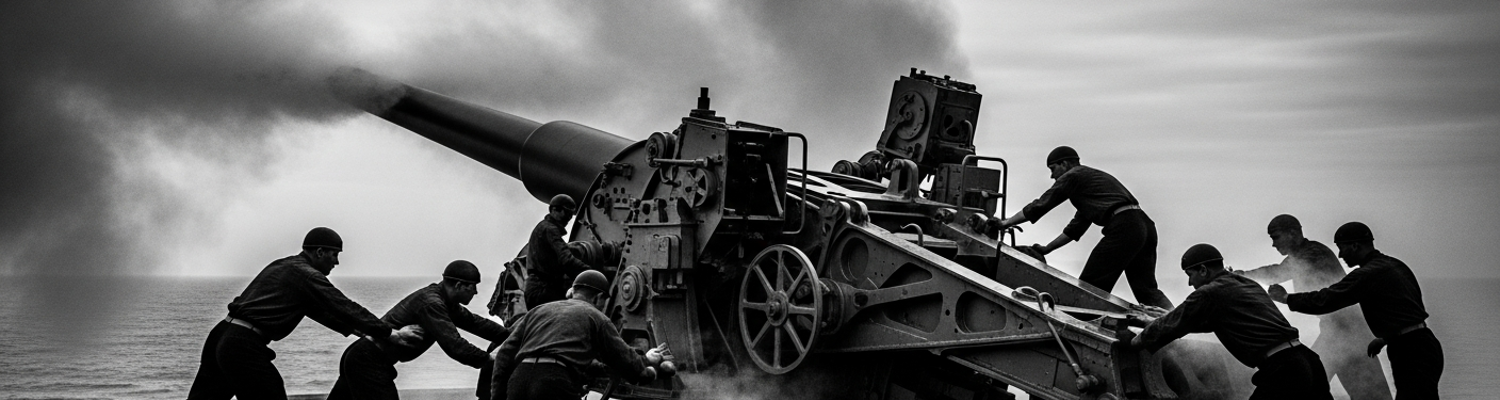
The technological core of the Endicott System was the marriage of massive new artillery with ingenious methods of protection. The era of guns blazing from open embrasures in vertical stone walls was finished. The new defense demanded that the primary armament remain hidden from naval observers until the moment of firing. The solution was the disappearing gun carriage, a marvel of Gilded Age mechanical engineering. The most successful model was the Buffington-Crozier design, developed by Army ordnance officers Adelbert R. Buffington and William Crozier. This intricate mechanism of steel arms and massive lead counterweights, often weighing hundreds of tons in total, operated on a simple principle. The gun, such as the 12-inch M1895 rifle manufactured at the Watervliet Arsenal, was mounted on the carriage in a massive concrete pit. Its parapet was flush with the surrounding terrain and camouflaged with earth and vegetation. For loading, the gun crew worked in the complete safety of the pit. Once loaded with its nearly 1,100-pound projectile and propellant charge, the gun was ready. Upon the command to fire, a clutch released the immense counterweight, which dropped and swung the gun upward and forward over the parapet. For a brief moment, the barrel was exposed before it unleashed its payload. The powerful recoil force, instead of being wasted, was harnessed by the mechanism. It drove the gun back and down, returning it to the protected loading position, where the cycle would begin again. This process was not fast, with a well-drilled crew managing perhaps one round every two to five minutes, but its emphasis was on survivability, not volume. These disappearing guns were housed in fortifications that bore no resemblance to their predecessors. Built of reinforced concrete with walls many feet thick and covered by sloping earthen glacis, these batteries were designed to absorb the impact of heavy naval shells and were nearly invisible from the sea. They were not single forts but dispersed systems of individual batteries, often separated by considerable distances to prevent a single ship from engaging multiple emplacements at once. Underground magazines, connected by tunnels and serviced by ammunition lifts, protected the volatile powder and shells. The system also incorporated batteries of heavy 12-inch mortars. Arranged in pits of four, these weapons delivered high-angle, plunging fire that could bypass a warship’s thick belt armor to smash its thinly protected decks, a devastating threat to any vessel attempting to anchor or move slowly.
The Science of Long-Range Destruction
The most lasting shift delivered by the Endicott System was not in its hardware, but in its doctrine. It fundamentally altered how the U.S. Army approached the problem of hitting a moving target at sea. The old method was direct fire, with gunners physically sighting down the barrel at a visible ship. This was a close-range form of combat, limited by the human eye. The Endicott System instituted a new era of long-range, indirect fire, a scientific process managed through a complex command and control network. Guns would now be directed at targets they could not see, their fire controlled from afar. This network was a nervous system of observation and communication, made possible by the telephone and electrical power. The eyes of the system were the base-end stations, small, often camouflaged concrete bunkers set at precisely surveyed locations, sometimes miles apart along the coast. Inside each station, observers used an azimuth telescope, or alidade, to track a target ship, reading its bearing at synchronized intervals. This timing was coordinated by a system of time-interval bells that rang simultaneously in all linked stations and in the battery’s command center. When the bell rang, each observer would call out their bearing to a soldier manning a telephone. The bearings were relayed to a central plotting room, a nerve center typically buried deep within the concrete battery or in a separate, protected bunker. Here, a team of soldiers in the Coast Artillery Corps translated the raw data into a firing solution. On a large map table called a plotting board, which represented the harbor and its approaches, they used mechanical arms corresponding to the base-end stations to triangulate the target’s position at each interval. By plotting a series of these positions, they could determine the ship’s course and speed. This allowed them to calculate a predicted position where the ship would be after the shell’s time of flight. This set-forward point was then adjusted for variables like wind, air temperature, tide, and even the curvature of the Earth. The final firing data, an azimuth and elevation for the guns, was then telephoned or sent via mechanical telegraph to the gun pits. Gunners, who may never have laid eyes on the enemy vessel, would traverse and elevate their massive weapons according to the data received, and fire on command. This coordinated, almost industrial process of observation, calculation, and firing marked a complete break from the past, turning coastal defense from an art into a science.
A Shield for a Rising Power
The construction of this immense defensive shield had a palpable effect on the nation. In coastal cities from Boston to San Francisco, the sight of massive concrete batteries rising to guard harbor entrances fostered a sense of security that had been absent for decades. This renewed confidence helped fuel economic development and port expansion, as the threat of a paralyzing naval raid diminished. On the international stage, the Endicott System was a clear statement of American intent. It signaled that the United States was no longer a soft target but a nation capable of defending its sovereign territory with the most advanced military technology of the age. This new defensive posture provided the strategic backstop that allowed the New Steel Navy to steam out from its protected anchorages during the Spanish-American War and announce America's arrival as a global power. The guns of the Endicott System, hidden behind concrete and earth, stood silent watch for half a century, their existence a powerful deterrent. Though they never fired a shot in anger at a hostile fleet, their presence reshaped the strategic calculus of naval power in the Western Hemisphere. They served through World War I, but the rise of military aviation ultimately rendered them obsolete. By World War II, their guns were being scrapped, their purpose supplanted by the long reach of the bomber. Today, their silent concrete forms still dot the American coastline, remnants of an era when the nation turned its industrial might toward building an impenetrable fortress of steel and stone.