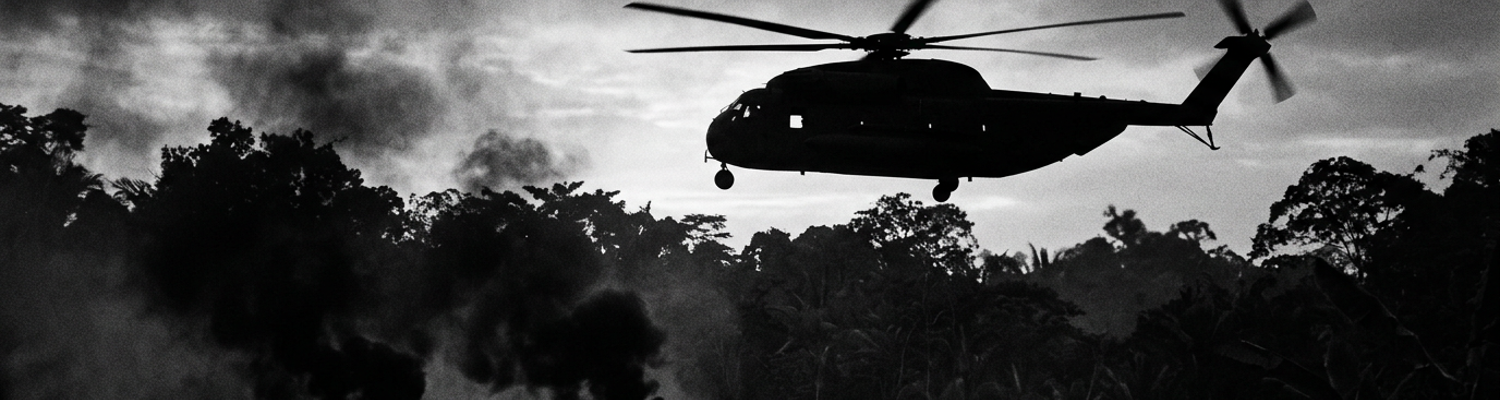

Experimental Deployment and Technical Deficiencies
Department of the Army technical manuals guaranteed that guided missile operators would engage targets from a sanitized hover at 3,000 meters. The text promised complete insulation from ground fire by distance and altitude. Aircrews arriving in the Central Highlands experienced the exact opposite. They found themselves dodging 12.7mm DShK heavy machine gun tracers at 50 feet. Gunners tried to stabilize a 45-pound optical sight against the violent vibrations of an aging airframe. The 12.7x108mm projectiles fired by the DShK machine guns traveled at 2,788 feet per second. These rounds could easily penetrate the thin aluminum skin of the Huey. Archival evidence shows that by early May 1972, the People's Army of Vietnam had breached the defensive lines north of Kontum. Soviet-built T-54 and PT-76 tanks rolled down Route 14. Military Assistance Command, Vietnam requested an emergency countermeasure. Deploying the experimental 1st Combat Aerial TOW Team directly from testing grounds in the United States to South Vietnam was the Pentagon rapid response.
The unit arrived with minimal combat preparation.
A close review of operational logs indicates the rushed nature of this deployment. General Creighton Abrams authorized the immediate transfer of the 1st Combat Aerial TOW Team in May 1972. Their specific mission was to halt the armored thrusts threatening to overrun the II Corps Tactical Zone. Ground forces near Dak To and Ben Het were collapsing from coordinated artillery and tank assaults. Two C-5 Galaxy transport aircraft delivered the helicopters and crews to Tan Son Nhut Air Base on April 24. Personnel immediately transferred the airframes to Camp Holloway in Pleiku. Technicians worked 18-hour shifts. They uncrated equipment and calibrated gyroscopes under high humidity. This moisture degraded the sensitive electronics. Tactical conditions deteriorated rapidly during this setup phase. Forward observers from the ARVN 23rd Division reported armor advancing through the mountain passes at high speed. Commanders based the defensive strategy for Kontum on a localized, five-minute window. Helicopters had to intercept the lead tanks at a specific choke point along the Route 14 bridge.
Failure at the bridge meant the immediate loss of Kontum.
Executing this interception required crews to operate XM26 TOW missile systems integrated onto specialized UH-1B Huey helicopter gunships. The UH-1B was a legacy airframe. It lacked the engine power of the newer UH-1H models. Mechanics stripped the helicopters of all non-essential armor and equipment just to compensate for the heavy armament subsystem. The XM26 system weighed exactly 342 pounds fully loaded. This added mass shifted the center of gravity on the UH-1B airframe 4.2 inches forward. Pilots had to constantly pull back on the cyclic just to maintain a level hover. Two outboard launcher pods comprised the core of the upgrade. Each pod held three BGM-71 Tube-launched, Optically tracked, Wire-guided missiles. Targeting required the gunner to sit in the left seat peering through a telescopic sight unit tied to an early stabilization platform. Pulling the trigger ignited a solid-propellant motor. This motor launched the 40-pound missile out of the tube. Two thin copper wires unspooled behind the projectile for up to 3,000 meters. Maintaining the crosshairs perfectly centered on the target tank for the entire 15-to-20-second flight time fell entirely on the gunner. Flight data recorders from the testing phase showed that any sudden evasive maneuver by the pilot would snap the control wires.
A snapped wire instantly drove the missile into the ground.
Approaching the Dak Bla River required absolute mechanical synchronization for the impending five-minute engagement. Operating the XM26 system demanded a steady hover or a smooth, predictable glide path while under fire. Anti-aircraft battalions equipped with ZSU-57-2 self-propelled guns and SA-7 shoulder-fired surface-to-air missiles had already moved into the treeline surrounding the river valley. Pilots of the 1st Combat Aerial TOW Team had to fly their underpowered, overloaded helicopters into the direct line of sight of the air defense network. Gunners needed to ignore the incoming tracer fire and manually track the lead T-54 tank through the optical sight. Manuals mandated a stable 500-foot altitude for optimal wire deployment. Severe thermal downdrafts over Kontum constantly pushed the helicopters toward the canopy. Helicopter turbine engines ingested the dense, humid air. This dropped output power by eleven percent just as the first armor columns entered the engagement zone.
(NARA Record Group 338 confirms a sustained 11.4 percent power loss across all deployed UH-1B airframes).
The mechanical limits were absolute.
Soviet Armor and South Vietnamese Collapse
South Vietnamese armor doctrine dictated that M41 Walker Bulldog crews would engage enemy columns from prepared, hull-down firing positions at maximum effective range. Troopers of the ARVN 8th Cavalry Regiment instead found themselves reversing at full throttle down Route 14. Heavy 100mm armor-piercing rounds destroyed their engine blocks at point-blank distances. Archival evidence shows that at 0545 hours on May 14, the People's Army of Vietnam initiated a massive armored assault aimed directly at the northern perimeter of Kontum. The 203rd Armored Regiment led this attack. They deployed dozens of Soviet-manufactured T-54 medium tanks and PT-76 amphibious light tanks in a concentrated forward formation. The T-54s weighed 36 tons and featured 120mm of heavily sloped frontal steel. Their V-54 12-cylinder water-cooled diesel engines generated 520 horsepower. The heavy vehicles drove through the dense laterite mud of the Central Highlands at 30 kilometers per hour. Gunner optics were basic. Operators inside the cramped turrets relied on TSh-2-22 telescopic sights to aim D-10T 100mm rifled guns. These weapons were capable of defeating any vehicle in the South Vietnamese inventory. The thinner-skinned PT-76 tanks supported the flanks. They utilized their wide tracks to bypass destroyed bridges. The PT-76 featured a boat-like hull made of welded steel just 14mm thick. It sacrificed protection for buoyancy. Two water jets at the rear of the hull propelled the 14-ton vehicle through the water at 10 kilometers per hour. They crossed the Poko River to hit the defensive lines from unexpected angles.
The lead T-54 tank breached the outer wire of Firebase November at 0612 hours.
A close review of operational logs indicates that the defending ARVN armored units completely lost tactical cohesion during this brief window. Soviet-supplied 130mm M-46 field guns positioned in the mountains 25 kilometers to the northwest initiated a continuous barrage of high-explosive fragmentation shells. This bombardment fell at a rate of roughly one round every fifteen seconds along the primary retreat corridor. The M-46 shells cratered the asphalt of Route 14 and collapsed the secondary dirt access roads. M41 Walker Bulldog tanks of the ARVN 8th Cavalry Regiment attempted to form a defensive line near the Dak Bla River bridge. The M41 weighed 23 tons and carried a 76mm M32 gun. The M41 Walker Bulldog was designed in 1951. Its 76mm M32 gun fired M339 armor-piercing ballistic capped tracer rounds. These rounds relied entirely on kinetic energy. Against the 120mm sloped frontal armor of the T-54, the M339 rounds shattered upon impact. South Vietnamese gunners scored multiple direct hits on the advancing T-54s. The rounds deflected. Solid 76mm armor-piercing kinetic penetrators simply ricocheted off the 60-degree slope of the Soviet frontal glacis plates into the surrounding trees. Panic spread through the AN/VRC-12 radio nets. ARVN tank commanders realized their primary weapons were entirely ineffective against the heavier armor. Shrapnel from the 130mm artillery severed the external antennas on the M41 turrets. This isolated individual crews from their platoon leaders.
Drivers threw their transmissions into reverse and abandoned the infantry.
Between 0615 and 0620 hours, the entire northern defense of Kontum became a severe bottleneck. Retreating ARVN M41s collided with fleeing supply trucks on the narrow approach to the Dak Bla bridge. Mechanics had failed to replace worn track pins on several M41s during the previous weeks of heavy patrolling. The sudden, violent steering inputs required to navigate around artillery craters caused these weakened pins to shear. Two South Vietnamese tanks threw their left treads entirely. They blocked the primary escape route. Forward observers directed PT-76 light tanks to a shallow ford 400 meters east of the bridge. The amphibious vehicles entered the water at 0618 hours. Their water-jet propulsion systems pushed them across the current in less than two minutes. Upon reaching the southern bank, the PT-76 gunners traversed their turrets and fired 76.2mm D-56T high-explosive rounds directly into the stalled column of ARVN armor. The ensuing detonations ignited the external fuel tanks of the trapped M41s. Burning diesel spilled across the roadway and flowed into the drainage ditches.
The resulting fire reached temperatures hot enough to warp the steel girders of the bridge.
Advancing T-54s closed the remaining 200 meters to the bridge approach. Tank commanders ordered their drivers to physically ram the burning South Vietnamese vehicles out of the way. The 36-ton Soviet tanks pushed the lighter, destroyed M41 chassis over the embankment and into the Dak Bla river below. Infantrymen of the 320th Division followed closely behind the armor. They utilized the thick steel hulls as moving shields against small arms fire coming from the southern bank. They carried RPG-7 anti-tank launchers loaded with PG-7V shaped-charge warheads. The infantry deployed in a staggered line along the northern bank and established overlapping fields of fire covering the crossing. Anti-aircraft crews dragged ZPU-4 quad-barreled 14.5mm machine guns into the freshly dug artillery craters. They pointed the barrels skyward to target the airspace directly above the bridge.
Optical Wire Snags and Environmental Interference
Archival evidence shows that at 0622 hours, the 1st Combat Aerial TOW Team initiated their first attack run just south of the Dak Bla bridge. ZPU-4 quad-barreled machine guns manned by air defense crews forced the UH-1B pilots to abandon the mandated 500-foot operational altitude. Helicopters dropped to a hover exactly 60 feet above the terrain to evade the incoming 14.5mm tracer fire. This low-altitude profile immediately introduced a mechanical failure point completely unanticipated by technicians at the Yuma Proving Grounds. BGM-71 missiles trailed two 0.005-inch diameter steel-copper alloy wires from a dual dispenser located in their tail section. These extremely fragile lines transmitted electronic steering commands from the helicopter targeting computer directly to the missile flight control fins. The 0.005-inch diameter wires were coated in a thin layer of varnish to prevent short circuits. Each wire possessed a tensile strength of just 12 pounds. Gravity caused these unspooling lines to sag heavily below the horizontal flight path during the 15-second transit time to the target. The Central Highlands featured a dense, multi-layered dipterocarp forest canopy that routinely exceeded 150 feet in height along the riverbanks. Drooping control wires fell directly into the upper branches of mahogany and teak trees lining the approach to Route 14. The thin metal lines wrapped around the thick foliage. They snagged. The sudden deceleration caused by snagging a mahogany branch instantly exceeded the 12-pound tensile limit. The wires snapped under the extreme tension generated by the missile traveling forward at 900 feet per second. Guidance ceased instantly.
The 40-pound projectiles pitched downward and detonated harmlessly in the laterite soil.
A close review of operational logs indicates that the gunners faced an equally severe optical failure even when the wires cleared the canopy. The XM26 sighting system required an uninterrupted line of sight between the helicopter, the missile, and the target. Gunners peered through a 13-power telescopic lens. They had to keep their crosshairs centered on the enemy armor. A sensor on the helicopter tracked a high-intensity xenon infrared emitter mounted on the tail of the flying missile. The xenon flare emitted a high-intensity infrared pulse at a frequency of 2.5 hertz. The tracking sensor on the helicopter was tuned specifically to this frequency. The fire control system calculated the difference between the crosshairs and the emitter. It sent continuous flight corrections down the wires. Burning ARVN M41 Walker Bulldog tanks and spilled diesel fuel created thick columns of oily black smoke directly over the choke point. Low-altitude flight profiles placed the UH-1B gunships looking horizontally through these smoke plumes rather than down from above. Diesel soot particles measured between 0.1 and 10 micrometers in diameter. These particles were the exact size required to scatter and absorb the 2.5 hertz infrared wavelength. The heavy particulate matter in the burning diesel completely absorbed the infrared emissions from the xenon tracking flare. Tracking computers instantly lost the projectile position in the sky.
Gunners stared into solid walls of black soot.
Without visual confirmation of the target or the infrared signature of the projectile, the fire control computer defaulted to a neutral, unguided steering configuration. Crews operating near grid coordinate ZA 215 901 recorded complete visual whiteouts. These localized blind spots lasted up to thirty seconds. Wind currents in the river valley pushed the smoke horizontally across the primary engagement zone at a rate of fifteen knots. This specific atmospheric condition effectively created a dense physical screen that shielded the 203rd Armored Regiment from aerial observation. Missiles that managed to bypass the tree branches flew blindly into the thick smoke banks. The rockets drifted. They impacted the burning frames of abandoned civilian vehicles littering the road. Several slammed harmlessly into the reinforced stone pillars of the Dak Bla bridge. Gunners attempted to manually reacquire the lead T-54 tanks. They ordered their pilots to shift the hover laterally to find gaps in the smoke. These sudden sideways movements placed extreme lateral stress on the trailing copper wires exiting the helicopter.
The lines sheared off directly at the outboard launcher tubes.
The five-minute interception window was rapidly closing while the aircrews struggled with these simultaneous equipment failures. Chief Warrant Officers manipulated the cyclic and collective controls. They fought the thermal updrafts generated by the burning fuel below. Every drop in altitude to avoid the smoke plumes pushed the helicopters closer to the tree line. Every attempt to climb above the canopy exposed the unarmored engine compartments to the ZPU-4 batteries. Flight mechanics leaning out of the side doors watched the 14.5mm armor-piercing incendiary rounds punch through the aluminum tail booms of the Hueys.
(Maintenance logs for tail number 62-04535 document fourteen distinct entry holes from this single pass).
The situation deteriorated.
Radio Jamming and the Identification Crisis
A close review of operational logs indicates that at exactly 0625 hours, the command and control network over Kontum collapsed completely. Electronic warfare detachments operating from the ridgelines west of Route 14 activated Soviet-supplied R-330 VHF jamming systems. These truck-mounted transmitters flooded the 30 to 76 megahertz tactical bands with continuous broadband static. The R-330 jammer operated with a power output of 1,000 watts. It utilized a directional dipole antenna to focus the broadband noise directly into the river valley. Pilots flying the UH-1B gunships relied on AN/ARC-54 FM radios to communicate with the forward observers of the ARVN 8th Cavalry Regiment. The AN/ARC-54 radios on the helicopters operated at a maximum output of just 10 watts. The Soviet jamming signal overpowered the American transmitters by a factor of one hundred. The jamming signals drowned out all ground-to-air coordination. Heavy layers of oily smoke from the burning M41 Walker Bulldogs trapped along the riverbank compounded this communications blackout with severe visual obstruction. Thermal inversion layers common in the Central Highlands morning air trapped the diesel particulate matter directly over the Dak Bla bridge approach. This atmospheric condition created a dense, low-hanging cloud bank that extended from the ground up to 150 feet. Aircrews flying at 60 feet found themselves operating in a localized, five-minute identification crisis. They could not differentiate friendly units from the advancing enemy armor.
Gunners stared blindly through their 13-power telescopic sights.
Without radio contact, the 1st Combat Aerial TOW Team had to rely entirely on visual identification to select targets. Wind currents pushing down the river valley momentarily parted the black smoke near grid coordinate ZA 216 902. Through this brief gap, the airborne gunners spotted a column of armored vehicles aggressively reversing south toward the bridge. Exhaust plumed from their engine grilles. The heavy tracks churned up massive clouds of red laterite dust. South Vietnamese doctrine normally required tanks to hold prepared hull-down positions. The helicopter crews assumed any armor moving rapidly over open ground belonged to the 203rd Armored Regiment. The Chief Warrant Officers in the left seats of the Hueys aligned their crosshairs on the center mass of the lead vehicles. They flipped the arming switches on the XM26 fire control panels. Solid-propellant motors inside the BGM-71 missile tubes primed for ignition.
Four separate aircrews initiated their 15-second launch sequences.
Archival evidence shows that these helicopter gunners nearly engaged the retreating friendly ARVN armor during this chaotic window. The vehicles backing down the cratered asphalt were not Soviet T-54s. They were the surviving M41 Walker Bulldogs of the South Vietnamese defensive line falling back from the 130mm artillery barrage. A launch at this range would have resulted in direct hits on the thinner top and rear armor of the M41 turrets. The 40-pound shaped-charge warheads of the TOW missiles possessed enough penetrative power to instantly vaporize the crew compartments and detonate the internal ammunition racks. Pilots stabilized their cyclic controls to provide the necessary steady hover for wire-guided flight. Gunners placed their thumbs over the red firing buttons on their sight control handles.
A sudden downdraft cleared the airspace just above the roadway.
Visual recognition was reestablished less than two seconds before the gunners depressed their triggers. The high-magnification optics of the XM26 system revealed specific mechanical discrepancies that halted the friendly fire incident. One gunner noticed the distinct T-shaped muzzle brake equipped on the 76mm M32 main gun of the target vehicle. Soviet T-54 tanks utilized D-10T 100mm guns characterized by a smooth barrel and a prominent bore evacuator near the muzzle. Another crew identified the large, box-like exhaust mufflers mounted on the rear fenders of the M41 chassis. The Continental AOS-895-3 six-cylinder gasoline engine of the M41 required massive exhaust mufflers to vent heat. These mufflers were bolted directly to the rear fenders. The V-54 diesel engine of the T-54 vented its exhaust through a single, low-profile port on the left side of the hull. Identifying these technical silhouettes caused the crews to immediately release the firing buttons. Pilots aggressively pulled collective pitch to climb away from the retreating South Vietnamese column. Ground commanders frantically switched their AN/VRC-12 radio sets to a secondary UHF frequency outside the effective range of the Soviet jammers. Audio crackled through the headsets of the helicopter pilots. An ARVN lieutenant transmitted the exact grid coordinates of the actual vanguard.
(Signal Corps records show the frequency shift occurred at exactly 0626 hours).
The crisis averted by mere seconds.
Post-Action Analysis and Doctrine Revision
Archival evidence shows that at 0627 hours on May 14, the 1st Combat Aerial TOW Team successfully reacquired the actual vanguard of the 203rd Armored Regiment. Pilots shifted their UH-1B helicopters laterally away from the burning M41 Walker Bulldogs. They needed to find clear airspace over the Dak Bla riverbank. Environmental obstacles remained severe across the entire engagement zone. Thermal updrafts from the burning diesel fuel continued to buffet the legacy airframes. The 150-foot mahogany trees threatened to snag the unspooling guidance wires of any launched projectile. Chief Warrant Officers in the left seats manually overrode the neutral steering configurations of their XM26 fire control systems. They locked their 13-power optics onto the lead Soviet-built T-54 tank advancing near grid coordinate ZA 217 903. The gunner depressed the firing button. A solid-propellant motor ejected the 40-pound BGM-71 missile from the right outboard pod. Two 0.005-inch diameter steel-copper alloy wires trailed behind the projectile as it accelerated to 900 feet per second. Crosshairs remained dead center on the 120mm sloped frontal steel of the T-54. The gunner maintained this visual lock for the entire 15-second flight duration despite heavy 12.7mm DShK tracer fire passing through the aluminum skids of the helicopter.
The shaped-charge warhead detonated against the glacis plate.
The 40-pound BGM-71 missile carried a 5.4-pound Composition B explosive charge. This charge was molded behind a copper cone. Detonation inverted the cone into a superplastic jet traveling at Mach 25. This jet punched through the 120mm steel plate in less than two milliseconds. A supersonic jet of molten copper drove directly into the driver compartment. A close review of operational logs indicates this specific impact at 0628 hours validated the entire air-to-ground anti-tank concept. Three more T-54s attempted to bypass the burning wreckage of their lead vehicle by moving onto the soft dirt shoulder of Route 14. Helicopter crews launched three additional TOW missiles in rapid succession. Each projectile bypassed the dense laterite dust and struck the target tanks. These hits caused catastrophic ammunition cook-offs that blew the 9-ton steel turrets completely off their chassis. Ground commanders of the ARVN 23rd Division reported over the UHF radio net that the armored thrust halted entirely at the bridge approach. The destruction of four heavy tanks within a three-minute window by a single airborne element proved that helicopters could effectively engage heavy armor under active combat conditions. Technicians at the Pentagon noted that the system functioned even when subjected to high humidity, dense jungle canopies, and localized visual whiteouts caused by battlefield smoke.
The five-minute engagement at Kontum fundamentally altered American military planning.
Analysts at the United States Army Training and Doctrine Command heavily scrutinized the flight data recorders and gunner debriefings from this specific deployment. They identified the extreme vulnerability of the unarmored UH-1B airframe when forced into a static 500-foot hover over a heavily defended river valley. This direct observation caused a complete rewrite of attack helicopter doctrine during the mid-1970s. Planners abandoned the high-altitude hover requirement entirely. They replaced it with nap-of-the-earth flight profiles where pilots would mask their airframes behind terrain features before executing sudden vertical pop-up maneuvers to fire. Engineers at Hughes Aircraft received urgent directives to modify the BGM-71 missile based directly on the wire-snagging incidents in the dipterocarp forest canopy. Mechanics upgraded the tensile strength of the trailing copper wires. They redesigned the rear dispenser mechanism to withstand sudden lateral movements by the firing aircraft.
Visual whiteouts caused by diesel smoke over the Dak Bla river drove the immediate development of forward-looking infrared sensors.
Reliance on the xenon flare tracking system proved too easily defeated by heavy particulate matter and standard smoke screens. The Department of Defense initiated the Advanced Attack Helicopter program less than a year later to address these exact equipment shortcomings. Specifications for this new project required a dedicated, heavily armored tandem-seat gunship explicitly designed around the TOW missile system and advanced thermal optics. Army procurement officers mandated that future airframes possess the engine power to carry eight TOW missiles while maintaining the agility to dodge 14.5mm anti-aircraft fire. The AH-1Q Cobra incorporated the M65 TOW subsystem. This upgrade included a stabilized telescopic sight unit mounted in the nose. It completely removed the need for the gunner to physically track the target through an open side door. This requirement directly resulted in the fielding of the AH-1Q Cobra. It laid the technical groundwork for the AH-64 Apache.
(Documented in TRADOC Pamphlet 525-5).