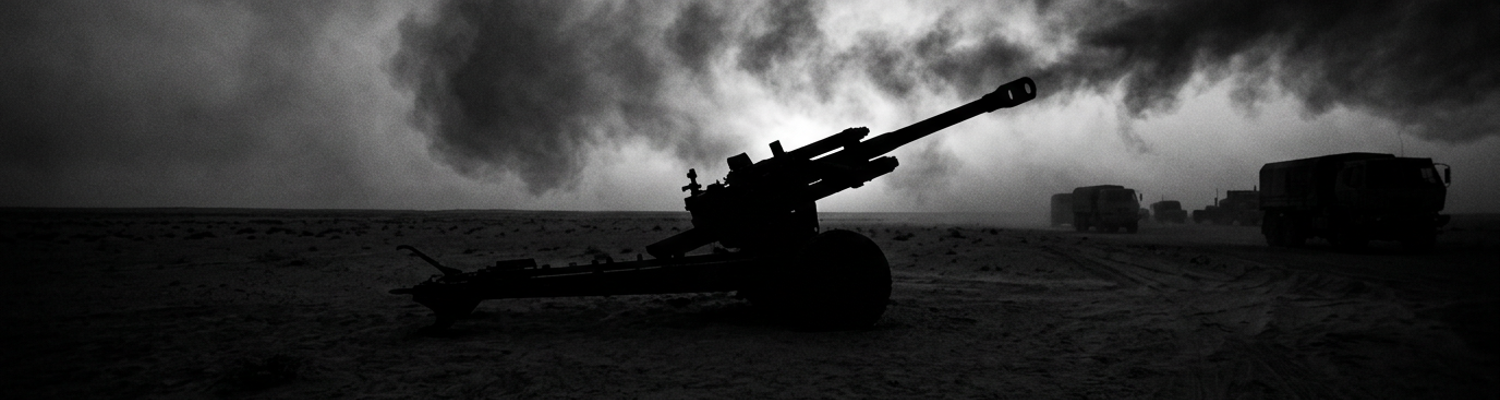

Breach Lane Congestion at Assembly Area Bear
Across the Kuwaiti border, Iraqi forces held overwhelming numerical superiority. Over three hundred thousand entrenched soldiers manned dense defensive belts. These belts were backed by more than two thousand tanks and an artillery concentration that outnumbered Coalition barrels by more than two to one. Hardened concrete bunkers, deep tank ditches, and barbed-wire tangles stretched across hundreds of kilometers of open desert. Millions of buried explosive devices shielded these positions. Marine planners calculated that an assault directly into these positions would produce catastrophic casualty counts if supporting fires faltered for even an hour. The Second Marine Division had to punch through two fortified obstacle belts to clear the path toward Al Jaber Air Base. They relied entirely on the continuous drumbeat of Tenth Marines artillery to suppress enemy defensive batteries.
Pure arithmetic favored the fortified defender.
Archival evidence shows that this supply line cracked before the first combat vehicles crossed the starting line. At Assembly Area Bear, a designated staging sector positioned just south of the border berm, Combat Service Support Group 2 encountered severe staging gridlocks. Heavy cargo haulers stacked up bumper-to-bumper across unpaved desert sand. This included heavy tactical truck units and five-ton M923 transports. Wheels churned deep into the soft sand. Overloaded trailers packed with thousands of pounds of 155mm high-explosive projectiles, fuzes, and propellant cans high-centered in the ruts. Mechanical components failed rapidly under the strain. Drive shafts snapped. Transmission fluid boiled in the heat. Radiator hoses burst across the dispersed vehicle parks. Staging officers struggled to establish orderly traffic control patterns in the absence of hardball roads or established bypass lanes.
Command posts ordered supply convoys to pull aside and halt.
Priority shifted to moving tracked armored battalions forward. Munitions carriers were left trapped behind idling armor columns for hours on end.
Engines ran dry while ammunition stayed locked in place.
A close review of operational logs indicates that the physical bottlenecks escalated dramatically as the assault forces entered the breach. Combat engineers deployed rocket-projected line charges and armored M60A1 tanks fitted with track-width mine plows to blast passages through the Iraqi barrier lines. The cleared corridors measured only sixteen feet across. These paths formed restrictive single-lane cuts through dense belts of Type 72 anti-tank and VS-50 blast mines. Resupply convoys carrying reserve munitions for Tenth Marines were forced to move in rigid single file. There was zero clearance on either side of the cleared tracks. Leaving the marked ruts meant driving directly onto live ordnance. This completely eliminated the possibility of vehicle passing or roadside staging.
An armored D7 bulldozer struck a buried mine while attempting to level ruts in Lane Blue 3.
The entire lane became blocked. Munitions trucks ground to a dead halt behind the disabled hulk. Convoy lines stretched across miles of exposed approach routes.
Forward batteries were firing high-explosive shells faster than haulers could traverse the narrow corridors.
Operational records from February 24 demonstrate that clearing these blockages took entire operational shifts. Recovery vehicles could not swing retrieval booms without extending outriggers into uncleared mine territory. Crews had to extract immobilized equipment with straight cable winching from front and rear. Dispatchers at the division tactical command center had to divert ammunition serials across distant alternative lanes. This doubled transit times and burned scarce fuel reserves. Tenth Marines howitzer crews south of the Al Jaber defensive sector dropped to emergency ammunition thresholds. They rationed fire missions to defensive calls while loaded transport trucks remained halted in single-file columns behind stalled lead vehicles.
Transportation Misallocation and Munitions Staging Deficits
A close review of operational logs indicates that the primary bottleneck in Class V ammunition distribution originated in decisions made days before the assault. Within the rear staging sectors operated by 2nd Force Service Support Group at Al Khanjar, transport coordinators faced an acute shortage of heavy military prime movers. They specifically lacked the M915 tractor-trucks and M870 forty-ton flatbed semi-trailers needed to haul break-bulk munitions forward. Supply officers directed dozens of these flatbed assets toward rearward salvage tasks. Motor transport dispatchers assigned cargo trailers to haul empty wooden dunnage, broken cargo straps, bent ISO shipping containers, and evacuated maintenance hulks south toward ports along the Persian Gulf.
Standard operating procedures established during pre-offensive buildup mandated the rapid clearing of staging yards.
This prevented administrative clutter. It created an institutional impulse to move deadlined components to coastal depots at Al Jubail. Transport clerks processed trip tickets that sent commercial lowboys south under partial loads of damaged electrical generators and blown truck tires. Forward artillery units waited for chassis to move explosive charges.
Tractors carried scrap metal away from the front lines while forward guns ran on empty caissons.
Archival evidence shows that this misdirection of rolling stock paralyzed the forward flow of munitions during the peak offensive push through the Iraqi obstacle belts. At Ammunition Supply Point 2, located more than sixty miles behind the breach, thousands of steel cargo pallets loaded with 155mm M107 high-explosive and M483A1 Dual-Purpose Improved Conventional Munition projectiles sat immobile on packed dirt revetments. Rough-terrain forklifts had arrayed the steel-strapped eight-round pallets in uniform rows beneath green mesh camouflage. Corresponding stacks of M4A2 and M119A2 propellant canisters and boxes of M739 point-detonating fuzes sat beside them.
Battery officers of Tenth Marines had calculated consumption profiles requiring six hundred rounds of high-explosive and DPICM per tube for the initial seventy-two hours of the breach operation.
ASP-2 held more than twelve thousand rounds of these specific munition types locked in open holding areas. Line-haul vehicles had not reported to the loading aprons. Ground crews watched flight lines and tractor parks sit quiet through February 24 while the artillery regiment fired through its onboard reserves north of the Saudi border berm.
The division had ample high explosives on paper.
When examining the historical record of the 1st and 2nd Battalions of Tenth Marines, the impact of these stranded munitions escalated as ground units approached the Burgan oil field south of Al Jaber. Battery commanders received immediate counter-battery fire missions to suppress Iraqi 152mm D-20 gun-howitzers firing from revetments near the airfield perimeter. Artillery fire direction centers could not authorize wide-area DPICM strikes. Battery supply sergeants reported stockpiles down to twelve projectiles per M198 howitzer.
Gun crews had to substitute illuminating shells and older variable-time fuzes to fulfill defensive fire missions.
They preserved their few high-explosive shells exclusively for direct armor threats. Forward observers spotted entrenched Iraqi infantry companies along the base perimeter. Fire direction officers refused target coordinates due to Class V rationing orders issued at 0900 hours on February 25. Sixty miles to the south, pallets of M483A1 bomblet carriers sat in revetments under baking midday sun. Internal pressures rose inside sealed propellant cans stacked beside empty loading bays.
AN/PAQ-1 Target Designator Power Failures
Voltages dropped faster than the mercury.
Archival evidence shows that during the pre-dawn hours of February 25, ambient temperatures across the open desert plain six kilometers south of Al Jaber dropped below three degrees Celsius. Thirty-knot northern winds blew across wet, rain-soaked sand. Forward observer teams assigned to Headquarters Battery, 2nd Battalion, Tenth Marines found their optical hardware incapacitated before daylight operations commenced. Sub-freezing pre-dawn desert winds triggered rapid thermal battery starvation in optical targeting hardware across the sector.
The primary issue stemmed from the electrochemical limits of standard BA-5590 lithium sulfur dioxide battery blocks.
Internal thermal cells powering the targeting suites failed. Sub-freezing exposure created rapid electrolyte crystallization and passive internal resistance spikes. Working cell output dropped from a rated twenty-four volts down to intermittent pulses under twelve volts within twenty minutes of field deployment. Lithium cells simply could not sustain the continuous amp-hour draw needed to trigger capacitor banks inside tripod-mounted target designators. Ground controllers attempted to warm reserve battery packs under their chemical protective suits or against warm truck manifolds. Continuous wind chill pulled surface temperatures back down the instant hardware returned to tripod mounts along the perimeter berms.
Dead batteries turned laser designators into twenty-pound deadweights.
A close review of operational logs indicates that this electrical starvation triggered widespread system breakdowns across frontline units. Forward observers experienced severe optic failures across AN/PAQ-1 and Modular Universal Laser Equipment suites. Forward observer teams positioned north of the second obstacle belt prepared to designate entrenched Iraqi T-55 tanks and hardened artillery bunkers for incoming M712 Copperhead guided shells. The optoelectronic assemblies refused to achieve laser resonance. The neodymium-doped yttrium aluminum garnet laser cavities required steady, high-voltage discharges to fire excitation flashlamps.
Fluctuating current from cold-soaked power supplies caused continuous misfires, beam wander, and incomplete pulse coding.
Condensation formed across internal collimating lenses and beam splitters. Humid, freezing desert air slipped past deteriorated rubber gaskets into the unsealed optical housings. Observers peering through seven-power magnification sights encountered clouded reticles and erratic range readouts on digital display panels. Battery commanders with Tenth Marines were forced to abort scheduled precision strikes with laser-guided artillery rounds. They switched back to unguided M107 high-explosive barrages. These unguided barrages consumed four times as much Class V ammunition to suppress single bunker targets.
Tenth Marines logged eighteen consecutive optic failures between 0400 and 0730 hours.
When examining the historical record of 1st Battalion, Tenth Marines operating near breach grid coordinates QT 452178, artillery liaison officers instructed observer detachments to pack target designator optic heads inside insulated canvas transit bags between fire missions. This mechanical workaround failed to halt moisture accumulation inside the receiver-transmitter units. Technicians from the regimental electronics maintenance section discovered that the rapid thermal cycling between heated vehicle cabins and freezing sand ridges cracked the seals around the optical sighting windows. Airborne desert dust and sulfur smoke from burning oil wells caked onto mirror surfaces.
By 0800 hours, eight separate forward observer outposts supporting the advance on the Al Jaber perimeter had completely abandoned laser designation protocols.
Battery fire direction centers scrubbed thirty-six planned Copperhead missions. Forward spotters calculated manual target plots using standard M19 binoculars and grease pencils on paper grid sheets.
Tactical Abandonment of the M712 Copperhead Round
Archival evidence shows that by 0845 hours on February 25, forward observers across the 1st and 2nd Battalions of Tenth Marines stopped calling for precision guided munitions. The M712 Copperhead projectile required a continuous, coded twenty-hertz laser pulse from ground-based designators during the final fifteen seconds of terminal flight to guide its internal seeker head. Ambient cold and sulfur-laden smoke from ignited oil wells crippled the AN/PAQ-1 and Modular Universal Laser Equipment suites. Forward observer teams could not maintain coherent beam reflections on target surfaces.
Inside the nose cone of each 138-pound Copperhead, the five-element optical seeker array failed to acquire the scattered 1.064-micrometer wavelength energy.
The projectile control section left the four spring-loaded steering fins locked in their neutral positions. The internal stabilization gyroscopes spun up upon barrel exit, but lacked laser acquisition. Instead of executing aerodynamic course corrections to strike hardened concrete bunkers, the expensive munitions functioned as erratic, unguided ballistic weights. They impacted hundreds of meters off target in the open desert.
Every misdirected Copperhead burned thirty-five thousand dollars of ordnance into empty dirt.
A close review of operational logs indicates that the physical handling of the round quickly broke down under combat conditions. Unpacking an M712 from its cylindrical steel container required loading crews to assemble the projectile in two distinct sections. They aligned sensitive guidance electronics with the forward warhead while wearing bulky Mission Oriented Protective Posture gear. Fine airborne sand infiltrated the seal rings between the forward guidance section and the main body during field assembly at gun pits near grid coordinates QT 435160.
Battery officers discovered that rough handling along breached minefield tracks sheared the fragile internal wiring harnesses.
These harnesses connected the thermal battery to the aft fin actuators. Three consecutive rounds fired by Battery D failed to track and landed harmlessly in open sand ridges south of the Al Jaber runway. Tenth Marines regimental fire direction officers ordered an absolute halt to all guided-projectile fire missions.
Guns were ordered to stow the laser rounds back into their transit cases.
When examining the historical record of the 2nd Marine Division artillery line, battery commanders defaulted completely to unguided, strictly rationed conventional high-explosive barrages against enemy strongpoints. Regimental combat orders restricted each M198 split-trail howitzer to unguided 155mm M107 projectiles fitted with standard M739 point-detonating fuzes. The supply pipeline through the breached mine belts could not deliver replacement shells. The regimental fire support coordinator imposed an emergency quota limiting each gun to three high-explosive rounds per target engagement.
Suppressing an entrenched Iraqi platoon position or reinforced concrete shelter historically required thirty to fifty unguided shells walking across the target footprint.
Battery fire direction centers had to reject observer requests for continuous suppression. They restricted fires to short, three-round converging volleys before forcing guns to shift to defensive priority reserves. Artillerymen set the mechanical delay settings on M739 fuzes by hand with flat-blade screwdrivers. They attempted to achieve penetration into sand-berm bunkers through sheer kinetic impact.
Tenth Marines gunners were forced to fight a precision war with manual math and iron shells.
Operational reports from Battery F, positioned along the northern exit of Breach Lane Red, document the tactical cost of this rationing policy at 1115 hours. Forward observers spotted an Iraqi defensive trench network anchored by two entrenched T-55 tanks and three reinforced machine-gun bunkers guarding the southern perimeter fence of Al Jaber Air Base at grid QT 472195. Rather than eliminating each hard point with single-shot Copperheads, the battery could only fire a nine-round volley of M107 rounds mixed with older M4A2 white bag propellant charges.
The unguided projectiles threw up large plumes of chalky soil across the Iraqi parapets.
Cratering patterns dispersed across an eighty-meter radius failed to crack the reinforced overhead cover. By 1230 hours, Battery F held fewer than sixteen high-explosive rounds per howitzer in its immediate ready pits. The guns were unable to engage active mortar pits less than two kilometers forward of the lead Marine infantry companies.
Theater Fire Mission Ceilings on February 25
Archival evidence shows that theater-level commanders enforced strict ammunition conservation measures across Marine operational areas on February 25. At 0615 hours, officers at the I Marine Expeditionary Force command element issued priority fire restrictions across all subordinate tactical nets. This superseded pre-planned engagement schedules. Heavy transport delays in the obstacle clearing lanes south of the border berm had backed up cargo columns. Theater commanders were concerned that front-line stocks would vanish before ground units met the Iraqi mechanized reserves south of Kuwait City.
Central Command planners feared an armored counterstroke by the Iraqi 3rd Armored Division or elements of the Republican Guard.
This would catch forward combat elements without Class V resupply. General distribution orders prioritized defensive barrier fires. Battery fire direction centers were forbidden from initiating preemptive suppressive fires on unconfirmed enemy positions. Dispatch records from the 2nd Force Service Support Group confirmed that reserve stockpiles in forward staging bases contained fewer than two days of basic supply loads.
Regimental commanders had to approve all tactical fire requests individually over secure high-frequency radio nets.
This stripped battery commanders of their autonomous firing authority. Supply clerks accounted for every heavy shell on paper before a crew could touch the brass.
A close review of operational logs indicates that the direct consequence of this conservation order fell squarely on field artillery units. M198 howitzer batteries were capped at an operational limit of fewer than five rounds per tube per hour. Designed to deliver continuous fire at two to four rounds per minute, the 155mm towed howitzers were reduced to almost complete silence. Regimental fire direction centers for Tenth Marines issued tabular quotas to each subordinate battery. Each crew was restricted to a single projectile every twelve to fifteen minutes unless repelling an active, confirmed ground assault.
Fire mission charts inside battery command posts were marked with red grease pencil.
Officers tracked individual round expenditures against strict hourly allocations. Loading crews stood idle around their split-trail carriages. The screw-type breech mechanisms remained closed and the hydraulic elevation cylinders cold while spotter planes radioed coordinates of enemy troop concentrations along the desert road networks. Even when Iraqi mortar batteries targeted forward Marine infantry outposts, artillery liaison officers refused battery fire missions if the unit had already consumed its hourly allotment.
Guns sat cold while targets moved freely.
When examining the historical record of 2nd Battalion, Tenth Marines, the arithmetic of the five-round ceiling halted fire support operations during the push toward Al Jaber Air Base. At 1340 hours, forward observers from the 6th Marine Regiment spotted an Iraqi mechanized infantry column dismounting four kilometers north of the base boundary at grid coordinates QT 485220. Battery E prepared fire mission calculations using tabular data for high-explosive M107 projectiles. The regimental fire support coordinator denied clearance for a six-gun battery volley.
Authorizing a standard three-volley mission would have consumed eighteen shells.
This would exhaust the entire battery allocation for almost four hours. Artillerymen loaded only two howitzers with single M107 shells. They matched these to low-zone green-bag propelling charges to conserve extended-range white-bag propellant cans. The two high-explosive shells exploded four hundred meters short of the enemy vehicles. Observer teams were denied corrective spotting rounds because the battery had crossed its assigned hourly quota.
Forward observers folded their maps and waited for the clock to clear their next allocation.
Battery logs from 1st Battalion, Tenth Marines reveal identical constraints along Breach Lane Red. At 1510 hours, Battery A recorded an onboard inventory of forty-two high-explosive shells shared among six howitzers. No resupply transports were sighted on the approach corridors south of the breach. Division tactical directives confirmed that any battery exceeding the hourly cap had to submit a written justification directly to the assistant division commander within six hours of expenditure.
Battery commanders instructed cannoneers to leave fuze setters and projectile rammers locked in their transport brackets.
They preserved the physical hardware in complete stasis. Gun crews spent the late afternoon scraping sulfur soot off the equilibrator assemblies while listening to diesel engines of Iraqi armor rumbling unhindered past grid QT 512245.
Unsuppressed Iraqi Artillery Outside Al Jaber Air Base
Archival evidence shows that by 1300 hours on February 25, Marine forward observation posts along the outer perimeter of the Burgan oil field established visual contact with active Iraqi artillery emplacements surrounding Al Jaber Air Base. Spotter detachments from 1st Battalion, Tenth Marines, positioned on sand ridges near grid coordinates QT 468192, visually logged muzzle flashes from dug-in Iraqi batteries throwing ordnance toward the breach corridors. Heavy black smoke from sabotaged wellheads hung thirty feet off the desert floor. Forward observers used M19 binoculars and compass resection lines across surveyed desert control points to track firing signatures.
Iraqi gunners from the 48th Infantry Division had entrenched multiple batteries of 152mm D-20 towed gun-howitzers and 122mm D-30 howitzers.
They sat inside four-meter-high earthen revetments two kilometers south of the runway apron. Forward observers plotted eight separate battery firing centers with eight-digit grid precision. They transmitted the coordinates over the regimental fire direction net to direct counter-battery fires before the Iraqi gunners could displace.
Target coordinates filled the tactical logbooks while incoming shells cratered the sand around the breach exits.
A close review of operational logs indicates that mobile radar detachments confirmed these visual plots with instrumental counter-battery tracks. Section personnel operating an AN/TPQ-36 Firefinder radar from 2nd Battalion, Tenth Marines, positioned along the edge of the second obstacle belt at grid QT 441180, picked up incoming ballistic arcs within three seconds of barrel discharge. The phased-array antenna scanned the horizon. It tracked ascending 152mm projectiles, calculated their parabolic flight trajectories, and back-plotted the exact point of origin to Iraqi gun pits at grid QT 479218.
Target coordinates generated inside the radar shelter passed as digital fire mission requests directly to the Tenth Marines regimental fire direction center within fifteen seconds of detection.
Ground observers corroborated these electronic calculations with visual sightings of ammunition revetments and towed prime movers parked behind the protective sand berms. Every active Iraqi barrel across the southern approach to Al Jaber was fixed on Marine tactical map sheets.
Not a single counter-battery volley left the American gun tubes in response.
When examining the historical record of the 2nd Marine Division artillery line, counter-battery strikes were systematically withheld or delayed as a direct consequence of mandatory fire mission restrictions. Regimental fire support coordinators at Tenth Marines headquarters faced strict ammunition caps that limited each M198 howitzer battery to five rounds per tube per hour. This was backed by division directives designed to preserve dwindling Class V reserves for defensive ground contingencies. Approving a standard regimental counter-battery mission against eight entrenched Iraqi howitzers required a minimum of twenty-four to forty-eight 155mm high-explosive or DPICM rounds to achieve adequate suppression.
Clearing that volume of fire would have bankrupted the ammunition allowance of entire artillery battalions for the afternoon.
Tactical command posts ordered battery fire direction centers to withhold engagement orders on the radar-acquired targets. They directed artillerymen to hold their fire unless Iraqi incoming rounds scored direct impacts inside designated high-value command bunkers or fuel points.
Operational records from Battery G, 2nd Battalion, Tenth Marines document the tactical cost of these withheld fires at 1420 hours. Forward observers submitted an immediate counter-battery fire call against an active four-gun battery of Iraqi D-30 howitzers firing from grid QT 483226. The battalion fire direction officer placed the mission on indefinite administrative hold pending clearance from the division tactical operations center. Cannoneers stood by their M198 howitzers with fuzed M107 rounds lying in the dirt.
They were forbidden to slide projectiles into the open breeches while division staff officers calculated whether the expenditure complied with hourly theater conservation quotas.
The regimental fire support coordinator authorized an emergency two-gun, two-round suppressive mission at 1545 hours. This was eighty-five minutes after initial target acquisition. The Iraqi gun crews had ceased firing, covered their artillery pieces with thermal camouflage nets, and withdrawn their crews into reinforced underground concrete shelters.
M198 Howitzer Crew Frustration and Ammunition Conservation
Archival evidence shows that by 1400 hours on February 25, cannoneers of Battery C, 1st Battalion, Tenth Marines occupied exposed firing pits five kilometers south of Al Jaber Air Base under strict conservation mandates while taking direct incoming fire. Earthen berms barely shielded the M198 split-trail howitzers from bursting fragments as Iraqi 152mm D-20 rounds detonated two hundred meters downrange. Shrapnel sliced through camouflage netting and chipped the olive-drab paint on the recoil cylinders. Battery officers received clear visual and radar plots of the enemy firing positions. The regimental fire support coordinator refused to clear return fires.
The division-wide rationing quota capped each gun at fewer than five rounds per hour.
Marine gunners crouched in shallow trenches beside their loaded weapons. Section chiefs stood with lanyards coiled in their fists. They tracked the flight paths of incoming artillery that geysered sand fifty feet into the air. Marine cannoneers could hear the distant low reports of Iraqi muzzle discharges across the flat plain. Battery fire direction centers kept the breech blocks closed to save ammunition for an anticipated armored counterattack.
Gunners took incoming fire with clean tubes.
A close review of operational logs indicates that the physical mechanics of the M198 carriage amplified the strain on these six-man crews. Iraqi artillery bursts showered the battery position at grid QT 461189 with gravel. The gunners had to inspect the pneumatic equilibrators and nitrogen charge seals to ensure concussion waves had not compromised the elevation mechanisms. Cannoneers monitored five Iraqi shells walking across the perimeter wire every six minutes. They calculated target adjustments on their M17 panoramic telescopes without firing a single spotting round.
Battery wire lines crackled with urgent calls from forward infantry outposts requesting smoke or high-explosive cover.
Fire direction officers permitted the guns to answer only catastrophic, immediate perimeter breaches. Gun chiefs checked their watches between detonations, counting down the minutes until the next scheduled sixty-minute Class V allocation window opened. Marines sweated inside heavy Mission Oriented Protective Posture overgarments beneath toxic black smoke from the Burgan oil fires. They cleaned breech threads and swabbed bore surfaces that had not fired a round in three hours.
Class V trucks never arrived on schedule.
When examining the historical record of 2nd Battalion, Tenth Marines, supply columns from Combat Service Support Group 2 failed to maintain predictable resupply intervals along the breach corridors. Munitions transports arrived without pattern. Hours of dead silence gave way to an unannounced dump of cargo trucks that departed within fifteen minutes. Crews realized that waiting for division distribution channels meant running dry during active fire fights. Battery personnel systematically skirted official accounting procedures by manually stockpiling loose 155mm projectiles inside their immediate gun pits.
Cannoneers hauled ninety-five-pound M107 high-explosive projectiles off flatbeds by hand.
They refused to stage them in central battery ammunition dumps where regimental quartermasters could count and reallocate them to other units. Men hoisted shells onto their shoulders or rolled the unboxed steel bodies across the sand into private drainage ditches behind the spade anchors. Gun crews buried clusters of eight to ten projectiles under canvas tarpaulins and desert dirt. This concealed the physical ordnance from visiting inspection officers.
Every extra shell was hidden off the books.
Operational reports from Battery D confirm that this illicit caching required backbreaking physical effort under continuous chemical gear conditions. Cannoneers lacked forklifts or mechanical pallet jacks at the gun pits. They unloaded five-ton trucks with sheer muscle. Men passed individual projectile bodies along human bucket lines to keep supply drivers moving south. Artillerymen unbanded wooden shipping pallets with crowbars, pocketed M739 fuzes in vehicle toolboxes, and buried sealed canisters of M4A2 propellant beneath the floorboards of their five-ton prime movers.
Each hidden stockpile ensured a gun section possessed forty to sixty unrecorded rounds directly adjacent to the loading trays when Iraqi counter-battery strikes intensified.
By 1640 hours, Gun Three of Battery D held twenty-two unregistered M107 rounds wedged beneath sandbags behind its left trail spade. These were completely absent from the ammunition status report transmitted to the 2nd Marine Division tactical command net.
Post-Breach Logistical Strain on Tenth Marines Operations
Archival evidence shows that as the Second Marine Division cleared the northern obstacle belts and pushed into the oil-choked plains surrounding Al Jaber, the tactical velocity of the Tenth Marines decoupled entirely from frontline infantry maneuvering. Division combat orders intended for the artillery regiment to leapfrog firing batteries forward along Phase Line Red to lay suppressive fires ahead of the 6th and 8th Marine Regiments. Forward infantry commanders reported retreating Iraqi mechanized infantry columns consolidating four kilometers north of the base perimeter near grid coordinates QT 490240. Regimental artillery planners could not clear fire missions.
The regiment had burned through forty percent of its carried basic load during the breach prep fires.
Replacements failed to cross the single-lane gaps. Battery commanders in 1st Battalion, Tenth Marines, halted their advance across the soft sand at grid QT 445205 because prime movers possessed fewer than eight M107 high-explosive projectiles per carriage. Battery C sat immobilized for four hours waiting on authorization to burn its remaining shells. Infantry companies halted their push across the open desert plain. They waited for artillery coverage that could not legally fire under division Class V conservation dictates.
Supply trucks, not enemy barricades, determined when the regiment could move.
A close review of operational logs indicates that battery movements were systematically canceled when ammunition transport status reached zero-balance reporting. Regimental fire support officers rejected forty-two consecutive fire requests from forward air controllers and infantry company commanders between 1700 hours on February 25 and 0400 hours on February 26. The 3rd Battalion, 8th Marines encountered small-arms fire from entrenched Iraqi rear-guard squads along the western perimeter of Al Jaber Air Base. Battery B of Tenth Marines held sixteen unfired high-explosive shells across six tubes.
Cannoneers were barred from loading their M198 howitzers.
Regimental directives mandated retaining twelve rounds per gun as an emergency reserve against armored counterattacks. Battery officers spent the night tracking friendly unit maneuvers on 1:50,000 maps by flashlight. They were forced to deny suppressive missions while listening to direct fire fights erupting three miles to the northeast.
Guns sat silent while forward units cleared bunkers with rifles and grenades.
Post-action reviews conducted by the 2nd Marine Division and Marine Corps Research, Development and Acquisition Command later identified severe design oversights in cold-weather battery resilience that paralyzed targeting suites. Standard BA-5590 lithium sulfur dioxide cells suffered catastrophic voltage drops when nighttime ambient temperatures hovered near freezing. The electrochemical solution inside the sealed cells thickened. This spiked internal cell resistance and caused terminal discharge rates to collapse by more than sixty percent. Laser designators like the AN/PAQ-1 and Modular Universal Laser Equipment required steady current draws to cycle high-energy flashlamps.
Freezing temperatures rendered the uninsulated battery cases incapable of maintaining twenty-four volts.
Forward observers had been issued no thermal blankets, chemical hand-warmers, or insulated battery holsters to protect power supplies against thirty-knot desert winds. Technicians inspecting recovered equipment at Camp Lejeune found that repeated thermal shock between warm vehicle cabs and sub-freezing night air shattered the ceramic terminal seals on thirty-eight percent of field-issued lithium packs. This vented sulfur dioxide gas and left observer detachments without functional laser optics.
When examining the historical record of 2nd Force Service Support Group operations, post-action reviews revealed an equal structural failure in dedicated munitions transport allocation. Pre-war Marine supply planning relied on pooled distribution networks. This forced artillery regiments to compete with food, fuel, and medical units for line-haul assets rather than maintaining dedicated Class V trucks under direct regimental command. Division motor transport dispatchers frequently diverted M923 five-ton cargo trucks and heavy tactical vehicle haulers away from ammunition points to transport empty sea containers, salvage scrap, and prisoners of war to rear staging bases.
Tenth Marines lost sixty-five percent of its scheduled lift capacity during the first forty-eight hours of combat operations.
They lacked organic, untouchable flatbed allocations permanently assigned to hauling 155mm projectiles and propellant canisters. Munitions officers logged three hundred flatbed loads of artillery shells that sat stationary on dirt pads at ASP-2 while frontline batteries fought with empty caissons.