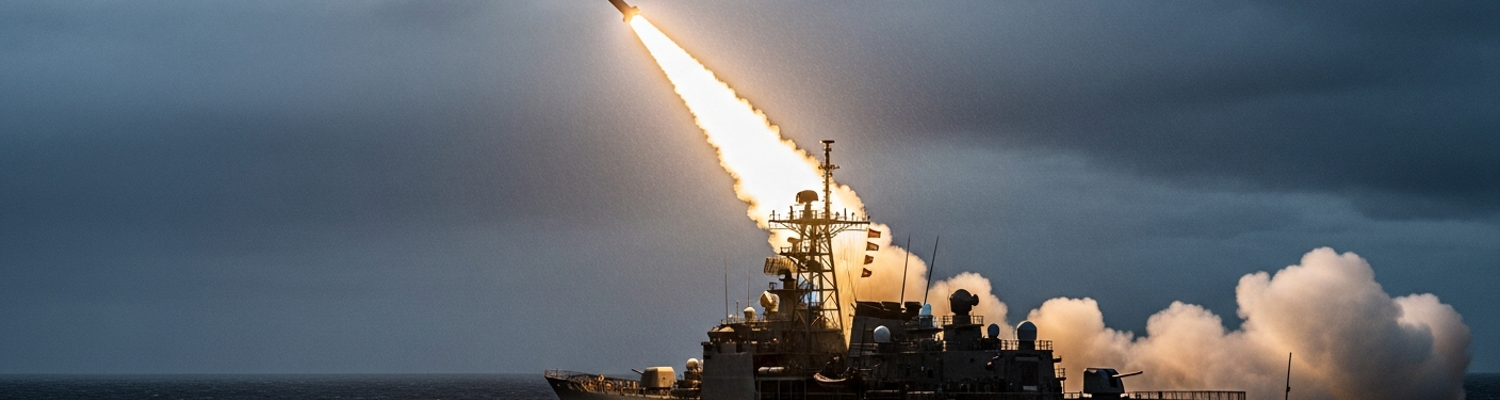

The arrival of the RIM-2 Terrier surface-to-air missile initiated a permanent and unsettling transformation in United States Navy strategy, ship design, and the calculus of global power. The weapon system was born from the urgent need to counter high-speed aerial threats that outpaced traditional gunnery. The Terrier pushed fleet air defense from the visual horizon to an electronic one, creating a protective bubble that altered the dynamics of international confrontations. This new capability was far from a simple technological victory. It became a catalyst for escalation, introducing a volatile variable into the Cold War’s balance of power and setting a precedent for technology-driven brinkmanship on the high seas.
The Terrier's Developmental Imperative
The requirement for a sea-based guided missile grew from the brutal air-sea battles of World War II. Kamikaze attacks and guided bombs exposed the fatal limitations of anti-aircraft artillery. This reality drove the U.S. Navy to launch Operation Bumblebee in 1945, a vast research program managed by the Johns Hopkins University Applied Physics Laboratory (APL). The program's mission was to develop missiles capable of defeating standoff bombers before they could release their payloads. While the primary goal was the ambitious, ramjet-powered RIM-8 Talos, a simpler offshoot showed immediate promise. A solid-propellant supersonic test vehicle, designed to prove guidance principles, performed so effectively that the Bureau of Ordnance decided to weaponize it. On December 29, 1948, the project was officially named Terrier, a suggestion from APL's Dr. R.B. Kershner meant to evoke a small but tenacious hunter. Convair was chosen as the prime contractor for the missile, then designated SAM-N-7, later to become the RIM-2. The core of the early Terrier system was its beam-riding guidance. A ship's fire control radar, the AN/SPQ-5, would lock onto a target and illuminate it with a narrow radar beam. The missile, launched into this beam, used rear-facing antennas to sense its position within the energy cone. Its control surfaces made continuous adjustments to keep it centered, allowing it to ride the beam to interception. The two-stage weapon featured a large solid-fuel booster for initial acceleration and a sustainer motor for the terminal phase. The initial RIM-2A variant, weighing 1,392 kilograms, could reach Mach 1.8 and engage targets at a range of approximately 10 nautical miles with its 99 kilogram continuous-rod warhead. Engineers at APL and Convair overcame significant scientific hurdles. They wrestled with roll stabilization during supersonic flight, clean booster separation, and refining the guidance system to filter out beam jitter caused by the ship's pitching and rolling. Flight tests began in 1951. By 1953, successful at-sea trials from the experimental command ship USS Mississippi (AG-128) against KDN Firebee target drones validated the concept and cleared the path for production.
Reshaping Naval Doctrine for the Missile Age
The transition from guns to missiles was a doctrinal upheaval. It forced a complete rethinking of ship design, fleet tactics, and strategic posture. Anti-aircraft artillery was a discipline of volume, filling a section of sky with shrapnel. Missile defense was a discipline of precision, demanding new skills, complex electronics, and a different operational mindset.
This technology required a new type of warship. In January 1952, the Navy reclassified the heavy cruisers USS Boston (CA-69) and USS Canberra (CA-70) as CAG-1 and CAG-2. They were sent to the New York Shipbuilding Corporation for radical conversion. Their entire aft ends were rebuilt. The massive 8-inch gun turrets and their barbettes were removed. In their place, engineers installed twin-arm Mk 4 launchers and a complex 72-round magazine system. The superstructures were altered to carry the large AN/SPQ-5 guidance radars.
This doctrinal shift carried immense strategic and financial consequences. The ability to destroy enemy aircraft 10 nautical miles away created a defensive zone that could shield an entire task group. A single guided missile cruiser could provide air defense that previously required multiple gunships. This capability came at a high price. A single Terrier missile in 1957 cost around $60,000, equivalent to over $600,000 today, while an 8-inch shell cost a tiny fraction of that. The conversions of Boston and Canberra were major budgetary items, representing a gamble on a future where technological superiority would outweigh the number of gun barrels. This decision locked the Navy into a cycle of expensive, high-tech development.
The influence was immediate. The purpose-built Farragut-class guided missile destroyers were designed around the Terrier system, followed by the larger Leahy and Belknap-class cruisers which dispensed with guns almost entirely in their initial designs, solidifying the missile as the primary surface combatant weapon.
Early Sea Trials and Tactical Realities
The world’s first guided missile cruiser, USS Boston, was recommissioned on November 1, 1955. Its sister ship, USS Canberra, achieved operational status on June 15, 1956. The ships immediately began a demanding series of evaluations in the Atlantic. Crews faced a steep learning curve. The transition from the mechanical, physical work of a gun crew to the electronic, abstract process of missile fire control was profound. A Fire Controlman now monitored radar scopes and consoles, a world away from a Gunner's Mate manhandling shells.
Early deployments exposed the system's weaknesses. Beam-riding guidance degraded in heavy seas and could be disrupted by atmospheric conditions. A Terrier ship could only engage one or two targets at a time per fire control director, a critical vulnerability against a coordinated, multi-axis attack. A more dangerous flaw was the system's poor performance against low-altitude targets. The radar beam would reflect off the ocean's surface, creating a phenomenon known as multipath interference that confused the missile's guidance sensors.
These limitations had grave implications for international relations. A U.S. fleet with Terrier missiles, positioned off a hostile coast, was a powerful political tool. It signaled an ability to enforce a no-fly zone with unprecedented reach. This extended shield permitted more aggressive power projection, as carrier groups could operate with greater perceived safety. The system's vulnerabilities, however, added a layer of dangerous uncertainty. A naval commander, aware of the missile's poor low-level performance, might feel compelled to act preemptively in a crisis rather than risk a saturation attack that could overwhelm his defenses.
The introduction of the nuclear-armed RIM-2D variant, carrying a 1-kiloton W45 warhead, raised the stakes to an almost unthinkable level. This weapon offered the terrifying ability to annihilate an entire bomber formation with a single missile, but its use would have instantly transformed a conventional conflict into a nuclear one. The presence of these weapons on ships created a constant state of high-stakes tension. Every encounter between American and Soviet naval forces became a potential flashpoint, where a technical error or a commander's misjudgment could have catastrophic results. The Terrier missile, conceived as a shield, had become a tripwire for global conflict, forever altering the calculus of naval deterrence and leaving a legacy of heightened risk that defined the Cold War at sea.