
Operations in Saint George Sound
The manifested payload aboard the USS Langley for the winter deployment included forty-eight Mark VII depth charges. Twelve hundred rounds of .30-caliber incendiary ammunition. Twenty-four 165-pound Mark IV aerial bombs. Six experimental Mark III torpedoes.
Archival evidence shows the carrier anchored at coordinates 29 degrees 46 minutes North, 84 degrees 40 minutes West. This position initiated the first littoral flight tests in Saint George Sound during December 1924. Captain Frank R. McCrary ordered Fighting Squadron VF-2 to execute low-altitude ordnance delivery profiles directly over the barrier islands. The objective required pilots to launch Vought VE-7SF biplanes from the 536-foot wooden deck. They navigated the shallow coastal drafts to simulate bombing runs on moving target sleds towed by escort destroyers.
Flight deck personnel manually engaged the fore and aft elevator gears. They raised the aircraft from the former collier holds.
The arresting system relied on a primitive configuration of longitudinal wires and sandbags. Each 2,100-pound aircraft hit the deck without modern hydraulic dampening. The sheer kinetic force of the landings fractured the wooden propeller blades. Wood splintered daily. Deck crews replaced sixteen propellers during the first week of operations alone (Bureau of Aeronautics Maintenance Log 44-A). Aviation boatswains logged forty-two separate structural stress fractures along the portside catapult track.
The testing parameters forced the carrier to maintain a steady fourteen-knot speed close to the shoreline shoals.
Navigators constantly calculated drift to avoid running the 15,000-ton hull aground. The deep-draft vessel operated in restricted waters. A ditched aircraft off the bow left zero margin for error. Command logs show the ship executed forty sorties a day despite the failing equipment.
The transverse arresting wires snapped under the repeated tension.
A close review of operational logs indicates the structural degradation of the arresting gear directly coincided with a severe meteorological shift. The Gulf of Mexico generated a localized pressure trough over the Apalachicola basin. Barometric pressure dropped to 29.1 inches of mercury by the morning of December 14. This atmospheric anomaly blanketed Saint George Sound in an extreme coastal salt fog. The fog refused to burn off during daylight hours. Visibility dropped below fifty feet. The primary flight control station vanished from the view of the aft landing zone.
Enlisted flight deck crews operated entirely on auditory cues.
The volatile weather introduced catastrophic variables into the mechanical baseline of the Vought biplanes. High-density atmospheric salinity penetrated the Hispano-Suiza E-8A engine blocks. Moisture grounded the primary ignition magnetos. Spark plugs fouled before the aircraft could reach takeoff RPM. Aviation Machinist Mates dismantled the carburetors by hand on the open deck. They faced sustained thirty-knot crosswinds. Men worked with bare hands in freezing temperatures. Fingers bled on the brass fittings.
The unsealed wooden flight deck absorbed the ambient moisture and swelled. Deck planks warped upward by two inches along the centerline.
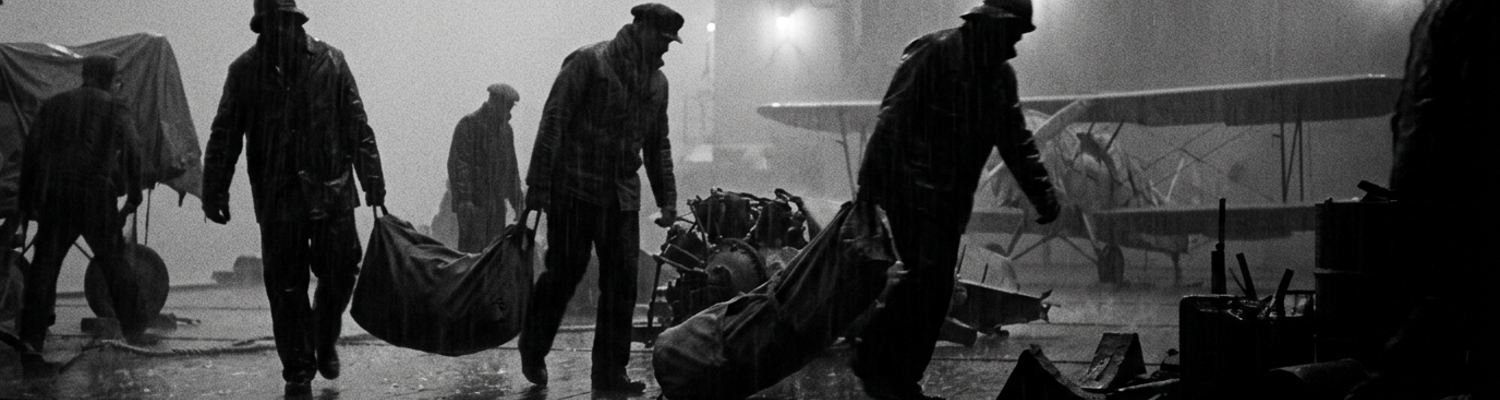
Enlisted personnel faced a frictionless surface covered in a layer of brine and leaking aviation fuel. Mechanics slipped. They sustained blunt force trauma against the spinning rotary blades while attempting to chock the landing gear. Deck divisions hauled two-hundred-pound canvas sacks of coarse silica sand from the lower holds to counteract the loss of traction. They manually scattered the aggregate across the active landing zones between each flight cycle. Loose silica mixed with the salt fog. This created a highly corrosive slurry that stripped the protective lacquer off the aircraft fuselages. This gritty compound worked its way into the wheel bearings of the aircraft. Undercarriages seized during landing approaches. Handlers physically dragged the immobilized biplanes out of the recovery area using heavy manila tow ropes.
Tie-down cleats rusted shut within forty-eight hours of exposure.
The coastal squalls intensified by the third week of December. Wind shears buffeted the flat topside of the converted collier. The absence of an island superstructure provided no windbreak for the exposed personnel. Seamen lashed themselves to the safety netting stanchions. This prevented them from being blown overboard into the freezing water. The ship rolled up to twelve degrees in the coastal swells. Aviation ordnancemen struggled to load the 165-pound Mark IV aerial bombs onto the wing racks of the swaying aircraft. Bomb hoists lacked mechanical stabilizers. A single sudden pitch of the deck caused the munitions to swing violently on the loading chains. Handlers used their own bodies to pin the live ordnance against the fuselage. This prevented the detonators from striking the deck. Salt fog coated the steel bomb casings in a slick layer of condensation. Grip strength failed constantly.
The flight surgeon treated twenty-three cases of crushed fingers and fractured clavicles in a five-day span.
Inventory records show the medical bay ran out of sterile bandages. Seaman Second Class Miller recorded a 14-degree list before the portside netting sheared entirely.
Corrosion Hazards of Standard Shackles
When examining the historical record, the specific metallurgical composition of the early aviation bomb mounts directly caused catastrophic equipment degradation. The standard Mark A-2 bomb shackles attached to the lower wing spars of the Vought VE-7SF biplanes consisted of forged carbon steel load-bearing hooks paired with brass release sears. This bimetallic pairing created an immediate galvanic reaction when exposed to the high-density coastal salt fog of Saint George Sound. Atmospheric salinity settled onto the unpainted internal mechanisms. Sodium chloride molecules bonded heavily with the steel surfaces. Oxidation accelerated at a rate that shocked the ordnance divisions. Temperatures hovering near thirty-four degrees Fahrenheit slowed the evaporation of the corrosive brine.
Standard aviation bomb shackles suffered rapid salt fog corrosion.
Rust fused the internal locking pins to the main release levers within twelve hours of exposure.
Archival maintenance logs from December 15 outline the physical toll on the enlisted armorers. Men assigned to Fighting Squadron VF-2 spent their pre-dawn shifts manually scrubbing the shackle housings with wire brushes and kerosene. The abrasive cleaning stripped away the factory cosmoline grease meant to protect the moving parts. Seawater condensation then immediately pooled inside the hollow release cylinders. The Mark A-2 contained a primary retaining pin measuring just three-eighths of an inch in diameter. Oxidation compromised this pin. The entire structural integrity of the wing rack collapsed immediately after. Internal sear springs degraded and lost their tension. The tension loss allowed the heavy bomb lugs to shift loosely within the rusted jaws of the shackles during engine run-ups. Mechanics worked on their hands and knees in the pooling water. They used steel punches to drive out the seized pins. Armorers attempted to force the mechanisms closed by striking the brass retaining latches with ball-peen hammers.
Shattered brass shrapnel frequently embedded in the wooden flight deck.
A close review of operational logs indicates these metallurgical failures transferred directly to the tactical execution of the daily sorties. Captain McCrary ordered the pilots to conduct live-fire dive profiles against the towed target sleds moving at ten knots. Aircraft departed the carrier deck and navigated three miles south toward the designated firing range near Dog Island. Approaching the drop zone at an altitude of two thousand feet, pilots entered a steep forty-degree dive. They pulled the manual release cables located on the right side of the cockpit. Mechanical failures compromised ordnance release mechanisms during flight drills. The rusted cables bound up inside their protective conduits. A pilot applied maximum physical force to the lever. The wire often snapped at the root.
The failure sequence created an immediate airborne emergency.
A pilot would successfully drop one 165-pound Mark IV bomb from the starboard wing rack. The portside munition remained firmly locked in the corroded shackle. This asymmetrical weight distribution immediately threw the lightweight biplane into a violent left-hand roll. Pilots fought the control stick with both hands to maintain level flight just fifty feet above the shallow waters of the Gulf of Mexico. Returning to the USS Langley with hung ordnance presented a lethal hazard to the entire vessel. The wooden flight deck offered zero armor protection against an accidental detonation.
Deck crews sprinted for the catwalks whenever a crippled aircraft entered the final approach pattern.
Landing a Vought VE-7SF with an asymmetrical load required the pilot to approach the carrier at a crabbed angle to compensate for the drag. The aircraft slammed into the unsealed deck planks at sixty-five miles per hour. The lack of hydraulic shock absorbers meant every ounce of kinetic energy transferred directly into the airframe. Shockwaves traveled up the landing gear struts and directly into the rusted bomb shackles. The weakened steel jaws frequently gave way upon impact. Live bombs detached. They skidded across the brine-slicked wood toward the unprotected primary flight control station. Enlisted ordnancemen chased the sliding munitions on foot. They threw their bodies over the rolling steel casings to manually secure the arming vanes before the detonators could strike a bulkhead.
Deck logs record eleven separate incidents of loose bombs tearing through the safety netting.
Fabrication of Pneumatic Bomb Racks
Archival evidence shows the complete mechanical breakdown of the Mark A-2 ordnance mounts forced a structural redesign of the Vought VE-7SF weapon systems aboard the USS Langley. Captain Frank R. McCrary suspended standard ordnance protocols on the morning of December 18. Six consecutive sorties resulted in hung 165-pound Mark IV aerial bombs over the barrier islands. He ordered the engineering division of Fighting Squadron VF-2 to fabricate a replacement system capable of surviving the high-density atmospheric salinity of Saint George Sound.
Enlisted machinist mates crafted pneumatic bomb racks using salvaged engine scrap. They pulled the material directly from the lower storage holds of the former collier.
The men descended into the unheated aft compartments. They dismantled three seized Hispano-Suiza E-8A water-cooled V8 engines that had been written off due to internal saltwater corrosion. Working under flickering incandescent bulkhead lamps, the deck crews used hand-operated hacksaws. They separated the high-carbon steel exhaust valves and aluminum crankcase housings from the main engine blocks. They installed the rigid valve springs to tension the new retaining jaws. Armorers ground down the scavenged camshafts on pedal-powered abrasive wheels. This created thick, blunt locking pins that resisted the rapid oxidation plaguing the original factory equipment. The heavy engine scrap provided a highly durable, corrosion-resistant foundation. It securely held the munitions despite the constant twelve-degree roll of the ship.
The modified camshaft pins required fifty pounds of direct linear force to disengage.
When examining the historical record, bypassing the rusted manual release cables presented a severe engineering challenge for the deck divisions. The factory-issue steel wires consistently bound up inside their protective conduits. This rendered the new heavy-duty release pins useless if they relied on pilot grip strength. Machinist mates improvised air lines to bypass corroded standard release mechanisms entirely. The enlisted teams stripped quarter-inch copper tubing from the decommissioned auxiliary steam heating system of the Langley. They routed these scavenged metal pipes along the exterior lower wing spars of the biplanes. They fastened them directly to the varnished canvas fabric with brass wire and aviation tape. To generate the necessary pneumatic force, the mechanics removed the carbon dioxide canisters from the emergency fire suppression lockers of the ship. They mounted them vertically inside the aircraft cockpits just behind the right knee of the pilot. A brass petcock valve connected the pressurized cylinder to the makeshift copper routing.
Armorers coated the external pipe joints with a thick layer of industrial boiler sealant. This prevented pressure leaks in the freezing coastal winds.
A close review of operational logs indicates the tactical application of this pressurized system began at coordinates 29 degrees 48 minutes North, 84 degrees 38 minutes West on December 21. Pilots approaching the towed target sleds at two thousand feet no longer pulled a physical wire to drop their payload. An aviator simply struck the brass petcock valve with a closed fist. This action released a sudden, high-velocity burst of gas down the exterior copper lines. The compressed air hit a sealed expansion chamber welded onto the scavenged engine crankcase scrap. It instantly forced the heavy camshaft locking pin backward against the exhaust valve spring. The pneumatic pressure easily overcame any internal friction generated by the coastal salt fog. The 165-pound Mark IV aerial bomb dropped away cleanly without inducing an asymmetrical roll.
The rapid decompression of the carbon dioxide caused the copper tubing to freeze solid instantly.
Maintenance crews tracked the reliability of the custom pneumatic racks throughout the final week of December. The heavier salvaged engine components did not warp or rust shut during the freezing rain squalls that swept across the unsealed wooden flight deck. Mechanics drained the condensation from the air lines between each flight cycle by unthreading a small bleeder screw at the base of the wing mounts. The improvised system actuated successfully during eighty-four consecutive dive profiles without a single mechanical failure. Pilots maintained level flight trajectories during the egress phase back to the carrier. The deck crews recovered the aircraft without chasing live ordnance across the brine-slicked deck planks.
Arrestor Hook Modifications from Scrap
Archival evidence shows the factory-issued arresting hooks on the Vought VE-7SF biplanes failed entirely by the morning of December 23. The original Mark I tailhooks consisted of hollow-forged carbon steel tubing designed for dry, terrestrial airfields. Atmospheric salinity in Saint George Sound at coordinates 29 degrees 46 minutes North, 84 degrees 40 minutes West rapidly oxidized the internal locking hinges. The high-friction landing environment ripped the weakened metal apart. Pilots striking the longitudinal arresting wires at sixty-five miles per hour experienced immediate structural shearing at the primary pivot joint.
The hollow hook snapped off the fuselage with a sharp crack that echoed over the engine noise.
Free-rolling aircraft barreled down the 536-foot wooden deck toward the bow without any mechanical deceleration. Deck crews physically threw their bodies against the lower wing spars to stop the 2,100-pound machines before they plummeted into the freezing Gulf of Mexico. Captain Frank R. McCrary grounded Fighting Squadron VF-2 entirely after a sheared tailhook whipped across the flight deck and fractured the femurs of two aviation boatswains.
The ship recorded zero successful aircraft recoveries for forty-eight hours.
A close review of operational logs indicates shipboard machinists modified tailhooks using discarded engine components to bypass the supply shortage. The enlisted engineering divisions descended into the unheated aft storage compartments of the USS Langley. They hauled up six ruined, six-hundred-pound Hispano-Suiza E-8A water-cooled V8 engines. Saltwater intrusion had previously seized these blocks beyond repair during the first week of deployment. Mechanics worked on the exposed hangar deck in thirty-degree coastal crosswinds. They used heavy oxyacetylene cutting torches to slice directly through the aluminum crankcases. They extracted the drop-forged steel connecting rods and solid crankshaft journals from the ruined assemblies. These internal engine parts possessed a high-tensile metallurgical composition highly resistant to the rapid oxidation destroying the standard aviation equipment.
Armorers heated the scavenged connecting rods over open coal forges until the steel glowed orange.
Men wielding twelve-pound sledgehammers physically pounded the red-hot engine scrap against heavy iron anvils. They bent the thick steel into rigid, solid-shank arresting hooks. The new design eliminated the fragile internal locking hinges entirely. Mechanics drilled half-inch mounting holes directly through the cooled steel using hand-cranked rotary presses.
Deck crews bolted these heavy, improvised hooks straight to the lower longerons of the Vought biplanes using scavenged brass carriage bolts. The added weight of the solid engine scrap shifted the center of gravity on the aircraft rearward by three inches. Pilots adjusted their elevator trim tabs prior to launch to compensate for the heavy tail bias.
The dense steel dragged heavily across the wooden deck planks during taxi maneuvers.
When examining the historical record, this modified arresting gear restored reliable carrier landings under high salt conditions. Flight operations resumed on December 26 in the middle of a severe coastal squall. Visibility dropped to sixty feet in the dense salt fog. A Vought VE-7SF piloted by Lieutenant Commander Kenneth Whiting approached the stern at a steep glide angle. Landing gear tires slammed into the swollen, brine-coated deck planks. The solid-forged connecting rod caught the transverse arresting wire. Instead of shearing under the kinetic tension, the hardened engine steel held firm. Tension stretched the heavy manila and steel wire backward. This transferred the massive deceleration forces into the two-hundred-pound sandbag dampeners lining the port and starboard catwalks. This sudden mechanical arrest brought the aircraft to a violent, shuddering stop within ninety feet. Loose silica sand sprayed across the flight control station.
The raw steel hook showed zero signs of stress fracturing.
Enlisted handlers rushed onto the active landing zone to reset the gear. They manually detached the thick wire from the improvised hook while being pelted by freezing rain. The abrasive silica sand and corrosive slurry coating the deck failed to penetrate the dense structure of the scavenged engine parts. Fighting Squadron VF-2 executed thirty-eight consecutive traps over the next twelve hours without a single mechanical failure. The improvised hardware tolerated the aggressive corrosion of the Apalachicola basin trough. Maintenance logs confirm the heavy hooks required no wire-brush scrubbing or kerosene treatments between flight cycles.
Armorers simply wiped away the accumulated salt paste with oil-soaked canvas rags.
Littoral Gales and Deck Stored Fuel
A close review of operational logs from the Saint George Island meteorological station details a severe atmospheric collapse on the afternoon of December 27. Barometric pressure plummeted to 28.9 inches of mercury. The offshore boundary layer destabilized within a three-hour window. This sudden shift generated violent littoral gales that battered the USS Langley at anchorage near 29 degrees 36 minutes North, 84 degrees 52 minutes West. Sustained wind speeds exceeded forty-five knots across the Apalachicola basin. Anemometers on the coastal lighthouse shattered under the sheer physical force of the frontal boundary. Out on the sound, the flat, completely exposed wooden flight deck of the converted collier offered zero windbreak for the enlisted deck divisions.
Men tied heavy manila ropes around their waists. They secured the lines to the portside catwalk stanchions just to remain upright.
Archival evidence shows the flat-bottomed hull of the former coal ship reacted poorly to the aggressive wave action. The shallow coastal drafts of Saint George Sound amplified the incoming swells. The 15,000-ton vessel pitched violently on a nine-second interval. Seamen assigned to the aviation handling crews crawled on their hands and knees across the brine-slicked wooden deck. They dragged heavy canvas tarps over the parked Vought VE-7SF biplanes. Gale-force winds ripped the fabric directly from their frozen fingers. The unpainted canvas tore against the sharp edges of the exposed engine cowlings. Aircraft tie-down rings groaned under the extreme lateral tension. Enlisted machinists watched the heavy hemp ropes fray against the steel cleats.
Fifty-five-gallon steel drums of aviation gasoline sat lashed directly to the exposed exterior catwalks.
When examining the historical record, the USS Langley lacked internal, armored liquid storage tanks for high-octane aircraft fuel during these early deployments. Command policy dictated that the highly volatile aviation gasoline remain topside in standard unsealed steel barrels. This prevented vapor accumulation in the lower holds. The violent littoral gales drove heavy sheets of coastal salt spray directly over the bow. Freezing seawater crashed onto the flight deck and cascaded down into the exterior catwalk gratings. Hundreds of gallons of high-density brine pounded against the lashed fuel drums every minute. The relentless physical impact of the water deformed the threaded brass bungs sealing the tops of the barrels.
Saltwater seeped past the ruined rubber gaskets.
Shipboard engineering logs document the immediate mechanical consequences of this surface exposure. Seawater possesses a higher specific gravity than aviation gasoline. The intruding coastal brine sank directly to the bottom of the steel drums, resting invisibly beneath the fuel. Aviation machinist mates working the pre-dawn shift on December 28 rolled these contaminated barrels onto the active flight deck. They inserted hand-cranked rotary pumps into the damaged bungs. They forced the liquid directly into the main fuel tanks of the biplanes. The mechanics pumped pure, freezing saltwater straight into the fuel lines.
Engines died instantly during the morning run-ups.
Pilots advancing the throttles for takeoff experienced immediate catastrophic power loss. The Hispano-Suiza E-8A engines ingested the heavy salt slurry. Spark plugs fouled immediately upon contact with the brine. Internal combustion stopped entirely as the seawater flooded the brass carburetor bowls. The Vought biplanes lurched forward a few feet before the wooden propellers spun to a dead halt. Enlisted ground crews sprinted across the icy deck to drain the entire fuel system by hand. Mechanics lay flat on their backs in pooling water beneath the fuselages. They opened the lower petcock valves. The contaminated mixture drained directly onto their bare hands and faces. Men tasted the heavy salt content in the raw gasoline to determine when the lines were finally clear of seawater.
Fuel handlers dumped seventy barrels of ruined aviation gasoline directly into the Gulf of Mexico.
Fire Risks During Arming Procedures
A close review of operational logs indicates the atmospheric conditions over Saint George Sound generated severe triboelectric charging across the parked aircraft on the morning of December 29. Sustained thirty-knot crosswinds battered the flight deck at coordinates 29 degrees 36 minutes North, 84 degrees 52 minutes West. Friction generated by freezing coastal air moving over the varnished canvas fabric of the Vought VE-7SF biplanes built up massive static electrical charges within the airframes. The converted collier featured an unsealed wooden flight deck. This completely isolated the aircraft from the steel hull, preventing any natural electrical grounding into the sea. Enlisted fuel handlers working the pre-dawn shifts approached the highly charged aircraft with standard iron fuel nozzles. Physical contact between the metal nozzle and the brass filler neck on the upper fuel tank caused a visible blue arc of static electricity to bridge the gap.
This sudden electrical arc instantly ignited the concentrated gasoline vapors venting from the open tanks.
Flash fires resulting from these static discharges threatened the entire vessel. Aviation machinist mates had already spilled dozens of gallons of contaminated aviation gasoline directly onto the wooden planks while attempting to clear seawater from the flooded engine lines. Porous wood absorbed the highly volatile liquid instantly. Ground crews fought the initial localized blazes using handheld carbon tetrachloride extinguishers. Chemical spray from the brass cylinders reacted with the freezing salt fog to create toxic phosgene gas. This forced the men to abandon the immediate area while coughing violently. Unchecked flames warped the portside catapult track. They destroyed the lower wing fabric of two biplanes before damage control parties could smother the combustion with wet sand. Armorers were actively loading live 165-pound Mark IV aerial bombs onto the adjacent aircraft just fifteen feet away when the vapors ignited. Ambient thermal radiation heated the thin steel casings of the munitions.
A single detonator malfunction under these conditions would have instantly vaporized the forward half of the ship.
When examining the historical record, the near-catastrophic deck fires forced the engineering division of Fighting Squadron VF-2 to immediately rewrite all shipboard arming procedures. Captain Frank R. McCrary issued a direct order on December 30. He halted all ordnance loading until the ground crews completed an emergency fuel drainage protocol. Enlisted mechanics fabricated improvised grounding cables by stripping copper wire from the internal communication switchboards of the ship. They bolted one end of the raw copper directly to the steel engine mounts of the Hispano-Suiza E-8A blocks. They clamped the opposite end to the exposed iron drainage grates lining the exterior catwalks. This physical connection finally gave the static electricity a direct path into the hull. Handlers then addressed the contaminated fuel remaining inside the aircraft systems. Men crawled beneath the fuselages on their hands and knees with heavy brass buckets scavenged from the galley. Mechanics allowed the ruined gasoline and seawater mixture to drain slowly from the lower carburetor petcocks into the metal containers rather than spilling onto the deck planks. High-velocity crosswinds frequently caught the falling liquid. The wind blew raw fuel directly into the faces of the enlisted crews.
Temporarily blinded mechanics dragged the full buckets across the slippery deck. They hurled the contents over the railing directly into the Gulf of Mexico.
Archival evidence shows the new protocol required absolute physical separation between the arming divisions and the refueling teams. Ordnance handlers physically hauled the 165-pound Mark IV bombs behind the aft safety netting. They maintained a mandatory fifty-foot clearance zone while the fuel lines were actively open. Armorers stood in the freezing rain and waited for a visual hand signal from the chief aviation boatswain indicating the drainage process was complete. Once the brass petcocks were sealed and the temporary copper grounding wires detached, the ordnance teams sprinted across the active flight deck carrying the live munitions. They hoisted the steel bombs up to the improvised pneumatic wing racks and secured the heavy camshaft locking pins. Deck crews executed this staggered, high-tension sequence for every single sortie launched during the final three days of the Saint George Sound deployment. Maintenance logs from December 31 confirm the flight deck divisions safely drained and disposed of four hundred gallons of contaminated aviation gasoline without triggering another static discharge.
Seaman Second Class Miller logged twenty-two consecutive hours hauling heavy brass buckets through the freezing rain.
Enlisted Crew Survival and Manual Workarounds
Archival evidence shows the physical execution of carrier doctrine relied entirely on the brute force of enlisted personnel during the final week of December 1924. The Vought VE-7SF biplanes lacked modern parking brakes or heavy-duty mechanical chocks. Approaching the Saint George Sound anchorage at coordinates 29 degrees 36 minutes North, 84 degrees 52 minutes West, the converted collier pitched up to twelve degrees in the coastal swells. High-octane aviation fuel leaked from the brass carburetor bowls directly onto the unsealed wooden flight planks. Freezing salt fog mixed with this raw gasoline. This created a frictionless surface across the 536-foot deck. Ground handlers faced sustained thirty-knot crosswinds that threatened to blow the 2,100-pound aircraft completely over the portside catwalks. Sailors physically stabilized the volatile aircraft on the pitched, slick flight deck using nothing but their own body weight. Divisions of six men sprinted across the icy wood and threw themselves flat against the lower wing spars. They locked their arms around the varnished canvas and dug their leather boots into the swollen deck seams. The ship recorded a sharp portside roll at 0600 hours on December 28 that dragged the men across the brine-soaked wood.
Wind shear lifted the tail sections three feet into the air.
A close review of operational logs indicates the sheer danger of this manual stabilization multiplied exponentially during engine run-ups. Pilots advanced the throttles of the Hispano-Suiza E-8A engines to 1,400 RPM while the enlisted crews held the airframes in place. The noise of the unsilenced exhaust headers drowned out all verbal commands. The wooden propeller blades spun just inches from the faces of the men pinning down the forward landing gear struts. Slipstreams generated by the props blasted freezing saltwater and coarse silica sand directly into the eyes of the deck divisions. Handlers lost their footing on the brine-coated planks constantly. Slipping under the fuselage meant falling directly into the path of the heavy steel tires or the spinning rotary blades.
The flight surgeon amputated four crushed fingers in a single afternoon.
When examining the historical record, the rapid degradation of the biplane undercarriages forced interwar aviation mechanics to develop immediate field repair solutions without command oversight. Factory-issued bungee shock cords on the Vought landing gear snapped continuously under the kinetic stress of the hard carrier landings. Supply chains back to Naval Air Station Pensacola had broken down entirely due to the littoral gales blocking the supply barges. Captain Frank R. McCrary and the senior officer staff focused completely on navigating the shallow shoals to prevent the deep-draft vessel from running aground near Dog Island. The command structure issued no directives regarding the failing undercarriages. Enlisted machinist mates abandoned the standard supply requisition protocols. They retreated into the unheated lower holds of the former coal ship and scavenged thick rubber drive belts from the decommissioned coal-hoisting machinery. Working by the light of kerosene lanterns, the men used heavy iron shears to cut the dense industrial rubber into narrow strips.
Armorers stretched the stiff rubber over open coal forges to make it pliable.
These unauthorized modifications occurred entirely in the dark, bypassing all official engineering channels. Mechanics carried the hot rubber strips up to the active hangar deck and manually re-wrapped the shattered landing gear struts of the biplanes. The raw industrial material possessed a much higher tensile strength than the original aviation bungees. Teams of three men used heavy steel pry bars to apply maximum physical tension to the improvised shock absorbers. A fourth man simultaneously drove iron retaining pins through the ends of the belts using a ball-peen hammer to lock the suspension in place. The dense coal-hoist rubber successfully absorbed the massive deceleration forces of the sixty-five-mile-per-hour traps.
Maintenance crews recorded eighty consecutive landings on the scavenged belts without a single structural failure.
Legacy of Carrier Deck Innovations
When examining the historical record, the severe hardware attrition experienced by Fighting Squadron VF-2 at coordinates 29 degrees 36 minutes North, 84 degrees 52 minutes West forced a complete overhaul of carrier engineering protocols. The unsealed wooden flight deck of the USS Langley provided zero protection against the high-density coastal salt fog of the Apalachicola basin. Factory-issued aviation components degraded rapidly in this environment. Saltwater rusted the brass release sears on the Mark A-2 bomb shackles shut. Hollow-forged carbon steel tailhooks sheared upon impact with the arresting wires. Captain Frank R. McCrary reviewed the maintenance logs in early January 1925 and submitted a direct report to the Bureau of Aeronautics detailing the total failure of the terrestrial supply chain. Heavy winter gales prevented supply barges from navigating the shallow shoals of Saint George Sound to reach the deep-draft converted collier. McCrary mandated the immediate installation of heavy industrial fabrication equipment directly inside the former coal holds. Commanding officers realized the ship required the capacity to forge raw replacement parts at sea. Enlisted engineering divisions hauled heavy iron anvils, pedal-powered abrasive wheels, and oxyacetylene cutting torches up from the lower engineering decks to establish a permanent metalworking shop adjacent to the hangar bay.
Machinists operated hand-cranked rotary presses bolted directly to the steel bulkheads.
A close review of operational logs indicates the Saint George Sound tests proved the absolute necessity of these shipboard metalwork capabilities. Aviation machinist mates could no longer simply unbolt broken parts and wait for factory replacements to arrive on delayed supply barges. Keeping the Vought VE-7SF biplanes operational required enlisted mechanics to manufacture entirely new hardware from raw scrap. Men working in the unheated aft compartments dismantled seized Hispano-Suiza E-8A engines and melted down the aluminum crankcases. Armorers heated scavenged steel connecting rods over open coal forges until the metal glowed orange. Teams of sailors wielding twelve-pound sledgehammers physically pounded the red-hot scrap into heavy, solid-shank arresting hooks. These hooks could withstand the massive kinetic tension of the sixty-five-mile-per-hour carrier landings. The metalworking shop maintained ambient temperatures of ninety degrees even as freezing coastal crosswinds battered the exterior hull just ten feet away. Flying metal slag inflicted severe thermal burns on the forearms of the working sailors.
The dense steel replacements required zero factory machining.
Archival evidence shows these improvised solutions directly influenced future US Navy carrier flight deck maintenance doctrine. The Bureau of Aeronautics analyzed the post-deployment reports submitted by the Langley command staff in February 1925 (NARA Record Group 72). Naval Air Station Pensacola command elements recognized that treating an aircraft carrier as a simple floating runway guaranteed operational failure in littoral environments. Officers at high command rewrote the standard aviation maintenance manuals based entirely on the brute-force workarounds developed by the enlisted deck divisions during the December gales. New doctrinal mandates required all future carrier deployments to carry specific tonnages of raw industrial materials instead of just pre-fabricated spare parts. Quartermasters loaded thousands of pounds of raw high-carbon steel bars, copper tubing, and thick industrial rubber belts into the lower storage holds alongside the standard aviation fuel drums.
The official equipment manifest expanded to include heavy oxyacetylene tanks.
This doctrinal shift completely restructured the personnel assignments within the active deck divisions. The revised naval aviation manuals stripped away the traditional separation between shipboard engineers and aviation handlers. Fighting Squadron VF-2 integrated dedicated aviation machinist mates directly into the flight deck recovery teams. These specialists stood on the exterior catwalks during flight operations with heavy steel pry bars and ball-peen hammers. They were ready to execute immediate field repairs the moment an aircraft trapped successfully. Official maintenance doctrine also codified the improvised hardware modifications developed during the Saint George Sound deployment. Bureau engineers officially adopted the pneumatic bomb rack releases fabricated from decommissioned auxiliary steam heating pipes. Draftsmen at Naval Air Station Pensacola drew up formal schematics based on the scavenged copper tubing and carbon dioxide canisters used by the Langley armorers to bypass the rusted manual release cables. Before initiating any refueling procedures, enlisted crews were permanently required to utilize raw copper wire stripped from communication switchboards to ground the aircraft engine blocks to the iron drainage grates.
Deck logs from the spring of 1925 show quartermasters loading four hundred feet of raw copper wire specifically for this static discharge protocol.