
Air Corps Tactical School Doctrine and Environmental Disconnect
Rime ice slammed into the windshield of the leading Boeing B-17E Flying Fortress at 1,500 feet over Kiska Harbor. Forward visibility vanished in seconds. Lieutenant Russell A. Davis piloted aircraft 41-2471 of the 36th Bombardment Squadron. He fought the control yoke. Downdrafts rolling off the 4,004-foot peak of Mount Kiska dropped the heavy bomber 800 feet in three seconds. Inside the nose compartment, the bombardier wiped condensation from the viewing prism of the Norden Mark XV bombsight. The optical glass had already fogged and frozen solid from cabin moisture meeting sub-zero external air. Below, the planned bomb run across the Japanese naval anchorage dissolved into a dense gray layer of ocean fog and low stratocumulus clouds. Engines strained against carburetor icing. Cockpit instruments vibrated uncontrollably. Bomb bay doors grooved and jammed on frozen hydraulic lines.
The operational plan collapsed at five hundred feet.
When examining the historical record from Maxwell Field, military planners had spent the 1930s constructing an air campaign methodology rooted in optimal environmental conditions. Air Corps Tactical School text manuals taught that industrial targets could be destroyed with daylight precision bombing executed from altitudes between 20,000 and 25,000 feet. Central to this doctrine was the mechanical precision of the Norden Mark XV optical bombsight. The instrument was built around an analog mechanical computer and a gyroscopically stabilized sighting head. The device calculated drift, ground speed, and release points through an intricate series of gears, mirrors, and leveling bubbles. It matched ground speed against an internal motor. Operating the Norden required a straight, level bombing run of at least twenty to thirty seconds with an uninterrupted visual lock on the target below. Instructors at Maxwell drilled crews on high-altitude horizontal bombing over the clear, sunlit terrain of Louisiana and California. Formal doctrine assumed clear skies, calm air columns, and distinct terrain features from four miles up.
North Pacific weather patterns prevented these conditions.
A close review of operational logs from the Eleventh Air Force indicates that the Aleutian theater lacked every mechanical prerequisite of the Maxwell doctrine. Across the coordinates of 52 degrees North and 177 degrees East, warm air masses carried by the Kuroshio Current collided directly with freezing Arctic air flowing south from the Bering Sea. This oceanic junction generated continuous, multi-layered cloud decks extending unbroken from two hundred feet above the water up to thirty thousand feet. Over Kiska Harbor and the Japanese garrison at Gertrude Cove, low-altitude stratus formations obscured the entire shoreline for weeks at a time. The Norden bombsight could not acquire a surface target through the cloud floor. Flight crews on high-altitude runs released their five-hundred-pound demolition bombs purely on dead reckoning. They sent ordnance into open water miles wide of anti-aircraft emplacements. Violent vertical wind currents known as williwaws tore across the jagged volcanic ridges of North Head at speeds surpassing eighty knots. These winds threw multi-engine bombers out of trim and made steady release runs mechanically impossible. Rime ice clogged pitot static tubes. This blinded airspeed indicators and altimeters while flight leaders attempted horizontal approach runs through solid overcast.
By mid-June 1942, the 28th Bombardment Group had expended tens of thousands of pounds of ordnance into coastal fog banks without scoring a single direct hit on a Japanese naval vessel.
Cold Weather Maintenance and Lubricant Failures
A close review of operational logs indicates that the primary engineering breakdown facing Eleventh Air Force ground units on Adak and Umnak originated deep within the rear echelon supply apparatus. Flight service manuals dictated the immediate distribution of diluted, low-viscosity lubricating fluids engineered to flow across Arctic temperature ranges. Quartermaster supply depots operating out of Seattle and San Francisco failed to allocate winterized stocks. They loaded northbound cargo transports with standard Army Navy Specification 3580 Grade 1120 engine oil. Refined from heavy paraffin-base petroleum, Spec 3580 maintained the high viscosity required to protect high-output radial engines operating under the scorching desert conditions of Louisiana or the Southwest Pacific. At the forward fighter and bomber strips of the Aleutian Chain, prevailing temperatures between zero and twenty degrees Fahrenheit caused standard Spec 3580 to congeal into tar inside aircraft sumps. Heavy bomber crews entering the flight line at dawn found the dry-sump tanks, crankcases, and external scavenge lines filled with an unyielding, black mass.
The oil solidified into tar before pre-flight briefings concluded.
Archival maintenance reports from the 28th Composite Group document the systemic mechanical damage triggered by this lubricant failure. Ground personnel connected 24-volt mobile generator units to Consolidated B-24D Liberators to turn over the Pratt and Whitney R-1830-43 Twin Wasp radial engines. Electric starter motors burned out under the resistance of the frozen oil. Hand-cranking the Hamilton Standard three-bladed propellers with five-foot inertia starter bars stripped bronze reduction gear teeth. If an engine did spark and turn on auxiliary primer fuel, the high-pressure engine-driven oil pumps forced the solid lubricant against the interior walls of the accessory cases. Oil pressure gauges spiked past one hundred pounds per square inch within three revolutions. This blew the soldered seams of the front oil radiator cores wide open. Scavenger pump drive splines sheared instantly because the pumps could not draw the tar out of the lower engine sumps. This starved the cylinder master rod bearings of liquid lubrication and fused the pistons within ninety seconds of ground idle.
Ground mechanics worked bare-handed in freezing mud because heavy wool mittens snagged on cowl clips.
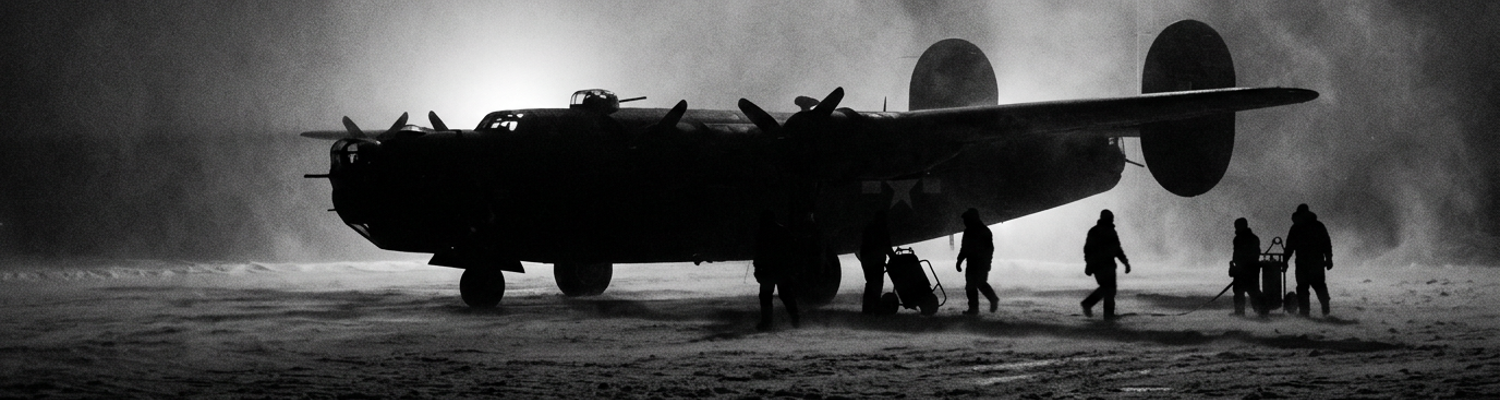
When examining the historical record from the 404th Bombardment Squadron during the buildup at Davis Army Airfield on Adak, line mechanics abandoned established maintenance doctrine to force their bombers into the air. Standard field shelters and Herman Nelson portable hot-air heaters were unavailable due to shipping delays along the Alaska Marine Highway. Ground crews wrapped heavy canvas tarpaulins directly around the engine nacelles. They lashed the fabric to the propeller blades to trap heat. Crewmen then slid underneath the aircraft onto the perforated steel Marston Matting revetments carrying commercial gasoline blowtorches and pressurized plumber torches. Mechanics held these roaring, open-flame gasoline torches inches away from the bottom cowlings. They played the bare flames directly across the crankcase housings, external oil lines, and sumps for three to four hours before every takeoff.
This improvised pre-heating routine introduced severe fire hazards to the snow-covered revetments. Volatile 100-octane aviation fuel routinely dripped down the engine firewalls from Bendix-Stromberg carburetors. The neoprene gaskets on these carburetors had shrunken and cracked in the cold. When open blowtorch flames struck the escaping fuel vapors, the canvas engine wraps ignited in seconds. Ground crews kept chemical foam extinguishers and shovels of frozen volcanic ash on hand to douse flash fires before the flames could reach the internal wing fuel cells. On December 18, 1942, an open torch ignited pooled gasoline under the number four engine of a B-24D on Adak. The fire destroyed the engine mount and gutted the nacelle wiring harness before emergency crews could drag the bomber away from the adjacent ordnance revetments.
Pneumatic Line Failures and Frozen Bomb Shackles
When examining the historical record at Davis Army Airfield on Adak, line mechanics encountered total structural failures within the compressed-gas networks of heavy bombers before the aircraft could even taxi. Standard production Boeing B-17Es and Consolidated B-24Ds came off assembly lines in Seattle and San Diego equipped with uninsulated, synthetic-rubber pneumatic lines and thin-walled copper air tubing. These conduits powered emergency brake accumulators, de-icing boots, and auxiliary bomb-bay door actuators under working pressures reaching one thousand pounds per square inch. Across the Aleutian Chain, surface ambient temperatures on the sodden runways dropped well below zero degrees Fahrenheit. Temperatures dropped lower still when gale-force Arctic squalls ripped across the Bering Sea. Synthetic elastomers formulated for temperate testing grounds lost plasticizer elasticity within thirty minutes of exposure on the open revetments.
The rubber hardened and lost all flexibility.
As flight crews applied initial brake pressure or activated pneumatic valves during engine run-up checks over corrugated steel Marston matting, severe structural vibration propagated straight through the landing gear struts. The uninsulated lines snapped clean in half.
Compressed air blew out through fractured lines.
Archival evidence shows that maintenance crews of the 28th Composite Group exhausted their allotments of replacement tubing before November 1942. Ground engineers scavenged high-pressure flexible hose from wrecked transports. Replacement stock hardened just as rapidly in the sub-zero mud. When pneumatic pressure bled to zero, emergency brake systems ceased functioning across entire bomber flights. Heavy bombers weighing fifty-six thousand pounds spun out of control on icy steel-plank runways. They careened into volcanic drainage ditches or collided with fuel storage drums. Eleventh Air Force mechanics attempted to wrap the exposed tubing in layers of friction tape and wool rags soaked in engine grease. The fix did not hold against the internal pressure loads. Flight leaders routinely scrubbed sorties during the taxi phase because shattered tubing drained the air tanks. This grounded as many as six out of twelve scheduled aircraft before their tires crossed the runway threshold.
A close review of operational logs indicates that the physical delivery of ordnance broke down at the target area because of water entering the bomb bays. Heavily loaded B-24Ds of the 404th Bombardment Squadron flew low-level approaches between one hundred and five hundred feet above the ocean to evade Japanese radar installations on Little Kiska Island. Saltwater sea spray thrown up by seventy-knot surface winds drove directly into the non-hermetic bomb-bay door seams, unsealed roller tracks, and lower fuselage vents. Inside the unheated bomb bays, this continuous marine mist settled across the suspension lugs, electrical solenoids, and mechanical release hooks of the Type B-7 bomb shackles. As the bombers climbed to clearing altitudes over the volcanic perimeter of Kiska, sub-zero ambient air transformed this moisture and condensation into dense, solid rime ice. The ice sealed moving parts inside the release mechanisms. Jaws holding the five-hundred-pound and one-thousand-pound demolition bombs froze locked around the suspension lugs.
The mechanical release levers refused to budge.
Over Kiska Harbor, bombardiers looking down at anchored Japanese cargo vessels triggered the electrical intervalometers. Inside the bomb bays, electrical solenoids clicked, pulled standard amperage, and burned out against the immovable, frozen iron jaws of the shackles. Bombardiers pulled manual mechanical release cables with both hands. They strained against the frozen linkage arms without releasing a single weapon. Crews flying over the Japanese garrison at Gertrude Cove made repeated runs through heavy twenty-five-millimeter anti-aircraft fire, unable to jettison their ordnance. The bombers were forced to turn back toward Adak carrying their full combat payloads across four hundred miles of open ocean. Crewmen crawled into the drafty, sub-zero bomb bays with fire axes and heavy steel pry bars. They physically chipped at blocks of sea ice around the live detonators in a desperate attempt to free hung ordnance before landing on the slick steel runway. On January 21, 1943, three B-24s returned to Davis Airfield with all bombs frozen solidly into the racks.
Dutch Harbor Communications Relays and Atmospheric Blackouts
When examining the historical record at Naval Operating Base Dutch Harbor on Unalaska Island, regional meteorological monitoring collapsed along the radio spectrum before bombers ever reached cruising altitude. Eleventh Air Force Weather Central attempted to transmit hourly ceiling observations, barometric trends, and barometric altimeter pressure settings outward to forward fighter-bomber strips at Fort Glenn on Umnak and Davis Army Airfield on Adak. Signals died in transit. Severe electromagnetic anomalies originating in the lower auroral ionosphere caused complete communications blackouts between Dutch Harbor weather monitors and forward airfields for forty-eight to seventy-two hours at a stretch. High-frequency radio sets relied entirely on skywave propagation bouncing off the ionospheric F-layer across the North Pacific. These included the standard SCR-274-N aircraft command radios and ground-based BC-375 transmitters. Solar geomagnetic storms coupled with intense auroral electrojet activity stripped that reflective layer away. Radio operators sitting in quonset huts at Dutch Harbor twisted their tuning dials across the 3,000 to 6,000 kilocycle bands. They encountered total receiver deadness interspersed with deafening precipitation static. Trailing wire antennas on outbound aircraft accumulated heavy electrical charges from freezing drizzle. This snapped carbon suppressors and fried receiver coils in the BC-348 radio sets. Forward airfield towers received zero barometric updates. Pilots flew across five hundred miles of ocean with altimeters set to obsolete departure pressures. They misjudged their actual altitude above sea level by as much as seven hundred feet.
Radio silence was absolute.
Archival evidence shows that this communications vacuum stripped Eleventh Air Force headquarters of the ability to warn airborne strike groups about rapidly deteriorating route conditions. Strike formations composed of Consolidated B-24Ds from the 404th Bombardment Squadron and Boeing B-17Es from the 36th Bombardment Squadron routinely launched into clear morning air pockets at Adak. They flew unaware that the transit corridor toward Kiska had vanished beneath a wall of gale-force turbulence. Unforecast 100-knot williwaw gale fronts routinely struck transit routes across the open waters of Amchitka Pass. This caused widespread navigational disorientation across entire bomber groups. These violent katabatic air masses poured off the glaciated volcanic summits of Great Sitkin and Tanaga. They accelerated downward into maritime channels with zero visual warning. Flight leaders flying straight-and-level at five thousand feet suddenly encountered sustained lateral gusts that exceeded the maximum operating airspeed of the airframes. The violent shear instantly threw twenty-eight-ton bombers onto their wingtips. This exceeded the control authority of pilots fighting the rudder pedals.
Formations fractured into scattered singletons within sixty seconds.
A close review of operational logs indicates that these hundred-knot winds shattered every dead reckoning calculation maintained by bomber navigators. Standard drift meters were completely useless because solid cloud cover obscured the ocean surface. This prevented navigators from taking visual drift readings on wave crests. Magnetic compasses spun erratically inside the cockpit housings. They were influenced by local volcanic mineral deposits on surrounding islands and severe electrical charges building across the airframes. Flight leaders attempting to maintain a standard westerly heading of 260 degrees toward Kiska were swept fifty miles south into the empty North Pacific. Crab angles exceeded forty-five degrees merely to arrest the lateral drift. Airspeed indicators dropped precipitously when pitot tubes froze. Crews were unable to calculate true airspeed while their fuel supplies drained into headwind resistance. Entire flights of the 28th Bombardment Group broke formation as pilots dove blindly toward the surface. They attempted to break under the cloud decks to find a recognizable coastline. They found the sea surface churning white with williwaw foam at zero feet. On October 16, 1942, an unforecast front scattered six B-24 bombers returning to Adak. Three aircraft made emergency off-field landings on rocky beaches when fuel reserves burned dry during the search for the runway marker beacon.
Low-Altitude Radar Skimming Over Fog Decks
When examining the historical record of the 28th Composite Group, the failure of high-level horizontal bombing forced an immediate operational shift in late 1942. Eleventh Air Force strike leader Colonel William O. Eareckson recognized that thousands of demolition bombs had dropped harmlessly into empty surf because heavy stratocumulus decks shielded Kiska Harbor. Tactical doctrine from Maxwell Field was formally discarded. Aircrews flying Consolidated B-24D Liberators of the 404th Bombardment Squadron and twin-engine B-25 Mitchells were ordered to abandon their standard fifteen-thousand-foot flight profiles. Flight leaders shoved control columns forward. They dove heavily laden bombers through three miles of solid overcast to level off fifty to one hundred feet above the Bering Sea swells. At this altitude, pilots skimmed beneath the cloud floor. They threaded low-altitude approach runs between the jagged volcanic walls of North Head and South Head. Japanese gunners at Gertrude Cove had positioned dual twenty-five-millimeter anti-aircraft batteries for high-altitude tracking. Crews at fifty feet flew temporarily beneath the depression angles of heavy shore artillery.
Bombers skimmed thirty feet above cresting waves.
Archival evidence shows that running twin-engine and four-engine bombers at wave-top altitude introduced violent mechanical hazards. Props spun inches above ocean swells. They kicked up tons of saltwater into engine cowlings and airframes moving at two hundred knots. Outside air temperatures hovered near twenty degrees Fahrenheit. Dense marine brine thrown back from the propellers struck the forward windshields of the B-24s. It instantly crystallized into a thick crust of frozen salt. Cockpit defrosters lacked the thermal output to melt the saline slush. Rubber wiper blades froze solid against the tempered glass frames. They stripped their pneumatic actuator splines within three sweeps. Pilots lost every shred of forward visibility. Cockpits were sealed behind opaque sheets of salt ice. Flight commanders were unable to see the ocean surface, the volcanic peaks flanking the harbor entrance, or the masts of anchored transport ships.
Forward visibility was zero.
A close review of operational logs indicates that survival and weapon delivery shifted entirely to early airborne electronic equipment. Inside the dark radio compartments of modified Liberators, operators manned early SCR-521 long-wave and SCR-517 microwave search radar systems. Technicians stared into green phosphor cathode-ray tubes. They tracked target spikes against intense ocean-clutter returns caused by ten-foot sea swells. Radar operators used interphone headsets to talk pilots through the blind approaches. They barked steering corrections in real time as the aircraft hurtled toward the rocky coastline. The radar scope revealed the sharp volcanic contours of Kiska Volcano on the left and the stationary radar blips of Japanese naval hulls in the harbor basin ahead. Flight leaders leveled their wings entirely by gyroscopic turn-and-bank indicators and radio altimeter needles bouncing wildly over ocean troughs. Bombardiers armed the five-hundred-pound ordnance on radar range markers alone. They released weapons into the gray mist when the distance trace on the oscilloscope collapsed into the target pip.
Instruments replaced human eyesight.
Operational records from January 1943 document that these blind skimming strikes succeeded in scoring hits where months of high-altitude runs had failed. On January 24, two radar-guided B-24Ds skimmed through Gertrude Cove at sixty feet. They dropped five-hundred-pound bombs onto an anchored Japanese cargo freighter by radar ranging before pulling up steeply into the solid overcast to clear the four-thousand-foot peak of Mount Kiska. Mechanics on Adak later chipped two inches of solid sea salt from the engine cowlings and wings of the surviving bombers.
Zero-Visibility Approaches and Fuel Exhaustion Ditchings
When examining the historical record of the 28th Composite Group, the return flight from Kiska to the forward base at Adak caused more casualties than Japanese anti-aircraft fire over the target. After expending ordnance across Gertrude Cove, Consolidated B-24D Liberators of the 404th Bombardment Squadron turned east into Amchitka Pass. They faced sustained easterly head gales exceeding seventy knots. Four Pratt and Whitney R-1830-43 radial engines burned through fuel reserves at a rate of over two hundred gallons per hour. Flight leaders fought to maintain forward momentum against the shearing air stream. Aircraft ground speeds dropped below eighty knots. By the time navigators calculated that the bombers had reached the vicinity of Davis Army Airfield, the flight had burned through its planned reserve margins. Below them, Adak sat buried under a dense wall of ground fog and freezing drizzle that stretched from the sea surface to four thousand feet. Runways laid with steel Marston matting offered zero ceiling and zero horizontal visibility. Ground personnel fired red flares into the overcast. They ran portable searchlights pointed vertically into the sky. The glare diffused into an impenetrable yellow blur inside the fog bank. Pilots had no ground-controlled radar approach systems in late 1942. Flight crews orbited blindly over Sweeper Cove while fuel pressure needles bounced on zero.
Engines sputtered and died in the clouds.
Archival evidence shows that fuel starvation left pilots with an immediate choice between controlled ocean ditchings and flying blind into the fog-shrouded volcanic peaks of Mount Moffett. At least six B-24Ds and B-17Es were forced down into the open sea between October 1942 and February 1943 when their auxiliary tanks ran dry. Bringing a twenty-eight-ton four-engine bomber down into the North Pacific required pilots to fly the aircraft onto the crests of rolling fifteen-foot swells without stalling the high-aspect-ratio Davis wing. As airspeed dropped below ninety knots, the open bomb bay doors and deep ventral fuselage structures acted as water scoops.
The ocean tore the fuselages apart upon contact.
A close review of operational logs indicates that survival for crews escaping sinking airframes was dictated entirely by rapid physiological collapse. Surface water temperatures in the Bering Sea and the northern Pacific perimeter fluctuated between thirty-three and thirty-eight degrees Fahrenheit throughout the winter bombing campaign. Flight crews wore standard issue heavy shearling-lined leather jackets and wool flight trousers. These garments absorbed tens of pounds of brine within seconds of immersion. Aircrews equipped with Type B-4 inflatable life vests and five-man rubber rafts found their gross motor functions completely paralyzed by peripheral vasoconstriction before they could pull the manual inflation cords. Uncontrolled hyperventilation induced by cold shock caused men to aspirate freezing saltwater directly into their lungs. Loss of finger dexterity occurred within three minutes. Core body temperatures dropped below eighty-six degrees Fahrenheit in under ten minutes. This brought on cardiac arrest and fatal immersion hypothermia before emergency lifeboats could be launched from Adak.
Navy rescue craft had no visibility to guide them.
Records from the Eleventh Air Force Air-Sea Rescue units document that the same meteorological conditions driving bombers into the sea systematically blocked retrieval efforts. Twin-engine Consolidated PBY-5A Catalinas and wooden eighty-five-foot crash boats dispatched from Kuluk Bay were unable to locate survivors across the turbulent water. Surface fog reduced search visibility to less than thirty yards. Radio direction finders could not calibrate positions through ionospheric static. Floating crews were left adrift in thirty-four-degree water. On January 18, 1943, a B-24D crew from the 404th Bombardment Squadron ditched three miles offshore from Sweeper Cove after burning their final gallons of 100-octane fuel during a fourth missed landing pass. Recovery vessels reached the floating wing section twenty-two minutes after impact to discover all eight crew members dead of hypothermia.
Cold Weather Experimental Stations and System Modifications
When examining the historical record of Eleventh Air Force casualty ledgers from June 1942 through August 1943, tactical attrition curves reveal a severe imbalance between hostile fire and natural hazards. Imperial Japanese Navy anti-aircraft batteries positioned along North Head, Gertrude Cove, and Little Kiska expended thousands of 25-millimeter Type 96 and 75-millimeter Type 88 shells against American strike formations. Combat debriefs record fewer than forty aircraft destroyed by enemy flak and naval interceptors throughout the entire Aleutian offensive. Flight status logs reveal that non-combat operational write-offs exceeded one hundred and seventy airframes during the exact same operational window. Over four times as many bombers and fighters plunged into the Bering Sea or struck obscured mountain peaks due to blinding fog decks, violent williwaws, and structural icing than fell to Japanese gunners. Crews of the 28th Bombardment Group routinely lost more Consolidated B-24s during ferry flights and missed instrument approaches at Davis Army Airfield than during low-level bombing passes across target coordinates at 52 degrees North, 177 degrees East.
Fog and fuel starvation destroyed five aircraft for every one downed by enemy fire.
Archival evidence shows that primary equipment failures compounded these non-combat casualties across every deployed air group. Pilots flying Lockheed P-38 Lightnings of the 54th Fighter Squadron repeatedly suffered dual engine flameouts. Standard carburetors froze solid during patrols through saturated cloud layers. Undercarriage mechanisms on Boeing B-17s cracked upon contact with frost-heaved Marston matting on Adak. This flipped heavy bombers into drainage ditches. Navigators operating without ground radar stations miscalculated drift against ninety-knot crosswinds. They steered dozens of twin-engine North American B-25 Mitchells into the sheer rock walls of Tanaga Island and Mount Great Sitkin. Water landings in Sweeper Cove resulted in immediate drowning because standard cockpit emergency kits lacked adequate thermal immersion suits.
Standard manuals had prepared flight crews for flak corridors rather than frozen flight surfaces.
A close review of operational logs indicates that this sustained rate of mechanical attrition compelled Headquarters Army Air Forces to rebuild its cold-weather operational doctrine. Command leadership recognized that pre-war flight manuals drafted at Wright Field, Ohio, were completely unusable in sub-zero subarctic conditions. General Henry H. Arnold ordered the immediate expansion of cold-weather experimental stations. He directed operational data straight from the Aleutian chain to Ladd Field in Fairbanks, Alaska. Engineers assigned to the Cold Weather Test Detachment at Ladd Field took battered airframes from frontline squadrons. They evaluated systemic component breakdowns under ambient conditions reaching fifty degrees below zero Fahrenheit. Testing validated the Worth oil dilution system. This mechanism injected aviation gasoline directly into engine oil lines prior to engine shutdown to prevent congealing overnight. Refined Spec 3580 engine oils were discarded in favor of newly engineered, low-viscosity synthetic blends. Hydraulic networks were stripped of natural rubber hoses and refitted with low-temperature neoprene and Univis 40 petroleum-based fluids.
Assembly lines across California and Washington revised aircraft blueprints while bombers were actively flying combat sorties.
Technicians at Ladd Field modified over two dozen standard aircraft systems between late 1942 and 1944 to withstand extreme subarctic operations. Ground mechanics replaced open-flame blowtorches on the flight lines with trailer-mounted Herman Nelson Model BT-400 gasoline combustion heaters. These units ducted pressurized warm air directly into engine cowlings and wing roots through flexible canvas sleeves. Pneumatic rubber de-icing boots that routinely shredded in sub-zero Aleutian squalls were phased out. They were replaced by heated-air leading-edge thermal ducts routed from exhaust heat exchangers. Aircrews received redesigned multi-layered alpaca-lined flight clothing, electrically wired F-2 flight suits, and vulcanized rubber life rafts equipped with high-calorie cold-weather survival rations. Experimental results were codified into the 1943 revision of Army Air Forces Technical Order 00-25-7. This manual established mandatory pre-heating procedures, minimum cold-starting fuel dilutions, and low-temperature brake fluid specifications for all aircraft deployed above the 50th parallel.