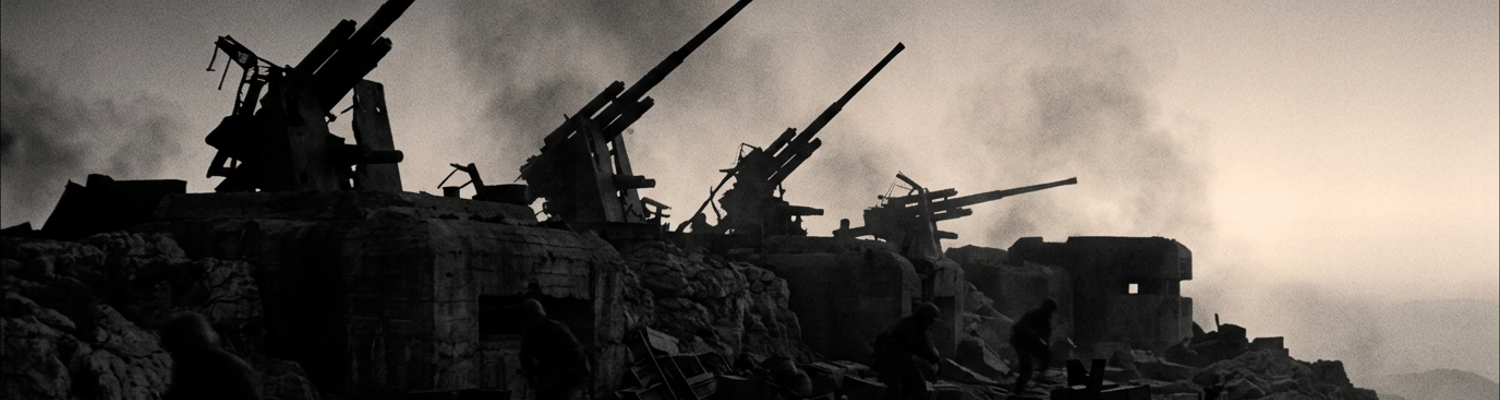

Antiaircraft Deployments and Open Revetment Vulnerabilities
Splintered rock and superheated steel blew horizontally across the summit of Denver Hill. The first Japanese artillery barrage struck Battery Denver without warning. Men pressed their chests into the gravel. They suffocated on pulverized limestone and cordite. Concussive shockwaves ruptured eardrums and blew optical sights clean off their mountings.
Gun crews from the 60th Coast Artillery scrambled through falling debris. They coughed black soot while reaching blindly for traverse wheels that were already burning to the touch. The pre-planned integrated fire-control grid ceased to function in less than thirty seconds. Blast overpressure sheared unarmored communication wires. This instantly severed the gun pits from the plotting room.
Every coordinated defensive scheme collapsed into individual survival.
A close review of operational logs indicates that Battery Denver operated four 3-inch M3 antiaircraft guns along Corregidor's eastern ridgeline. These were set on exposed concrete platforms designed for wide fields of fire rather than crew protection (Ordnance Department specification 1928). These weapons fired a 12.8-pound high-explosive projectile with a muzzle velocity of 2,800 feet per second. Their tactical mission required continuous high-volume fire to deny Japanese bombers the airspace directly over Malinta Tunnel and the island's narrow tail. Emplaced along the ridge roughly midway between Malinta Hill and Kindley Field, the guns had an effective vertical ceiling of approximately 30,000 feet. The open revetments left them directly exposed to counterbattery bombardments originating from the Cavite coastline and the newly captured heights of Bataan.
Gun commanders faced impossible firing solutions.
Twin-engine bombers flew well above twenty thousand feet while ground artillery pounded the ridgeline from four miles away. Shrapnel chipped concrete from the parapets. Loaders shoved brass shells into hot breeches by hand. Their skin blistered against gun barrels lacking water jackets for cooling.
Mechanical coordination died where the copper wires snapped.
Archival evidence shows that the artillery crews relied on electromechanical Sperry M4 directors connected to gun mounts via exposed surface cabling. This architectural vulnerability proved disastrous under relentless counterbattery fire. The Sperry M4 used mechanical ball-and-disk integrators and internal gear trains to solve complex lead angles. It transmitted these data values electrically through multiconductor cables to synchronous receiver dials on each 3-inch mount. Those thick rubber-insulated cables were strung across jagged volcanic terrain without underground conduit or armored sleeving (Signal Corps specification 14-A). Shell fragments from standard 75-millimeter and heavy 240-millimeter artillery cut through the rubber sheathing within minutes of any engagement opening.
When shrapnel severed the internal wiring, the matched-pointer dials on the M3 guns dropped dead.
Crews abandoned director-controlled barrage patterns. Gunners scrambled onto the exposed platforms to set mechanical time fuses with hand wrenches. They turned azimuth handwheels using auxiliary ring sights while tracking Japanese aircraft through thick clouds of shell smoke and dust.
When examining the historical record of the 60th Coast Artillery, individual weapon sections attempted to splice broken transmission lines under active fire. Repeated concussions rattled the M4 director's internal balance mechanisms. This threw computed target predictions off by hundreds of yards. Battery commanders resorted to crude quadrant elevations and estimated target speeds called out through brass megaphones. By the final days of April 1942, three of Battery Denver's four 3-inch guns sat damaged by splinter impacts. Their recoil cylinders leaked hydraulic fluid onto the fractured concrete pads.
Counterbattery Bombardment and Electromechanical System Failure
Japanese counter-battery fire intensified past four thousand shells every twenty-four hours by the start of May 1942. Japanese Imperial Army 240-millimeter Type 45 siege howitzers and 150-millimeter Type 96 guns firing from the southern slopes of Mount Mariveles bracketed the ridge continuously. Incoming high-explosive rounds threw up dense clouds of abrasive limestone grit and pulverized shale. This material hung suspended in the stagnant tropical heat.
Detonations of picric-acid and trinitrotoluene charges filled the battery positions with thick yellow sulfur dust.
The dust coated gun barrels and penetrated crew respirators. It caused chemical burning in the eyes and throats of the loaders. Concussive shockwaves from near-miss impacts exerted ground pressures exceeding fifty pounds per square linear inch. This force threw gunners against the revetment bulkheads and blew their cloth service uniforms to shreds. Men suffered recurring middle-ear trauma, nosebleeds, and temporary blindness. High-velocity overpressure waves displaced the air inside open gun pits. Every round detonating against the crest sheared away feet of protective soil. The elevation emplacements were stripped down to bare, fissured stone.
Concussive blast waves repeatedly knocked the heavy steel tracking mounts off their leveling jacks.
Archival evidence shows that environmental factors combined with mechanical stress to destroy the operational capacity of the battery fire-control computers. Battery Denver utilized the Sperry M4 director. This analog electromechanical computing instrument housed thousands of miniature brass gears, differential gears, and clockwork tracking cams. These components were designed to operate inside a sealed tolerance of two ten-thousandths of an inch (Ordnance Department manual TM 9-1659). Moisture-heavy salt-air haze pushed inland off Manila Bay across the low-lying tail of Corregidor. It condensed directly onto the metallic casings and open optical tracking slits of the computing units.
This saline dampness mixed with airborne sulfur soot and pulverized rock particles.
It formed a pasty, abrasive grit that seeped past the director's weather gaskets and settled inside the mechanical computing clusters. Ground vibrations from surrounding 240-millimeter artillery impacts shook the delicate instrument chassis thousands of times each hour. This warped the internal drive shafts. The precision gear trains of the Sperry M4 directors seized up completely during active tracking operations. Tracking operators stripped the bronze teeth when attempting to force the frozen handwheels.
Without computing gear trains, the battery could not generate slant-range corrections.
A close review of operational logs indicates that by May 2, battery technicians attempted field-stripping the Sperry directors under active shellfire. They tried to flush the clogged assemblies with kerosene and lubricating oil. Technicians found the internal tracking differentials jammed solid with sulfur compound deposits and corroded gear teeth. Three-dimensional lead calculations became impossible. Captain Godfrey R. Ames and the battery officers disconnected the electrical data transmitters entirely. They shifted the four 3-inch guns to emergency manual engagement doctrine.
The crews used hand-cranked elevation mechanisms and visual line-of-sight estimations.
They relied on auxiliary optical sights already pitted by shrapnel fragments. Battery Denver's average rate of fire collapsed from twenty-five rounds per minute down to less than six rounds per gun. Gun commanders observed incoming Japanese formation speeds through grease-smeared binoculars. They shouted estimated fuse timings over the concussive noise to loaders working with hand wrenches at the fuse pots. At 1400 hours on May 4, a direct hit from a 240-millimeter shell breached the primary fire-control station. The blast fragmented the M4 computing chassis into scrap and killed the battery's remaining range-finder crew.
Amphibious Assault Navigation Errors and Infantry Reorganization
A close review of operational logs indicates that elements of the Japanese 4th Division launched an amphibious assault targeting North Point on the night of May 5, 1942. Japanese Fourteenth Army commander Lieutenant General Masaharu Homma designated Colonel Gempachi Sato's 61st Infantry Regiment as the primary strike echelon. They boarded motorized Daihatsu landing craft at Limay and Cabcaben on the southern Bataan coastline. Crossing the three-mile expanse of the North Channel under cover of darkness, the assault craft encountered violent eastward tidal currents running past the Corregidor tail.
Navigational pilots misjudged the drift.
They missed their planned touchdown zone between Cavalry Point and Infantry Point by roughly one thousand yards. The first wave struck the rocky shoals flanking North Point at approximately 2300 hours. Defending American searchlights snapped on. They instantly illuminated flat-bottomed steel barges stranded against submerged reefs. Seventy-five-millimeter beach defense guns and water-cooled Browning machine guns opened fire at point-blank range. Exploding ordnance ignited slick oil coatings on the water. This incinerated landing craft and drowned heavily geared Japanese soldiers before they reached the sand.
Sato pushed his surviving infantry inland across the coral shelf.
Archival evidence shows that despite heavy losses among the initial assault companies, nearly eight hundred Japanese soldiers secured a foothold along the North Point beaches by midnight. Japanese infantry squads equipped with Type 99 bolt-action rifles, Type 89 knee mortars, and Type 92 heavy machine guns infiltrated through shell-blasted ravines. They moved toward the elevated ridgeline running west toward Malinta Tunnel. High-velocity mortar shells knocked out the surviving American searchlight stations. The blasts severed local telephone circuits connecting the beach bunkers to the island command center. Small groups of Japanese riflemen used the defilade of deep drainage ditches to flank the primary concrete pillboxes. They threw Type 97 hand grenades through observation slits and cleared out the exterior defensive positions.
By 0100 hours on May 6, Sato had landed his second echelon.
He expanded the beachhead and secured the low ground directly below Denver Hill.
Artillerymen had to become infantry in minutes.
When examining the historical record of the 60th Coast Artillery, Captain Paul R. Cornwall re-organized the remaining 60th Coast Artillery gunners into emergency rifle platoons. Battery Denver's 3-inch antiaircraft guns were twisted metal. Their leveling jacks were bent and their recoil cylinders drained of hydraulic fluid by days of direct hits. Cornwall gathered the surviving gun commanders, range-finder operators, and shell loaders from their shattered revetments. He directed them to open emergency ordnance crates cached near the ridge bunkers.
Out of those crates came vintage M1903 Springfield bolt-action rifles chambered in .30-06 caliber.
They were still coated in heavy cosmoline packing grease (Quartermaster issue standard 1918). Men scraped the amber grease out of rifle bolt assemblies and receiver tracks with pocketknives, dry rags, and handfuls of volcanic dirt in pitch darkness. None of these coastal artillery specialists possessed tactical infantry training. Rifle belts containing sixty rounds per man in five-round brass stripper clips were issued alongside bayonets. Cornwall divided the battery into small defensive sections.
Positioning his improvised platoons along the cratered slopes of Denver Hill and the adjacent Water Tank Hill, Cornwall formed a blocking line. This line was intended to halt the Japanese drive toward the east entrance of Malinta Tunnel. Gunners adjusted their leaf sights for short-range defensive fire. They piled shattered limestone fragments along the rims of shell craters to make makeshift fighting positions. Japanese scouts probing up the eastern slope drew immediate rifle volleys from the ridge crest. This initiated hours of close-quarters combat amidst dense clouds of sulfur dust and brush fires. When Japanese mortar rounds struck the limestone crest, flying stone splinters caused dozens of laceration wounds among the exposed American gunners. Cornwall maintained the defensive perimeter on Denver Hill until dawn. He relied entirely on bolt-action fire and obsolete Mark II fragmentation grenades to contest the advance of Sato's infantry.
Subterranean Isolation and Ventilation System Collapse
A close review of operational logs indicates that personnel retreating from the pulverized gun emplacements on Denver Hill packed into the reinforced concrete magazine galleries built into the reverse slope of the ridge. Inside these subterranean chambers, mechanical ventilation systems failed after exterior intake cowls were sheared away by 240-millimeter artillery blasts. Pulverized shale, limestone grit, and sulfur residue drifted down into the broken intake shafts. This debris choked the electric blower fans until their drive motors burned out on their mounts.
Without forced airflow, artillerymen sheltered inside bunker galleries where compromised ventilation pushed ambient temperatures to 105 degrees Fahrenheit.
Trapped body heat from dozens of exhausted artillerymen combined with lingering gases from hot rifle barrels and smoldering uniform cloth. This pushed relative humidity past ninety percent. Men stripped down to their waistbands. Their skin broke out into severe heat rashes while sweat dripped continuously onto concrete flooring covered in pulverized stone dust. Breathing became labored as oxygen levels dropped. Heavy carbon dioxide settled into the unventilated lower recesses of the magazine shafts.
Static heat and accumulating carbon dioxide made respiration inside the bunkers physically debilitating.
Archival evidence shows that repeated salvos from Japanese siege batteries obliterated every piece of external communications infrastructure linking Denver Hill to the island command center. High-explosive detonations churned the soil along the ridge spine. Shellfire severed external telephone connections to Topside command and ruptured freshwater pipes leading into the battery redoubts. Battery officers attempted to use standard EE-8 field telephones to report incoming Japanese assault craft near North Point. The twisted-pair copper lines lay shredded across hundreds of yards of cratered volcanic stone.
Signal corps linemen who climbed into the open craters to locate breaks faced continuous bracketing fire from 150-millimeter guns.
Cable splicing became impossible under active shrapnel fall. Isolated in the dark, the surviving officers of the 60th Coast Artillery could neither request counter-battery fires from the 12-inch mortars of Battery Way nor receive tactical orders from Major General George F. Moore inside the Malinta Tunnel command complex.
Denver Hill was completely cut off from the defensive chain of command.
When examining the historical record of the 60th Coast Artillery, incoming artillery rounds also fractured the exposed utility lines running along the rocky saddle connecting Malinta Hill to the eastern ridge. Direct artillery hits cracked the two-inch steel conduits delivering fresh water from the Topside storage reservoirs to the defensive redoubts on Denver Hill. This drained hundreds of gallons of stored water into the dry subsoil within seconds. Enlisted men inside the bunkers turned brass relief valves only to hear dry air hissing through empty pipe collars.
The destruction of the pipeline left the battery without running water.
They could not cool blistered skin, flush deep shrapnel lacerations, or refill individual one-quart canteens. Soldiers rationed whatever fluid remained in their canvas-covered canteens. They held swallows of warm, metallic-tasting water against swollen tongues to stretch out supplies. Small groups of men crawled into dark drainage sumps to scoop up contaminated runoff and condenser drip. They used empty tin ration cans to catch moisture weeping through cracked concrete bulkheads.
By midnight on May 5, the detachment had consumed its last drop of potable water.
Casemate Breaches and Point-Blank Counter-Assaults
A close review of operational logs indicates that infiltrating Japanese combat engineer detachments from the 4th Division climbed the northern ravines of Denver Hill around 0230 hours on May 6. These specialized assault squads specifically targeted the thick, steel-reinforced concrete ammunition traverses separating Battery Denver's four 3-inch antiaircraft emplacements. Moving through shell-excavated craters under continuous darkness, the engineers carried five-kilogram satchel charges assembled from blocks of yellow picric acid wrapped in waterproof canvas. They also carried Type 93 white-phosphorus smoke grenades.
Japanese sappers crawled across the broken parapet walls.
They located the external air vents and service hatches of each concrete magazine traverse. Pulling the friction-wire fuses of their smoke grenades, the engineers dropped them straight down the traverse intake vents to suffocate the American gunners sheltering below. They then shoved heavy satchel charges directly against the armored blast hatches. Secondary concussions tore through the magazine walls as the charges detonated in quick succession. The blasts cracked twelve-inch concrete slabs and turned gravel fill into lethal horizontal shrapnel.
The initial explosion ruptured two stacks of wooden ammunition crates inside traverse number two.
This detonated twenty-four rounds of fixed antiaircraft ordnance instantly.
Archival evidence shows that burning cordite and dense white-phosphorus smoke poured through the shattered steel bulkheads directly into the subterranean corridors. Concrete spalling blew outward from the interior traverse ceilings. This inflicted severe lacerations on the artillerymen crowded near the ammunition distribution hoists. Inside the casemate passages, men fired their M1903 rifles into the blinding smoke without targets while secondary blasts blew out the remaining incandescent light bulbs. Japanese combat engineers threw additional canvas demolition packs through the splintered embrasures. They attempted to blast their way down into the central plotting room.
Steel fragmentation from the exploding satchel charges tore through the thin sheet-metal walls of the battery office.
The fragments ignited administrative papers and cut the last auxiliary battery wiring harnesses. Toxic picric-acid gas rapidly displaced all breathable oxygen along the central corridor floor.
When examining the historical record of the 60th Coast Artillery, Captain Paul R. Cornwall organized an immediate close-quarters counter-assault through the damaged subterranean galleries to secure the remaining battery positions. Cornwall drew his M1911A1 .45-caliber service pistol. He rallied six artillerymen equipped with fixed bayonets and M1903 rifles. He grabbed a box of Mark II fragmentation grenades. Advancing through knee-deep water and pulverized concrete rubble in the pitch-black eastern gallery, the group moved toward the breach below traverse number three.
A single dry-cell flashlight illuminated Japanese sappers crawling over the collapsed concrete doorway with drawn bayonets.
Cornwall opened fire at an engagement distance of less than ten feet. He emptied his seven-round magazine into the entrance corridor while his men hurled two Mark II grenades directly over the rubble heap. The twin detonations blew the lead Japanese engineers back onto the open concrete ramp. This temporarily broke the infiltration attempt into the lower battery complex.
Three dead Japanese sappers lay wedged between the bent steel blast door and the fractured magazine threshold.
A close review of operational logs indicates that Cornwall advanced his squad through the smoking breach to reoccupy the forward traverse platforms by 0345 hours. Riflemen established hasty firing positions behind cracked concrete fragments along the gun pit apron. They engaged Japanese infantry moving across the open ground between Denver Hill and Kindley Field. Gun crews pulled surviving boxes of 3-inch ammunition from traverse number one. They piled them in the deepest subterranean alcoves to protect the propellant from burning debris.
Cornwall assigned four soldiers to hold the narrow subterranean blast doors.
Medics dragged eight wounded artillerymen back toward the rear gallery aid post. The counter-assault secured the remaining battery traverses. Four intact Japanese satchel charges and six unexploded smoke candles sat abandoned across the shattered concrete approaches. The 60th Coast Artillery held the traverse line until 1030 hours, when orders for the general surrender of Corregidor reached the surviving pockets of resistance. The battery expended its final remaining rounds of .30-06 ammunition minutes before the white flag was raised over Malinta Hill.