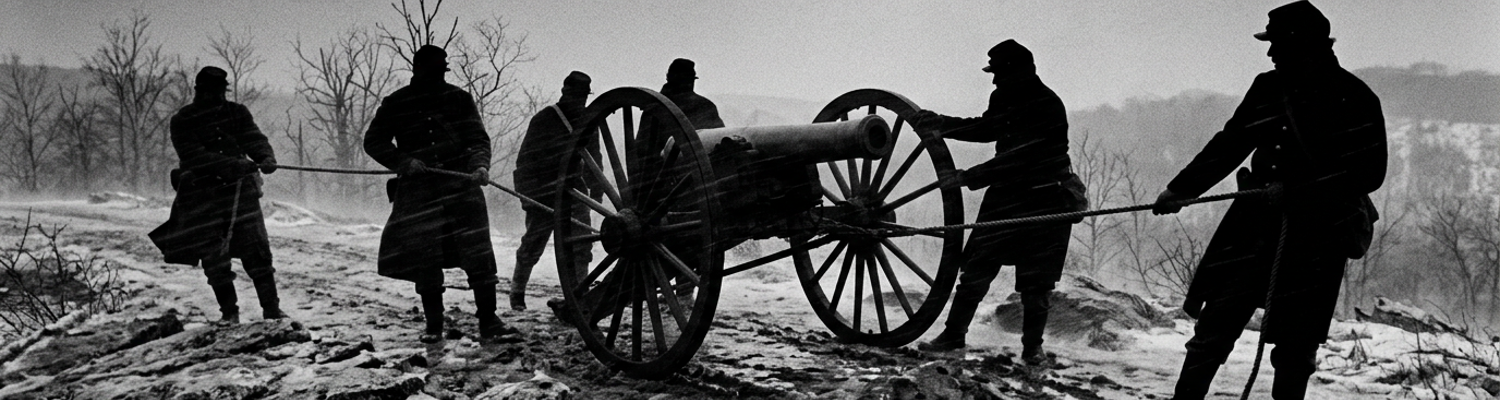

Sub-Zero Conditions in Murfreesboro Limestone Glades
Federal field batteries deployed at Stones River lost twenty-eight guns and 544 artillery horses. Equipment attrition hit twenty-four percent. When examining the operational logs of the Fourteenth Army Corps Center (NARA Record Group 393), weather records register a severe barometric drop on December 30, 1862. Freezing rain and sleet swept across the basin northwest of Murfreesboro. The precipitation coated exposed cedar brakes and limestone outcrops. The terrain between the Nashville Turnpike and the Wilkinson Crossroads turned into a solid shelf of ice. This karst terrain featured flat limestone layers covered by barely three inches of topsoil. Dense stands of Juniperus virginiana broke up the rock shelves. Six-animal draft teams attempting to move 3,800-pound gun-and-limber combinations skidded across the glazed rock benches. Horses repeatedly threw iron shoes. Teams collapsed under the weight. Wooden wheels slipped sideways off limestone ledges into hidden fissures. The impacts shattered felloes and fractured wrought-iron axle-trees before batteries could establish fields of fire. Infantry and artillerymen serving under Major General George H. Thomas struggled along the frozen forest lanes. Their woolen overcoats soaked through with sleet before freezing stiff in the northern gale.
By late evening, ambient temperatures across Rutherford County dropped to sixteen degrees Fahrenheit.
Archival evidence from field ordnance returns confirms that this rapid freeze crippled the primary safety mechanism of the Model 1857 12-pounder light field gun. Solid ice formed inside the sheet-iron and wooden sponge buckets slung beneath the limbers of the bronze Napoleons. Battery drill mandated that the Number One cannoneer thoroughly drench the wool fleece head of the rammer in water before driving it down the smoothbore 4.62-inch bronze barrel between rounds. This step extinguished burning embers left behind by the prior shot's wool flannel cartridge casing. Number Three cannoneers held a leather thumbstall over the vent hole to seal the draft. They relied on the wet sponge to snuff any remaining spark in the vacuum. With the water frozen solid inside the buckets, gunners struck the ice with iron trail handspikes. The solid blocks yielded only unusable dry slivers. Ramming a dry sponge down a bore caked with frozen potassium carbonate fouling failed to extinguish burning cartridge fragments lodged near the breech plug. Pushing a fresh two-and-a-half-pound bag of loose black powder down against a surviving ember caused immediate chamber detonation. The blast blew the rammer staff back through the Number One cannoneer's body. The explosion destroyed the hands of the loader.
Standard field battery doctrine failed when water supplies froze solid.
A close review of operational logs from Battery H of the 5th U.S. Artillery and the 1st Michigan Battery indicates that gun crews attempted to thaw their frozen sponge buckets. They held lighted paper from cartridge boxes under the bases. Division commands strictly prohibited open fires within seven hundred yards of Confederate skirmish lines. Men resorted to chipping ice away from the brass elevation screws using bayonet tips to keep the elevation mechanisms from locking solid. The wet leather of the harness collars and trace ropes froze into unyielding boards on the horses. Teamsters could not strip the gear or rest the animals. Artillerymen lay on the bare sleet-covered limestone ledges beside their frozen gun tubes without blankets or fire. They held the reins of the shuddering teams through the darkness until dawn.
Mechanical Failures of the Bronze Napoleon
Ten batteries belonging to the Fourteenth Army Corps brought forty-six bronze Model 1857 12-pounders into the tree lines surrounding the Cowan farm on December 31.
Quartermaster records show that rapid temperature drops crippled the ignition assemblies of these guns within the opening ninety minutes of the Confederate dawn assault. Ordnance specifications required the insertion of a brass friction primer into the 0.175-inch touchhole drilled through the bronze breech. The primer contained two grains of fulminating powder and an internal serrated friction wire. Sleet and black powder exhaust formed a thick sulfurous slurry. This mixture seeped into the narrow channel during continuous firing. As wind chill pushed the effective temperature toward single digits, this carbon sludge hardened into an unyielding plug of frozen fouling. Cannoneers in Battery G, 1st Ohio Light Artillery, clipped their lanyards to the primer loop. They stepped back and jerked the cord. The slider wire tore free without detonating the damp chemical compound inside the tube. When the primer did flash, the low heat failed to burn through the icy fouled crust at the bottom of the vent. The two-and-a-half-pound flannel powder charge remained untouched inside the chamber. Number Three cannoneers had to drive steel vent picks down the vent with bare palms. They cut through frozen residue while lead balls splintered the carriage cheeks.
Gunners on the right flank averaged three dry misfires for every successful discharge.
When examining the historical record of Negley's division in the cedar thickets east of the Wilkinson Pike, a second mechanical breakdown paralyzed battery defense lines. The elevation mechanism of the Model 1857 Napoleon (Ordnance Department specification 1841) relied on a heavy cast-iron screw turning within an elevating nut pinned to the carriage stock. This regulated the vertical angle of the 1,227-pound bronze barrel. Ordnance regulations mandated greasing the threads with beef tallow or commercial sperm oil to prevent binding during sustained recoil. At sixteen degrees Fahrenheit, this animal fat congealed into solid wax. The wax locked the screw threads solidly against the housing nut. Gunners who gripped the four-spoke iron handle found the mechanism immobilized. They could not depress the muzzles to meet infantry charges emerging at ranges under one hundred yards. Artillerymen threw their body weight against the handles until the wrought-iron levers sheared off at the hub. Crews used pioneer axes to chop split-rail fences and cedar logs into rough wooden wedges. Cannoneers shoved these wooden blocks directly under the breech ring. They hammered them deeper with handspikes to raise the muzzle. They battered them loose with the flat sides of axes to depress the barrel.
Improvised timber blocks replaced the mechanical elevation controls on at least twelve Napoleons across the Fourteenth Army Corps during the morning retreat. The blunt wedges provided no fine thread adjustments for distance. This limited the guns to fixed horizontal trajectory sweeps across the flat limestone shelves. Recoil forces exceeding six thousand pounds crushed the soft cedar grain with every shot. The impacts split the field-cut blocks into fragments and threw the bronze barrels out of alignment. Loaders scrambled across the frozen rock between discharges. They searched through cedar brush for thicker pieces of oak or hickory firewood. They wedged the wood beneath the cascading breeches before the next canister round could be rammed.
Battery H of the 5th U.S. Artillery abandoned two guns along the cedar edge. Fractured wedges dropped the breeches flat against the axle bodies, pointing the tubes uselessly toward the sky.
Cumberland River Munitions Transport by Western Flotilla
When examining naval logs from the Cumberland River patrol in late December 1862, Federal supply operations hung on a fragile two-hundred-mile water corridor. This route connected the Ohio River depot at Smithland to the forward supply base at Nashville. Confederate raiders under John Hunt Morgan had severed the Louisville and Nashville Railroad tracks at Muldraugh's Hill. This cut off all overland rail transit to Major General William S. Rosecrans' army. Low winter river levels combined with the sudden temperature plunge produced thick jagged ice floes. These floes clogged narrow navigation channels along Harpeth Shoals. Shallow-draft civilian sternwheel steamers chartered by the Quartermaster Department forced their way upstream against heavy current. They used reinforced oak bows to batter through surface sheets. Submerged ice chunks smashed into the spinning stern paddlewheels. The impacts sheared white-oak wheel buckets from their iron flanges and threw mechanical crank arms out of true. Crewmen stood on exposed forecastles in blinding sleet with long pine poles. They shoved heavy drift ice away from the wooden hull timbers to prevent crushed seams below the waterline.
Boiler pressure gauges spiked as paddle wheels ground against packed ice.
Confederate cavalry detachments and partisan snipers took advantage of the choked channels. They occupied the limestone bluffs rising seventy feet above the riverbanks between Clarksville and Ashland City. Marksmen firing Enfield rifles and short-range field pieces directed their aim directly into the unarmored pilothouses, glass windows, and high-pressure steam pipes of the cargo transports. Converted river gunboats designated as tinclads (including the USS Lexington and USS Tyler) operated under Lieutenant Commander LeRoy Fitch of the Western Flotilla. These vessels positioned their hulls between the shoreline bluffs and the vulnerable civilian steamers. The gunboats carried only one-half inch to three-quarters of an inch of soft iron plate bolted over heavy white-oak bulwarks. This provided minimal protection against plunging rifle fire. Lead bullets flattened against the iron sheathing with continuous concussions while naval gun crews worked their broadside 24-pounder brass howitzers. Gunners cranked elevation screws to extreme upper limits to throw spherical case shot directly into the timbered ridgelines. The explosions broke up infantry ambush nests before steamers drifted into dead water.
Gun crews loaded behind dented oak planks while musket balls punched through the smokestacks.
A close review of operational logs from the Department of the Cumberland reveals that artillery batteries outside Murfreesboro were burning through forty rounds per gun per day. This required direct underway munitions transfers along the frozen river. Rather than waiting for boats to tie up at congested central depots, tinclads and sternwheelers pulled alongside river lighters and military transports in midstream channels to shift ordnance. Laborers, contraband workers, and infantry details hauled tons of heavy wooden crates from the damp vessel holds across swaying ice-slicked gangways. Each transport hold stored thousands of combustible units. These included zinc-lined powder kegs, paper-wrapped friction primers, and fragile wool-flannel propellant bags loaded with DuPont black rifle powder. Loose coal sparks flying from a steamer stack threatened to ignite open deck cargo. Working through sub-freezing gales, crews manhandled fifty-pound ammunition chests packed with fixed 12-pounder canister and solid shot directly from boat decks into waiting four-mule army wagons. These supply wagons pushed south through sleet along the Nashville Turnpike without stopping to unload at intermediate warehouses. They hauled fresh munitions boxes directly to division ammunition parks to replenish the depleted limber chests and forward caissons of Fourteenth Corps batteries.
Every caisson box received forty-four rounds of powder and iron before the next artillery assault began.
Ammunition Replenishment under Counter-Battery Fire
Archival evidence shows that by mid-morning on December 31, caisson teams attempting to reach the forward gun positions of Battery G, 1st Ohio Light Artillery, faced complete spatial disorientation in the cedar brakes west of the Wilkinson Pike. Artillery drivers forced four-mule and six-mule harness teams off the frozen ruts of the turnpike directly into the roadless thickets. Stunted red cedar trunks stood barely four feet apart. Panicked by the sound of incoming Confederate twelve-pound solid shot cutting down the timber canopy, the mules lunged against their trace chains. They threw their iron-shod hooves over the wooden singletrees. Drivers straddling the near-wheel animals drove raw spurs into shivering flanks. They hauled back on stiff leather-bound lead reins to prevent the limbers from overturning across three-foot limestone drop-offs. The heavy iron-tired wheels repeatedly wedged between limestone boulders. The friction stripped the wooden spokes and hung the ammunition chests against low cedar limbs. Shrapnel from Captain Felix Robertson's Confederate battery shredded the upper branches overhead. Wood splinters and iron fragments showered across the open limbers. Drivers cut dead or thrashing lead mules out of their tangled leather harnesses with pocketknives to keep the remaining team moving forward.
Solid shot cleaved clean through caisson frames before the teams could unhitch.
Gun lines ran completely out of prepared rounds as Confederate counter-battery fire converged on the Fourteenth Corps center. Canister fire had stripped the forward limber chests down to their zinc linings within forty minutes of contact. Replacement chests finally arrived at the gun positions. Cannoneers working the Model 1857 Napoleons encountered catastrophic ignition failures. Freezing rain and sub-twenty-degree air had penetrated the non-waterproofed wooden packing boxes. The moisture soaked the wool-flannel powder bags. The loose black rifle powder inside caked into cold wet lumps that failed to burn properly. This reduced chamber pressure and dropped shot trajectories dozens of yards short of the advancing infantry lines. At the touchhole, the physical mechanics of the ignition assembly failed. Ordnance crates yielded friction primers (Frankford Arsenal production lot 44) whose internal serrated brass slider wires had turned brittle in the freeze. The Number Four cannoneer hooked his lanyard to the wire ring and pulled. The embrittled metal snapped clean at the primer collar instead of drawing through the friction compound. Sparks never reached the vent.
Cannoneers dug sheared brass stems out of touchholes with bare bleeding fingers.
When examining the historical record of the 5th U.S. Artillery, Battery H, cannoneers faced direct fire from twelve Confederate smoothbores while trying to clear these obstructed breech vents. Number Three gunners shoved steel vent picks down into the touchholes. They struck the picks with iron handspikes to crush the frozen plugs of sulfur and broken primer wire. Counter-battery case shot burst directly over the open ammunition chests. Cannoneers sorted through cracked paper tubes of priming compound under continuous iron hail. Gun captains rejected three out of every five powder charges due to dampness. They discarded the saturated bags into the freezing mud while searching for dry wool casings at the bottom of the chests. Handlers carried the surviving charges between their woolen coats and their chests to shield the black powder from sleet until loaders could ram the rounds down the fouled bronze bores. Two caisson chests exploded along the tree line when an incoming Confederate percussion shell struck an open limber lid. The blast killed five artillerymen and scattered burning ammunition crates across the frozen limestone ledge.
Major John Mendenhall and Defensive Line Consolidation
Archival evidence shows that at 4:00 PM on January 2, 1863, Major John Mendenhall took personal command of the artillery park to organize a desperate consolidation of guns along the ridge above McFadden Ford. Riding through masses of routed Federal infantry surging west across the Stones River, he diverted every available battery toward a low limestone bluff that rose barely forty feet above the water. Battery drivers lashed six-horse draft teams through frozen mud. They forced bronze Napoleons, 10-pounder Parrotts, and 3-inch Ordnance Rifles directly into axle-to-axle alignment. Cannoneers from the 3rd Wisconsin Battery, the 8th Indiana Battery, and Battery M of the 1st Ohio Light Artillery dropped handspikes into the rocky dirt. They muscled carriages into battery barely ten feet apart along the crest. Harness traces snapped as panicked artillery horses slipped on wet rock shelves. Gun crews unhitched dead animals and rolled the 3,800-pound pieces into position by hand. Within twenty minutes, Mendenhall had crammed fifty-eight field pieces along a frontage of less than six hundred yards.
Fifty-eight muzzles crowned the crest before the retreating infantry cleared the freezing river.
A close review of operational logs indicates that Mendenhall immediately began surveying firing lanes across the open cotton fields as John C. Breckinridge's division advanced from the eastern wood line. Four brigades under Brigadier General Roger Hanson, Brigadier General Daniel Adams, Brigadier General William Preston, and Colonel Joseph Palmer moved forward across the muddy river bottom in two tight waves. Their battle flags were visible across eight hundred yards of open agricultural ground. Dead cotton stalks and drainage swales did little to conceal the four-thousand-man infantry front advancing at quick-time. Mendenhall walked the battery line with field glasses. He adjusted azimuths and directed each battery commander to target specific sections of the field. Rifle guns on the higher ground received orders to zero their sights for long-range spherical case shot over the center swales. The smoothbore Napoleons positioned along the lower shelf sighted their tubes for oblique enfilading trajectories aimed directly at the river crossing.
Retreating Federal skirmishers scrambled through waist-deep water to clear the eastern bank.
When examining the historical record of Battery H, 4th U.S. Artillery, cannoneers rammed double charges into their fouled smoothbores the moment the leading Confederate ranks reached three hundred yards. Tin cylinders packed with heavy iron balls slid down bronze barrels over loose two-and-a-half-pound propellant bags. Number Three gunners clamped leather thumbstalls over vents to hold vacuum seals. Number Four cannoneers yanked lanyards, igniting simultaneous discharges that shook the frozen ridge. Sustained recoil slammed carriage trail shoes into limestone ledges. The impacts sheared iron bolts, stripped wooden felloes, and cracked elevation screws locked with frozen tallow. Gun crews fired over one hundred rounds every sixty seconds across the designated lanes. The metal tore continuous gaps through the Kentucky Orphan Brigade as Breckinridge's soldiers tried to scale the eastern river bank. Hanson fell mortally wounded by a shell fragment near the riverbank as artillery fire chopped through company formations. Confederate battle lines disintegrated in the open cotton fields. The assault force lost over eighteen hundred men in twenty-five minutes before the surviving regiments broke into a disorganized retreat toward the eastern woods.
Massed Artillery Deployment at McFadden Ford
Standard Federal artillery tactics prescribed an interval of fourteen yards between individual gun carriages to allow safe recoil and limber access. Along the low limestone ridge overlooking McFadden Ford, battery commanders discarded this regulation entirely on January 2. Gunners manhandled fifty-eight field pieces into a compressed line spanning approximately five hundred yards. They locked iron-tired wheels less than two feet apart. Hub-to-hub positioning created immediate physical dangers for the crews working the carriages. When an eight-hundred-pound Model 1857 Napoleon discharged its two-and-a-half-pound charge, the carriage recoiled rearward six to eight feet across the wet limestone shelf. Trail handspikes overlapped adjacent gun stations. Cannoneers were repeatedly struck by neighboring carriage trails or pinned against the forward limber wheels. Number Six and Seven cannoneers hauling rounds from the ammunition chests had to squeeze through a solid wall of smoking bronze and iron tubes. They ducked under hot muzzles while sulfur exhaust blinded their view of the slopes below.
Hubs ground against hubs as crews dragged discharged guns back into battery by hand.
When examining the historical record of the XIV Corps and the Left Wing, the alignment of these fifty-eight pieces produced a concentrated zone of interlocking fire covering the four-hundred-yard river bottom. Smoothbore 12-pounders anchored the forward break of the slope. Rifled 10-pounder Parrotts and 3-inch Ordnance Rifles elevated over their breeches from the secondary crest fifteen feet higher up. Down in the mud of the ford, Confederate brigades under Preston and Palmer converged directly into the geographic center of this overlapping crossfire. Canister rounds packed with twenty-seven iron balls discharged simultaneously with spherical case shot fused to explode ten feet above the water line. The line was packed so tight that blast waves from adjacent muzzle brakes blew flannel residue, hot wadding, and burnt powder directly across the faces of neighboring crews. Gun teams expended upwards of three rounds per gun per minute. This produced an unrelenting sheet of lead and iron that struck the crossing at an oblique angle from both flanks at once.
Over two tons of lead and iron struck the river crossing every minute.
A close review of operational logs indicates that this fifty-eight-gun line operated with zero electrical telegraph lines or Signal Corps flag communication. Signal flags proved useless. A low-hanging canopy of dense black powder smoke settled across the river basin within ninety seconds of the first salvos. This blinded visual relay officers across the ridge. Field telegraph wire reels sat abandoned in wagon parks two miles to the rear on the Nashville Turnpike. Artillery officers had to synchronize twelve independent batteries. These units originated from different divisions with no shared training. Synchronization occurred solely through acoustic relay, shouted orders, and physical pattern imitation. Buglers attempted to sound fire commands. The concussive roar of fifty-eight tubes firing in open batteries ruptured eardrums. This rendered brass bugle calls completely inaudible beyond ten paces. Battery captains stood directly behind the trail handspikes. They watched the smoke flashes of the adjacent battery to calibrate their own rate of fire.
Commanders solved the fire control problem by establishing manual chain-of-sight directives along the line. Captain George R. Swallow of the 7th Indiana Battery and Captain Peter Simonson of the 5th Indiana Battery passed target designations laterally down the line. They dispatched mounted orderlies and runners on foot behind the caissons. Runners fell to counter-battery fire from the eastern bank. Gun captains tracked the fire of the 3rd Wisconsin Battery on the far right flank. Wisconsin crews shifted their sights from long-range case shot to double-canister. Adjoining gun captains immediately matched the ammunition selection without waiting for written or signaled orders. Loaders used brass fuse gouges to shave paper fuses to one-second increments by eye. They watched the dirt splashes of adjoining rounds to estimate range corrections across the river. Battery officers maintained this manual synchronization until Confederate forward regiments collapsed at the water's edge. The riverbed was left blocked with four hundred abandoned muskets and eighty-six dead draft horses.
Canister Barrage against Confederate Infantry Formations
Archival evidence shows that when the leading regiments of Breckinridge's division crossed the open fields toward McFadden Ford at 4:30 PM, Federal battery commanders ordered all smoothbore crews to switch immediately from spherical case shot to double-canister. In Battery H, 4th U.S. Artillery, loaders broke open wood packing cases and pulled out thirty-six-pound bundles. These bundles contained two tin canisters seated over a single two-and-a-half-pound propellant charge. Each tin cylinder contained twenty-seven heavy cast-iron balls packed in sawdust. This gave every smoothbore shot an outgoing payload of fifty-four iron projectiles. Ramming two projectiles into a hot fouled bronze tube raised bore friction significantly. Number One cannoneers drove their wooden rammer heads down the barrel with multiple running lunges. Friction primers were seated into carbon-caked touchholes without clearing the residue. By staggering discharges between the sections, twelve batteries maintained an uninterrupted cycle of ignition. They filled the river bottom with continuous iron scrap before the Confederate front line could reach the west bank.
Gun tubes grew too hot for cannoneers to touch with bare skin.
A close review of operational logs indicates that the massed battery line sustained four uninterrupted minutes of double-canister discharge. The fire tore through the advancing Confederate ranks without pausing to swab the barrels. Between 4:34 PM and 4:38 PM, forty-six smoothbore guns fired at an average rate of two-and-a-half rounds per minute. They expended more than four hundred double-canister rounds into the charging formations of Hanson's Kentucky Brigade and Palmer's infantry. Men on the gun line operated purely by tactile reflex through choking sulfur gas. Number Three gunners pressed greasy leather thumbstalls over the vents. They absorbed intense chamber heat that scorched their skin through the wet cowhide while the breech pressure surged. Lanyards were pulled. The muzzle explosions produced forty-foot sheets of flame that scorched dead grass along the limestone ledge. Projectiles struck the Confederate ranks at point-blank distances of two hundred down to seventy yards. The metal tore wide swaths through the 2nd and 4th Kentucky Infantry regiments. Company columns collapsed beneath the weight of metal. Round after round sheared through men four ranks deep.
Recoil forces pushed carriage trails six feet back into the limestone shelf.
When examining the historical record of the 3rd Wisconsin Battery and the 8th Indiana Battery, overlapping cones of iron and lead shot converted the icy ford into impassable mud and frozen carnage. The spread of canister balls expanded at a ballistic ratio of one foot of lateral dispersion for every nine feet of travel. Fifty-eight guns occupied a frontage of less than six hundred yards. These expanding shot patterns crossed each other fifty yards in front of the muzzles. This created an interlocking grid of high-velocity iron across McFadden Ford. Projectiles sheared the surface of the freezing river. They shattered surface ice shelves and threw tons of gravel and water into the ranks of the wading troops. Thousands of iron pellets tore into the frozen clay banks. The impacts churned the solid earth and crushed ice into knee-deep blood-soaked mud that trapped retreating soldiers. Wounded men from the 6th Kentucky and 9th Kentucky fell face down into the churning mire. They could not pull their limbs free under the hail of metal. Abandoned muskets, crushed cedar rails, and dead artillery horses formed physical dams across the shallow crossing. These obstructions blocked all retreat routes.
The assault force lost one-third of its men in twenty minutes.
Battery commanders finally ceased firing when retreating Confederates broke past the timberline eight hundred yards away. Cannoneers in the 1st Ohio Light Artillery collapsed against the smoking carriage wheels. Their faces were blackened with carbon and their ears bled from ruptured tympanic membranes. Inspection of the smoothbore barrels revealed deep score marks cut into the bronze rifling lands by the unjacketed iron canister balls. Number Four cannoneers dropped snapped lanyard hooks into the dirt. Their hands were blistered raw from friction pulls. In the riverbed below the bluffs, the 19th Tennessee left three shattered regimental battle flags abandoned in the mud beside forty dead infantrymen.
Enlisted Survival and Aftermath on the Riverbank
Archival evidence shows that temperatures dropped to nine degrees Fahrenheit along the east bank of Stones River during the night of January 2, 1863. In the 3rd Wisconsin Battery and the 8th Indiana Battery, cannoneers operating fifty-eight field pieces locked hub-to-hub experienced catastrophic acoustic trauma. Muzzle overpressure exceeding one hundred and eighty decibels continuously hammered the gun line at five-second intervals. The shockwaves tore tympanic membranes and drove concussive force directly into the cranial vaults of the loaders. Men working adjacent pieces stood within two feet of exploding muzzle brakes. The violent expansion of hot gas ruptured blood vessels in the eardrum and nasal passages. Artillerymen lost all functional hearing within three minutes of the barrage. They communicated solely by watching hand gestures and weapon recoils through sulfurous fog. Extreme cold worsened the physical trauma as ambient moisture froze over raw tissue. Cannoneers who removed damp woolen mittens to thread serrated friction wires into narrow touchholes left strips of living skin bonded to sub-freezing iron handspikes and brass elevating screws.
Blood oozed from ruptured ear canals and froze into black crusts along the soldiers' jawlines.
When examining casualty returns from Fourteenth Army Corps field hospitals, medical officers logged dozens of gunners with severe peripheral gangrene and deep thermal necrosis. Wet wool overcoats and soaked trousers froze into rigid boards when river spray and black powder water splashed across the gun platforms. Number One and Number Two cannoneers who handled wet sheepskin sponges absorbed freezing water into their sleeves. Their forearms turned numb and clumsy. Model 1857 Napoleons recoiled six feet back across the wet limestone shelves. Soldiers suffering from concussive disorientation could not clear the recoil paths in time. Iron-shod carriage wheels rolled over inert limbs. The weight crushed frozen hands and fractured the metatarsal bones of men pinned against the ammunition limbers. Gun captains collapsed over the trail handles. Their extremities lost capillary circulation until fingers turned dead white and hardened into solid wax before division relief wagons arrived.
Surgeons at field hospitals north of the McFadden house amputated seventy-six frozen toes and fingers by candlelight before dawn.
A close review of operational logs from the Fourteenth Army Corps Center indicates that recovery details moved down to the McFadden Ford riverbank at daybreak on January 3. They retrieved abandoned ordnance before swelling floodwaters drowned the valley. Detachments from the 1st Ohio Light Artillery and pioneer work details discovered twelve disabled field guns abandoned along the frozen river bottom. Sustained double-canister discharges had scorched the linseed oil and olive-drab paint on the white-oak carriage cheeks down to blistered blackened wood. The bronze barrels were encrusted with baked sulfur residue and lead scrap. Three smoothbore Napoleons sat axle-deep in frozen silt. Their iron wheel tires were cemented in river ice beside the carcasses of twenty-two drowned artillery horses. Ordnance sergeants drove heavy iron wedges into the ice to free the running gear. They hitched fresh four-mule teams to heavy hemp tow ropes wrapped around the axle-trees. Pioneer crews rigged double-purchase tackle systems to stout red cedar trunks on the bluff. They hauled the 3,800-pound assemblies up the slick forty-foot embankment.
Axes chopped away three-inch river ice encasing the carriage wheels before draft chains could budge the submerged iron frames.
Ordnance inspectors cataloged nineteen scorched field carriages and limbers (Quartermaster Form 4) dragged from the river margin to the Nashville Turnpike railhead by the evening of January 4. Heat from uninterrupted rapid firing had crystallized the bronze around the vent channels. The thermal stress widened the 0.175-inch touchholes into irregular oval gashes and expanded bore dimensions beyond acceptable tolerances. Cannoneers salvaged seven bronze barrels with cracked trunnions. They pried them off fractured carriage beds with iron crowbars. They rolled the metal tubes onto flatbed supply wagons bound for the Nashville depot.