
Stanton and the Federal Command Directives
Along the shallow flats of the lower Cape Fear River, muffled oars dipped into dark water. Ironclad hulls and small steam launches drifted northward with the incoming tide toward the Confederate obstructions below Sugar Loaf and Fort Anderson. Gun crews on the decks of Rear Admiral David Dixon Porter's gunboats crouched behind armor plates. They listened for the metallic scrape of iron grappling hooks dragging across riverbed sediment. All operational noise was suppressed. Federal sailors wrapped rowlocks in canvas to eliminate friction. They scanned the waterline for floating wooden kegs, submerged beer barrels packed with black powder, and sensitive chemical fuses anchored to pine pilings. A single heavy oar stroke risked severing or triggering electrical cables connected directly to galvanic shore batteries hidden inside the pine woods.
Submerged electrical wires and cast-iron powder cylinders lay undisturbed under the black water.
Archival evidence shows that this slow river movement was forced by events hundreds of miles north. Secretary of War Edwin Stanton bombarded Lieutenant General Ulysses S. Grant with urgent electronic transmissions (War Department Telegraph Office Log Book 4, January 1865). Stanton spent January 1865 pacing the War Department telegraph room in Washington. He sent direct demands to Grant's headquarters at City Point, Virginia. The War Department demanded the capture of Wilmington without delay. General Robert E. Lee's Army of Northern Virginia relied upon the Wilmington and Weldon Railroad for grain, lead, and imported English rifles that ran the coastal blockade.
A close review of operational logs indicates that Stanton rejected military administrative delays. He warned Grant that taking Fort Fisher was meaningless if Confederate forces retained river access and Wilmington's rail hubs. Dispatches reached City Point repeatedly demanding to know why federal troops were not already marching northward along the sand spits. Grant preferred building supply stockpiles before pushing inland. Stanton viewed every idle day as administrative failure. He pressed the telegraph keys to force an immediate coastal advance against the Cape Fear river basin.
Washington expected immediate forward momentum regardless of unmapped minefields or swamp terrain.
When examining the historical record, Grant resolved Stanton's pressure by reassigning Major General John M. Schofield and the entire Department of the Ohio to the coastal sector. Schofield's XXIII Corps consisted of roughly fifteen thousand men encamped at Clifton, Tennessee. They received marching orders on January 14, 1865. The movement required forty-seven separate train runs and dozens of river steamers through winter storms. These transports carried infantry regiments, artillery batteries, and draft animals along the Ohio River and over the Allegheny Mountains to deep-water docks at Alexandria and Annapolis. Ocean steam transports then carried the divisions down the Atlantic coast directly to Federal Point. Grant designated this combined force the Department of North Carolina. He placed Schofield in overall command, superseding Major General Alfred Terry despite Terry's success in capturing Fort Fisher weeks earlier. Schofield established his command post at Smithville on the western riverbank. He confronted heavy sandbars, unfordable tidal creeks, and sharp friction with the naval command. Porter's vessels drew too much water to cross the lower flats safely without mine clearance. Schofield refused to march his regiments against the parapets of Fort Anderson without continuous offshore artillery support from naval guns.
Inter-Service Discord in the Cape Fear Estuary
Archival evidence shows that command authority dissolved into bitter administrative infighting the moment Major General John M. Schofield established headquarters at Smithville on February 9, 1865. Rear Admiral David Dixon Porter flatly refused to recognize Schofield as his operational superior. Naval regulations placed him entirely outside Army department hierarchy. Porter answered solely to Secretary of the Navy Gideon Welles and Lieutenant General Ulysses S. Grant. When Schofield attempted to issue joint staging timetables for advancing against Fort Anderson, Porter dismissed the directives. He viewed them as overreach by an army officer who had arrived in North Carolina weeks after naval gunners battered Fort Fisher.
Neither commander conceded precedence.
Department of North Carolina staff officers recorded daily arguments over protocol, escort vessels, and which service had the right to dictate movement schedules (NARA Record Group 393). Schofield pointed to Grant's written orders giving him broad regional authority over all forces operating inside the Cape Fear basin. Naval headquarters openly rejected that interpretation. Porter refused to place a single warship under Schofield's formal command. The two commanders communicated through sharp written memoranda delivered by boat across the harbor. They avoided in-person conferences for days at a time.
Navy logbooks from the North Atlantic Blockading Squadron reveal mounting anger among naval officers over army passivity along both riverbanks. Porter sent official messages accusing Schofield of stalling the campaign while gunboat crews spent freezing nights clearing submerged mines under Confederate sniper fire. Sailors aboard the monitors Montauk and Huron watched federal infantry remain motionless in their wet encampments near Smithville and Federal Point. Gunboat commanders insisted that an aggressive overland rush by Schofield's XXIII Corps would quickly surround Fort Anderson and force Confederate Brigadier General Johnson Hagood to abandon the lower river without naval casualties. Schofield flatly refused to order an unsupported charge.
His reconnaissance officers reported that Fort Anderson mounted twelve heavy coastal guns. These included an eight-inch Armstrong rifle and multiple thirty-two-pounders pointing straight down the river approaches. To the west, impassable wetlands bordered by Orton Pond funneled any infantry assault into a narrow corridor of deep mud and prepared abatis. Schofield notified Porter that Major General Jacob D. Cox's division would not step onto the causeways without guaranteed naval flanking fire to suppress Confederate artillery along the river parapets. Federal field orders explicitly demanded that Porter's ironclads steam past the mine lines, anchor off Big Island, and systematically batter the fort's river batteries before a single infantry regiment stepped forward.
Porter claimed the river torpedoes made that request impossible without heavy naval losses.
A close review of operational logs indicates that this deadlock froze the federal advance for nearly a week. Schofield refused to sacrifice infantry against unbroken field fortifications while Porter kept his deep-draft gunboats idling south of the defensive mine perimeter. Federal sailors spent those days working from unarmored yawls. They dragged iron grapnels through the silt near Reeves' Point to snag wire-guided galvanic fuses. Confederate artillerists at Fort Anderson intermittently lobbed ten-inch columbiad shells into the sweep zones. These projectiles capsized launches and killed sweep crews in open water. Porter argued that the Army sat comfortably behind sand berms while his men absorbed all the risk. Army staff dispatches to Grant countered that throwing infantry into the Orton Pond bottleneck without suppressing fire from monitor turrets was tactical negligence. Cox's brigades stayed put in their lines, wet down to their cartridge boxes, waiting for naval bombardments that Porter delayed until mine sweeps cleared a channel four hundred yards wide. Gunboats eventually nudged forward only after Schofield agreed to coordinate his land assault precisely with the tidal cycle of February 17.
Confederate Galvanic Torpedo Defenses at Fort Anderson
Archival evidence shows that Confederate naval specialists turned the river bottom fronting the old colonial ruins of Brunswick Town into an electrically linked minefield.
Operating under the Confederate Submarine Battery Service, specialists anchored rows of submerged iron and wood-cased galvanic torpedoes across the river approaches below Fort Anderson. Each weapon held between two hundred and five hundred pounds of fine-grain rifle powder. This explosive material was packed into sealed sheet-iron cylinders or pitch-coated wooden casks. Copper conductor cables wrapped in natural gutta-percha insulation extended from internal platinum-wire igniters directly across the riverbed. These cables connected to covered battery bombproofs dug into the bluff. Confederate electricians deployed Grove and Smee chemical cells containing zinc and carbon plates submersed in diluted sulfuric acid to power the ignition circuits.
Sighting crews occupied paired observation posts along the western bank. They tracked Federal ship movements across surveyed alignment stakes driven into the shoreline turf. When a target's hull crossed the optical intersection of the two survey lines, an operator pressed a brass hand-key. This action completed the galvanic loop and heated the platinum bridge wire to incandescence.
Failures plagued the apparatus in field conditions.
Brackish estuary currents shredded the soft gutta-percha coating against submerged oyster beds. This friction created electrical short circuits that grounded the current before it reached the primers. Silt accumulated over the wooden casings, weighting down floating barrels and burying contact points beneath feet of river sediment.
A close review of operational logs indicates that Fort Anderson's riverfront defenses were engineered specifically to protect these unexploded minefields from Federal boat crews. Confederate Brigadier General Johnson Hagood directed the construction of ten massive sand traverses rising twenty feet above the river. These earthworks shielded heavy artillery positions oriented directly across the main ship channel. The Cape Fear's deep-water draft had been dredged to a width of barely two hundred yards. This geography forced any approaching vessel into a linear corridor within point-blank range of the fort's water battery. Artillery detachments manned a dozen heavy pieces. The battery centered around an English-manufactured 150-pounder Armstrong rifled gun alongside ten-inch smoothbore columbiads, banded thirty-two-pounders, and eight-inch shell guns mounted on barbette carriages.
Solid shot and explosive shell from these batteries covered every yard of the dredged channel at flat trajectories. The projectiles were capable of stripping away the armor plating of monitors or splintering wooden launches. Long-range fire held Federal mine-sweeping details pinned against the eastern shallows. Any launch attempting to cast grappling hooks into the channel drew concentrated grapeshot and spherical case shot. This defensive fire prevented federal sailors from severing the submarine wiring harness.
Heavy artillery fire made sustained sweeping impossible during daylight hours.
When examining the historical record, Confederate artillery officers at Fort Anderson maintained continuous visual interlock between gun sights and the galvanic detonation markers. Artillery crews withheld their fire until Federal vessels slowed down to avoid the suspected mine lines. This tactic trapped the ships in pre-ranged kill zones. Lieutenant Commander William B. Cushing's reconnaissance parties reported that attempting to grapple the wires by night brought down blind canister sweeps from the thirty-two-pounders. These guns skipped iron balls across the water at wave-top level. Defenders filled five-inch shell casings with quick-burning pitch to illuminate the river surface whenever picket boats were heard splashing near the obstructions. The arrangement gave the Confederate garrison complete tactical control over the navigation channel. This setup held Porter's ironclad flotilla at bay three miles downriver while Schofield's infantry remained bogged down in the swamp causeways south of Orton Pond. Hagood maintained this defensive blockade using fewer than one thousand artillerymen and supporting North Carolina infantry.
Tactical Operations of Union Mine-Sweeping Launches
Archival evidence shows that Lieutenant Commander William B. Cushing organized specialized boat crews from the North Atlantic Blockading Squadron to execute targeted counter-mine sweeps across the Cape Fear channel. Working from twenty-six-foot pulling cutters and small steam launches stripped of all reflective brass, naval seamen rowed into the shallows between Reeves' Point and Big Island under absolute blackouts. Crews cast custom four-pronged iron grapnels overboard on seventy-fathom lengths of tarred manila line. These creepers scraped through mud and shell banks. They searched for the submerged gutta-percha lines that linked Confederate galvanic torpedoes to battery bombproofs inside Fort Anderson.
Rowers pulled against the heavy drag at two knots.
They felt the hemp lines pulse through calloused hands until a sudden jerk signaled a snagged cable. Whenever a grapnel hooked an electrical circuit, boat crews hauled the tensioned cable to the surface using wooden davits mounted over the cutter gunwales. Sailors severed the copper conductor core with axes and dropped the dead ends back into the riverbed silt. A single slip of an axe blade against live wires could trigger fifty kegs of powder directly underneath an open boat.
A close review of operational logs indicates that Commander William G. Temple coordinated tactical support using double-ender side-wheel gunboats. These vessels included the Pawtuxet and Mackinaw. They sheltered the sweep details from southern counter-attacks. Double-ender vessels possessed identical rudders at bow and stern. This design allowed them to reverse direction in the narrow 200-yard dredged channel without turning broadside into Confederate artillery lanes. Gunboat engineers rigged heavy iron framework outriggers extending past the paddle-wheel housings. These outriggers trailed steel-toothed sweeps designed to foul and drag bottom wires ahead of the hull.
Equipment broke down repeatedly in the heavy river current.
Sharp oyster beds cut through hemp towlines. Submerged pine snags snapped iron grapnel tines clean off their shanks. When Confederate sharpshooters on the western bluffs spotted the sweeps and opened fire with Whitworth rifles, double-enders responded by firing eleven-inch Dahlgren smoothbores loaded with grape into the brush. Launch crews continued their sweeps beneath smoke clouds drifting over the water. Army observers on the eastern shore reported the naval gunfire as aimless delay rather than deliberate mine clearance.
When examining the historical record, shallow-draft boat sweeps depended on narrow tidal windows between midnight and the onset of morning fog. The Cape Fear estuary generated ebb tides running at three to four knots over uncharted sandbars. These currents threatened to ground the heavy wooden cutters within three hundred yards of Fort Anderson's water battery. Specialized seamen operated with muffled ash oars while lead-line men called out soundings in whispers to avoid alerting Confederate picket stations along Lilliput Creek. Strong crosscurrents spun the small cutters sideways. The water tangled sweeping gear and pulled dragging grapnels directly into defensive log booms spiked with contact torpedoes. Friction with Schofield's headquarters intensified as XXIII Corps staff officers questioned why these boat operations took days to clear a few hundred yards of channel. Porter's naval officers countered that Schofield's infantry captains failed to comprehend that rushing unarmored craft over unswept electrical fields would destroy the entire sweeping flotilla before the main assault began.
Crews cleared seventeen galvanic lines out of the channel bottom by the morning of February 17, 1865.
Tidal Hydrography and River Obstructions
Archival evidence shows that the natural hydrography of the lower Cape Fear River presented an obstacle equal to the torpedo fields. Between Federal Point and the colonial wharf at Brunswick Town, shifting sandbars known as the Lower Flats choked the main channel. This reduced low-water clearance to less than eight feet. Most gunboats belonging to the North Atlantic Blockading Squadron drew between nine and twelve feet of water. Deep-draft warships, including the twin-turret ironclad Monadnock, were forced to remain entirely outside the river mouth. Monitors such as Montauk and wooden gunboats like Pequot scraped their keels across hard sand ridges and calcified oyster reefs.
Engine rooms suffered constant mechanical casualties.
Suction pumps drew thick river silt directly into the condensers. This abrasive material scoured brass valve faces, choked steam lines, and forced vessel engineers to shut down boilers for emergency blow-downs. Outgoing tides funneled through the narrows at speeds reaching five knots. These rapid crosscurrents caught the flat bottoms of monitors, overpowering their steering linkages. The water spun the armored hulls sideways and wedged them into uncharted sandspits within direct range of Confederate artillery. Channel soundings shifted every six hours as wind and outgoing tides redistributed loose bottom sediment.
A close review of operational logs indicates that Confederate engineers exploited these natural choke points by constructing complex physical obstacles directly below Fort Anderson. Enormous pine pilings were driven deep into the riverbed with steam pile drivers. These logs were cut off four feet below the low-tide mark to impale wooden hulls without showing above the waterline. Behind these stakes, Confederate laborers had sunk timber cribs filled with heavy river stones. They linked the entire barrier system with iron-bound log booms and cheveaux-de-frise. Clearing these barricades required Union sailors to row directly into the obstruction field aboard unarmored cutters. They used hand crosscut saws, iron wedges, and submerged powder pots to split the timbers.
Confederate defense planners neutralized these attempts through coordinated defensive fires.
Brigadier General Johnson Hagood arranged rifle pits along the river bluffs. He garrisoned them with infantrymen from the 21st South Carolina who swept the water with British Enfield rifles. Gun crews at Fort Anderson's water batteries worked in continuous visual link with these rifle pits. Spotters directed thirty-two-pounder smoothbores and eight-inch columbiads to skip canister shot along the waterline. The iron balls shredded the wooden hulls of the clearing boats and killed sailors holding towlines. Naval logs recorded twelve launch hulls splintered by interlocking artillery and rifle fire during clearance attempts on February 16 alone (Squadron Logbook, Entry 412).
When examining the historical record, this tactical impasse aggravated the operational dispute between the Army and the Navy. Major General John M. Schofield's staff watched the stalled flotilla from forward pickets near Smithville. They sent dispatches to Department of North Carolina headquarters that accused naval commanders of excessive caution. Schofield argued that the gunboats possessed the armor and firepower necessary to run past the river pilings and engage Fort Anderson at close quarters. This action would protect his XXIII Corps infantry from riverbank flanking fire. Naval officers rejected this assessment as ignorant of tidal mechanics. Commander Daniel L. Braine of the gunboat Pequot informed squadron commanders that forcing a ten-foot draft vessel across an eight-foot shoal during an ebb tide would strand the ship beneath Confederate guns. It would turn the vessel into a stationary target for plunging battery fire. Pulling a grounded gunboat free required hours of kedging with deck capstans under concentrated enemy artillery. Schofield's division commanders refused to advance along the marshy roads without naval support. This left the boat crews to work the pilings under rifle fire while the tide dropped another foot.
The Failure of Joint Assault Doctrine
Archival evidence shows that neither the War Department nor the Department of the Navy had established a shared manual of joint amphibious doctrine by February 1865. Command authority remained split down the middle between Major General John M. Schofield and Rear Admiral David Dixon Porter. Neither officer held formal veto power over the other. At the deep-water staging wharves of Smithville, this administrative partition halted logistical movement. Quartermaster officers of the XXIII Corps could not commandeer shallow-draft naval steam tugs to offload army draft mules, wagons, and heavy caissons from pitching ocean transports anchored in the mouth of the estuary.
Porter's naval dispatchers retained exclusive control of all steam lighters.
They reserved them to haul replacement Dahlgren shells and soft coal for the blockading squadron. Field artillery pieces belonging to the 1st Ohio Light Artillery sat packed inside transport holds for three days while infantrymen waited ashore without rations. Messengers attempting to coordinate harbor lighterage had to hand-carry written requests through separate army and navy bureaucratic offices. They waited hours for junior naval lieutenants to countersign army manifests.
Joint army and navy signals collapsed entirely in the dense maritime fog.
A close review of operational logs indicates that army and navy signal officers operated without an integrated tactical cipher. Soldiers in the XXIII Corps relied upon Major Albert J. Myer's system of flag and torch wig-wag messaging. This method required line-of-sight elevation poles. Naval signalmen aboard the flagship Malvern worked from Secret Navy Code books using colored pennants hoisted to yardarms. When heavy sulfur smoke and coastal mist descended on the river on February 17, visual contact broke down completely. Army signal sergeants climbing tall longleaf pines near Reeves' Point waved signal flags toward the gunboat line. Porter's watch officers mistook the movements for Confederate activity along the western shore. Written dispatches carried by naval cutters across the choppy river took ninety minutes to travel between Smithville headquarters and Porter's cabin. This delay prevented real-time tactical synchronization during active combat.
Both branches maintained entirely incompatible tactical timetables.
When examining the historical record, this disconnect severed Schofield's ground advance from Porter's river assault against Fort Anderson. Schofield ordered Major General Jacob D. Cox to march two divisions around the western perimeter of Orton Pond. The objective was to sever Confederate Brigadier General Johnson Hagood's retreat route north to Wilmington. Cox's infantry stepped off at daylight on February 18. They expected naval gunboats to delay heavy firing until ground troops maneuvered through the swamp causeways. Porter disregarded Cox's movement schedule. At 0730 hours, twenty-five naval vessels opened broadsides on Fort Anderson's sand parapets. They expended thousands of pounds of ordnance while Cox's brigades were still pinned waist-deep in blackwater swamps four miles south at Russell's Creek. Confederate artillerists abandoned their exposed water batteries under the naval fire and concentrated inland. They redirected their field guns against Cox's struggling columns. By noon, Porter ceased firing due to accumulating smoke and depleted ready-service powder boxes. This cessation occurred precisely when Cox's lead regiments reached the fort's outer abatis. Heavy eleven-inch shells from federal gunboat mortars had dropped short into the maritime scrub. The friendly fire scattered the skirmishers of the 104th Ohio Infantry and halted the army's flanking movement.
Cox halted his advance at the tree line.
Deployment of the Cushing Decoy Monitor
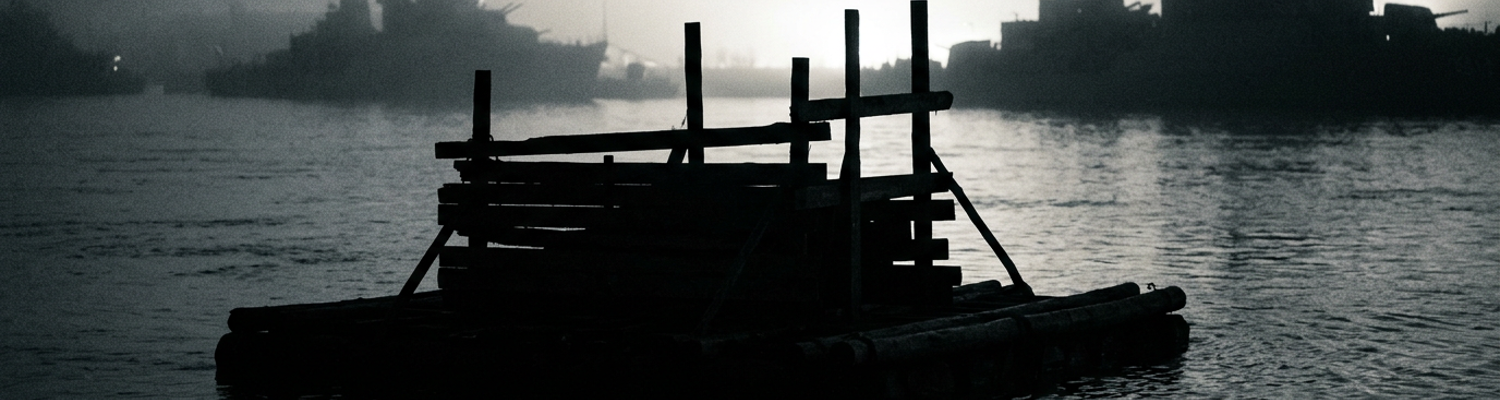
A discarded scow stranded in the mudflats of Smithville provided the raw material for a deception operation.
Archival evidence shows that Lieutenant Commander William B. Cushing seized upon an unorthodox plan to break the inter-service deadlock without risking another naval crew to shore battery fire. Working along the sandy beach near the Smithville wharf on February 18, Cushing and a detachment of carpenters from the gunboat Montauk commandeered an abandoned army flatboat measuring roughly forty feet in length. The sailors hauled pine scantlings, rough deck planks, and barrel staves from abandoned wharf warehouses. They built an elevated false deck and a rounded silhouette resembling a Passaic-class monitor. For the turret, Cushing's men raised a circular wooden frame. They wrapped it in heavy ship canvas painted with lampblack, coal tar, and boat varnish to mimic thick rolled-iron armor plate. An empty pork barrel served as a smokestack mounted amidships. The barrel was stripped of its brine and lined with scrap sheet iron. Inside the iron-lined barrel, seamen packed chunks of pitch pine, resin, and oakum soaked in lard. The mixture was engineered to burn slowly without flaming out.
To simulate the low freeboard of an armored warship, the work detail filled the bottom of the scow with gravel ballast. This sank the wooden hull down to twelve inches of clearance above the river surface. Two carved pine logs jutted from rectangular canvas slits to imitate eleven-inch Dahlgren smoothbores.
The entire vessel cost nothing to construct.
A close review of operational logs indicates that Cushing waited for the turn of the flood tide shortly after midnight on February 18, 1865, to launch the craft. Picket boats towed the silent, uncrewed contraption past the outer federal anchorages near Reeves' Point. They angled the bow directly into the dredged shipping corridor. Cushing lit the smudge pot inside the mock smokestack before severing the towline. Dense black smoke poured from the barrel stack. The smoke trailed along the river surface as the incoming ocean swell pushed the dummy monitor northward against the natural current. At two knots, the flatboat drifted into the visual crosshairs of Fort Anderson's spotters stationed at the western sand parapets. Sentries in the rifle pits sounded the alarm. They mistook the low-slung, smoke-belching silhouette for a federal ironclad attempting to force the channel obstructions. Battery commanders under Brigadier General Johnson Hagood ordered immediate defensive action. Spotters along the bluffs tracked the decoy against surveyed shore stakes. They calculated that the vessel had entered the primary kill grid.
The ruse triggered an immediate Confederate response.
When examining the historical record, Confederate electrical operators inside the battery bombproofs slammed down brass firing keys to close their galvanic circuits. Submerged Grove and Smee chemical cells sent direct current surging through the riverbed copper cables. This detonated five-hundred-pound powder cylinders beneath the passing shadow. Columns of muddy brackish water and exploded casing fragments geysered sixty feet into the night sky. The blast lifted the light wooden flatboat without penetrating its flat bottom. The premature blasts blew open broad gaps across the primary torpedo line. The explosions severed adjacent gutta-percha lines and discharged the static charge of the shore stations. Simultaneously, gunners at the water batteries opened panic-stricken fire. A 150-pounder Armstrong rifled gun and multiple thirty-two-pounder smoothbores fired solid iron shot into the smoke. Their projectiles tore cleanly through the painted canvas without meeting armored resistance. Canvas tears and splintered framing accumulated as the uncrewed vessel absorbed direct hits. The flatboat drifted steadily toward Brunswick Town on the rising tide. Confederate artillerists expended eighty-two heavy rounds against the phantom target before dawn revealed the torn canvas and charred barrel. Hagood abandoned Fort Anderson six hours later as Schofield's lead brigades cut the Wilmington road.
The Evacuation of Fort Anderson and Fall of Wilmington
Archival evidence shows that Confederate Brigadier General Johnson Hagood recognized his position was untenable during the early evening hours of February 18, 1865. Premature detonations triggered by Cushing's decoy had wrecked the galvanic wire junctions. This left the river approaches open to Porter's gunboats. West of the fort, Major General Jacob D. Cox pushed two brigades of the XXIII Corps around the northern finger of Orton Pond. The infantry waded through freezing cypress sloughs to cut Hagood's singular escape route along the Old Post Road. Outnumbered five to one, Hagood received authorization from Department of North Carolina commander General Braxton Bragg to withdraw before Union infantry severed his lines.
Confederate artillery crews worked through the darkness of February 19 to disable their batteries.
They drove iron spikes into the touchholes of the heavy 150-pounder Armstrong rifle. They knocked the cast-iron trunnions off multiple thirty-two-pounders. South Carolina infantrymen set fire to unexpended powder charges inside the earth-covered magazines. They abandoned twenty-six pieces of mounted artillery and retreated north behind Town Creek under cover of an ocean fog. When skirmishers from the 140th Indiana Infantry scaled the empty sand parapets at sunrise on February 19, they found only spiked guns and smoldering pine timber.
The fort fell without a single bayonet charge.
A close review of operational logs indicates that the fall of Fort Anderson immediately reignited service rivalries over operational credit. Rear Admiral David Dixon Porter dispatched naval landing parties to hoist the national colors over the river ramparts minutes before Cox's ground troops consolidated their perimeter. This action prompted furious formal protests from Schofield's headquarters staff. Without pausing to resolve the flag dispute, Cox pressed his divisions northward along the western bank toward the deep-water natural barrier at Town Creek. Confederate engineers had burned the plank bridge. They dug rifle trenches on the northern bluff to contest the crossing with four field guns. Cox countered by sending the brigades of Colonel Thomas J. Henderson and Colonel Orlando H. Moore through swamp bogs a mile upstream on February 20. The troops used captured dugout canoes and makeshift pine rafts to ferry infantry across the forty-yard creek channel. Striking Hagood's flank, Henderson's regiments broke the Confederate defensive line. They captured 375 prisoners along with two brass field pieces. Porter pushed his shallow-draft gunboats upriver to clear log booms at Campbell Island. Naval sweeps were slowed when river currents carried free-floating contact torpedoes into the hull framing of the side-wheel gunboat Mackinaw.
Commanders in Washington received conflicting telegrams claiming sole credit for the victory.
When examining the historical record, the collapse of Hagood's position along the western bank rendered Braxton Bragg's defenses on the eastern peninsula completely untenable. Major General Alfred Terry pushed his federal divisions northward from Sugar Loaf. He applied steady pressure against Major General Robert Hoke's Confederate lines at Fork Road while Cox swung north of Town Creek directly toward the Brunswick riverfront opposite downtown Wilmington. On February 21, Bragg accepted that federal forces were within artillery range of the city and ordered the total evacuation of all remaining garrison units. Confederate rear guards set torches to thousands of bales of compressed export cotton, government tobacco depots, and naval storage yards packed with liquid pitch. They burned half-built blockade runners stranded along the river slipways. Explosions shook the wharves when depot details ignited the hulls of the ironclads CSS Arctic and CSS Tallahassee to prevent their capture. Union forces entered the burning city at 1000 hours on February 22, 1865. Troops from the 5th United States Colored Troops led the advance alongside regiments from Cox's advance guard. The fall of Wilmington permanently severed the Wilmington and Weldon Railroad. This ended the delivery of imported Enfield rifles, uniform cloth, lead pigs, and foreign foodstuffs to General Robert E. Lee's besieged army at Petersburg.
Confederate supply trains ceased running north along the Weldon line at 1400 hours.