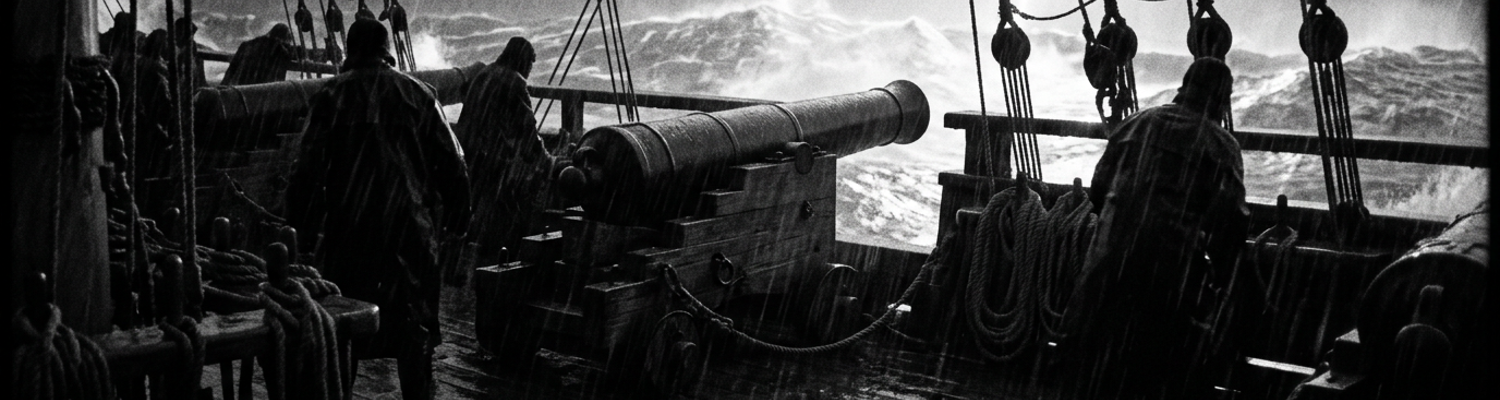

Cape Fear Gales and Blockade Fleet Deployment
A green sea broke over the bow of the USS Minnesota. The impact smashed the forward signal locker into splintered pine. Kerosene lanterns drowned before the night watch could hoist a single coordinate. Salt spray mixed with freezing rain. This mixture stripped the tallow grease from deck winches and blinded the forward lookouts within seconds. Signal officer Samuel Dana attempted to relay a night-order sequence to the inner cordon off Federal Point. Forty-knot wind gusts tore the wool bunting directly out of the signalman's hands. The visual communication system connecting the outer patrol ring to the inner gunboats collapsed immediately. Archival evidence shows that torrential northeasters across the first ten days of November 1863 paralyzed maritime surveillance throughout the entire North Atlantic Blockading Squadron. Rear Admiral Samuel Phillips Lee commanded this force. Stationed aboard the flagship Minnesota, Lee faced an operational sector stretching across hundreds of square miles of turbulent Atlantic water. Wooden screw steamers and converted iron-hulled ferryboats struggled to maintain basic station. Boilers consumed double their standard bituminous coal ration just to keep the vessels pointed into the wind. This generated thick black exhaust. The smoke mixed with driving coastal rain to reduce daylight visibility to less than three hundred yards.
Steam sloops like the USS Iroquois and USS Mount Vernon experienced continuous mechanical breakdowns.
Heavy sand and brine clogged condenser tubes. Violent wave action twisted rudder posts and filled bilge spaces with contaminated water. Lookouts stationed in the rigging had to be ordered down to the spar deck. Gale-force gusts threatened to snap topmasts cleanly off their stays. Lee ordered his outer perimeter ships to drift miles off their designated patrol stations. They were completely unable to establish solar sights or deploy armed launch pickets into the storm.
The storm blinded the entire Union fleet.
A close review of operational logs indicates that violent surf breaking along the North Carolina outer shoals severely restricted line-of-sight reconnaissance outside New Inlet and Masonboro Sound. Eight-to-ten-foot breakers formed a churning barrier between the treacherous shallows of Frying Pan Shoals to the south and the shifting sandbars of Masonboro to the north. This prevented Union double-enders from closing within two miles of the barrier islands. Shallow-draft Confederate blockade runners exploited the blind spots inside these protected coastal waterways. They slipped along the mainland shore beneath the heavy artillery batteries of Fort Fisher and the Carolina Beach earthworks. The Union gunboats could not spot the low-profile steam pipes or twin raked funnels of inbound runners through the dense wall of spray and sea smoke. Sounding leads cast by crewmen aboard the USS Niphon failed to find consistent bottom. Hydraulic action rearranged the outer sandbars by the hour. Skippers feared losing their vessels on uncharted sand spits. They refused to push through the outer breakers to verify ship movement across the inlet bars.
Pinned in deep water, the federal gunboats rolled through thirty-degree arcs.
Breakdown of Visual Signal Networks
Signal halyards snapped across the squadron before midnight.
Archival evidence shows that by November 5, 1863, torrential rain and ground-hugging fog banks erased all direct visual pathways separating the offshore perimeter from the inner patrol cordon off New Inlet. Signal quartermasters aboard inshore picket gunboats like the USS Aries and USS State of Georgia repeatedly hoisted the standard two-flag and three-flag combinations from the naval signal book. The red, yellow, and blue wool bunting soaked through immediately. The fabric twisted against the rigging and draped flat against the wooden spars. At distances exceeding four hundred yards, the driving sheets of water reduced the colored wool patterns to gray smudges against the Atlantic surf. Nightfall brought no relief to the deck crews. Watch officers ignited kerosene-fueled Coston flares and raised directional Fresnel lanterns up the mainmasts to indicate unidentified steam plumes cutting through the breakers. Thick moisture particles dispersed the colored beams into scattered ambient glare. Heavy onshore gales drove salt spray directly into the glass lenses of the signal lamps. This cracked the heated covers and extinguished the oil wicks within seconds of exposure.
Picket launches stationed within half a mile of the barrier sand dunes attempted to warn the outer cruisers of inward-bound Confederate runners. They waved shielded lanterns. Dense sea fog stopped the light transmission before the illumination could reach the outer patrol ring.
Visual contact between the patrol tiers ceased entirely.
A close review of operational logs indicates that the sudden termination of ship-to-ship coordination left individual gunboat commanders without fire direction. They lacked target designation and fall-of-shot telemetry. Under standard squadron tactical doctrine, the outer flagship or senior division officer observed muzzle flashes. They plotted shore bearings against coastal charts and signaled quadrant elevations and deflection corrections back to the shallow-draft gunboats anchored closer to the surf. All visual pathways were blocked by the November storm fronts. Skippers aboard vessels such as the USS Penobscot and USS Chocura had to guess the coordinates of Confederate supply runners passing under the Confederate works at Zeek's Island. Gun crews operating forward XI-inch Dahlgren smoothbores and 100-pounder Parrott rifles had no forward spotters. They could not relay whether their cast-iron rounds were exploding high in the salt marshes, burying into offshore sandspits, or dropping into the ocean behind the blockade runners. Elevating screws were adjusted by lantern light inside dripping gun casemates. Crews based these adjustments solely on compass headings recorded before sunset and acoustic estimates derived from distant steam exhaust thumps.
The total lack of fire correction data meant that rapid firing risked striking the hulls of sister gunboats.
Every warship fired blind into the dark.
When examining the historical record, deck officers on the inshore line faced mounting hazards. Confederate artillerymen at Fort Fisher and Mound Battery began returning blind counter-battery fire using sound triangulation alone. Deck logs from the USS Niphon under Acting Master Joseph B. Breck recorded that gunners could not confirm if an inbound target had run aground, passed through the inlet, or reversed course back into open water. Lacking any central signaling link to confirm the disposition of the blockade cordon, commanders could not coordinate overlapping fields of fire across the Federal Point channel. Each vessel discharged its heavy ordnance independently at maximum powder charges. They attempted to deny the shipping channel through uncoordinated saturation fire across pre-plotted bearing lines. Without spotters to report splashes or burst heights, gun captains routinely miscalculated the burning rate of powder fuses exposed to saturated atmospheric conditions. Five-second paper fuses failed entirely or produced premature bursts fifty yards off their own bowsprits.
At four in the morning, the Niphon checked fire. An unobserved shell exploded three hundred yards off the port beam of the nearby Aries.
Indirect Fire Tactics at Masonboro Sound
Archival evidence shows that between November 4 and 10, the paddle-wheel gunboat USS Keystone State and the screw steamer USS Nansemond engaged targets they could not visually identify off Masonboro Sound. High surf and driving rain had driven the twin-funneled blockade runner Margaret and Jessie aground on the outer bars north of Masonboro Inlet. This left the iron-hulled steamer stranded in the shallows under the canopy of coastal bluffs. Confederate field batteries and dismounted cavalry units quickly converged on the mainland marsh directly behind the wreck. They intended to salvage five hundred bales of outbound cotton and protect the vessel with mobile Whitworth rifles. Pounding breakers kept the Union warships anchored more than two miles offshore in seven fathoms of churning water. Neither Commander Edward Donaldson of the Keystone State nor Lieutenant Roswell Lamson of the Nansemond could spot the runner's low-slung hull. The southern earthworks remained invisible through the sheet of falling water.
Both commanders ordered their batteries to open rapid fire regardless.
The targets sat entirely hidden behind three miles of dense barrier dunes and timber.
A close review of operational logs indicates that gun crews directed their weapons using dead-reckoning compass bearings and pre-war navigational charts produced by the United States Coast Survey. Navigation officers unrolled water-damaged hydrographic maps across the mess tables. They calculated vessel positions from lead-line depth soundings and dead reckoning run from their last known positions off Federal Point (NARA Record Group 45). Plotting sheets established fixed firing bearings across the southern spine of Masonboro Island. These pointed directly into the pine forests where Confederate salvage parties were operating. Aboard the Keystone State, gunners swung their heavy 100-pounder Parrott rifles and broadside Dahlgren smoothbores to bearings of northwest-by-north. They manually aligned the carriages to azimuths scribed into the wet pine deck with chalk. Gunners aboard the smaller Nansemond aimed their lighter 20-pounder rifled cannon along matching compass headings. They coordinated firing intervals across the open water through steam whistle blasts rather than visual flags.
Every cast-iron projectile had to climb on a steep trajectory.
The rounds needed to clear coastal maritime pine stands reaching thirty to forty feet above sea level. Elevation wedges and ratchets were pushed to their physical limits to achieve angles of sixteen to twenty degrees. This lofted 100-pound conical projectiles into ballistic arcs that peaked hundreds of feet above the maritime timber.
Recoil repeatedly drove the iron axles backward until carriage cheeks smashed against the deck coamings.
When examining the historical record, this continuous blind firing in heavy weather destroyed the internal components of the pivot guns. Thick salt crust mixed with unburnt black powder residue to seize the brass elevating screws. This stripped the hand-turned threads as gun captains struggled to raise the heavy breeches against the downward roll of the ships. Brine washing across the open decks seeped into the vent tubes. This rotted copper primers and caused misfires in one out of every four lanyard pulls. Gunners cleaned corroded touchholes with steel pricking pins after every round. Fouling inside the vents triggered hangfires that scorched the faces of the powder monkeys standing near the carriage breeches. Paper fuses cut for eight and ten seconds soaked up atmospheric humidity before gunners could ram them home into the Dahlgren shells. The projectiles burst prematurely over the open ocean or buried into the salt marshes as duds. Shell fragments sheared the tops off coastal pine stands along the mainland edge. This provided the federal lookouts no splash indicators or visible smoke signatures to correct their aim.
Heavy gales drove the smoke straight back down the open hatchways.
By November 10, the Keystone State had expended more than three hundred rounds of heavy ammunition into the unseen sound without observing a single direct hit.
Extreme Elevation Stress on Heavy Parrott Rifles
Iron carriages groaned under mechanical loads they were never cast to bear.
Archival evidence shows that artillerists aboard Union gunboats patrolling off New Inlet deliberately pushed their 100-pounder Parrott rifles far beyond ordnance manual thresholds during the gale of November 8. Robert Parker Parrott had designed the 9,700-pound naval rifle with a wrought-iron jacket shrunk over a cast-iron core. He rated the weapon for standard elevations between fifteen and twenty degrees. Gun captains aboard vessels such as the USS Pequot found this arc inadequate. They needed to loft 6.4-inch explosive shells over the barrier dunes into the Cape Fear River channel where Confederate runners sheltered. The threaded iron elevating screws were turned down to their absolute limits. Crews then jammed heavy oak quoin wedges directly underneath the cascabel and breech. Wedging split-log billets into the carriage chassis forced the gun tube upward to angles exceeding twenty-six degrees.
Ordnance instructions warned that this extreme incline altered the weapon's recoil geometry.
It converted what should have been a linear slide into a violent downward thrust against the deck timbers. Each discharge drove the pivot carriages into the wet pine planks with enough kinetic force to shear iron mounting bolts and buckle the carriage slides.
The guns were shaking their own mountings loose.
A close review of operational logs indicates that the gun decks faced an equally severe hazard in their ignition channels. Repeated discharges of ten-pound black powder service charges left a thick cake of carbonized saltpeter and charcoal soot inside the narrow vent tubes. Freezing ocean spray washing continuously across the open forecastles transformed this hot residue into a dense, gummy paste. Friction primers failed to ignite the main powder charge. Wet slag sealed the vent openings every three or four rounds. Deck crews had to clear these jammed channels while freezing Atlantic rollers broke over the bulwarks. Gun captains climbed directly onto the pitching carriage frames. They drove hardened steel pricking wires and vent drills down through the touchhole by hand to punch through the calcified fouling.
This maintenance carried immediate physical risk.
Smoldering embers buried deep inside the unventilated chamber could detonate residual powder while an artillerist leaned his chest across the vent opening. Heavy deck wash repeatedly threw crewmen across the iron chassis. The water tore tools from their fingers and sent them sliding toward the open scuppers.
A single premature flash could take a man's hands off at the wrist.
When examining the historical record, shipboard surgeons cataloged severe somatic trauma caused by operating over-elevated ordnance in heavy seas. Shockwaves from high-angle concussions ruptured the eardrums of loaders crowded into narrow forecastle corners. Violent recoil from the wedged tubes repeatedly threw carriage guide lips clear of the iron deck tracks. Deck logs from the USS Monticello document that salt water rushing through the gun ports drenched wool powder cartridges inside the passing boxes before powder boys could deliver them to the breech. This forced gun captains to re-drill vents amidst three inches of standing deck water. The strain of maximum powder charges detonating at unnatural angles widened microscopic fissures inside the cast-iron core directly behind the trunnions. Artillerists continued driving oak quoin wedges under the breeches through the morning of November 9. They ignored hairline fractures expanding beneath the wrought-iron reinforce.
Ordnance Degradation and Vent Tube Fouling
Saltwater intrusion destroyed the chemical stability of the fleet's ammunition supply.
Archival evidence shows that continuous exposure to the November gales severely degraded the friction primers and black powder cartridges required to fire the heavy naval rifles. Standard naval ordnance procedures required powder monkeys to transport ten-pound wool cartridges from the lower magazines to the spar deck inside sealed copper passing boxes. The sheer volume of water boarding the Union gunboats defeated these precautions. Solid green seas washed over the forward pivot guns of the USS Mount Vernon every five minutes. This constant deluge forced water past the rubber gaskets of the passing boxes. The wool fabric absorbed the brine. The coarse-grain black powder dissolved into a useless black sludge before it could be rammed down the muzzle.
Gun captains ordered double charges to compensate for the damp powder.
A close review of operational logs indicates that this chemical degradation extended to the ignition systems. The standard issue friction primer consisted of a serrated wire pulled through a copper tube filled with fulminate of mercury. The driving rain and sea spray penetrated the paper wrapping at the top of these tubes. The moisture neutralized the fulminate. When a gun captain pulled the firing lanyard, the serrated wire would slide out of the tube without generating a spark. This failure rate reached fifty percent aboard the USS Iroquois during the height of the storm on November 6.
Misfires required immediate and dangerous intervention.
Standard drill dictated a mandatory wait time of three minutes following a misfire to ensure the charge was not experiencing a hangfire. The tactical urgency of denying the coastal channels forced gun captains to ignore this safety protocol. They immediately stepped up to the breech and poured loose priming powder directly into the vent. If the vent was clogged with wet fouling, they used a steel vent punch to clear the channel. This action exposed the crew to the risk of a delayed detonation. The loose powder could ignite smoldering residue left from the previous shot.
The resulting flash would travel straight up the vent tube into the face of the gun captain.
When examining the historical record, the mechanical erosion of the firing mechanisms compounded these chemical failures. The brass elevating screws on the IX-inch Dahlgrens seized completely as salt crystals formed within the threads. Gun crews resorted to using handspikes and iron crowbars to lever the heavy breeches up and down. This crude method eliminated any precise control over the weapon's elevation. The guns were locked into fixed firing angles. The crews could only adjust range by altering the size of the powder charge. This practice placed extreme and unpredictable stress on the cast-iron barrels.
Somatic Trauma and Deck Explosions
Metal fatigued before the storm relented.
Archival evidence shows that artillerists off Federal Point pushed their rifled pivot cannon past safe metallurgical limits as November 11 brought another dense wall of coastal rain. Seeking extra range to strike Confederate battery positions masked behind the high dunes of Zeek's Island, gun divisions aboard the screw steamer USS Pequot and sister gunboats raised powder charges. They increased the load from standard ten-pound service cartridges to twelve and fourteen pounds of coarse grain powder. The cast-iron core of the 100-pounder Parrott rifle lacked the structural elasticity to absorb this sudden surge in chamber pressure. This was especially true when the gun tube stood wedged at an elevation of twenty-six degrees. Microscopic structural fissures beneath the wrought-iron reinforce band connected into jagged tears along the chamber wall during rapid cycling.
The breech casing disintegrated on the fourth consecutive discharge.
Over six hundred pounds of hot cast-iron fragments sheared out radially across the confined forecastle. The metal cut through oak bulwarks and iron stanchions before hitting the nine-man gun crew. Spongebuckets and rammers broke apart under the shrapnel spray. Jagged iron chunks traveling at rifle velocity instantly decapitated the second loader and eviscerated three crewmen standing beside the port track.
Cast iron burst under twenty thousand pounds of pressure per square inch.
A close review of operational logs indicates that assistant surgeons working in lower-deck sick bays faced an immediate flood of catastrophic blast and impact injuries. Medical daybooks kept aboard vessels stationed along the Cape Fear perimeter cataloged pervasive blast concussions among artillerists. Acoustic shockwaves ruptured tympanic membranes and drove crewmen to collapse from pulmonary contusions without external shrapnel wounds. Premature chamber detonations and uncontained vent flashfires threw expanding sheets of flame across the wet pine planking. This scorched facial tissue and seared deep dermal burns into the chests of powder boys who carried wool-wrapped service charges in their bare arms. Snapping recoil tackle produced equally severe somatic trauma across the slippery deck batteries. When the 9,700-pound rifled guns recoiled at extreme incline, the violent rearward jerk repeatedly overwhelmed three-inch manila breech ropes and wrought-iron snatch blocks.
The severed hemp lines whipped laterally across the gun deck under thousands of foot-pounds of stored tension.
These lines splintered through lower extremities and drove bone fragments straight out through trousers. Surgeons recorded twelve separate compound fractures of the tibia and femur within a forty-eight-hour operational window (NARA Record Group 52). These injuries required emergency amputations performed by candlelight in rocking cockpits contaminated with bilge vapor and salt spray.
Amputation bone saws dulled before dawn.
When examining the historical record, medical officers routinely noted that these surgical casualties occurred without the ships taking a single enemy round from Confederate batteries ashore. The damage stemmed directly from naval command directives that prioritized saturation bombardment over ordnance tolerances. In the sick bay of the USS Monticello, Assistant Surgeon William Longshaw recorded that men dragged down the forward companionway presented combinations of traumatic amputations, third-degree facial scorching from deflagrating black powder, and chest wall collapse from flying carriage timber. Salt water leaking down the forward hatchways washed across the operating table while surgeons clamped femoral arteries with curved tenacula. By noon on November 12, the gunboat's forward battery sat disabled. Both the carriage chassis and its original operating crew were broken beyond repair.
Fratricide Risks and Ballistic Dispersal
Archival evidence shows that during the northeast gales of November 10, cross-compartment wind sheer and uncalculated lateral drift expanded standard naval artillery dispersion ellipses beyond two hundred yards. High-angle trajectories fired from outer patrol cordons sent 100-pounder Parrott bolts and spherical Dahlgren shells climbing through storm squalls. Forty-five-knot coastal winds acted continuously against the projectiles. The 6.4-inch rifled rounds loitered in the air across flight times exceeding eighteen seconds. Aerodynamic cross-currents threw the conical shells far to the leeward of their intended compass azimuths. Gyroscopic drift combined with severe atmospheric density variations to alter terminal points of impact by hundreds of yards. Gun divisions aboard offshore blockaders had zero forward observation posts to register splashes or correct deflection settings.
Every heavy projectile plunged into the churning coastal mist on an uncontrolled ballistic track.
Heavy naval shells fell directly across the patrol track of Union picket launches rowing blind in the surf.
A close review of operational logs indicates that armed cutters deployed from the USS Niphon and USS Aries operated within four hundred yards of the breakers off Federal Point to intercept inbound runners. Six-oared wooden launches rowed without signal lanterns to prevent visual detection by Confederate lookouts stationed atop the Fort Fisher mounds. Freezing Atlantic breakers repeatedly filled the launch cockpits. Junior officers had to steer by the acoustic roar of the beach surf alone. Instead of clearing the coastal sand spits to hit interior channels, heavy ordnance launched from their own squadron screamed out of the low cloud cover and crashed into the outer breaker line. Solid shot and exploding percussion shells detonated fifty to seventy-five yards off the gunwales of these open boats. Concussive water columns swamped the cutters. The blasts shattered spruce oars and sprayed razor-sharp iron fragments across exposed oarsmen. These men could neither locate the offshore gunboats nor signal their own identity without drawing Confederate battery fire.
Outer gunboat commanders accepted this tactical friction without checking their fire.
When examining the historical record, squadron leaders weighed the immediate physical danger to their launch crews against the loss of stranded blockade runner cargo. Confederate salvage parties regularly swarmed iron-hulled steamers driven onto the sandbars between New Inlet and Masonboro. Detachments of the 36th North Carolina Artillery reinforced these groups to strip munitions before Union boarding teams could secure the wrecks. Crews from Fort Fisher and local coastal militia dragged wagons directly into the intertidal wash to unload Enfield rifles, gunpowder kegs, and uniform wool. Skippers stationed on the outer Union perimeter knew federal longboats were simultaneously rowing into the shoals with turpentine pots to board and burn the same grounded hulks. Halting naval gunfire to ensure the safety of these small boats meant handing high-value munitions directly to Confederate supply wagons.
Union captains chose blind, sustained area bombardment.
They aimed their XI-inch Dahlgrens and heavy pivot rifles into the suspected coordinates of the hulls regardless of who occupied the surf line. Deck logs from the USS Daylight show that forward pivot crews sustained an unobserved firing rate of one round every ten minutes throughout the gale of November 11. Hundred-pound shells churned the shallow bars within thirty paces of federal seamen wading through freezing waist-deep water toward the stranded runner Margaret and Jessie. Concussive shockwaves from nearby shell bursts drove boat crews flat into the salt wash. The blasts blew sand and cast-iron shards across their exposed backs. Confederate salvage parties abandoned the stranded hull after three rounds obliterated the runner's stern deckhouse. This left thirty crates of British small arms submerged in the flooded hold. The unobserved federal barrage also shattered the rudder of an advancing Union gig and drove four federal oarsmen into the offshore breakers with severe blast concussions.
Strategic Assessment of the Cape Fear Bombardment
The calculated gunnery gamble broke the Confederate supply funnel at the shoreline.
Archival evidence shows that unobserved naval shelling between November 4 and 12 successfully prevented Confederate salvage corps from securing critical war materiel stranded in the coastal shoals. Grounded merchant steamers like the Margaret and Jessie off Masonboro and the iron-hulled Cornubia near New Inlet carried hundreds of tons of high-value cargo purchased in England. This included Enfield pattern rifles, percussion caps, shoe leather, and uniform wool bound for the Army of Northern Virginia. Confederate District Commander Major General W.H.C. Whiting had assigned coastal cavalry details, local North Carolina militia, and heavy working detachments from the 36th North Carolina Artillery to strip these vessels under the cover of torrential gales. Whiting ordered teamsters to run heavy draft wagons directly into the surf. They worked with lighters to offload dry goods before the pounding Atlantic breakers broke open the holds.
Sustained high-angle saturation bombardment from federal gunboats like the USS Nansemond and USS Daylight shattered these recovery efforts.
Plunging 100-pounder shells and XI-inch explosive spheres ripped into the shallow sandbanks around the wrecks on ten-minute intervals. The barrage threw tons of wet sand into the open cargo hatches and blew wagon teams off the beach. Confederate recovery crews abandoned the outer holds under the shrapnel spray. They left two-thirds of the military cargo to drown in seawater or burn down to the waterline when federal boarding cutters finally penetrated the surf with incendiary turpentine.
Crates of foreign munitions dissolved in the salt wash.
A close review of operational logs indicates that the physical destruction of heavy artillery across the North Atlantic Blockading Squadron triggered immediate organizational upheaval inside the federal naval command. Discharging cast-iron rifled cannon at continuous maximum charges and twenty-six-degree angles split gun chassis, stripped elevating gears, and repeatedly ruptured Parrott breeches at the trunnion line. Gun crews had been forced to load hundreds of rounds into fouled muzzle tubes while standing in two feet of green water breaking over forecastle rails. Touchholes clogged with carbonized residue and sodden black powder regularly produced catastrophic hangfires or failed discharges. Moisture infiltrated standard paper-wrapped friction primers and rusted copper ignition cups inside the vent channels. The severe material toll on ordnance accelerated naval demands for improved breech design and waterproof percussion systems across the fleet. Rear Admiral Samuel Phillips Lee sent urgent dispatches to Chief of the Bureau of Ordnance Henry A. Wise. He demanded weapons that could be loaded, primed, and swabbed from an enclosed gun casemate without exposing artillerists to seawater and premature deck bursts.
The muzzle-loading system had failed in the gale.
When examining the historical record, this operational crisis pushed the Navy Department to bypass traditional foundry procurement in favor of experimental European breech mechanisms and hermetically sealed ignition trains. Naval ordnance engineers documented that muzzle-loading rifles were mechanically incapable of surviving sustained high-angle bombardment in coastal gales. Salt brine continually corrupted the open powder chambers. Bureau inspectors accelerated field tests on broadwell rings, sliding wedge mechanisms, and interrupted-screw breechblocks. These systems could lock explosive charges into the rear of the tube behind gas-tight steel gaskets. Ordnance workshops at the Washington Navy Yard simultaneously redesigned shipboard friction tubes. They abandoned standard paper sleeves for heavy-gauge tinned copper jackets and guttapercha waterproof seals capable of surviving complete immersion in sea wash. Fabricators replaced raw manila elevating tackle with cast-steel ratchet arcs and worm gears. These resisted the abrasive paste of beach sand and unburnt powder fouling.
Bureau engineers shipped the first waterproof copper friction primers to the squadron before December 1863 came to an end.