
Cold War Naval Strategy in the North Sea
Operational logs from Allied Forces Northern Europe (AFNORTH) reveal the strategic weight placed upon the North Sea during the Cold War. It was the volatile frontier between two world powers, a naval chokepoint where the outcome of a potential third world war could be decided. Geography dictated strategy. Soviet naval doctrine for a hot war scenario hinged on a single action: breaking the Soviet Northern Fleet out from its bases on the Kola Peninsula. This force would surge through the Greenland-Iceland-United Kingdom (GIUK) Gap and flood the North Atlantic.
The breakout had one objective: to sever the transatlantic sea lanes of communication. These SLOCs were NATO’s lifeline, the conduit for reinforcements of troops, equipment, and supplies from North America to the European mainland. Soviet planners calculated that if their submarine and surface fleets could disrupt this logistical flow, the numerically superior conventional forces of the Warsaw Pact could overwhelm NATO defenses in Europe. NATO’s entire maritime strategy was a mirror image of this threat, focused on containment. The alliance’s naval posture was designed to turn the GIUK Gap into an impenetrable barrier, bottling up the Soviet fleet in the Norwegian Sea.
This doctrine demanded perpetual, high-stakes readiness. The Cold War at sea was a daily contest fought in the maintenance bays of Faslane, Norfolk, and Polyarny. NATO’s anti-submarine warfare (ASW) capability was a complex, layered system. It began with the Sound Surveillance System (SOSUS), a secret chain of hydrophone arrays laid across the seabed of the GIUK Gap, listening for the acoustic signatures of Soviet submarines. These fixed arrays were supplemented by mobile assets. Squadrons of P-3 Orion and Nimrod maritime patrol aircraft flew from bases in Iceland, Scotland, and Norway. Fleets of hunter-killer submarines from American, British, and other NATO navies patrolled the depths. Readiness states were kept at exceptionally high levels, with many vessels and their crews on 24-hour notice to sail. Exercises like NATO’s Teamwork and Ocean Safari were full-scale dress rehearsals for war, involving dozens of ships and aircraft operating in close proximity to probing Soviet forces. These interactions often became tense standoffs. Soviet Tu-95 Bear maritime reconnaissance aircraft were intercepted by NATO fighters, and surface warships shadowed each other at uncomfortably close ranges.
Into this operational environment, Project Cerberus was introduced. The core problem for AFNORTH was informational. The various layers of the anti-submarine screen generated a torrent of disparate data: acoustic detections from SOSUS, radar contacts from patrol aircraft, and sonar readings from individual naval units. Before Cerberus, this information was funneled to different command centers, manually collated, and then relayed up the chain of command. The process was slow and prone to error. Commanders often made decisions based on an incomplete or outdated picture of the battlespace. Project Cerberus was a network-centric command and control system, intended to fuse all of this data in real-time. It connected the Naval Facility (NAVFAC) shore stations that processed SOSUS data, airborne warning and control system (AWACS) aircraft, and individual naval task groups via secure data links. The goal was to create a single, unified operational picture at the North Sea naval command headquarters. It was an ambitious attempt to lift the fog of war through computational power, relying on a new generation of processing hardware and complex software algorithms to correlate contacts and predict enemy movements.
Industrial Foundations of Atomic Naval Ordnance
The technological superiority of NATO naval power was not forged in the North Atlantic, but decades earlier on the factory floors of the American industrial heartland. Declassified economic data reveals the foundational role of the federal government’s Certificates of Necessity program, initiated during the military buildup of the early 1940s. This program was a supply-side intervention designed to rapidly expand industrial capacity by offering massive tax amortization benefits to private companies willing to build defense-related plants. For the Navy, this meant the construction of an entirely new ecosystem of ordnance production. Government-owned, contractor-operated facilities sprang up, fabricating everything from heavy steel casings of 16-inch naval shells to the clockwork of mechanical time fuses. The program underwrote the creation of new forging presses, chemical plants for smokeless powder, and precision machine tool shops. By 1945, the government effectively owned the majority of national production capacity for guns, ammunition, and explosives.
Within this industrial network, certain corporate partners became indispensable. The Western Cartridge Company, a subsidiary of the Olin Corporation, was a primary driver of ammunition production. While focused on small arms, its expertise in propellant chemistry and mass production of brass casings was foundational. Their development of improved smokeless powders allowed for higher muzzle velocities and more consistent performance in naval artillery. On the mechanical side, Western Gear Works proved essential. A review of their production contracts (NARA Record Group 156) shows a company that specialized in high-torque gear sets for rotating gun turrets and radar arrays, powerful winches for handling ordnance, and the intricate machinery for submarine dive planes and rudder controls. The ability of a Fletcher-class destroyer to rapidly train its 5-inch guns or a Gato-class submarine to execute a crash dive was directly tied to the quality of the gears coming out of these plants.
This industrial capacity was repurposed for the atomic age. The Cold War naval arms race demanded components of a previously unimagined complexity. The shift from TNT-filled shells to nuclear-tipped missiles and torpedoes required a complete transformation in manufacturing philosophy. The same industrial base that once mass-produced conventional artillery fuses now had to craft the astonishingly precise and reliable components for nuclear weapon triggers. Archival evidence from the Manhattan Project shows that companies like DuPont, known for their work in chemical manufacturing, were enlisted because of their experience in handling complex, hazardous processes on an industrial scale. This expertise was directly transferable to the production of fissile materials and the fabrication of high-explosive lenses for implosion-type weapons. The challenge was no longer just mass, but perfection. A single faulty bearing in a submarine’s reactor coolant pump or an impure weld in a ballistic missile casing could lead to catastrophic failure. The very factories that had churned out deck guns were retooled to produce the high-pressure steel vessels for naval reactors and the radiation-hardened electronics for a fleet prepared to fight in a nuclear environment.
Sturgeon-Class Submarines and Special Operations
The Sturgeon-class submarine formed the operational backbone of the U.S. Navy’s hunter-killer force for much of the Cold War. These were not the largest or fastest submarines, a direct consequence of their design pairing the proven S5W nuclear reactor with a larger, improved hull form. This trade-off exchanged raw speed for a significant advantage in stealth. Their primary mission in the North Atlantic was anti-submarine warfare, specifically hunting for Soviet ballistic missile and attack submarines moving through the GIUK gap. Their effectiveness hinged on the advanced BQQ-5 sonar suite, a digital system that integrated a spherical bow-mounted sonar with hull-mounted hydrophones and a towed array. This combination allowed a Sturgeon to remain acoustically passive, listening with its towed array for the faint mechanical signatures of a distant Soviet boat.
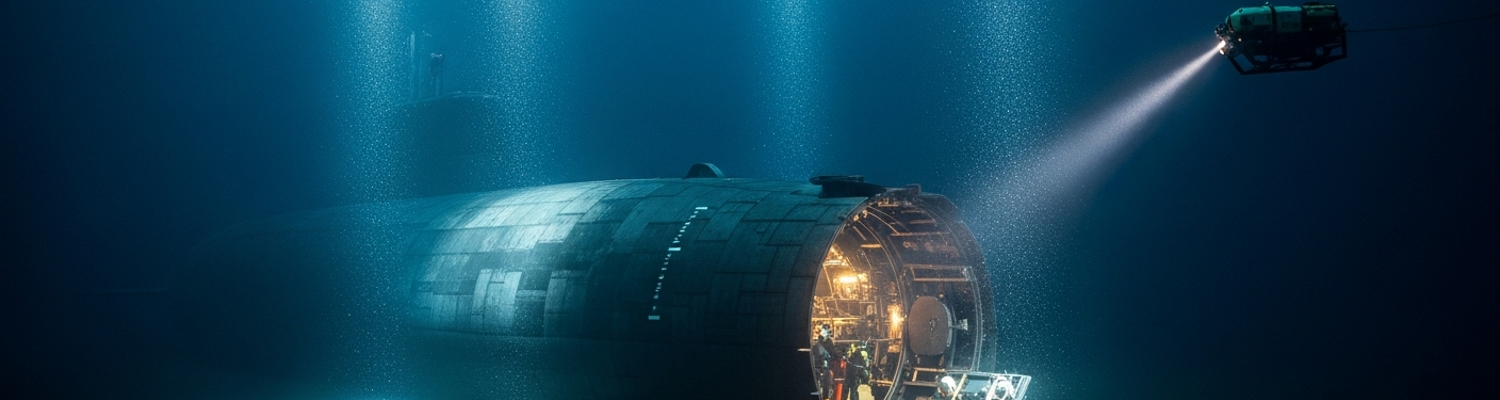
This primary mission profile concealed a more specialized and clandestine capability. A review of modification records reveals that at least seven Sturgeon-class boats were heavily modified to support covert special warfare operations. The centerpiece was the Dry Deck Shelter (DDS), a large, transportable hangar attached to the submarine’s midships weapons shipping hatch. This was a complex piece of machinery capable of being flooded and pressurized to match the outside sea pressure, allowing Navy SEALs to exit the host submarine while fully submerged. Inside the DDS, a Mark VIII SEAL Delivery Vehicle (SDV) waited. The Mk VIII was a free-flooding wet submersible. Its operators were exposed to the frigid water for the duration of their transit, relying on their own breathing apparatus supplemented by the vehicle’s onboard air supply. The SDV, powered by lithium-ion batteries, could carry a pilot, co-pilot, and a combat swimmer team with their equipment from the launch point to a hostile objective. This gave commanders a tool to insert reconnaissance teams near heavily defended Soviet naval installations on the Kola Peninsula without the submarine ever having to approach the coast.
Beyond inserting commandos, certain Sturgeon-class submarines were transformed into dedicated platforms for sensitive intelligence-gathering and EOD-support missions. The heavily modified USS Parche (SSN-683) stands as the primary example. While publicly designated as a research and development submarine, its true purpose was different. Operational histories show that Parche and similarly configured boats were tasked with locating and recovering Soviet missile fragments from the seabed after test launches, providing invaluable technical intelligence. These missions extended to direct support of EOD objectives, such as the analysis of advanced Soviet sea mines. The most secret of these operations involved tapping directly into Soviet underwater communications cables. Drawing on the experience of Operation Ivy Bells, which first proved the concept in the Sea of Okhotsk, specially modified Sturgeons were fitted with equipment allowing them to settle on the seabed, locate a specific cable, and install a large listening device over it. This work required the submarine to remain stationary on the ocean floor for extended periods in heavily patrolled Soviet waters, a high-risk state that made it vulnerable to detection.
The WE.177 Incident and Exclusion Zone
The crisis began not with an explosion, but with a series of anomalous data points flagged by a Royal Air Force Nimrod MR2 maritime patrol aircraft, callsign Whiskey-Jack 9. The aircraft, flying a routine ASW patrol pattern over the Norwegian Trench, registered faint but persistent gamma radiation spikes on its ARI 18240/1 radiation detector. The readings were inconsistent with natural background radiation. Command staff at RAF Kinloss were alerted. Per Cold War standing orders for a potential Broken Arrow or Empty Quiver event, the data was immediately cross-referenced through the Project Cerberus network. The system correlated Whiskey-Jack 9’s sensor data with hydro-acoustic information from a nearby SOSUS array, which had detected a short, sharp metallic impact on the seabed minutes before the radiation was detected. A radiological hazard zone was immediately declared, a 50-nautical-mile circle centered on the coordinates of the incident.
Within hours, the source of the radiological leak was identified. The specific isotopic signature of the radiation, a mix of plutonium and americium particles suspended in the water column, pointed to the fissile core of a British WE.177 nuclear depth charge. An audit of naval ordnance logs produced a confirmation. The HMS Broadsword, a Type 22 frigate that had been prosecuting a suspected Soviet Victor-class submarine contact, reported the unexplained loss of a single WE.177A from its port-side STWS-1 torpedo launcher. The report from Broadsword’s captain cited a possible catastrophic mechanical failure in the launch tube’s retention clamps during a high-G evasive maneuver. Sabotage was not ruled out. The weapon, armed with a 10-kiloton warhead, now lay on the seafloor over 300 meters below the surface, its casing compromised and leaking highly toxic radioactive material into the North Sea. The immediate danger was not a nuclear detonation, as multiple safety interlocks would prevent it, but the long-term environmental disaster and the acute political fallout. There was also the risk that Soviet Spetsnaz naval units could attempt to recover the weapon.
The recovery mission, codenamed Operation Siren's Hush, fell to the most specialized assets in the NATO order of battle. Mission parameters reveal the extreme complexity of the task. The U.S. Navy’s specially modified Sturgeon-class submarine, the USS Parche (SSN-683), was diverted from an intelligence-gathering mission off the Kola Peninsula and ordered to the radioactive exclusion zone at flank speed. The Parche was one of the few platforms capable of supporting the deep-sea EOD operation required. Its onboard Dry Deck Shelter housed the deep-submergence ROV Scarab II and a team from the US Navy’s Explosive Ordnance Disposal Mobile Unit Two. The mission profile was direct. The Parche would bottom-out on the seabed up-current from the weapon’s estimated location to minimize radiological exposure. From there, the Scarab II ROV would be deployed to locate the weapon and provide a live video feed of its condition to the command element aboard the submarine and, via a tenuous satellite uplink, back to the North Sea naval command headquarters.
Based on the ROV’s assessment, the EOD divers would have to perform one of the most dangerous tasks imaginable. The plan called for a two-man team to exit the Parche’s DDS and navigate to the weapon. Their suits offered only limited protection from the gamma radiation. The divers’ primary task was to manually attach a specialized lifting cradle, the Octopus Harness, to the body of the depth charge. This required them to physically handle the weapon. If the ROV’s inspection revealed the arming mechanism was damaged or unstable, the divers were authorized to attempt a remote render-safe procedure using a custom-built, hydraulically powered cutting tool to sever the weapon’s internal battery connections. Every action was relayed back to the isolated commanders, who watched the divers’ helmet-camera feeds with a significant time delay. They were forced to issue commands into a void, knowing their words would arrive too late to avert disaster on the seafloor.
SEAL Delivery Vehicle Submerged Deployment
Operational doctrine from the late Cold War period reveals that the deployment of a SEAL Delivery Vehicle team was a rigidly choreographed procedure. The process began hours before launch, with the host submarine maneuvering to a pre-determined, deep, and acoustically quiet patch of ocean. Inside the Dry Deck Shelter, the SEAL team and DDS crew performed exhaustive pre-flight checks on the Mark VIII SDV. This was a free-flooding wet submersible. Its operators were completely exposed to the frigid water, breathing from the vehicle’s own compressed air supply or their personal closed-circuit rebreathers. These rebreathers scrubbed carbon dioxide and recycled oxygen to prevent the bubble stream that could give away their position.
Once checks were complete, the team boarded the SDV's cramped, dark interior. The DDS deck captain would then seal the inner hatch connecting the shelter to the submarine’s interior and begin the flooding process. Seawater would fill the entire chamber, equalizing the pressure with the ocean outside. Only then could the massive outer door of the DDS be hydraulically opened to the sea.
Submarine launch and recovery methods were the most hazardous phases of any SDV operation. For the launch, the host submarine had to achieve a state of perfect neutral buoyancy and stability, often hovering just meters above the seabed to use the terrain for acoustic cover. With the DDS outer door open, the SDV pilot would power up the vehicle’s silver-zinc batteries and electric motor, detach from its internal docking cradle, and carefully navigate out into open water. The submarine was at its most vulnerable during this sequence. Once clear, the SDV would depart, and the submarine would withdraw to a secure loitering point, running silent and deep, awaiting the team’s return.
Recovery was an order of magnitude more difficult. The SDV team had to navigate back to a precise rendezvous point in the open ocean, often in zero-visibility conditions and fighting strong currents. Engineering logs show the rendezvous was facilitated by a specialized submarine rendezvous and docking system (RDS) that used a low-probability-of-intercept acoustic homing beacon. The SDV pilot would follow this signal for the final approach, aligning the vehicle with the open outer door of the Dry Deck Shelter. A DDS crewman, tethered inside the flooded chamber, would guide the pilot in using hand signals, directing the vehicle to settle back into its docking cradle. Any miscalculation could cause a collision, a catastrophic failure at depth. Once the SDV was secured, the outer door would be closed, the DDS would be drained, and the team could finally exit the vehicle.
Stealth and navigation were the fundamental pillars of SDV mission success. Because the Mark VIII was all-electric and designed with a fiberglass hull and non-ferrous materials to minimize its acoustic and magnetic signatures, it was exceptionally difficult to detect with passive sonar. This stealth was its primary defense. To achieve this, underwater navigation had to be flawless without resorting to active sonar pings or surfacing for a GPS fix. Technical specifications show that navigation was accomplished through a Doppler Inertial Navigation System (DINS). This system used a Doppler Velocity Log (DVL) to bounce acoustic signals off the seabed, measuring the vehicle’s speed relative to the ocean floor. This velocity data was fed into an inertial navigation system, which continuously calculated the SDV’s position from its last known starting point. The pilot and navigator had to meticulously plan their route, often following the contours of the seabed to use underwater ridges and canyons as cover, a practice known as terrain-masking.
The Headquarters Bubble and Communication Latency
Command logs for Operation Siren's Hush reveal a structural flaw in NATO’s North Sea command posture. The leadership element, comprised of senior British and American naval officers, was geographically and sensorily detached from the crisis. They were not on a command ship in the area, but were located deep within the hardened command bunker of AFNORTH’s naval headquarters, a subterranean facility built to withstand a direct nuclear strike. This bunker, located hundreds of miles away from the incident site, was a concrete and steel cocoon designed for strategic warfare, not for the granular, second-by-second management of a deep-sea recovery. Its very design, intended to protect the chain of command, now served to isolate it. The commanders saw the battlespace not through a bridge window, but as abstracted data points on the glowing phosphor screens of the Project Cerberus system.
The communication link back to this headquarters was the operation’s most significant vulnerability. Archival evidence shows that the data stream from the USS Parche, containing ROV video, diver biometrics, and radiological readings, was a fragile and delayed connection. The primary link was a Super High Frequency (SHF) satellite uplink from the submarine. This signal had to travel from the Parche’s towed communications buoy, up to a satellite in geosynchronous orbit, down to a ground station in the United Kingdom, and then be routed via secure landlines to the command bunker. Each leg of this journey introduced latency. The raw data from the ROV’s camera feed had to be digitally compressed, encrypted, transmitted, received, decrypted, and then re-constituted on the command center screens. The total time lag from an event happening on the seabed to it being seen by the commander was, on average, between 45 and 70 seconds. Any verbal order given in response to a visual cue was already almost a minute out of date by the time it was spoken. That order then had to make the entire journey in reverse, creating a feedback loop of nearly two-and-a-half minutes.
This technical failure was compounded by a rigid command doctrine ill-suited for the dynamic environment. NATO’s command and control structure was built for large-scale, pre-planned conflict, emphasizing centralized command and strict adherence to established procedures. The doctrine of command by negation, allowing a subordinate to act unless explicitly forbidden, was often too slow for a crisis where conditions changed by the second. The operational plan for Siren's Hush was a prime example of this doctrinal inflexibility. It contained a series of predetermined go/no-go decision points that required explicit authorization from the remote command bunker. Logs show the EOD team on the seabed requesting permission to take a specific action, such as adjusting the placement of the Octopus Harness on the damaged WE.177A casing. The commanders, viewing a video feed that was already a minute old, would deliberate and issue a command. By the time the authorization was received by the divers, the local current might have shifted or the weapon might have settled deeper into the silt, making the order irrelevant or even dangerous. The divers were trapped, forced to wait for obsolete commands from officers who were blind to the immediate situation.
Autonomous Decision-Making on the Seafloor
A review of the divers’ biometric data and helmet-camera footage shows the moment command and control disintegrated. The senior EOD technician from Explosive Ordnance Disposal Mobile Unit Two, designated EOD-1, was positioned over the WE.177A’s damaged tail assembly. His partner, EOD-2, was monitoring the ambient radiation field with a handheld probe. A voice transmission from the command bunker, distorted by encryption and the helium-rich breathing mix, crackled in their headsets with a 70-second delay. The distant commander, reacting to an old image of the weapon lying flat, ordered EOD-1 to use the custom hydraulic shears to sever the external arming connections near the nose cone.
The order was impossible.
Post-mission analysis confirmed that in the time it took for the video to reach the bunker and the command to return, a shift in the local current had caused the 600-pound weapon to roll slightly. Its nose and the connection panel were now buried deep into the seabed silt.
Faced with an obsolete order, the EOD team was forced into a state of total autonomy. The mission clock was their new commander. A close examination of their actions reveals a shift from established render-safe procedures to high-risk improvisation. EOD-1 had two choices: attempt to dig the weapon’s nose out of the silt, an action that would consume precious minutes of their limited bottom time and stir up a cloud of highly radioactive sediment, or violate protocol. He chose the latter. Ignoring the useless chatter from headquarters, he signaled to EOD-2 and moved to the weapon’s mid-section. His new objective was an emergency access panel used for diagnostics, a panel that EOD doctrine for a damaged nuclear weapon strictly forbade tampering with. Using the flat edge of a standard multi-tool as a pry bar, he began the slow, deliberate work of forcing the panel open to gain access to the weapon’s internal power bus. This was a procedure for which no approved protocol existed. Every movement was a gamble against the possibility of short-circuiting the delicate firing circuits or disturbing the unstable conventional explosives surrounding the fissile core.
This decision was made in a profoundly hostile environment. The divers were operating at a depth where the water temperature hovered just above freezing, reducing their manual dexterity. The operational risks were compounded by the invisible threat of the leaking warhead. The divers’ chest-mounted dosimeters chirped with increasing frequency, a constant reminder that their allowable stay time in the gamma radiation field was evaporating. Post-mission reports indicate that the radiation levels near the breach in the weapon’s casing were high enough to deliver a lifetime permissible dose in under fifteen minutes. The slow, methodical pace required for EOD work was fundamentally at odds with the urgent need to escape the radiation field. The failure of the command link meant that every second the divers spent waiting for an instruction, or attempting to follow a now-dangerous order, was a second of unnecessary exposure, bringing them closer to a lethal dose of radiation.