
The Unforgiving Physics of Naval Airpower
The archives of military progress are filled with technologies that promised a decisive edge. Few, however, were born from such a violent and unforgiving marriage of brute force and delicate machinery as the aircraft catapult. For the United States Navy in the interwar years, the allure of projecting airpower from the decks of its capital ships was an undeniable strategic imperative. Yet the path from concept to a reliable, combat-effective system was a brutal education in physics, engineering, and the harsh realities of operations at sea. The story of the catapult is not one of seamless innovation. It is a cautionary narrative of hard-won lessons, where each advance was paid for with failed launches, damaged airframes, and the constant risk to human life.
It underscores a permanent truth: mastery of naval aviation rests not just on the aircraft, but on the ten seconds of controlled violence required to get it airborne. Neglecting the fundamental engineering of the launch invites strategic failure.
Powder Charges and Precarious Flight
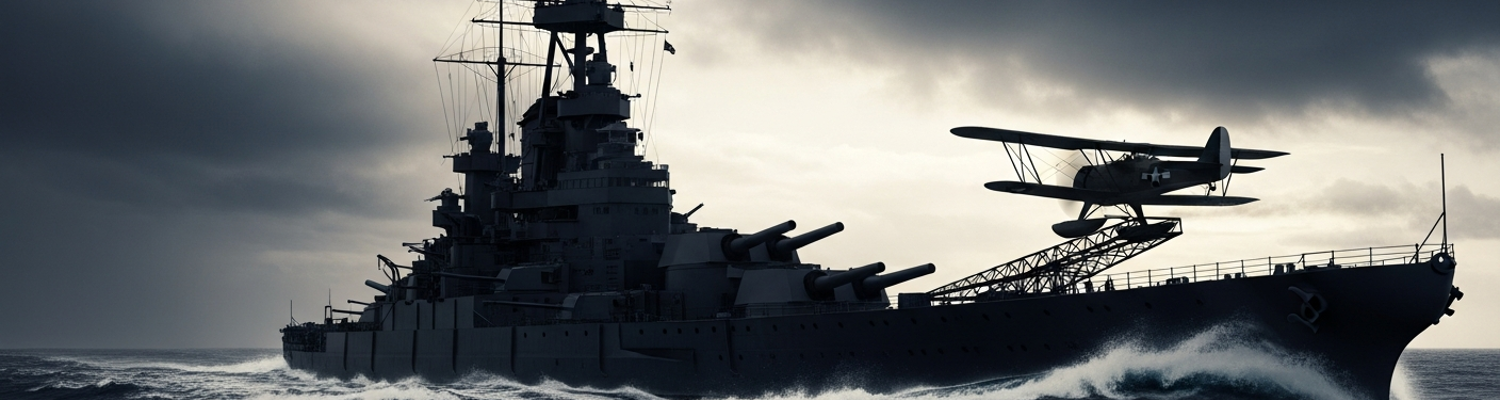
The US Navy of the 1920s was a fleet built around the gun. Battleships like the Tennessee-class and cruisers such as the new Omaha-class were the arbiters of sea power. The horizon, however, remained a persistent tyrant, limiting visual range and tactical awareness. The idea of launching scout aircraft to serve as the fleet’s eyes drove innovation. Early experiments, pioneered by figures like Captain Washington Irving Chambers, involved compressed-air systems, one of which was installed on the Navy’s first carrier, USS Langley (CV-1). These systems were complex and soon eclipsed by what seemed a more potent method for battleship and cruiser application: gunpowder. By the mid-1920s, powder-charge catapults became a standard feature on the fantails and turrets of capital ships. These devices were essentially short cannons. A slow-burning black powder charge, similar to that used for 5-inch naval guns, was ignited in a cylinder. The expanding gas drove a piston connected via cables to the aircraft’s launching cradle, or shuttle. The theory was simple. The execution was fraught with peril. The core engineering challenge was propellant consistency. An improperly packed or damp powder charge could result in a “cold shot,” where the aircraft failed to reach flying speed and simply dropped into the sea off the ship’s stern, a terrifying and often fatal event for the pilot. Conversely, a “hot shot” from an overly potent charge could generate acceleration forces that damaged the fragile wooden and fabric structures of early aircraft like the Vought UO-1 or Curtiss SOC Seagull. Pilots reported feeling a brutal kick that could snap their head back and momentarily disorient them at the most critical phase of flight. Reliability was a constant struggle. These catapults were complex mechanical systems exposed to the corrosive salt environment. Maintenance was a heavy burden for ship crews, requiring constant cleaning and calibration. Then came the problem of recovery. Unlike a carrier, these ships had no flight deck for landing. The floatplane had to land on the open sea, often in a less-than-ideal state, maneuver alongside the moving warship, and be hoisted back aboard by a crane. This was a hazardous operation in calm weather. In rough seas, with the ship rolling and pitching, the pilot had to “fly” the aircraft onto a recovery sled towed alongside the ship, a maneuver demanding immense skill. One misjudgment could see the aircraft smashed against the steel hull. This was an operational vulnerability that would shape naval doctrine for years to come.
A Doctrinal Shift for Fleet Air Power
Despite the technical hurdles, the 1930s saw the catapult-launched aircraft integrated from a mere experiment into a formal component of fleet doctrine. The annual Fleet Problems, large-scale naval exercises in the Atlantic and Pacific, consistently highlighted the need to find the enemy before they found you. The battleship’s guns were formidable, but they were blind without reconnaissance. The floatplanes of the fleet, flung into the air from cruisers and battleships, became the scouting force, extending an admiral’s vision hundreds of miles beyond the horizon. This doctrinal shift was championed by naval aviation advocates like Admiral Joseph M. Reeves, who saw airpower as more than just a support function. The aircraft themselves evolved. The Vought OS2U Kingfisher succeeded the Seagull as a workhorse, but the Navy also experimented with launching more capable planes, including early dive bombers like the Curtiss SBC Helldiver, from capital ships. The idea was to give the fleet a limited, forward-deployed strike and reconnaissance capability, independent of the still-small number of dedicated aircraft carriers. Fleet Problem IX in 1929 had already demonstrated the shocking potential of a carrier-led surprise attack, a simulated raid on the Panama Canal. The lesson that airpower could be a decisive offensive weapon was slowly taking root. The limitations, however, were severe and informed a sense of caution in naval planning. Catapult-launched scout planes were slow and poorly armed, easy targets for enemy fighters. Their operations were entirely dependent on weather and sea state. A surprise squall could prevent launches or make recovery impossible, effectively blinding the fleet. The time required for launch and recovery made them inflexible in a rapidly developing tactical situation. These constraints were acknowledged in naval planning documents, which treated battleship and cruiser-based aviation as a valuable but fragile asset. It was a capability to be used judiciously, a supplement to the main battle line, not a replacement for it.
Hydraulic Power and the Carrier Ascendant
The outbreak of World War II rendered the powder catapult obsolete almost overnight. The new generation of naval aircraft, the Grumman F4F Wildcat, Douglas SBD Dauntless, and Grumman TBF Avenger, were heavier, faster, and more robust. They were also far too heavy for the violent, inconsistent shove of a powder charge. The operational focus shifted decisively to the aircraft carrier, and with it came the demand for a new generation of catapult technology. The answer was the hydraulic catapult. During the war, hydraulic systems became the standard for American carriers. The U.S. Navy’s H-series hydraulic catapults, installed on the new Essex-class carriers, represented a monumental engineering leap. These systems used compressed air to pressurize a fluid, which then drove a piston in a much smoother, more powerful, and, critically, more controllable fashion. An H-4-1 catapult, for instance, could launch a 28,000-pound aircraft to 90 mph. This capability was essential. It allowed carriers to launch heavily loaded strike aircraft with full bomb and fuel loads, something often impossible with a deck-run takeoff alone, especially in low wind conditions. The transition to hydraulic catapults cemented the aircraft carrier as the new capital ship. While battleships retained their catapults for scout planes, this role diminished as the war progressed. The carrier was now the primary platform for projecting air power. Hydraulic catapults on the flight decks of ships like the Lexington-class and the 24 ships of the Essex-class enabled a tempo of operations that was previously unimaginable. They allowed carriers to cycle aircraft faster, launch and recover in a wider range of conditions, and operate ever heavier planes like the F6F Hellcat. This technical superiority directly translated to strategic impact, enabling sustained air campaigns across the Pacific, far from any land base. The evolution did not stop there. As aircraft grew even heavier toward the end of the war, the limits of hydraulic systems were becoming apparent. The ultimate warning came on May 26, 1954, when a hydraulic catapult explosion aboard the USS Bennington (CV-20) caused a catastrophic fire, killing over 100 sailors. The flammable hydraulic fluid, under immense pressure, had become a weapon against its own ship. This disaster accelerated the transition to the next great leap, the British-developed steam catapult, which promised even greater power by tapping directly into the ship’s propulsion system. This relentless cycle of development, driven by the escalating demands of aircraft performance, was the enduring legacy of the interwar and WWII experience. It proved that the ability to launch aircraft was not a static capability but a dynamic and continuous challenge. The hard-learned lesson was clear and permanent.