
Calculated Assault Mathematics and Terrain Deficits
Archival records (NARA Record Group 338) document the physical degradation of C Company. U.S. Army 6th Ranger Battalion personnel slept less than four hours over the previous forty-eight hours. They pushed through the dense cogon grass of Nueva Ecija province. Rations consisted of cold rice. Crushed K-ration crackers supplemented the diet. Dysentery affected exactly thirty-three percent of the unit roster. They marched thirty miles through enemy-controlled territory. Canvas boots sank deep into the mud of the unpaved Caraballo trails.
Exhausted infantrymen.
In January 1945, these soldiers prepared to execute a deep-penetration raid on the Pangatian prisoner of war camp. Sixth Army intelligence confirmed Japanese forces were executing remaining American and Allied captives. Planners at Sixth Army headquarters authorized the strike. Lieutenant Colonel Henry Mucci led the operational design. The flat terrain surrounding the facility offered zero concealment for an attacking force. The camp sat along the Cabu River. Three layers of barbed wire surrounded the perimeter. Heavily armed sentries occupied elevated pillboxes.
A high-risk mathematical calculation.
Captain Robert Prince handled the tactical assault math. He determined his ground elements needed exactly thirty minutes to breach the perimeter wire. They had to eliminate the garrison and extract over five hundred emaciated prisoners. Many captives were survivors of the Bataan Death March. Any delay extending past this strict thirty-minute window guaranteed failure. Eight thousand Japanese Imperial Army soldiers stationed across the Cabu River bridge would mobilize a mechanized counterattack. Planners discarded established infantry doctrine. They opted for an immediate frontal assault across a barren field at dusk. A low-crawling approach combined with a specific aerial distraction would confuse the Japanese sentries. The men had to cross an open distance of roughly seven hundred yards. They could not draw a single rifle shot. Soldiers stripped off their canteens. They taped their dog tags together to eliminate metallic clinking during the crawl.
Conventional artillery cover was denied.
Signal Corps radio teams deployed SCR-300 backpack transceivers. These units coordinated ground elements with incoming air support assets. Technical specifications of the SCR-300 required operators to carry thirty-two pounds of equipment. This included the heavy BA-70 dry cell battery and an eighteen-inch steel whip antenna. The unit operated on frequency modulation between 40.0 and 48.0 megahertz. Eighteen internal vacuum tubes powered the transmission system. These fragile glass components frequently shattered during forced marches. Operators dropping to the ground under fire regularly broke them. The standard effective range of the SCR-300 capped out at roughly three miles in dense jungle terrain. Communication specialists pushed this hardware well beyond its tested limits. They needed to maintain contact with the 547th Night Fighter Squadron.
Planners arranged for an airborne relay.
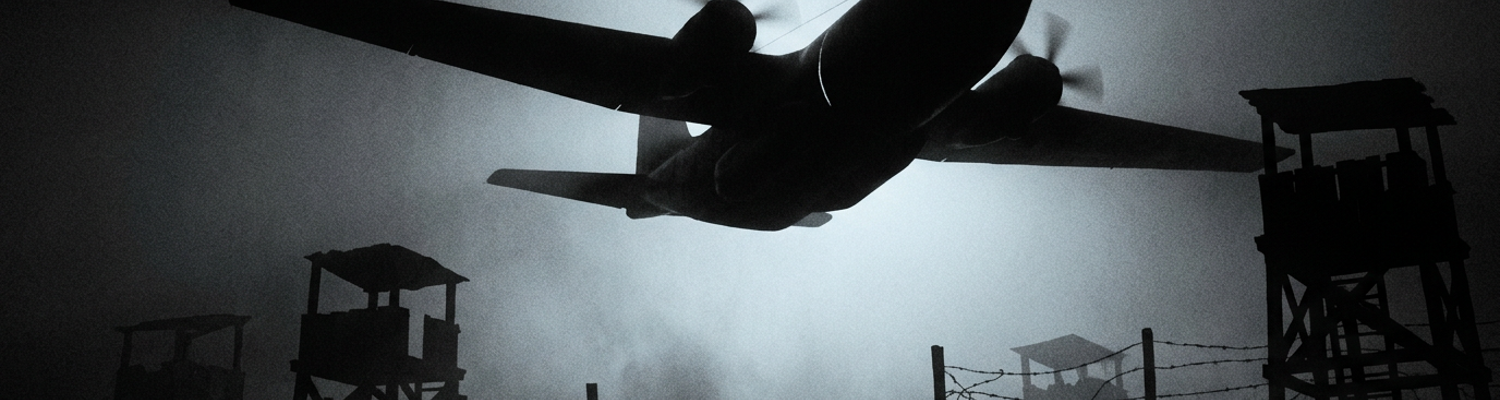
A P-61 Black Widow night fighter would loiter directly above the camp. The pilot acted as an airborne relay station. He simultaneously ran diversionary flight patterns. Ground operators tuned their SCR-300 dials to channel 42. This established a link with the twin-engine aircraft. The plan required the P-61 to cut its throttles. The aircraft would glide silently over the camp exactly forty-five minutes before the assault. This drew the visual attention of the Japanese guards upward. Radio technicians at the staging area applied thick layers of waterproofing grease around the battery terminals. This prevented short circuits from the heavy evening dew.
The primary ground operator carried two spare receiver tubes. Canvas pouches strapped to his chest rig held the glass components. A cracked VT-129 transmitting tube would instantly sever the link between the crawling Rangers and the aircraft circling three thousand feet above. The ground force would lose aerial coordination.
Airborne Diversion Mechanics and Radar Systems
Flight logs from January 30, 1945, detail the exact mechanical parameters of the aerial distraction. Planners assigned a specific Northrop P-61 Black Widow (serial number 42-39468) from the 547th Night Fighter Squadron. The aircraft bore the nose art Hard to Get. Captain Kenneth Schrieber commanded the flight controls. First Lieutenant Bonnie Rucks managed the onboard radar systems from the rear observer position. They initiated their takeoff roll precisely at 1800 local time. The heavy twin-boom airframe lifted off the pierced steel planking of their forward airstrip. The mission profile required Schrieber to navigate the aircraft into the airspace directly above the Cabanatuan camp. He had to avoid alerting the Japanese garrison to an impending ground assault.
Twin Pratt and Whitney R-2800-65W Double Wasp radial engines powered the interceptor.
These engines produced a distinct mechanical drone. The sound carried for miles across the quiet evening air. Sixth Army commanders calculated the sudden presence of an American night fighter loitering in local airspace would force the Japanese sentries to turn their attention skyward. The P-61 was designed primarily for high-altitude bomber interception. Deploying it as a low-level psychological distraction represented a severe deviation from standard tactical doctrine. Every pound of the aircraft fought against low-speed maneuverability. The empty weight totaled twenty-nine thousand pounds. Schrieber maintained constant physical tension on the yoke to prevent an aerodynamic stall.
The tactical success of this aerial maneuver depended entirely on precise timing. Ranger radio teams intended to maintain direct air-to-ground links with the P-61 pilots during the initial approach phase. This ensured the aircraft arrived exactly as the infantrymen began their final low crawl. Signal specialists operated the heavy SCR-300 backpack transceivers. They crouched in the damp cogon grass seven hundred yards from the camp perimeter. They attempted to push their frequency modulation signals through the dense atmosphere. Technical manuals from the era indicate the SCR-300 relied on strict line-of-sight propagation. The thick vegetation and the slight geographic depression of the Cabu River valley degraded the signal strength. The eighteen-inch steel whip antennas struggled to broadcast.
Ground operators continuously adjusted their squelch dials.
They tried to force a clear transmission through the static to reach the cockpit VHF receiver. The physical toll of the thirty-mile forced march had compromised several fragile VT-129 vacuum tubes inside the radio chassis. This reduced the transmission output well below the required wattage. Signalmen swapped out dead dry-cell batteries in the dark. Their fingers were coated in the waterproofing grease applied earlier that afternoon. The internal circuitry could not push the carrier wave through the dense humidity. Captain Robert Prince needed Schrieber to confirm his exact entry vector. The ground forces remained completely isolated from the air support circling three thousand feet above them.
Static interference consumed the entire frequency band.
Operating under complete radio silence, Schrieber initiated the diversionary sequence. He based his timing purely on his pre-mission briefing watch. Post-action reports indicate the pilot aggressively manipulated his engine controls at exactly 1,500 feet above the compound. He choked the fuel mixture to the left radial engine. This cut its power entirely to simulate a catastrophic mechanical failure. Seconds later, Schrieber forced the mixture back to full rich. He flipped the magneto switches. This dumped raw aviation fuel into the hot exhaust manifolds.
The action produced a series of massive concussive backfires. The noise physically rattled the wooden guard towers. The P-61 plummeted from 1,500 feet down to a mere 200 feet. Thick plumes of black smoke trailed directly over the barbed wire perimeter. Japanese guards abandoned their scanning arcs. They stepped out of their guardhouses to watch the aircraft. They believed it was a crippled American bomber spiraling into an uncontrolled crash. Schrieber repeated this high-risk maneuver twice more. He dragged the heavy airframe across the sky at just 110 miles per hour. This speed sat barely above the aircraft stall limit. The sheer noise of the sputtering radials masked the sound of the Rangers severing the perimeter wire with heavy bolt cutters.
The heavy airframe cleared the western ridgeline by thirty feet.
Dielectric Breakdown in Tropicalized Transceivers
The ambient temperature in the Cabu River valley dropped sharply as the sun set over Nueva Ecija province. This rapid cooling trapped ground-level moisture across the cogon grass fields. Local relative humidity pushed past ninety-five percent. Signal Corps technicians had previously subjected the SCR-300 transceivers to a standardized tropicalization process back at the staging areas. Maintenance crews coated the internal circuitry with fungicidal varnish. They sealed the delicate audio frequency transformers inside blocks of microcrystalline wax. These protective measures failed against the sustained dampness of the Philippine jungle.
Water vapor penetrated microscopic hairline fractures.
The physical shock of the thirty-mile forced march caused these fractures in the wax potting. Inside the radio chassis, the transformer coils relied on thin layers of kraft paper. This paper insulated the tightly wound copper wires from one another. The copper wires measured just zero-point-zero-two inches in diameter. They carried high-frequency audio signals required for frequency modulation. Extreme tropical humidity saturated this paper. The moisture fundamentally altered its electrical resistance properties. A localized dielectric breakdown occurred. The continuous moisture reduced the paper insulating capacity below the operational threshold of the radio power supply.
Ninety volts of direct current supplied by the heavy BA-70 dry cell battery suddenly found a path of least resistance. The current traveled through the damp paper rather than completing the intended circuit. Direct current bypassed the primary load. It surged directly into the secondary windings. Electrical arcs jumped between the tightly packed copper layers.
The resulting short circuit instantly fused the internal coils.
The exact timing of this hardware failure dictated the tactical sequence that followed. Ground operators crouched in a dry irrigation ditch just seven hundred yards from the heavily guarded perimeter of the Pangatian compound. They watched the dial on their frequency modulation set. The needle pinned hard to the left. This indicated a total loss of transmission power. Baseline static hiss from the carrier wave vanished completely. This mechanical failure happened exactly four minutes before Captain Robert Prince planned to initiate the final low crawl toward the barbed wire. Dielectric breakdown entirely severed the direct air-to-ground communication link on channel 42.
Signalmen stripped off the heavy canvas backpack cover in the dark. They accessed the radio internal chassis. They bypassed the standard squelch controls. They attempted to manually bridge the secondary battery terminals using their steel trench knives. Ranger ground commanders needed to confirm the final approach vector of the P-61 Black Widow night fighter circling at three thousand feet. A mistimed flyover would alert the sentries before the wire cutters could breach the outer fence.
The receiver could only produce a low-frequency hum.
The entire thirty-two-pound communication apparatus became mechanically inoperable without the audio frequency transformer. The primary operator swapped his spare VT-129 vacuum tubes into the sockets. This was a final attempt to restore the carrier wave. No transmission signal could push through the burned-out circuitry.
The isolated infantrymen faced an entrenched Japanese garrison without any method to recall or adjust their scheduled aerial support. Post-action reports from the 547th Night Fighter Squadron confirm Captain Kenneth Schrieber actively monitored his VHF receiver in the cockpit. He waited for the final execution order from the ground team. Sudden static on his headset meant the Rangers lacked any method to contact the aircraft. The strict assault window opened. Schrieber guessed the exact moment to drop his altitude. He initiated the engine-backfire sequence based solely on his pre-mission briefing watch.
Ground operators at the staging area tried to relay the signal. They used an SCR-284 vehicle radio mounted on a distant command jeep near Highway 5. Low elevation across the Cabu River valley blocked the line-of-sight required for the fifty-watt transmitter to penetrate the dense jungle canopy. Back in the irrigation ditch, the C Company radioman abandoned his troubleshooting efforts. He unscrewed the eighteen-inch steel whip antenna from its base mount. He disconnected the heavy BA-70 battery. This prevented a secondary acid leak from the shorted terminals. The radioman secured the heavy lead-acid component back into his canvas webbing. This prevented Japanese patrols from discovering discarded American equipment.
The assault team advanced into the open field in complete radio silence.
Tactical Isolation at the Pangatian Perimeter
The defensive architecture of the Pangatian compound heavily favored the Japanese Imperial Army garrison. Officers of the 14th Area Army commanded the facility. The camp sat along the Cabu River at geographic coordinates 15.501 N, 121.045 E. It occupied a slight elevation dominating the surrounding Nueva Ecija topography. Military engineers had systematically stripped the perimeter of all vegetation. This created a barren expanse of flattened earth extending roughly seven hundred yards in every direction.
Four primary wooden guard towers anchored the corners.
Each tower stood twenty feet tall. Heavy sandbags reinforced the structures. Sentries stationed inside these elevated pillboxes operated Type 92 heavy machine guns chambered in 7.7mm ammunition. This specific weapon system fired four hundred and fifty rounds per minute. Thirty-round rigid metal strips fed the firing mechanism. The elevated firing platforms provided the Japanese gunners with overlapping fields of fire across the completely flat cogon grass fields. American prisoners of war were housed in dilapidated wooden barracks situated directly in the center of this defensive grid. This effectively trapped them behind a continuous zone of potential suppressing fire.
The flattened grass offered zero topographical deflection against incoming ball ammunition.
Post-action reports detail the precise geometry of the Japanese defensive layout. The camp perimeter fence consisted of eight-foot-tall wooden posts strung with tightly coiled barbed wire. This wire was specifically designed to slow any infantry advance long enough for the tower gunners to acquire their targets. The surrounding terrain lacked any micro-topography. There were no boulders, fallen trees, or deep ravines. The Rangers could not employ standard bounding overwatch techniques. Standard infantry doctrine dictated attacking forces establish a base of fire to suppress elevated enemy positions before advancing across open ground.
Implementing this doctrine was impossible.
It would prematurely alert the garrison of eight thousand Japanese Imperial Army soldiers stationed just across the nearby Cabu River bridge. The aerial diversion was the only mechanism capable of neutralizing the strict visual discipline of the tower guards. A single misstep in the dry brush would instantly draw concentrated 7.7mm machine gun fire.
The sudden dielectric failure of the SCR-300 radio transceiver forced a severe tactical calculation upon Captain Robert Prince. Ground commanders crouched in a dry irrigation ditch at the eastern edge of the seven-hundred-yard clearing. They held their assault elements in a static prone position. They faced a strict binary operational choice. Prince could abort the infiltration. He could order his men to withdraw backward into the dense jungle canopy and abandon the diversionary strike entirely. Retreating meant leaving the remaining five hundred and twelve Allied captives vulnerable to the immediate execution orders recently intercepted by Sixth Army intelligence.
The alternative required the Rangers to initiate the frontal assault across the open field. They would rely completely on unguided air support. Captain Kenneth Schrieber actively circled his P-61 Black Widow interceptor three thousand feet above the target area. He was completely cut off from ground communication. Proceeding with the attack meant trusting Schrieber would manually initiate his low-altitude engine backfire sequence. He had to base this exclusively on the synchronized time of his cockpit mechanical clock.
A premature flyover would illuminate the crawling infantrymen.
Archival flight logs confirm the high mathematical risk of this unguided approach. Schrieber could miscalculate his throttle adjustments. He might initiate his dive one minute behind schedule. The Japanese sentries in the twenty-foot towers would maintain their visual focus on the ground level. The Rangers moved at a calculated physical rate of one foot per minute. This minimized the rustling of the dry cogon grass. Prince evaluated the physical state of his men. He weighed the inoperable radio equipment. He signaled the advance using manual hand gestures down the line of prone infantrymen.
Ground elements committed to the unguided gamble. They crossed the exposed terrain without any electronic confirmation that the heavy night fighter would perform its required psychological distraction. Infantrymen pushed their bodies flat against the packed dirt. Their canvas boots dragged silently behind them. They inched toward the overlapping machine gun arcs. The entire infiltration force relied entirely on the mechanical reliability of the cockpit altimeter and strict adherence to the pre-briefed schedule.
The leading Ranger elements closed to within two hundred yards of the main wooden gate.
Japanese guards actively scanned the perimeter using heavy searchlights mounted on the tower railings. The unguided P-61 banked sharply to the west. It dropped altitude without any ground vectoring to correct its flight path. Prince and his men stopped their forward crawl. They pressed their faces into the mud while waiting for the heavy radial engines to break the silence. The tactical dilemma resolved into a pure test of pre-mission synchronization. The twin-boom interceptor aligned its nose with the camp central barracks.
Unguided Visual Strafing and Ordnance Trajectories
Sixth Army planners authorized an extreme tactical risk involving heavy aerial ordnance. The Northrop P-61 Black Widow carried an internal armament of four 20mm Hispano M2 cannons mounted in the lower fuselage. Four .50 caliber Browning M2 machine guns were housed in the upper dorsal turret. Firing these weapons at low altitude in fading light typically required a minimum safe distance of over one thousand yards. This prevented friendly fire incidents. Captain Robert Prince and Lieutenant Colonel Henry Mucci discarded this standard safety protocol entirely during the planning phase.
They commanded a direct flight path.
This brought the twin-engine interceptor directly into the Cabu River valley. The pilot executed visual-only strafing runs within a two-hundred-yard radius of the Pangatian prisoner enclosures. The unguided ballistics threatened to shred the captives the Rangers were attempting to rescue.
The structural layout of the camp exacerbated this mathematical gamble. The five hundred and twelve Allied prisoners resided in dilapidated wooden barracks. Thin bamboo and dry nipa palm constructed these buildings. Several dozen civilian homes occupied by Filipino non-combatants sat just beyond the triple-strand barbed wire fence. A standard 20mm high-explosive incendiary round fired from an aircraft traveling at over one hundred miles per hour possessed massive kinetic energy. It could punch through multiple wooden structures before detonating.
The Japanese sentries occupied elevated pillboxes stationed roughly one hundred and fifty yards from these civilian and POW structures. Striking these exact pillboxes at dusk meant the pilot had to manually calculate bullet drop, aircraft speed, and target distance. He used only his naked eye. The pilot adjusted his firing angle in fractions of a second. He wrestled with the heavy flight yoke.
A slight hesitation on the trigger meant disaster.
It would send a lethal cone of heavy caliber fire directly into the civilian sector. Without the SCR-300 radio link, Captain Kenneth Schrieber commanded his P-61 into the target zone. He relied entirely on low-level buzzing maneuvers and dead-reckoning visual timing. Post-action reports detail the mechanics of this unguided approach across the Philippine airspace. The heavy interceptor dropped to an altitude of exactly two hundred feet to break below the local cloud ceiling. Schrieber operated the flight controls without any active ground guidance. This forced him to visually identify the specific wooden guard towers against the darkening Nueva Ecija terrain.
He initiated a series of aggressive buzzing passes directly over the camp perimeter. This disoriented the garrison of the 14th Area Army. The pilot pulled the throttles back. He intentionally dropped the Pratt and Whitney R-2800 engines into a near-stall state at 110 miles per hour. This maximized his visual observation window over the flattened cogon grass. The airframe shuddered violently as the aerodynamics broke down just feet above the tree line.
The total absence of electronic target marking forced visual navigation.
Schrieber navigated using the faint ambient reflection of the Cabu River. Ranger ground operators lying in the dry irrigation ditch watched the massive black silhouette of the night fighter eclipse the evening stars. Schrieber checked the mechanical chronometer mounted on his instrument panel. He verified his precise arrival time. He aligned the nose of the P-61 with the eastern fence line. He based this on the pre-briefed map coordinates memorized hours earlier at the forward staging airstrip.
The pilot depressed the firing button on his control yoke. He sent a burst of .50 caliber tracers toward the suspected location of a Japanese heavy machine gun nest. The heavy aircraft banked sharply to the right. This avoided a collision with the camp central wooden flag pole. Spent brass casings rained down on the tin roofs of the adjacent civilian housing block.
Guard Tower Suppression and Doctrinal Failures
Flight logs from January 30, 1945, detail the exact trajectory of the heavy munitions fired into the Pangatian compound. Captain Kenneth Schrieber pushed his P-61 Black Widow into a steep banking maneuver at two hundred feet above the Cabu River valley. He aligned his nose directly with the elevated wooden pillboxes on the eastern perimeter. He depressed the firing stud on his yoke. This engaged the four .50 caliber Browning M2 machine guns housed in the dorsal turret and the four 20mm Hispano M2 cannons mounted in the lower fuselage.
The unguided air strikes successfully suppressed enemy guard towers.
Schrieber executed this heavy ordnance delivery entirely through visual dead-reckoning in fading ambient light. He compensated manually for the 110-mile-per-hour speed of his aircraft. He targeted the sandbag-reinforced platforms where Japanese sentries manned Type 92 heavy machine guns. Heavy .50 caliber armor-piercing tracers impacted the thick sandbags at a velocity of 2,900 feet per second. High-explosive 20mm shells shattered the wooden support beams holding the pillboxes aloft. A standard 20mm round carried enough kinetic energy to penetrate multiple wooden structures before detonating.
The five hundred and twelve Allied prisoners were lying on the floorboards of their dilapidated nipa palm barracks. They were exactly one hundred and fifty yards from the primary target zone. Dozens of Filipino non-combatants occupied civilian housing blocks situated just beyond the outer triple-strand barbed wire fence. Schrieber adjusted his rudder pedals in micro-movements. He kept the concentrated ballistics locked exclusively on the twenty-foot towers. Incoming fire cleared the civilian roofs by less than forty feet. The sheer volume of heavy caliber suppression forced the Japanese gunners to drop to the floor of their pillboxes. This neutralized their overlapping fields of fire across the flattened cogon grass.
The Rangers breached the main gate.
The sentries sought physical cover from the aerial strafing. This unguided aerial execution masked a severe structural failure in American operational planning. The signal crisis exposed critical vulnerabilities in tropicalized Signal Corps equipment during joint tactical operations. Planners at Sixth Army headquarters had built the entire air-ground coordination doctrine around the presumed reliability of the SCR-300 backpack transceiver. Technical specifications required this frequency modulation unit to link the crawling infantrymen with the loitering night fighter on channel 42. This allowed ground commanders to vector the heavy ordnance safely away from the prisoner enclosures.
Ambient humidity in the Nueva Ecija province exceeded ninety-five percent as the sun set. Signal Corps maintenance crews had previously subjected the radios to a standardized tropicalization process. They coated the internal circuitry with fungicidal varnish and sealed the delicate audio frequency transformers inside blocks of microcrystalline wax. These defensive measures failed entirely against the sustained dampness of the Philippine environment. Water vapor penetrated microscopic hairline fractures in the wax potting. These cracked during the physical shock of the thirty-mile forced march.
Inside the thirty-two-pound radio chassis, the transformer coils relied on thin layers of kraft paper. This insulated tightly wound copper wires measuring zero-point-zero-two inches in diameter. Extreme tropical moisture saturated this paper insulation.
The resulting dielectric breakdown fundamentally altered the electrical resistance properties.
The continuous dampness reduced the paper insulating capacity below the operational threshold of the power supply. Ninety volts of direct current from the heavy BA-70 dry cell battery bypassed the primary load. It surged directly into the secondary windings. Electrical arcs jumped between the tightly packed copper layers. This instantly fused the internal coils into a solid mass of scorched metal. This hardware failure severed the air-to-ground link exactly four minutes before the assault window opened.
Post-mission analysis conducted by Fifth Air Force technicians revealed a severe doctrinal flaw. Relying on a single VHF frequency for close air support in dense jungle terrain represented a massive tactical error. The joint tactical framework required multiple redundant transmission methods. This included ground-to-air visual flares. The Rangers had discarded these to maintain absolute stealth. Ground operators abandoned their troubleshooting efforts. They disconnected the heavy lead-acid battery to prevent an acid leak from the shorted terminals.
The primary radioman stuffed the burned-out VT-129 vacuum tubes into his canvas webbing to conceal the equipment failure from passing enemy patrols.