
Mount Edgecumbe Engineering Survey and Structural Collapse
Inspectors from the Bureau of Indian Affairs and Public Health Service walked through the rotting remains of the Japonski Island military complex in 1965, cataloging the total collapse of infrastructure meant to last only five years. Military planners had rushed the base into service under emergency wartime conditions, directing crews to use green, unseasoned lumber and temporary construction standards. Exhausted work parties endured sixteen hour shifts in soaked wool uniforms, wrestling heavy timber through knee deep mud while ration cuts and delayed cargo ships left the base low on coal and proper building materials. These grueling working conditions and constant material shortages produced buildings with inadequate insulation, poor drainage, and hasty structural joins that immediately began to rot under relentless coastal rains. Postwar transfers turned the damp naval station over to civilian administration, where the neglected facilities housed educational and medical operations despite rapid physical deterioration. Twenty years of rain and neglect pushed the steam infrastructure to total collapse.
Steam hissed through fractured expansion joints along hundreds of yards of exposed pipeline, sending plumes of escaping vapor into the freezing rain while dormitory radiators sat cold and silent. Engineers conducting the assessment discovered that systemic failure of high pressure above ground steam distribution grids and rotting timber trestles crippled heating across the repurposed installation. Wooden trestles carrying these pressurized mains had rotted from decades of water exposure, sagging beneath the metal pipes until the heavy steel couplings snapped under the uneven weight. Boiler operators burned thousands of gallons of heavy fuel oil every week simply to keep the ruptured system pressurized, yet classrooms and hospital wards barely maintained indoor temperatures above freezing. Maintenance crews attempted to patch split distribution pipes with salvage metal, friction tape, and scrap lumber, but repeated pressure surges blew out the seals and sprayed boiling water across the central walkways. Escaping condensate gathered under the utility corridors, draining into the soft earth and pooling around the structural posts that held up the surrounding military buildings.
Muskeg beneath the barracks absorbed this constant runoff, turning the foundation soils into soft mud that could no longer carry structural loads. Differential settlement of untreated wooden foundation pilings caused pervasive structural twisting and roof deck failure across wartime barracks. Pilings driven into the marsh without chemical preservatives rotted rapidly from the outside in, sinking unevenly under the weight of the two story wooden superstructures. Door frames twisted out of square throughout the living quarters, locking bedroom doors shut and cracking the interior plasterboard as floors sloped by several inches over short distances. Roof decks buckled along their main ridge lines when the shifting foundation dragged support columns downward, tearing open the asphalt roofing paper and exposing raw plywood sheathing to the Sitka rain. Rainwater poured into second floor bunkrooms through these gaping structural tears, soaking ceiling insulation until heavy sodden panels collapsed onto the cots below.
Carpenters rushed into the flooded quarters to evacuate residents and throw canvas tarps over ruined bedding and instructional supplies. Work parties hauled mechanical screw jacks into the crawl spaces beneath the barracks to raise the dropped floor sills, but the jacks sank into the saturated ground under the weight of the buildings. Facilities directors condemned three entire barracks wings after discovering that the main load bearing timbers had sheared completely through their foundation pins. Electricians cut power feeds to these condemned barracks to prevent electrical fires as water ran through exposed conduit boxes and sparked along wall cavities. Commanding officers and agency administrators officially halted all repairs on the eastern housing blocks, boarding up doorways and rerouting utility lines around the abandoned structures.
Postwar Deactivation and Custodial Transfer Failures
Utility lines bypassed those condemned housing blocks because Navy authorities placed Sitka Naval Operating Base into caretaker status in 1944 following the Allied recapture of Attu and Kiska in the Aleutian chain. The War Department redirected heavy engineering assets, skilled Seabee battalions, and replacement components away from southeastern Alaska to sustain the central Pacific campaign once the immediate Japanese threat pushed westward. Skeleton caretaker detachments remained on Japonski Island to secure the perimeter, but these small crews lacked the personnel and heavy machinery needed to service the sprawling wooden base. Drainage ditches rapidly clogged with coastal silt, autumn gales stripped protective roofing paper from unheated warehouses, and moisture rotted structural framing timbers from the inside out. Watchstanders logged structural defects without executing repairs, letting salt spray pit critical brass fittings and rust seize large steam control valves in place.
Watchstanders handed over those frozen valves when custody of the complex transferred to civilian agencies in 1946 without provision of technical documentation, repair blueprints, or surplus parts. Bureau of Indian Affairs personnel and Department of the Interior supervisors walked into an industrial installation they had no technical means to operate, possessing not a single schematic for buried electrical lines or high pressure water mains. Maintenance workers had to dig blind exploratory trenches through saturated muskeg with pickaxes whenever subterranean pipes burst, regularly severing telephone cables and raw sewage lines in the process. Supply clerks scoured civilian shipyards and commercial salvage depots across Sitka for replacement parts, but local merchants carried none of the specialized naval fittings required to repair heavy military couplings. Work crews improvised temporary fixes by hammering soft lead into leaking seams and clamping split pipes with scrap metal strips, leaving the underlying water grid weakened and vulnerable to the next pressure surge.
Pressure surges inside the central powerhouse exposed the full scale of this breakdown, as civilian administrators struggled to maintain oversized military utility plants designed exclusively for high density wartime garrisons. Naval contractors had built these massive steam generators and industrial electrical dynamos to support thousands of active duty personnel, fleet repair shops, and around the clock patrol aircraft operations. Civilian employees running the Mount Edgecumbe boarding school and tuberculosis sanatorium numbered only a fraction of that population, forcing the powerhouse to operate far below its minimum efficient capacity. Running giant industrial furnaces at low output caused heavy soot to clog the exhaust flues, reduced combustion efficiency, and burned through limited civilian fuel budgets just to push steam through decaying distribution lines. Powerhouse operators listened to feedwater pumps shudder and shake on their concrete mountings, watching erratic water flow tear seals apart and strip metal threading from internal impeller shafts.
Mechanics responded to these mounting mechanical failures by systematically shutting down entire boiler banks and isolating secondary utility loops to prevent total boiler explosions. Maintenance crews drained ruptured piping across outlying wings by hand, blowing compressed air through cold lines before winter frost could split the remaining brass valve bodies. Facilities supervisors submitted emergency requests for specialized repair funding, but government supply boats delivered only basic construction lumber and residential hardware that could not handle industrial pressures. Workers abandoned the disabled mechanical systems across the outer perimeter, rolling portable oil drums and iron coal stoves into drafty dormitory hallways to keep residents warm. Maintenance staff stacked cords of hemlock firewood against the concrete exterior of the silent powerhouse, keeping individual room stoves burning while the naval heating grid sat completely dead.
Aleutian Crisis Patrol Logistics and Flight Operations
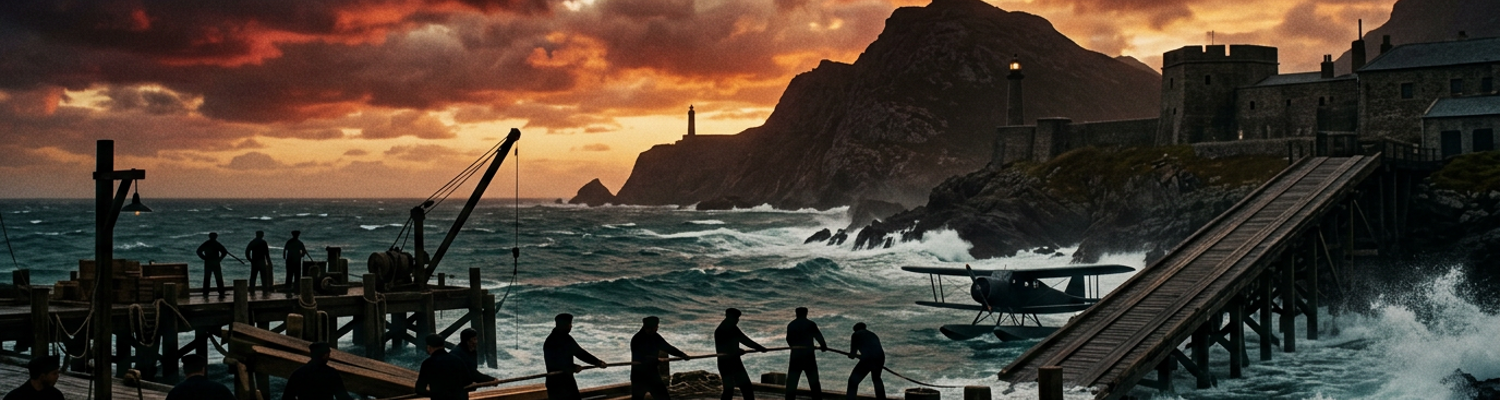
Coal stoves stood where military fuel trucks had once lined the perimeter, marking the decay of an airfield that had operated around the clock when Sitka sustained intensive PBY Catalina and OS2U Kingfisher maritime reconnaissance missions over the Gulf of Alaska during the 1942 Aleutian Islands campaign. Patrol squadrons took off directly into low fog and heavy sea spray, scouring hundreds of miles of open water to track Japanese naval activity and guard the approaches to southeastern Alaska. Flight crews spent ten to twelve continuous hours inside freezing, uninsulated fuselages, searching through rain squalls while carburetor ice choked their radial engines and salt water pitted their aluminum propellers. Exhausted pilots brought their heavily loaded seaplanes back onto Sitka Sound amid churning whitecaps, fighting crosswinds to keep from cartwheeling into the rocky shoreline. Ground handlers waded waist deep into the freezing surf with heavy hemp tow lines, securing each rolling aircraft so winches could haul it onto the exposed concrete ramps.
Concrete seaplane ramps coated in ice sheets caused severe hull damage as subarctic gales drove towering ocean swells against Japonski Island. Crushing waves slammed incoming OS2U Kingfishers and PBY Catalinas against the concrete incline before dollies could lock beneath the floats, puncturing thin metal skin and twisting tubular steel bracing. Mechanics inside the drafty maintenance hangars struggled to keep pace with the influx of damaged airframes, working with bare hands on frozen metal parts under flickering work lights. Aviation repair shops lacked spare aluminum sheeting, specialized hydraulic fluid, and replacement structural bulkheads, forcing machinists to strip scrap metal from crashed wrecks to patch punctured hulls. Work crews rigged canvas tents inside the hangars and directed portable kerosene heaters at airframe seams, hoping to thaw iced rivets long enough to drive new structural fasteners.
Fasteners required specialized tools that ground crews lacked as fuel shortages immediately threatened repair efforts and patrol schedules. Aviation fuel resupply relied on vulnerable coastal tanker runs and makeshift fuel bladders exposed to high winds and freezing temperatures. Small coastal tankers had to navigate dangerous passages without naval escorts, often turning back when severe gales barred entry into Sitka Sound. Ground crews anchored giant rubber fuel bladders directly on the gravel beach, where winter frost hardened the fabric and freezing salt spray coated transfer valves in solid sheets of ice. High winds ripped retaining stakes out of the rocky ground, threatening to send thousands of gallons of volatile fuel rolling across the seaplane parking aprons. Sailors manned manual hand pumps in sub zero drafts to transfer sluggish fuel through stiffened rubber hoses, struggling to filter out ice crystals before the fuel reached Catalina fuel tanks.
Catalina flying boats gulped this fuel as fast as shore crews pumped it, launching into blinding sleet on urgent search orders from the regional command. Base commanders pushed their remaining aircrews to the breaking point as intelligence reports warned of Japanese carrier strikes targeting Dutch Harbor and the Aleutian chain. Pilots flew back to back maritime reconnaissance sorties across thousands of square miles of gray water, unable to conduct routine engine overhauls or replace scored cylinder sleeves. Ground crews cannibalized unairworthy Kingfishers parked along the seawall, stripping spark plugs, oil radiators, and control cables to keep a dwindling core of patrol planes operational. Commanding officers dispatched these patched seaplanes into storm fronts with minimal fuel margins, committing every available machine to maritime surveillance while Japonski Island logistics chains fractured behind them.
Harbor Defense Networks and Coastal Artillery Disconnects
Logistics chains stretching across Fort Rousseau depended on fragile timber causeways connecting Japonski to neighboring barrier islets, leaving the harbor defenses dangerously isolated while the base poured its dwindling resources into offshore patrol flights. Soldiers of the 250th Coast Artillery manned six inch guns and anti aircraft mounts scattered across Makhnati, Kirushkin, and Nevski islands, staring into the stormy waters of Sitka Sound to guard against Japanese surface raids. Military engineers had built these tactical outposts on jagged volcanic rocks, tying them to the central naval station through makeshift wooden trestles and loose gravel embankments rather than permanent roads. Ocean swells constantly slammed into the exposed pilings, shaking the causeways and loosening structural cross bracing beneath the roadway deck. Battery commanders faced a worsening crisis as rising water repeatedly threatened to wash away their only physical link to Japonski Island, jeopardizing the daily delivery of food, fresh water, and heavy artillery ammunition.
Ammunition transport across unpaved causeways stalled when seasonal tides and surf eroded subgrade fill material, halting heavy supply convoys before they could reach the outer gun pits. Ten wheel cargo trucks loaded with hundreds of heavy artillery shells and explosive powder cans bogged down in saturated sand where winter waves scooped out the underlying rock base. Drivers jumped from their cabs into knee deep freezing saltwater to dig out spinning tires, but shifting mud swallowed wooden traction planks as fast as soldiers laid them down. Coastal surf breached the unpaved roadway during every high tide cycle, sweeping tons of loose rock into the ocean and carving deep gaps across the narrow causeway path. Ordnance officers suspended vehicle movements across the drowned causeways to keep loaded trucks from overturning into the surf, leaving isolated battery commanders to crank their field telephones to demand emergency barge support from Harbor Defense Command.
Signalmen trying to patch the calls through discovered that the entire offshore wire grid was already dead. Severe maritime storms repeatedly severed submerged landline communications linking Harbor Defense Command to outlying observation posts, cutting the electrical circuit between the gun batteries and the command center on Japonski Island. Violent storm waves dragged armored communication cables across the jagged volcanic seabed, stripping away protective rubber insulation and slicing through copper wiring against sharp underwater reefs. Maintenance crews lacked specialized cable laying vessels and diving equipment to locate and splice the broken lines under the churning North Pacific swells. Technicians in the central plotting room tapped on silent switchboard terminals, unable to receive visual vessel sightings, gun laying coordinates, or target ranges from the forward spotters overlooking the ocean approaches.
Spotters stationed in concrete bunkers on the outer islands aimed portable signal lamps into the driving mist, but thick rain squalls absorbed the light beams before they could reach Japonski. Coastal artillerymen attempted to use battery powered portable radios, yet the surrounding volcanic terrain and high atmospheric interference distorted radio traffic into unintelligible static. Harbor Defense Command officers stood over blank navigational tracking charts inside their headquarters, stripped of both telephone contact and reliable wireless reports from the outer rim of Fort Rousseau. Senior commanders canceled planned live fire coastal defense drills and ordered the artillery crews to conserve what little ammunition remained in their ready lockers. Island gunners hunkered down behind their cold weapons on the wave swept rocks, waiting in complete silence without ammunition resupply, functioning communication lines, or tactical orders.
Muskeg Foundations and Subarctic Construction Expedients
Orders failed to reach the outer batteries because the central headquarters on Japonski Island suffered catastrophic structural failure across the ground beneath its foundations. Civilian contractors and Navy Seabees drove unseasoned native timber pilings directly into saturated muskeg bogs between 1939 and 1942 to quickly anchor vital supply storehouses. The spongy muskeg consisted of decaying vegetation and waterlogged peat that lacked any solid bedrock to grip the friction pilings. Heavy pile drivers smashed raw spruce and hemlock trunks twenty feet into the mire, but the saturated organic soil offered almost no lateral resistance to horizontal loads. Storage buildings packed with artillery shells, aircraft parts, and canned rations exerted downward force that shoved the friction pilings deeper into the swamp. Foundation timbers shifted unevenly within months of installation, tilting warehouse floors at sharp angles and snapping cast iron sewer connections underneath the buildings, forcing work parties to pump thick brown water out of collapsing crawlspaces.
Water and liquefied peat bubbled up through newly laid floorboards, spreading foundation failures from the supply depots straight onto the operational flight facilities. Heavy concrete seaplane turnarounds and hangar aprons were poured over unstable tidal mudflats, prompting immediate hydraulic displacement. The massive weight of the wet cement slabs squeezed the underlying water and soft mud out from beneath the perimeter forms. Coastal tides surged beneath the fresh slabs twice daily, washing away the unstable subgrade and leaving massive open voids beneath the cured surfaces. Giant PBY Catalina flying boats rolled across the concrete only to break through unsupported sections of pavement, shearing their landing dollies and puncturing their aluminum fuselages. Ground crews scrambled with shovels and wheelbarrows to pump liquid grout beneath the sinking slabs, but ocean swells washed the fresh slurry into Sitka Sound before it could harden, leaving maintenance crews to haul buckled seaplanes off cracked slabs while water undermined the hangar walls.
Walls sagged until carpenters rushed into the maintenance bays to shore up roof trusses before the buildings collapsed onto the damaged patrol planes. Pre war builders substituted green unseasoned timber for structural framing to fulfill accelerated emergency construction schedules, creating severe architectural defects as the raw wood began to cure in place. Freshly cut hemlock and Sitka spruce timbers retained immense internal moisture, causing structural beams to shrink, twist, and pull apart from their metal gusset plates under the weight of winter snow. Main support columns warped outward, throwing hangar door tracks out of alignment so that heavy sliding doors jammed halfway open during driving rainstorms. Wet coastal winds blew freezing rain across open hangar floors, soaking electrical junction boxes and corroding aircraft engines sitting on maintenance blocks. Wall studs shrank unevenly and pulled thousands of iron framing nails free from the wood, snapping interior water pipes and dropping heavy roof purlins across parked maintenance trucks.
Trucks sat crushed until Seabees used heavy winches and hand saws to cut away fallen roof beams and pull twisted wall posts back into line. Work crews anchored heavy wire rope cables to exterior rock outcroppings, winching the exterior hangar walls backward against the prevailing winds to keep the roofs from caving in completely. Engineering officers requisitioned every dry board from supply warehouses to scab over cracked truss chords, leaving zero building materials available for repairing the shattered causeways leading to Fort Rousseau. Machinists welded scrap railroad iron across door headers to hold the distorted structural openings rigid enough for maintenance crews to wheel damaged aircraft inside. Base leadership officially classified the island primary hangar complex and supply depot as emergency repair priorities, directing all available engineering personnel to drive sister pilings and shovel crushed quarry rock into expanding sinkholes.
Mobilization Pressures and Japonski Island Base Design
Rock sank endlessly into the marshy voids because the 1939 Hepburn Board designated Sitka as an urgent air base outpost, trading long term durability for rapid construction milestones. Rear Admiral Arthur Hepburn and his special naval board concluded that southeastern Alaska required immediate air patrols to guard against cross Pacific strikes, prioritizing speed of delivery over sound permanent engineering. Naval planners in Washington accepted disposable timber designs and makeshift earthworks, calculating that temporary structures lasting only five years would be sufficient to fight the approaching war. Bureaucrats rushed blueprint approvals through regional commands without sending specialized geological surveyors to test the bearing strength of the island waterlogged bedrock. Drafting tables in Seattle churned out generic layout sheets meant for dry mainland naval stations, leaving field engineers with strict orders to break ground on Japonski Island regardless of ground conditions.
Engineers handed generic blueprints to Siems Drake Puget Sound contractor syndicates who bypassed standard subarctic engineering practices to establish air operational capabilities by 1941. Contractor bosses imported hundreds of civilian laborers from Washington state to blast channels and raise barracks, running round the clock work shifts to meet rigid contractual completion bonuses. Work crews skipped deep gravel excavation and frozen ground thermal insulation techniques, dumping unwashed beach gravel directly over wet tundra to create quick foundation pads for the seaplane hangars. Pile drivers hammered green spruce logs directly into shallow subsoil without peeling away the bark or treating the wood against moisture rot, driving each piling only until it held temporary friction. Foremen diverted manpower away from proper concrete curing and drainage grading, rushing the assembly of steel hangar frames and buried fuel pipes before winter storms closed the shipping lanes.
Pipes placed across these uninsulated pads faced swift destruction because initial site planning failed to anticipate the high structural degradation rates imposed by constant maritime precipitation and organic soil acidity. Heavy rainstorms dropped over one hundred inches of water onto Japonski Island each year, soaking the shallow earthworks and saturating the thick layers of muskeg beneath the buildings. Decomposing spruce needles and waterlogged moss produced high concentrations of organic acids that ate into the porous concrete pier blocks and stripped the fiber out of untreated wooden pilings. Planners in distant naval offices had failed to review local weather registries and soil chemistry tests, assuming that standard timber post footings could withstand perpetual subarctic moisture without rotting from the inside out. Saturated soil packed tight against the foundations held acid laced groundwater against the wooden pilings continuously, turning foundation posts into soft, waterlogged timber within months of installation.
Timber shoved hangar floors upward and pushed exterior walls outward as saturated muskeg expanded and contracted through seasonal freeze cycles. Navy maintenance chiefs discovered that the rapid build techniques designed to rush Sitka into operational readiness were actively wrecking the facilities before full patrol squadrons even arrived. Mechanics crawled under the twisting seaplane hangars with wooden shims and hydraulic jacks, attempting to level floor tracks so crews could open sliding doors and roll patrol bombers onto the ramp. Supply officers sent urgent requisitions south for chemical wood preservatives, structural steel beams, and heavy subgrade rock, but mainland depots routed those materials to offensive staging areas in the central Pacific. Station officers ordered maintenance gangs to tear up perimeter planking and cut scrap bridge timbers to brace the sagging foundations, locking the garrison into an endless cycle of salvage repairs just to keep the flight line open.