
Joint Board 325 and South Pacific Command Integration
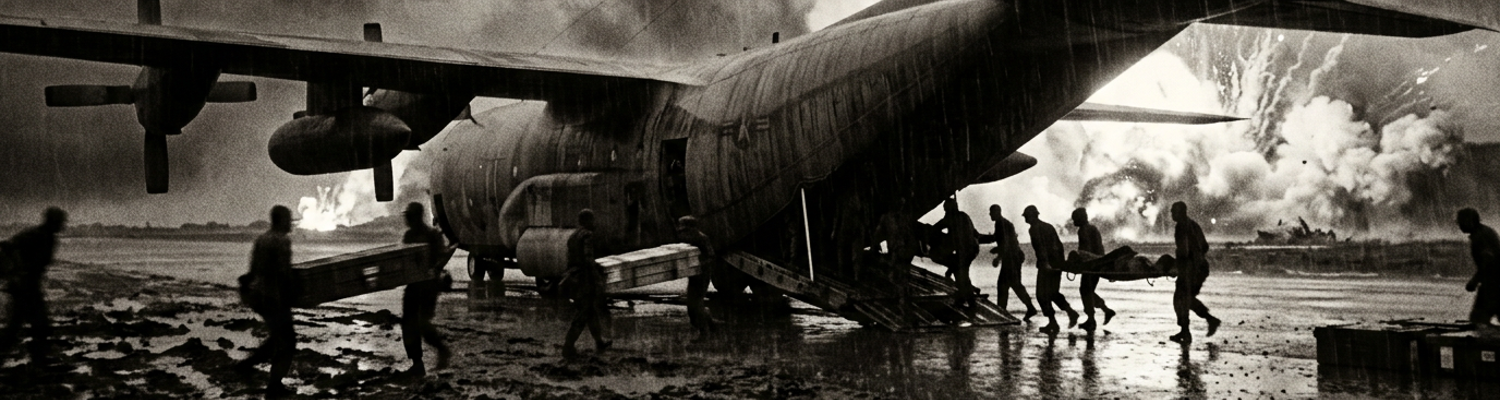
At 1314 hours, jagged fragments from a Japanese Type 96 150-millimeter howitzer shell ripped through the port fuel cell of a taxiing transport at Henderson Field. The blast drenched the crushed coral runway in eighty-octane aviation fuel. Ground handlers were blinded by black exhaust smoke. Litter cases lay dropped across the mud. Bleeding Marines waiting on stretchers swallowed dust while the pilot wrestled with a seized mixture control before shrapnel severed the left landing gear actuator. Standard sea evacuation plans failed within those three hundred seconds as artillery walked down the airstrip. Conventional Navy transports could not linger in Ironbottom Sound without facing immediate destruction.
Surface supply had failed.
A close review of operational logs indicates that this total collapse of maritime shipping forced the Joint Chiefs of Staff to bypass traditional service rivalries. Planners turned directly to the mandates of Joint Board 325. This regulatory directive was formulated to impose centralized coordination over inter-service aerial supply lines across the South Pacific Command. Vice Admiral Robert L. Ghormley and his successor, Vice Admiral William F. Halsey, lacked the cargo ships necessary to feed, arm, and evacuate the 1st Marine Division through standard naval channels. Joint Board 325 stripped the Army and Navy of their independent transport fiefdoms. It dictated that all twin-engine transport assets within the theater operate under unified operational control. Aerial supply became a co-equal combat arm rather than a piecemeal support service. Air transport doctrine shifted from moving rear-echelon supplies on administrative timetables to launching coordinated tactical airlifts into active drop zones. This established an integrated command structure across the Pacific fleet.
Paper directives translated into synchronized flight schedules.
Archival evidence shows that on November 24, 1942, this framework took physical shape through the formal activation of the South Pacific Combat Air Transport Command (SCAT). The command integrated Marine Aircraft Group 25, led by Colonel Perry K. Smith, with the United States Army Air Forces 13th Troop Carrier Squadron under a single operational staff. Service boundaries disappeared on the flight line. Marine Corps pilots in Douglas R4D-1 Skytrains flew alongside Army crews in C-47s. They utilized identical maintenance depots and standard operational procedures. Marine crews cannibalized Army engines for cylinder heads. USAAF mechanics requisitioned Marine radio crystals to maintain inter-plane communications on identical frequencies. Flight orders originated from a joint operations room where a Navy logistics officer and an Army flight controller shared the same grease pencil and dispatch desk. Outbound airframes delivered fifty-five-gallon drums of aviation gasoline, mortar shells, and dry plasma. They then immediately reloaded fifteen to eighteen litter patients for the return run.
No spare parts sat idle behind bureaucratic barriers.
When examining the historical record of theater geography, the entire mechanism relied on a chain of forward staging points carving six hundred miles across the Coral Sea. The command anchored its primary supply depot at Tontouta Airfield outside Noumea on New Caledonia. Heavy maritime cargo arrived here from the United States mainland and underwent sorting. Transports staged north through Espiritu Santo in the New Hebrides. They utilized the two crushed-rock runways at Bomber Field No. 1 and Palikulo Bay. Ground crews at Espiritu Santo fueled each aircraft to maximum takeoff weight, loaded specialized flight nurses, and checked emergency oxygen bottles before launching the final four-hundred-mile leg across open water into Henderson Field. Small relay fields on Efate and San Cristobal provided ditching strips for flak-damaged transports limping back from the combat zone with failed oil pumps and ruptured fuel bladders. SCAT dispatchers coordinated these flights without radar tracking. They relied solely on dead reckoning and low-frequency radio transmitters mounted on palm trees along the island route.
Douglas R4D Payload Limits and Navigation Deficits
A close review of operational logs indicates that South Pacific Combat Air Transport Command relied primarily on the Douglas R4D-1 Skytrain. This was the naval transport variant of the twin-engine civilian DC-3. Power came from two Pratt and Whitney R-1830-92 Twin Wasp fourteen-cylinder air-cooled radial engines. Each was rated at 1,200 horsepower for takeoff. The factory fuel configuration provided 804 US gallons across four wing tanks. This yielded a maximum safe range of approximately 1,000 miles under standard atmospheric conditions. A standard round-trip flight profile between Palikulo Bay on Espiritu Santo and Henderson Field covered over 1,200 miles across the Coral Sea. This calculation excluded holding patterns, weather diversions, and combat evasive maneuvers. Ground crews addressed this deficit by anchoring two to four cylindrical 100-gallon steel auxiliary tanks directly into the interior cabin floor using cargo tiedowns.
These fuselage drums fed directly into the wing sumps through exposed rubber hoses and manually operated hand-wobble pumps.
Adding four hundred gallons of volatile fuel inside the cargo compartment elevated maximum gross takeoff weight past 29,000 pounds. This was well beyond the factory design limit of 25,200 pounds. Single-engine rate of climb dropped to zero if a cylinder cracked during departure with full fuel tanks and three thousand pounds of mortar shells aboard.
Overloaded transports could not maintain altitude on one engine.
Archival evidence shows that early R4D-1 airframes operated without airborne search radar, cathode-ray tube scopes, or electronic collision-avoidance systems. Marine Aircraft Group 25 received no SCR-717 sea-search radar units or British-designed air-to-surface vessel gear. Flight decks were stripped down to standard flight instruments. Instrument panels carried basic magnetic compasses, directional gyroscopes prone to precessional error, turn-and-bank indicators, and sensitive barometric altimeters. The six-hundred-mile water corridor between Espiritu Santo and Cape Esperance contained zero ground-based radio homing stations or directional signal towers. South Pacific fleet units maintained absolute radio silence along the route to deny Japanese submarine tracking stations any usable direction-finding coordinates. Transports crossed vast expanses of open sea where pilots could not confirm their positions against surface features or electronic guidance emitters. Navigators calculated drift angles by opening the fuselage floor hatch and sighting magnesium flares dropped onto the dark ocean surface. Thick layers of tropical cumulus clouds and violent squalls along the Intertropical Convergence Zone repeatedly blocked the stars. This prevented navigators from using octants through the transparent overhead observation dome.
Flight crews flew hundreds of miles through turbulent squalls using dead reckoning alone.
When examining squadron flight records, precise timing determined survival across sectors vulnerable to land-based Japanese air patrols. The Imperial Japanese Navy 251st Kokutai and 204th Kokutai staged long-range Mitsubishi A6M Zero fighters and twin-engine G4M Betty bombers from Kahili Airfield on southern Bougainville and Buka. They intercepted Allied transports entering the southern Solomons. SCAT commanders counteracted these patrols by imposing total blackout protocols across the entire transit route. Transports took off from Palikulo Bay between 0400 and 0500 hours. They steered dogleg trajectories well east of San Cristobal to stay beyond the standard patrol radials of Japanese reconnaissance floatplanes. Pilots masked every external formation lamp and shielded the instrument panel with heavy red filters to eliminate visible light signatures through the cockpit glass. Communications discipline stayed absolute. Crews were prohibited from breaking radio silence even when suffering mechanical failure, combat damage, or sea ditchings. Flight schedules aimed to bring the unarmed transports over Henderson Field around mid-morning. They utilized localized cloud cover and synchronized combat air patrols flown by Marine F4F-4 Wildcats over Lunga Point for terminal protection.
A course deviation of five degrees meant fuel exhaustion over empty water.
Henderson Field Marston Matting and Artillery Bombardment
Archival evidence shows that arriving SCAT crews entered a terminal pattern dominated by pre-sighted Japanese artillery positions dug into the ridges southwest of the perimeter. The Imperial Japanese Army 4th Heavy Field Artillery Regiment positioned 150-millimeter Type 96 howitzers along the steep, jungle-covered ravines flanking Mount Austen and the upper Matanikau River. These batteries sat approximately four miles from the runway threshold. Marines categorized these scattered heavy batteries under the collective callsign Pistol Pete. Concealed forward observers perched on high limestone ridges maintained direct lines of sight across the 3,800-foot primary gravel-and-steel strip. They transmitted instantaneous coordinate corrections via field telephone lines to gun pits shielded beneath palm logs and earth. High-explosive shells weighing eighty pounds struck the runway with flight times under twenty-five seconds. They left blast craters eight feet deep and sprayed serrated casing fragments across the parking revetments. Japanese battery commanders timed their fire missions to coincide with transport engine run-ups and landing rollouts. They deliberately waited until lumbering Douglas airframes dropped below tree level and lost the airspeed needed to execute a go-around maneuver.
Artillery spotters calibrated their fire directly onto the runway intersection markers.
A close review of operational logs indicates that the physical condition of the runway presented an equal hazard to landing gear assemblies. The operational surface consisted of ten-gauge pierced steel planking, designated Marston matting, laid over an unstable subgrade of uncompacted river silt and crushed sea coral. Tropical monsoon squalls repeatedly dumped three inches of rain within sixty minutes. This liquefied the underlying soil into a thick slurry. Heavy R4D transports touching down at eighty-five miles per hour exerted extreme downward pressure that forced liquid mud upward through the two-and-a-half-inch matting perforations. This engineering failure was known as subgrade pumping. This hydraulic action dislodged steel locking bayonets and bent interlocking plates upward into sharp metal spikes. Ground mechanics discovered that these warped edges repeatedly slashed twenty-seven-inch smooth-contour main tires. They ripped away hydraulic brake lines and sheared tailwheel assemblies during heavy rollouts. Seabees from the 6th Naval Construction Battalion continually ran bulldozers under incoming fire. They dumped loads of river gravel into crater cavities to prevent taxiing transports from sinking to their axles.
Mud contamination regularly choked the exposed landing-gear retraction mechanisms.
When examining squadron flight records, surviving this landing zone depended on a strict command protocol governing ground turnaround times. Marine Aircraft Group 25 operational directives prohibited transport pilots from cutting their magnetos while on the airfield apron. Flight crews kept both 1,200-horsepower Pratt and Whitney R-1830-92 radial engines running at low idle. This enforced a non-negotiable ten-minute time ceiling from initial wheel-stop to takeoff roll. Shutting down the engines invited disaster. Restarting required auxiliary battery carts that were frequently damaged by shell fragments. Tropical engine vapor lock often immobilized hot carburetors. With three-blade Hamilton Standard propellers throwing blinding blasts of grit and prop wash at eight hundred revolutions per minute, corpsmen from the 1st Marine Division medical battalion scrambled through the cargo doorway. Handlers pushed out 55-gallon drums of aviation fuel and wooden crates of mortar ammunition into the mud. They simultaneously secured up to eighteen litter patients onto three-tiered internal web straps.
Pilots advanced both throttles to full military power while medical corpsmen were still fastening the final stretcher buckles.
Tarmac Triage and Payload Weight Restrictions
Archival evidence shows that naval flight surgeons assigned to Marine Aircraft Group 25 and hospital corpsmen from Company A, 1st Medical Battalion established their primary triage collection point forty yards from the western edge of the main Henderson taxiway. Shrapnel from 105-millimeter and 150-millimeter artillery bursts regularly slashed through the wet sandbag revetments where stretchers lay lined in two parallel rows in the mud. Incoming fire gave no warning. Medical personnel pulled wounded Marines into unreinforced drainage ditches when shells detonated near the runway threshold. They used their own bodies to shield exposed arterial dressings from high-velocity coral rock. Corpsmen cut away blood-caked utility uniforms with heavy bandage shears. They worked directly in rain and prop wash to secure fresh field dressings. Flight surgeons carried grease pencils and morphine syrettes in canvas pouches. They marked casualty categories directly onto the foreheads of patients lying on folding canvas stretchers. Burnt cordite and engine exhaust filled the collection pit as taxiing transports blew gravel across open surgical wounds. Two-man stretcher teams sprinted across the mud between shell impacts. They ducked low under rotating Hamilton Standard propeller arcs to slide litters through the narrow cargo door.
Triage occurred under direct artillery observation.
A close review of operational logs indicates that transport payload calculations dictated an unyielding upper limit of sixteen to eighteen non-ambulatory litter casualties per Douglas R4D airframe. Loadmasters calculated the bare weight of a rain-soaked canvas litter, steel hardware, and an immobilized patient at an average of two hundred and ten pounds. Eighteen litters totaled 3,780 pounds of non-negotiable payload. This competed directly with the two internal 100-gallon fuselage auxiliary fuel tanks anchored forward of the cargo door. Adding two medical corpsmen, plasma crates, and emergency splint kits shifted the center of gravity envelope dangerously close to the aft structural limit of twenty-eight percent mean aerodynamic chord. Takeoffs from the 3,800-foot runway left zero margin for mechanical degradation. If an R-1830 engine lost oil pressure during the initial climb over the tree line, excess weight guaranteed a fatal stall into the Matanikau swamps. Flight crews enforced these weight sheets without variance. They forced corpsmen to strip the nineteenth litter out of the fuselage tier brackets before clearing the pilot for takeoff.
Cabin dimensions allowed no deviations from the load manifest.
When examining the historical record of 1st Marine Division medical clearing stations, flight surgeons systematically turned away hundreds of incapacitated men at the runway apron. Ambulatory casualties suffering from severe bacillary dysentery, high-grade vivax malaria fevers, or perforated eardrums were barred from entering the aircraft loading queue. Regimental aid stations kept these diseased troops inside perimeter bunkers despite their physical exhaustion. Transport manifests reserved the interior tier straps exclusively for three surgical emergencies. These included penetrating abdominal trauma with perforated viscera, traumatic blast injuries with sucking chest wounds, and compound fractures caused by artillery fragments. Patients with shattered femurs or torn mesentery faced fatal secondary shock and gas gangrene within thirty-six hours without the sterile surgical facilities at Mobile Hospital No. 2 on Espiritu Santo. Flight surgeons verified that traction on Thomas leg splints remained taut and that abdominal dressings were bound tight with safety pins before signing the departure clearance. Every patient loaded required two corpsmen to verify pulse rates while artillery rounds cratered the perimeter scrub.
Evacuation priorities were determined solely by the probability of immediate surgical survival.
Five-Minute Loading Windows Under Artillery Fire
Archival evidence shows that the countdown began at 1342 hours when the forward gun positions of the Imperial Japanese Army 4th Heavy Field Artillery Regiment initiated a five-round walking bracket across the Henderson Field flight line. A 150-millimeter Type 96 high-explosive projectile detonated two hundred yards south of an idling Douglas R4D-1 assigned to Marine Aircraft Group 25. This threw mud and coral fragments across the dispersal revetments. Marine Captain Raymond Cole kept both Pratt and Whitney R-1830 engines spinning at 1,000 revolutions per minute. He watched his cockpit manifold pressure gauges vibrate while twin Hamilton Standard propellers pulled exhaust fumes across the windscreen. Japanese gunners on the limestone slopes of Mount Austen adjusted their quadrant elevation by two mils per shot. They deliberately walked each consecutive shell seventy-five yards closer to the transport fuselage to catch the ground personnel in the open. The second round struck one hundred and twenty yards out. It sheared tree limbs along the perimeter drainage ditch and launched razor-edged steel casings into the dirt. Cole checked his sweep-second stopwatch clamped to the throttle quadrant. Barely three hundred seconds separated the transport from direct battery fire.
The third shell exploded sixty yards short.
When examining the historical record of Company A, 1st Medical Battalion, hospital corpsmen faced exactly three minutes to complete the loading sequence before the next impact obliterated the loading apron. Four Navy corpsmen hauled three stretchers across forty yards of liquefied runway subgrade. They moved at a dead sprint beneath the spinning port propeller. These final patients suffered from catastrophic thoracic trauma. They presented with penetrating shrapnel tracks, open pneumothorax, and shattered ribs that hissed air with every ragged breath. Corpsmen had sealed the wound tracts using Vaseline-impregnated gauze pads clamped tight with safety pins to halt tension pneumothorax during altitude shifts. Inside the cabin, the loadmaster received the litter handles through the narrow double cargo doorway. He slid the tubular aluminum frames into the upper tier of the canvas suspension straps in under one hundred and eighty seconds. Blood dripped through the canvas stretchers onto the aluminum floor ribs while corpsmen latched the spring-loaded safety cotter pins. Every movement required raw physical force against the backblast of the port engine.
The cargo latch clicked shut at three minutes and forty seconds.
A close review of operational logs indicates that the fourth 150-millimeter shell struck fifty yards off the port beam before the loading team cleared the wingtip. The blast wave shattered the surrounding palm scrub. It sent a cloud of jagged casing splinters whistling horizontally through the wash of the port propeller. Multiple two-inch fragments punched clean entry holes through the 24S-T Alclad aluminum skin of the port horizontal stabilizer. They punctured the internal rib station and scraped the elevator control cable assembly. Inside the cockpit, Cole felt the airframe shudder against the wheel chocks as shockwaves rattled the rudder pedals and peppered the rear empennage with stones. Ground handlers yanked the wooden wheel chocks with braided rope lines and dropped flat into the drainage rut. Cole immediately shoved both throttle levers past forty inches of manifold pressure without waiting for an all-clear hand signal from the tarmac. The transport rolled forward through the settling cordite smoke at 1347 hours. It left behind two fresh eight-foot craters beside the taxiway.
Emergency Takeoff Parameters and Evasive Routing
A close review of operational logs indicates that Captain Raymond Cole jammed both throttle levers to their forward mechanical stops at 1348 hours. He demanded maximum manifold pressure from the Pratt and Whitney R-1830-92 radial engines. Both 1,200-horsepower powerplants surged past fifty-two inches of mercury and 2,700 revolutions per minute. This was well past the continuous operational ceiling specified in Douglas technical manuals. Japanese 150-millimeter Type 96 howitzers from the 4th Heavy Field Artillery Regiment had walked three consecutive impacts directly along the crushed coral centerline. Each detonation threw up shrapnel and mud plumes forty feet into the air. Shell bursts progressed in seventy-five-yard brackets toward the rolling transport. The impacts walked closer. Cylinder head temperature needles spiked toward 260 degrees Celsius within fifteen seconds of throttle advancement. Cole refused to ease the fuel-air mixture. The airframe trembled on its landing gear as twin Hamilton Standard hydromatic propellers tore into the humid tropical air.
Expanding cordite smoke completely blinded the cockpit glass.
Archival evidence shows that Cole initiated the takeoff roll without running magneto checks, testing hydraulic pressure accumulators, or aligning the fuselage with the surface wind. Henderson Field was registering an eight-knot crosswind from three hundred and twenty degrees off Sealark Channel. To avoid the primary artillery impact zone near the Pagoda, the pilot maintained a direct magnetic heading of zero-six-zero down the degraded Marston matting. Shell craters, loosely backfilled with uncompacted river gravel by the 6th Naval Construction Battalion, pitted the runway surface every thirty yards. Passing forty-five knots, the starboard main tire slammed into a buckled steel plank. Its locking bayonet had bent upward into a five-inch jagged prong. Sharp metal slashed through four plies of vulcanized rubber. This caused a rapid pressure drop that dragged the right wing downward. Cole countered the violent rightward yaw by applying full left rudder deflection and differential throttle. He dragged the listing thirty-thousand-pound airframe over three hundred feet of ruptured steel plates.
The damaged wheel cleared the final bomb crater by eight inches.
When examining squadron flight records, clearing the palm trees at the end of the strip presented only the initial phase of the escape maneuver. Standard flight profiles dictated an immediate climb to seven thousand feet. Cole kept the control column pushed forward to maintain a sea-skimming altitude beneath two hundred feet. Japanese army artillery spotters on the limestone crests of Mount Austen maintained direct telephone links with dual-purpose gun batteries clustered around Kokumbona and Cape Esperance. Climbing into standard traffic patterns exposed the unarmored Douglas transport to visual triangulation and 75-millimeter Type 88 anti-aircraft fire along the northern shoreline. Cole banked sixty degrees around Lunga Point. He dropped the transport to fifty feet above the salt water. The wings shuddered. Copilot Lieutenant Harold Vance monitored the radio altimeter while prop wash whipped sea spray against the belly skin. Flight speed hovered at one hundred and forty knots. This was barely ten knots above stall speed for an overloaded R4D carrying eighteen critically wounded casualties.
No pilot could survive a water ditching at that speed.
Archival evidence reveals that tactical evasion required holding this wave-top departure corridor for forty miles across Ironbottom Sound. Maintaining an altitude below five hundred feet utilized the curvature of the sea and the rugged volcanic topography of Savo Island to defeat Japanese early-warning tracking. Shore-based Type 11 radar stations operated by Imperial Japanese Navy units on New Georgia and land spotters with optical rangefinders could not distinguish the twin-engine transport from the severe sea clutter generated by tropical whitecaps. Engine oil temperatures climbed into the red warning zone after five continuous minutes at combat power. Vance had to manually crack open the cowl flaps two inches to prevent cylinder seizure. Salt spray steadily accumulated across the cockpit windshield panels. It dried into a white crust that obscured forward vision. Cole tracked his magnetic compass heading toward the slot between Tulagi and Florida Island. He kept the throttles pegged until the Henderson Field perimeter dropped entirely over the horizon at 1353 hours.
In-Flight Altitude Shifts and Plasma Administration
Archival evidence shows that once R4D transports cleared the slot south of Guadalcanal, pilots faced severe weather barriers across the Coral Sea. These atmospheric conditions forced extreme altitude shifts. Flight crews dropped down to fifty feet above the waves to evade Japanese floatplane search arcs from Rekata Bay. They then hauled back on the control columns to clear tropical storm fronts towering up to eight thousand feet. These abrupt atmospheric changes disrupted operations inside unpressurized cargo fuselages. Barometric pressure plunged from thirty inches of mercury at sea level to twenty-two inches at eight thousand feet. This caused trapped gases in intestinal wounds and thoracic cavities to expand by more than twenty percent. Standard aeromedical doctrine disintegrated under these swings. Plasma administration turned into a technical struggle against air embolism. Corpsmen reconstituted dried human plasma by injecting sterile pyrogen-free water into vacuum-sealed glass bottles. The dropping ambient pressure inverted the vacuum. This blew rubber stoppers out of bottle necks and frothed the serum. When fluid did flow, air bubbles gathered in the rubber delivery tubing. This threatened to inject lethal emboli into shattered femoral and brachial veins. Intramuscular morphine tartrate, administered via half-grain syrettes, failed to circulate as peripheral vessels constricted in the thin air. Corpsmen held back second doses out of fear that rapid absorption during subsequent descents to sea level would induce fatal respiratory failure.
Gravity-fed IV needles tore loose from collapsed veins every time convective updrafts dropped the transport fifty feet in a second.
When examining the historical record of Marine Aircraft Group 25, a single Navy hospital corpsman managed up to eighteen critical casualties strapped into three-tier web suspension litters. Working space inside the Douglas cabin shrank to an uninsulated eighteen-inch corridor. It was hemmed in by canvas stretchers, wooden splints, and two hundred-gallon auxiliary fuel tanks venting fumes. Ambient cabin temperatures plummeted forty degrees Fahrenheit during climbs to eight thousand feet. This dropped the unheated aluminum fuselage to freezing temperatures while slipstream winds blew through loose cargo door seals. Casualties stripped of blood-soaked utility uniforms on the Henderson mud entered severe secondary shock as hypothermia set in. Shivering triggered acute muscle spasms that reopened bandaged arterial lacerations. Systemic capillary leakage drained effective blood volume. The solitary corpsman clambered between the vibrating metal tiers in near-total darkness. He was illuminated only by a brass angle-head flashlight hooded with red cellophane. Standard issue chemical heat pads, packed in paper envelopes, failed completely. Tropical humidity had degraded the iron-filing compound before departure. Flight personnel pulled damp wool blankets over shivering torsos. They wedged Mae West life preservers under flail chests and used their own body warmth to thaw frozen hands while feeling for thready carotid pulses.
One man had to monitor eighteen dying patients along four hundred miles of open ocean.
A close review of operational logs indicates that flights approaching Espiritu Santo after eighteen hundred hours confronted strict defensive restrictions across the New Hebrides. Imperial Japanese submarine I-19 and sister vessels operated along the coastal approaches to Segond Channel. Naval commanders enforced absolute blackout rules across the island base. Arriving transports received no radio homing signals or illuminated approach lanes. Pilots guided by dead reckoning lined up on the darkened landmass. They hunted for the 6,000-foot crushed coral runway at Bomber Field No. 1 solely through visual outlines of palm tree canopies against the dark water. Ground crews used a primitive flare-path arrangement. This consisted of six smudge pots or shielded kerosene hurricane lamps buried inside five-gallon oil drums. These were aligned along the port boundary of the landing strip. These hooded lanterns emitted a faint amber glow visible only from a straight-in final approach below two hundred feet. At fifty feet of altitude, ground handlers switched on two jeep headlights at the runway threshold for precisely fifteen seconds. This gave the pilot a single fleeting glimpse of the touchdown zone before killing the circuit. Transports dropped hard onto the crushed coral in complete darkness. They cut their throttles as medical teams from Navy Mobile Hospital No. 2 rushed forward with stretcher carts.
Ambulance drivers cut their engines and loaded the litters under hand-shielded red flashlights.
Naval Aviation Procurement and Triage Protocol Revisions
Archival evidence shows that SCAT operations over Guadalcanal fundamentally altered naval aviation procurement. They proved that unmodified twin-engine civilian freighters could survive within direct line-of-fire artillery sectors. Marine Aircraft Group 25 and the USAAF 13th Troop Carrier Squadron operated Douglas R4D-1 and C-47 airframes without protective armor plating around cockpit floors, self-sealing fuel cells, or ventral gun positions. Ground crews at Henderson Field converted empty cargo haulers into flying ambulances in under eight minutes. They slotted standardized web straps into bulkhead eyebolts immediately after offloading mortar rounds. Pre-war aviation planners had repeatedly asserted that casualty evacuation required dedicated, pressurized hospital aircraft equipped with internal washrooms and permanent surgical berths. Guadalcanal disproved that premise. The stripped-down Douglas design absorbed rifle-caliber punctures, shrapnel holes across fuselage stringers, and rough landings on shredded Marston matting without structural failure. Flight surgeons watched twin Pratt and Whitney R-1830 engines haul 3,000 pounds of hemorrhaging casualties directly off muddy, active runways. This validated the converted cargo transport as the primary operational asset for frontline tactical casualty evacuation.
Steel cargo floors replaced dedicated hospital ship berths across Pacific planning rooms.
A close review of operational logs indicates that chaotic field handoffs between 1st Marine Division aid stations and naval transport crews forced an immediate overhaul of military triage clerical protocol. Early flight surgeons discovered that wounded men arrived at Espiritu Santo with illegible grease-pencil markings washed away by tropical sweat and rain. This caused receiving physicians at Mobile Hospital No. 2 to repeat exploratory examinations or administer dangerous duplicate doses of morphine tartrate. The Navy Bureau of Medicine and Surgery answered by instituting a standardized, weatherized aeromedical evacuation tag that unified Navy and Marine Corps records. Every tag was printed on heavy waterproof cardstock and fastened directly to the casualty upper chest via copper wire. It listed exact wound coordinates, tourniquet application timestamps, plasma lot numbers, and barometric flight ceiling limits. Flight surgeons categorized patients into three clinical tracks based on shock severity and surgical urgency rather than military rank or unit affiliation. This joint administrative architecture formed the foundational record system later implemented during assault landings across the Central Pacific. It directly governed medical intake procedures at Tarawa, Kwajalein, and Saipan.
Bureaucracy aligned with frontline trauma in the mud of Lunga Point.
When examining the historical record of South Pacific naval casualties, moving wounded men into sterile field operating rooms within twelve hours of trauma produced an unprecedented drop in combat mortality. Surface evacuation by naval assault transports took anywhere from seventy-two hours to six days to navigate the 560 nautical miles between Sealark Channel and Espiritu Santo. During this interval, abdominal peritonitis, deep wound sepsis, and irreversible hemorrhagic shock claimed up to ten percent of wounded troops. SCAT flights altered this physiological timeline by delivering casualties to surgical teams at Bomber Field No. 1 within four to five hours of departure from Henderson Field. Naval surgeons operated on open femoral fractures, penetrating lung injuries, and ruptured intestinal tracts while the patient circulating red cell volume was still supported by fresh field plasma. Out of the 2,879 combat casualties flown out of Guadalcanal by joint air crews between September and December 1942, mortality rates fell below one and a half percent for patients admitted to base surgical units within that twelve-hour operational threshold.
Survival was measured in hours rather than nautical miles.