
Lima Delta Quartermaster Realities
Operational logs for the 519th Military Police Battalion show the supply chain for Outpost Lima Delta was broken by the third week of September 1971. The designated ground route, a dirt track named Route 11B, was intended for weekly M35 truck convoys from the logistical complex at Qui Nhon. The northeast monsoon season rendered the route impassable. After-action reports (Logistics Report Q3-71, 519th MP Bn) mention multiple culvert washouts and the complete collapse of a bridge structure at grid coordinate BS 715 992. The road became a quagmire. This forced a shift to an improvised system using commandeered civilian river barges. These vessels were slow and mechanically unreliable. Their local crews possessed a transactional allegiance at best.
The primary supply vessel for Lima Delta, a rusting flat-bottomed boat the troops called the Mekong Queen, was noted in the camp’s radio log as four days overdue on the morning of the incident. That single vessel was carrying the outpost’s entire weekly allotment of medical supplies, specifically battle dressings and sterile gauze. It also carried water purification tablets and replacement parts for the camp’s failing generator.
Archival evidence shows the compound was a hastily constructed perimeter of earth berms and wire, designed for a maximum of 150 detainees. By late 1971, records confirm it held 382. The humidity rarely dropped below 90 percent. Inside the corrugated tin holding pens, temperatures regularly surpassed survivable limits. This was compounded by equipment failure. The outpost’s sole potable water source, a 400-gallon trailer known as a water buffalo, had a persistently faulty spigot documented in three separate maintenance requests. The defect resulted in a verified loss of approximately 40 to 50 gallons of water per day into the mud. With the riverine supply line choked, daily water rations were slashed to less than one liter per person for both American guards and detainees.
Lack of reliable resupply also forced a monotonous and nutritionally poor diet of canned C-rations. Some were discovered to be dated from the early 1950s. The combination of extreme crowding, heat, and moisture became an incubator for disease. The camp’s medic, a single SP5 with the 504th’s medical detachment, had exhausted his supply of antifungal powders and anti-diarrhea medication three days prior. This led to an uncontrolled spread of skin infections and dysentery.
These shortages directly fueled a precipitous rise in tensions. The shared hardship did not foster unity. It sharpened the edges of desperation. Internal reports from the 519th MP Battalion’s C Company, the unit garrisoning the outpost, reveal a significant spike in disciplinary actions in the 72 hours preceding the radio silence. Scarcity turned mundane items into objects of conflict. The daily water distribution became a high-stress ritual, with armed guards overseeing the doling out of meager cupfuls. Fights among the guards over hoarded cans of peaches or cigarettes from C-ration accessory packs became more frequent. The detainees, aware of the dwindling resources, began a series of low-level protests. Intelligence summaries noted a coordinated refusal of the morning ration in Holding Pen 4 just two days before the incident. It was a protest against the water cuts, met with a non-lethal but aggressive show of force.
Cold War Detainee Processing Challenges
The administrative burden of processing detainees at Lima Delta had, by late 1971, reached a point of functional collapse. A review of captured C Company records shows the 519th MP Battalion was unprepared for the fluid nature of local allegiances. The camp was not processing a monolithic enemy force. It held a chaotic mix of Viet Cong sympathizers, North Vietnamese Army regulars, press-ganged local militia, and individuals from feuding political factions like the Binh Xuyen and Hoa Hao revivalist groups. Each new arrival required a multi-page DA Form 55-J, the Detainee/Internee Processing Card, to be filled out by hand. The humidity in the processing tent caused ink in ballpoint pens to bleed through the thin paper. The dampness made fingerprinting a near-impossible task, with smudged, unreadable prints being the norm. Interpreters were a scarce resource, often shared between multiple outposts and flown in only when available. Initial interrogations were frequently delayed for days.
This intelligence vacuum was a direct product of failing equipment.
The primary communications link between Outpost Lima Delta and the 519th’s S-2 intelligence section at Qui Nhon was a single AN/PRC-77 man-portable radio. The unit’s operational logs detail persistent failures with this system. The humid environment corroded battery contacts and fostered mildew growth on internal components. This led to unpredictable signal degradation. The outpost’s location in a deep valley surrounded by dense jungle canopy created significant terrain masking. The radio-telephone operator had to constantly search for a viable transmission window, often by climbing onto the roof of the command bunker with the whip antenna fully extended. On the morning of the incident, a request for intelligence verification on a new batch of 12 detainees, picked up in a sweep near the village of An Khe, could not be completed. The RTO reported hearing only static and broken whispers from the battalion net, a consequence of atmospheric interference from the ongoing monsoon storms. He attempted to switch to a backup frequency, but the radio’s mechanical frequency selector dial was worn and would not lock into place.
The inability to communicate had immediate and dangerous consequences. Archival evidence shows the 12 new detainees were processed without any external intelligence verification. Their DA-55Js were marked with the generic designation VC Suspect based on nothing more than their geographic origin and age. Due to the communications blackout, the S-2 section at Qui Nhon could not warn Lima Delta’s command that three of the men on their intake list were high-value targets. Intelligence reports that never arrived had identified these individuals not as local sympathizers but as trained sappers from the NVA’s 3rd Sapper Regiment, known for their expertise in infiltrating and destroying fortified positions. The physical paperwork detailing their identities sat in a locked file cabinet at battalion headquarters, waiting for a helicopter that could not fly. The guards at Lima Delta, viewing the new arrivals as just more mouths to feed, processed and assigned them to Holding Pen 3, a low-security enclosure.
Pre-Silence Outpost Atmosphere
A review of the C Company command log from the days leading up to the incident reveals a growing preoccupation with an impending transfer of high-value detainees. A fragmentary order, received via the outpost’s intermittently functional AN/PRC-77 radio, had tasked Lima Delta with receiving and temporarily housing an unknown number of political prisoners. These were not local Viet Cong suspects. The partial transmission specified they were key political cadres from the Binh Xuyen criminal syndicate, captured in a recent sweep near Saigon and designated for priority interrogation. The order was a logistical death sentence for the outpost. With 382 detainees already straining a facility designed for 150, there was no physical space to segregate and secure such high-risk individuals. The command staff at Lima Delta, a First Lieutenant and a Platoon Sergeant, had immediately requested additional manpower, hardened holding facilities, and dedicated intelligence support.
Their request was met with radio silence.
The air inside the wire was a mixture of diesel fumes, human waste, and fear. The camp’s single MEP-003A 10kW generator, responsible for powering the perimeter lights and the command bunker radio, was failing. Maintenance records show the unit was operating with a faulty fuel injector, causing it to run rich and belch a continuous stream of thick, unburnt diesel exhaust. In the windless, humid valley, this black smoke would hang in the air for hours, coating every surface in a greasy film. This mechanical smell was inseparable from the biological one emanating from the holding pens. With the water supply choked off and dysentery rampant, the corrugated tin enclosures were foul. The heat and humidity trapped the odor of stale sweat, vomit, and excrement, a miasma that the monsoon rains only turned into a steaming, airborne slurry. Guards on duty reported the smell clinging to their uniforms and skin long after their shifts ended.
This sensory assault was the backdrop for a quantifiable escalation in tension. An analysis of the guard duty roster and disciplinary log shows a sharp increase in violent incidents in the 48 hours before communications ceased. A fight between two guards over a hoarded can of pears from a C-ration pack resulted in a formal report. Among the detainee population, knowledge of the coming political prisoners had spread, creating new and violent schisms. Detainees affiliated with the Hoa Hao sect began refusing to share space with a group of new arrivals from An Khe. This led to a mass brawl in Holding Pen 3 that required the deployment of the entire on-duty guard shift to suppress with riot batons. The guards themselves, operating on reduced sleep and contaminated water, were showing signs of extreme stress. Their movements became jerky and paranoid. Standard procedure was abandoned in favor of perceived self-preservation; guards were observed chambering rounds in their M16s upon entering the command bunker, a space that was supposed to be secure.
Critical Five-Minute Radio Failure
At 09:14 hours, the sputtering cough of the MEP-003A 10kW generator was the only harbinger of the operational disaster. Deep within the command bunker, the lights flickered violently before extinguishing. The primary communications console, a vehicle-mounted AN/VRC-12 radio set hardwired to the generator, went silent mid-squawk. Subsequent maintenance reports indicate the proximate cause was not the generator itself, but the radio’s own internal power supply unit. This component, stressed by the generator’s erratic voltage output, experienced a failure of its main voltage regulator circuit. The sudden power surge followed by a complete cutoff fried the regulator and several connected capacitors. The entire radio set was inert.
The blackout was absolute.
The radio-telephone operator, a Specialist Fourth Class from C Company, 519th Military Police Battalion, reacted instantly. He slammed the switch from primary to backup power, expecting the radio’s internal BA-4386/U batteries to take over. He was met with continued silence. An inspection with a red-lensed flashlight revealed the supply crisis: the battery terminals were caked in a thick layer of blue-green crystalline corrosion. The batteries were dead, their potential charge long since bled away into the humid air. For a period of five minutes and fourteen seconds, Outpost Lima Delta was electronically deaf.
That five-minute window was precisely when the 519th’s battalion headquarters at Qui Nhon attempted to transmit a FLASH precedence message. This was the highest urgency level for military communication. The RTO at Lima Delta heard just enough to recognize the nature of the call before the AN/VRC-12 died. He caught his own outpost’s call sign, the authentication word for the day, and the proword FLASH. He then heard a partial sentence concerning an unscheduled rerouting of asset-designate CHALICE. The speaker emitted a final pop and fell silent. The transmission was silenced before any actionable intelligence could be conveyed.
The full message, as recorded in the 519th’s radio log, contained an urgent warning. CHALICE was the operational designator for a trio of high-ranking Binh Xuyen political figures captured days earlier. These were key leaders of the powerful crime syndicate, and they were being moved via helicopter to a more secure facility. The message would have specified that their helicopter, due to a sudden mechanical issue, was being diverted to Lima Delta as the closest available fortified position. The transmission was meant to give the outpost commander preparatory data: the helicopter’s call sign, its estimated arrival time of 09:25, and the extreme security protocols required for handling the CHALICE assets. None of that information made it through.
This sudden communications failure created an immediate operational void. The outpost’s commander, a First Lieutenant, was now faced with a crippling intelligence deficit. The fragment of the message was more dangerous than no message at all. It confirmed a high-urgency event was unfolding but provided zero context. He had no means to re-establish contact. The man-portable AN/PRC-77 was already known to be ineffective in the valley during the monsoon’s atmospheric disturbances. He was blind. He could not ask for clarification. The five minutes of silence had effectively severed the outpost from the operational network, leaving its command staff to guess at the nature of the inbound threat. The Lieutenant was forced to make a tactical decision based on a single, corrupted data point.
Operational Pivot and Aftermath
In the blackness of the command bunker, the First Lieutenant commanding Outpost Lima Delta was operationally blind. The partial FLASH transmission, containing only the call sign, the authenticator, and the fragment about an unscheduled rerouting of asset-designate CHALICE, provided a single, terrifying data point. After-action reports show the commander was forced to make a tactical decision based almost entirely on this corrupted intelligence. His primary AN/VRC-12 radio was inert. The man-portable AN/PRC-77 was useless for contacting the battalion net from the valley floor. He had no means to request clarification. Weighing the possibility of a legitimate friendly aircraft in distress against a sophisticated enemy deception, the Lieutenant defaulted to the most dangerous-case scenario. The recent rise in compound tensions and the known presence of trained enemy sappers among the detainees informed his judgment. He made the decision to treat the inbound, unknown entity as hostile.
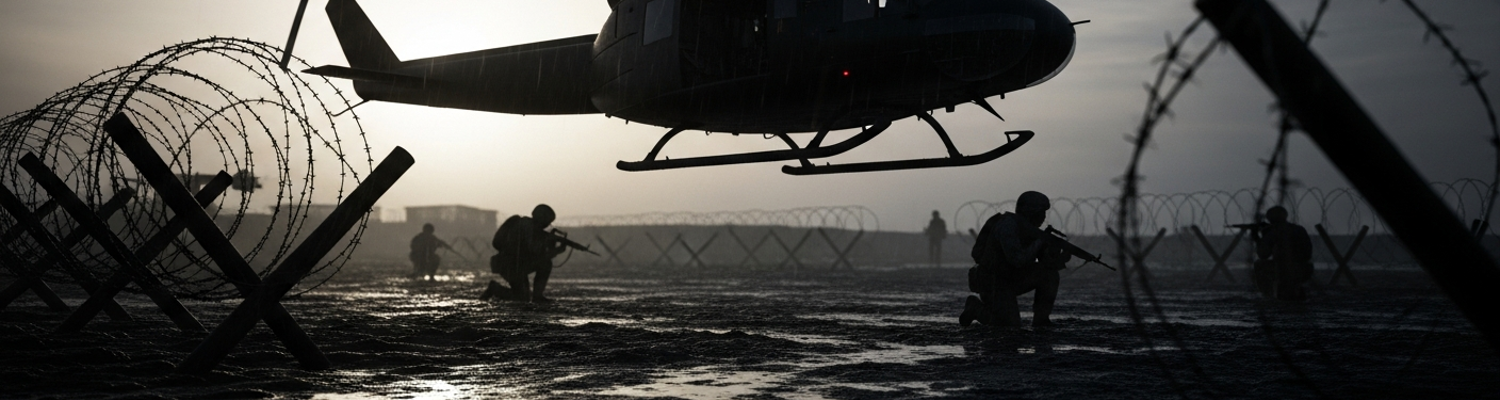
Within minutes, the small C Company garrison was at battle stations. Their posture was not one of reception but of defense. Men from the reaction force took up positions behind the main earthworks, their M16 rifles pointed toward the sky over the only viable helicopter landing zone within the wire. The outpost’s two M60 machine gun teams were directed to establish interlocking fields of fire covering the approach. The commander’s decision, made in an information vacuum, had pivoted the entire outpost’s function from a holding facility to a combat firebase preparing to repel an attack.
At precisely 09:25 hours, a single UH-1 Huey helicopter broke through the low, rain-filled clouds. The pilot, fighting the weather and a failing transmission, was met with the alarming sight of a garrison ready for a firefight. Instead of a cleared landing zone, he saw dozens of rifles and two machine guns aimed directly at his aircraft. A tense standoff unfolded. The pilot, following his own emergency procedures, refused to land in what was clearly a hostile posture. Incident reports from the 519th MP Battalion detail several minutes of confused hand signals between the hovering helicopter’s crew chief and a fire team the Lieutenant sent forward to the edge of the LZ. Only then, as soldiers on the ground made visual contact with the helicopter’s occupants, did the misunderstanding become clear. The helicopter was friendly. CHALICE was not a code for an attack, but the designator for three high-value Binh Xuyen political figures being urgently moved. The unscheduled rerouting was due to the helicopter’s mechanical emergency. The five minutes of radio silence had transformed a manageable friendly asset transfer into a near-disaster.
The immediate aftermath was chaotic. The high-risk Binh Xuyen prisoners were hustled from the damaged aircraft into a compound that was tactically arrayed for a battle, not for a secure transfer. There was no prepared isolation area, no specialized guard detail briefed on their identities or the high probability of an extraction attempt. In the scramble, the three leaders were shoved into an already overflowing general population pen, a direct violation of detainee handling protocols. This placed them among common criminals and enemy soldiers, creating a severe internal security risk.
The long-term consequences were systemic. A formal investigation led to a rapid, top-down revision of communications doctrine for isolated units. A directive issued by the Military Assistance Command, Vietnam, mandated that outposts like Lima Delta be equipped with a tertiary, independently powered radio system. Maintenance schedules for power supply components and battery terminals became a command-level inspection item. From this failure, the Lima Delta Rule was unofficially born within the military police corps: any partial or unacknowledged FLASH-precedence message concerning asset movement was to be treated as a potential hostile feint, and a defensive posture was to be assumed by default until verified by a secondary source. The Lieutenant’s decision, though factually incorrect, was deemed doctrinally sound in its caution. The investigation concluded that the failure was not one of judgment under fire, but a failure of equipment, supply, and logistical foresight.