
Demobilization Gridlock at the Oakland Processing Center
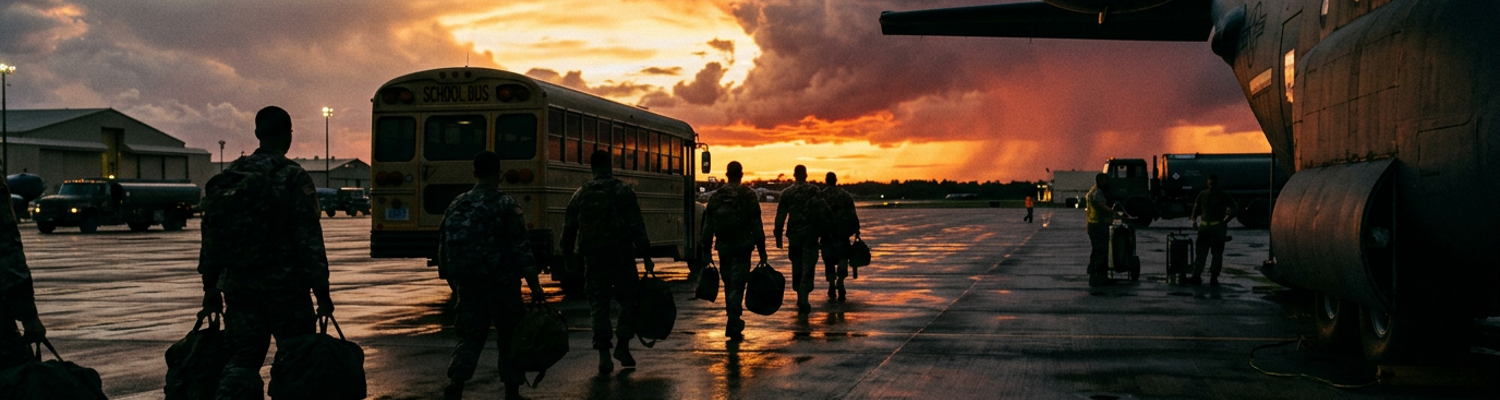
Steel hydraulic lines ruptured inside the main landing gear bay of a Lockheed C141A Starlifter transport as cracked aluminum fittings sprayed pressurized fluid over the hot wheel assembly during touchdown. Flight crews fought the violent shudder in the rudder pedals, toggled the emergency backup pressure valves, and steered the slowing transport off the active runway at Travis Air Force Base. Ground mechanics sprinted toward the smoking tires with dry chemical fire extinguishers and recovery cables, wrenching open the inspection panels to isolate the leak before it ignited. Cargo handlers rushed boarding stairs against the fuselage door to evacuate the troops, unloading three hundred soldiers who had just departed Saigon on one of the final airlift rotations. Military Assistance Command Vietnam formally cased its colors on March 29, 1973, triggering the final withdrawal of American ground elements and jamming the Pacific transit network with homeward bound units. Convoys of olive drab buses immediately loaded these arriving soldiers and ferried them down the interstate directly toward the Oakland Army Base.
Oakland Overseas Replacement Center gates received these bus convoys, but the staging base rapidly buckled under massive administrative backlogs as thousands of returnees required simultaneous records review, medical clearance, and payroll settlement. Clerks worked eighteen hour shifts at long wooden folding tables, manually inspecting dog eared personnel files, vaccination cards, and service record jackets pulled from cardboard shipping trunks. Medical technicians drew blood samples and ran hurried hearing tests in drafty converted warehouses, stamping clearance sheets as fast as soldiers filed past the examination stations. Finance officers counted stacks of cash and balanced military pay vouchers by hand, calculating combat pay differentials and travel allowances for men whose records had gaps from field redeployments. Exhausted returnees stacked their duffel bags three deep in open hallways, sleeping on bare linoleum floors while waiting two or three days for administrative clearance to travel home.
Cardboard boxes of personnel records piled beside these waiting men created an even deeper crisis because processing stations handled severe administrative gridlock exacerbated by high rates of other than honorable administrative discharges issued during the final withdrawal. Commanding officers in South Vietnam had pushed troublesome soldiers out of combat units through rapid administrative separations for narcotics use, unexcused absences, and insubordination during the final months of the theater drawdown. Staff judge advocates at Oakland had to review each contested separation file, ensuring every soldier received formal notification, legal counsel advisement, and rights waivers before release. Angry soldiers frequently refused to sign their separation forms, demanding formal board hearings and delaying entire muster formations from clearing the center. Paralegal clerks scrambled to pull missing arrest records and field hospital evaluations from overseas transit crates, holding up final discharges while telephone lines to military headquarters stayed busy.
Officers at the Oakland Overseas Replacement Center countered these record delays by establishing continuous processing shifts and routing overflow troops into vacant warehouse bays. Supply sergeants issued extra cots and wool blankets across the motor pool facilities, while civilian bus companies lined up vehicles along the perimeter roads to haul cleared personnel directly to San Francisco International Airport. Legal clerks streamlined separation packets by standardizing waiver documentation, allowing returnees with clean service records to bypass delayed disciplinary investigations. Typists produced discharge certificates on mechanical typewriters without pause, handing soldiers their separation papers, final pay envelopes, and civilian airline vouchers as soon as signatures dried. Escort details loaded the newly discharged civilians onto airfield shuttles, immediately freeing barracks cots for the next incoming flight of Pacific returnees.
Discharge Paperwork and Combat Trauma Processing Failures
Soldiers filled those vacated canvas cots within minutes of arrival, dropping heavy duffel bags on damp floorboards while bearing hidden neurological shock from months of heavy combat. Out processing facilities lacked standardized psychiatric screening mechanisms to evaluate acute combat trauma, acute stress reactions, or operational neurological strain. Medical officers conducted assembly line physicals that lasted less than five minutes, measuring resting heart rates and examining surgical scars while asking no formal questions about sleeplessness, blast concussions, or constant nightmares. Troops suffering from severe combat exhaustion, sudden panic attacks, and uncontrollable hand tremors received routine rubber stamps marking them physically qualified for separation. Doctors sent these struggling men back into general processing company formations, where their erratic behavior, sudden emotional outbursts, and deep confusion were treated by unit noncommissioned officers as intentional acts of insubordination.
Personnel officers seized on those insubordination reports to purge company rosters, routinely utilizing Chapter 10 and Chapter 13 administrative discharges to expedite the removal of disciplinary cases rather than convening special courts martial. Chapter 10 separations allowed commanders to eliminate soldiers facing court martial charges by offering them an immediate discharge for the good of the service in exchange for admitting guilt. Chapter 13 discharges provided an equally fast track to expel soldiers labeled as unsuited for military life due to apathy, alcohol dependency, or persistent rule violations. Company commanders preferred these quick paper discharges because preparing formal court martial charges required weeks of sworn witness testimony, full legal representation, and formal evidence logs that paralyzed base operations. Tired soldiers signed the administrative waiver forms just to escape the base, trading away their veteran medical benefits and civil service hiring preferences in exchange for an immediate undesirable discharge certificate.
Plastic sample bottles blocked these rapid administrative exits at the final medical station, where mandatory laboratory collections brought the clearance line to a complete halt. Urine drug testing pipelines established under Department of Defense Directive 1010.1 generated widespread administrative holding delays and false positive processing disputes. Central military laboratories used crude screening equipment that frequently misidentified legal prescription painkillers, over the counter cough syrups, and field antibiotics as illicit opiates or amphetamines. Misplaced test tubes, corrupted chemical reagents, and mixed up identification labels triggered hundreds of official legal challenges from outraged soldiers who insisted their test results were wrong. Paralegals and lab officers argued over contested sample batches while the accused men were stripped of their travel passes and marched under armed guard into temporary detention companies.
Barracks buildings assigned to these detention companies swelled with hundreds of stranded returnees as base supply sergeants set up canvas cots inside crowded gymnasiums and vehicle repair bays to handle the overflow. Attorneys from the Staff Judge Advocate office struggled through growing stacks of drug retest requests, finding that confirmation lab runs took up to three additional weeks to return from distant regional facilities. Base commanders faced severe overcrowding and resolved the crisis by forcing soldiers to accept compromise administrative separations that dropped criminal narcotics charges in exchange for immediate departure. Supply clerks issued civilian clothes, handed over partial travel allowances, and ordered transport drivers to load the released men onto departing buses. Convoy drivers shifted their buses into gear, hauling thousands of untreated and administratively scarred veterans through the installation gates toward downtown transit hubs.
Veteran Unemployment During Economic Stagflation
Veterans stepped off those arriving transport buses into metropolitan centers across the nation, carrying their green duffel bags into an economy unable to absorb them. The simultaneous onset of early 1970s macroeconomic stagflation severely reduced industrial manufacturing apprenticeships and corporate hiring quotas for returning combat veterans. Heavy industrial plants, automotive assembly lines, and steel foundries struggled under rapid cost inflation and stagnant product sales, prompting corporate directors to freeze new hires and cancel entry level training slots. Plant supervisors padlocked personnel offices at major manufacturing facilities in Detroit, Cleveland, and Pittsburgh, turning away daily lines of discharged service members. Union shop stewards enforced strict seniority rules that protected older civilian employees, barring newly returned veterans from entering union rolls without prior factory time. Foremen refused to accept military service records as qualification for commercial machine operation, leaving job seekers stranded without letters of recommendation or trade sponsorship.
Trade sponsorships remained entirely out of reach because Pentagon manpower registries revealed that mass conscription military occupational specialties offered minimal credential transferability to civilian employers. Draftees had spent their tours practicing squad tactical movements, firing machine guns, and clearing bunker complexes, tasks that provided no technical preparation for operating commercial lathes, wiring building circuits, or managing business payrolls. Corporate personnel directors routinely discarded applications from former infantrymen, actively favoring applicants who had avoided the draft and gained practical factory experience during the war years. State licensing agencies also refused to credit Army mechanical training toward civilian journeyman licenses, forcing former military mechanics and vehicle operators to restart four year apprentice programs from the beginning. Veterans who had operated complex tactical radios found civilian telecommunications companies demanding specialized commercial licenses that military signal courses had never provided. Combat arms veterans received only generalized discharge counseling that instructed them to visit state unemployment offices rather than offering direct vocational placement.
Caseworkers inside urban employment offices recorded unprecedented surges of jobless returnees who lined up daily to submit weekly claims. Data published in the April 1973 Bureau of Labor Statistics Monthly Labor Review documented an unemployment rate exceeding 9 percent for Vietnam era veterans aged 20 to 24. This percentage far exceeded the joblessness recorded among nonveterans of the same age bracket, exposing a deep gap between civilian youth and demobilized soldiers. Young veterans without family financial reserves exhausted their separation allowances within their first two months back home, forcing many to pawn their personal possessions and borrow cash to cover basic rent. Veterans Administration field offices offered little relief, leaving educational assistance claims unprocessed for months while processing clerks struggled under thousands of backlogged paper files. Claim examiners routinely delayed GI Bill tuition disbursements, leaving thousands of veteran students facing eviction from campus housing and expulsion from college courses.
Eviction notices forced these destitute returnees to gather outside private day labor dispatch halls and commercial plasma clinics at dawn, competing for temporary warehouse jobs to survive while their benefit claims remained frozen. Contractors hired these men for single shift assignments loading freight boxcars, digging construction trenches, and hauling agricultural produce, paying minimum wages in cash at the end of each day. Recruiters from newly formed all volunteer military stations attempted to capitalize on this destitution, pitching reenlistment to discharged soldiers as their only escape from long term poverty. Disillusioned veterans overwhelmingly rejected these recruitment appeals, refusing to reenlist after their combat tours and bitter homecomings had fractured their trust in military leadership. Army personnel officers watched their retention quotas collapse in urban districts, proving that economic distress alone could not persuade alienated combat veterans back into uniform. Former infantrymen pooled their daily wages to rent shared rooms in decaying boarding houses, pawned their dress uniforms, and walked back to the hiring halls each morning to wait for temporary manual labor.
Garrison Discipline Breakdowns in the Late Draft Army
Letters sent by those impoverished veterans reached active duty soldiers trapped in domestic military posts, warning them that loyalty to commanders offered no protection once their enlistments ended. Conscripted troops inside garrison barracks openly challenged routine morning inspections, ignored duty rosters, and walked away from their assigned units in unprecedented numbers. Absent without leave and desertion rates peaked across active duty divisions in 1971 at over 73 incidents per 1,000 soldiers. Draftees packed civilian clothes into gym bags, discarded their military identification tags, and climbed perimeter fences at night to escape base gates. Military police battalions struggled to locate thousands of missing personnel who fled across state lines and blended into counterculture communities in nearby college towns. Company commanders found morning roll call formations half empty, forcing battalions to cancel tactical field maneuvers and assign their remaining soldiers to continuous sentry watches.
Sentries assigned to those continuous watches carried empty rifles because senior leaders no longer trusted enlisted men with live ammunition inside domestic cantonments. Department of the Army incident logs tracked hundreds of reported fragging incidents and violent assaults on officers and senior noncommissioned officers between 1969 and 1972. Conscripts rolled M26 fragmentation grenades under the bunks of strict first sergeants, rigged tripwires to orderly room door handles, and ambushed lieutenants in darkened latrines to stop disciplinary crackdowns. Junior officers recognized the deadly hazards of enforcing routine military standards, leading many to abandon unannounced nighttime inspections and remove unit rank pins from their collar tabs. First sergeants armed themselves with privately owned handguns inside locked administrative offices, while staff officers installed security grates over command building windows. Battalion commanders responded to the escalating sabotage by chaining company arms rooms shut, locking vehicle ignition systems, and directing armed provost marshals to conduct surprise shakedown inspections through enlisted barracks bays.
Footlockers inside those barracks bays became the primary target of aggressive search details, igniting violent friction between white noncommissioned officers and minority soldiers who endured systemic discrimination. Racial polarization and administrative distrust produced major disturbances across continental garrisons, including Fort Carson and Travis Air Force Base transit barracks. Black soldiers faced disproportionate non judicial punishment under Article 15, received lower administrative efficiency ratings, and found themselves funneled into menial labor details while white peers took preferred technical assignments. Dissident service members formed unified defense councils, openly displayed cultural symbols, and demanded the immediate dismissal of prejudiced company commanders. Fights with steel pipes, broken bottles, and entrenching tools broke out inside mess halls, enlisted clubs, and transit dormitories, shattering base routines. Command authorities declared installation wide curfews, sealed off exterior access roads, and assembled quick reaction forces equipped with protective flak vests, riot shields, and tear gas dispensers.
Platoons armed with tear gas and wooden clubs charged into overcrowded barracks blocks at Fort Carson, fracturing resistant crowds and herding bruised soldiers into temporary stockade compounds. Air Force security police cordoned off the transient quarters at Travis, pushing fighting airmen onto adjacent tarmac aprons and arresting dozens of combat returnees. Base provost marshals jammed installation confinement cells past legal operating capacities, forcing supply sergeants to erect barbed wire pens and canvas holding tents across motor pool lots. Overwhelmed legal officers struggled to process hundreds of formal mutiny charges, creating backlogs that immobilized operational commands and drained installation manpower. Division commanders recognized that the draft era disciplinary apparatus had broken down entirely, leaving domestic garrisons completely incapable of maintaining basic unit cohesion or deploying combat ready forces. Senior staff officers abandoned further mass court martial proceedings, instead ordering transit commanders to expedite administrative separations and load unmanageable draftees onto chartered civilian buses headed for civilian terminals.
Project VOLAR Experiments at Selected Continental Posts
Buses carrying discharged draftees rolled away from garrison terminals, leaving hollowed out company blocks that forced senior leadership to reshape the military environment from the ground up. General William Westmoreland, serving as Army Chief of Staff in 1971, authorized Project VOLAR field experiments across test installations including Fort Benning, Fort Ord, and Fort Carson to halt this personnel hemorrhage. Westmoreland directed experimental posts to dismantle old draft era restrictions and treat soldiers more like civilian workers, betting that improved living standards would rescue recruiting numbers. Base logisticians scrambled to convert spartan World War II wooden barracks into partitioned dormitories with private rooms, acoustic ceiling tiles, and carpeted dayrooms. Staff officers tracked initial troop responses at each test site, recording daily duty attendance while construction crews began remodeling company spaces.
Carpenters remodeled interior barracks bays while experimental concessions eliminated mandatory reveille formations, allowing soldiers to report directly to their morning work sites without standing outside in dawn roll call lines. Post commanders altered dining regulations to allow beer in barracks mess facilities, installing cold beverage draft dispensers and commercial jukeboxes inside enlisted dining halls to boost morale. Private civilian vendors took over base maintenance details, sweeping perimeter roads, mowing company lawns, and cleaning grease traps that had previously trapped soldiers in endless fatigue duty. Infantrymen at Fort Carson and Fort Ord hung civilian posters on bedroom walls, purchased off duty civilian clothing, and walked off base after duty hours without requesting overnight passes. Unit supply sergeants locked away floor buffers and utility brooms as commercial cleaning crews washed latrines and waxed hallway linoleum under long term service contracts.
Commanders and field grade officers representing traditionalist factions watched these civilian janitors mop barracks hallways with growing alarm, warning that relaxed garrison standards degraded unit cohesion and undermined operational accountability without improving reenlistment. Battalion leaders discovered that dropping roll call formations caused morning work details to disintegrate, as junior enlisted troops routinely failed to report to motor pools and training ranges on time. Noncommissioned officers lost their daily supervisory grip over squad members, struggling to enforce basic grooming standards, uniform wear, or weapon cleanliness inside locked private rooms. Beer consumption inside barracks mess facilities sparked late night brawls, damaged dining furniture, and produced hungover crews who could not safely operate heavy tactical vehicles. Company commanders submitted formal assessment memorandums up their divisional chains of command, reporting that volunteer enlistment rates remained essentially flat while equipment readiness plummeted across experimental units.
Tanks and armored personnel carriers sat disabled on motor pool wash racks across Fort Carson as unmonitored crews bypassed scheduled preventive maintenance checks. Civilian contractors refused to work beyond their contracted daytime shifts, leaving broken diesel fuel injectors, stripped track pins, and drained hydraulic reservoirs unattended when field exercises ran into the evening. Mechanics arrived at work to find entire battalions of M60 tanks grounded by unrecorded electrical shorts and contaminated oil sumps that soldiers had neglected to report. Division inspectors conducting unannounced combat readiness evaluations found gun tubes fouled with carbon, radio batteries dead in their charging cradles, and weapons racks missing critical bolt assemblies. Staff officers at the Pentagon received these alarming inspection dossiers and drafted urgent policy revisions, directing installation commanders to reassert tactical discipline before the remaining combat divisions lost all operational utility.
Enlistment Shortfalls and Mental Category IV Quotas
Operational utility suffered another massive blow when Secretary of Defense Melvin Laird officially ended military draft inductions in January 1973, shifting the service to voluntary procurement ahead of the statutory June deadline and stripping those struggling installation commanders of their primary replacement manpower. This abrupt policy termination dismantled the Selective Service intake pipeline before Army training bases could establish a functioning volunteer replacement network, leaving depleted units unable to fill empty bunks created by the wave of administrative separations. Pentagon planners had banked on dramatic market incentives to lure civilian recruits, counting on recent federal legislation that provided a substantial military pay increase by more than doubling base wages for junior enlisted soldiers. Young civilian workers nonetheless avoided recruiting stations, viewing garrison life and lingering Vietnam era stigma as unacceptable risks despite the higher paycheck. Command sergeants major walked through half vacant reception barracks at basic training depots in Fort Jackson and Fort Knox, counting empty squad bays where hundreds of new draftees had previously arrived on chartered overnight buses every week.
Buses stopped arriving because United States Army Recruiting Command suffered chronic quota deficits during the initial months of 1973 despite the passage of substantial military pay increase legislation, stranding those training depot reception centers with a fraction of their planned troop volume. Station commanders in industrial cities across the Midwest and Northeast set up storefront offices, displayed color brochures promising technical trade training, and distributed radio advertisements to draw working class applicants. Recruiters logged sixty hour work weeks interviewing high school seniors, but prospective volunteers repeatedly walked out of stations after learning that combat arms specialties offered few direct civilian trade licenses. Monthly enlistment returns fell thousands of soldiers behind authorized procurement targets by March, creating severe personnel gaps in armor, artillery, and infantry entry streams. Field recruiters submitted urgent status teletypes to command headquarters in Maryland, documenting empty waiting rooms and reporting that raised wages failed to overcome widespread anti military sentiment among young men.
Pentagon staff officers analyzed these dismal recruiting teletypes and scrambled to prevent total troop numbers from falling below congressionally mandated thresholds. Recruiting shortfalls forced the Department of the Army to accept elevated proportions of Armed Forces Qualification Test Mental Category IV enlistees to maintain authorized end strength. Testing centers across the country lowered their admissions barriers, administering standardized paper exams to applicants whose test scores fell into the lowest acceptable percentile bands between ten and thirty. Processing doctors and test administrators stamped paperwork approving thousands of Category IV recruits who struggled with basic reading comprehension, elementary math, and basic technical instructions. Guidance counselors steered these newly admitted enlistees into combat arms and logistics pipelines, issuing them bus vouchers to shipping centers while flagging their files with educational remediation waivers.
Sergeants at Fort Jackson and Fort Dix watched these low scoring recruit companies climb down from arrival buses and immediately ran into severe instructional bottlenecks on rifle ranges and in classrooms. Trainees struggled to read basic operator manuals for the M16A1 rifle, failed to calculate correct sight adjustments, and frequently mishandled routine field maintenance on tactical equipment. Instructors halted standard training schedules to conduct emergency remedial reading courses in mess halls, using blackboard diagrams and flashcards to teach basic mechanical nomenclature. Company commanders pushed struggling platoons through simplified field qualification courses to prevent high attrition rates from shrinking squad rosters even further. Supply clerks stamped graduation certificates for soldiers who could barely service their assigned weapons, packing these underqualified volunteers onto transport flights bound for operational divisions in West Germany and across continental bases.
TRADOC Establishment and Combat Doctrine Overhaul
Infantry battalions in West Germany absorbed these arriving recruits only to find that the new soldiers could not bore sight tank guns, clear jammed machine guns, or calculate basic mortar trajectories during field maneuvers. Broken track assemblies, misaligned optics, and unmonitored radio frequencies paralyzed European motor pools, proving that the old Continental Army Command training pipeline was producing soldiers completely unready for modern mechanized combat. Army Chief of Staff General Creighton Abrams orchestrated Operation STEADFAST in July 1973, dismantling Continental Army Command to form the United States Army Training and Doctrine Command, known as TRADOC, alongside Forces Command. Abrams recognized that splitting training responsibilities across fragmented regional armies had destroyed instructional accountability and left the service without a unified tactical doctrine. General William E. DePuy assumed command of the newly established headquarters at Fort Monroe, Virginia, immediately taking direct control over all branch schools, training centers, and doctrine development desks.
TRADOC Commander General William E. DePuy eliminated obsolete mass conscription training doctrines across those newly acquired installations, discarding lecture heavy classroom hours that had advanced passive recruits through arbitrary schedules without testing individual technical skills. DePuy instituted performance oriented Basic Combat Training standards that required every trainee to demonstrate hands on mastery of specific tactical tasks before graduation. Instructors replaced traditional pass or fail group curves with strict task checklists, forcing soldiers to repeatedly strip weapons, troubleshoot field radios, and apply combat dressings until they performed each step without error. Drill sergeants stopped lecturing from classroom podiums and instead positioned trainees directly in front of weapon components and vehicle engines, testing recruits one by one against rigid time limits. Remedial instruction stations kept struggling enlistees on the practice pads until they proved competence, preventing underqualified soldiers from advancing on administrative waivers. Training depots printed thousands of pocket sized Soldier Manuals that clearly outlined every required skill, giving junior enlisted personnel straightforward reference guides for their exact duty positions.
Manuals issued to those company specialists reflected a sweeping strategic shift, as TRADOC doctrine pivoted from attrition based jungle warfare toward mechanized combined arms operations aimed at countering Warsaw Pact forces in the European theater. DePuy studied the high intensity tank engagements of the October 1973 Yom Kippur War, analyzing how modern anti tank guided missiles, precision artillery, and integrated surface to air defenses destroyed massed armor formations within hours. Tactical analysts at Fort Monroe examined the catastrophic vehicle loss rates across the Sinai and the Golan Heights, concluding that American forces in West Germany would face Soviet armored columns with staggering numerical superiority. Planners discarded lingering counterinsurgency search and destroy habits, designing new operational manuals around concentrated direct fire, rapid lateral movement, and tight tactical suppression to win the initial battle while heavily outnumbered. Combined arms teams integrated M60A1 tanks with M113 armored personnel carriers, self propelled howitzers, and close air support aircraft into layered defensive corridors along likely invasion routes like the Fulda Gap.
Crews operating those M60A1 tanks and M113 carriers deployed across West German training ranges to practice the synchronized defensive maneuvers demanded by this new doctrine. Tank gunners engaged pop up wooden targets from hull down defilade positions, drivers executed rapid displacements between prepared firing ramps under tactical smoke, and mechanized infantry squads dismounted rapidly to secure vehicle flanks. Field evaluators stood behind the firing lines with stopwatches and standardized scorecards, grading vehicle crews against the criteria referenced time benchmarks established by TRADOC. Battalions that failed qualification standards or missed designated engagement windows were pulled from rotation and sent back to motor pools for intensive remedial drills. Mechanics worked through the night replacing stripped track shoes, rebuilding hydraulic traversing mechanisms, and restocking live sabot ammunition to keep the armor battalions combat ready on the European frontier.
Sergeants and the Modern Noncommissioned Officer Corps
Tank commanders inspected those freshly restocked ammunition racks and rebuilt traversing gears at dawn, exposing a persistent failure among junior leaders who had advanced through rapid wartime promotion pipelines. Conscript era personnel policies during the Vietnam War had pushed soldiers into squad leader slots through two year temporary promotions, leaving armored cavalry troops and infantry platoons with sergeants who lacked deep technical expertise and small unit administrative discipline. The Army eliminated two year temporary conscript promotions and established the centralized Noncommissioned Officer Education System to create a structured sequence of institutional schooling tied to professional progression. Branch schools across continental training centers opened standardized classrooms where young enlisted leaders learned tactical decision making, troop accountability, and weapons maintenance through the Primary Leadership Development Course. Instructors forced corporals and prospective sergeants to navigate dense woodland terrain on foot, draft five paragraph field orders under time constraints, and physically direct live fire maneuver lanes to earn their noncommissioned officer credentials. Soldiers who completed this training returned to operational companies equipped with identical instruction methods, replacing haphazard company habits with uniform standards across motor pools and field assembly areas.
Scorecards and diagnostic gauges filled those motor pools as the Army instituted mandatory skill qualification testing to verify individual technical competence. Specialists and squad leaders had to pass hands on performance evaluations and written examinations covering equipment troubleshooting, gunnery calculations, and tactical radio operation. Rigorous retention screenings purged chronic disciplinary cases and barred soldiers who repeatedly failed their qualification tests from remaining in the ranks. Centralized promotion boards convened at the Military Personnel Center in Virginia, replacing local patronage systems that had allowed company commanders to award promotions based on personal favoritism or unit convenience to build the post Vietnam professional force. Board members reviewed standardized evaluation files, formal schooling certificates, and skill qualification scores to select only verified performers for advancement into higher noncommissioned grades. Enlisted personnel records received systematic scrutiny across every branch, ensuring that every newly promoted sergeant met identical institutional benchmarks before taking command of crews or squads.
Squads required strong leadership at the top, prompting General Creighton Abrams to expand the authority and institutional stature of the Sergeant Major of the Army and command sergeants major across brigade and battalion echelons to cement this reformed enlisted hierarchy. Command sergeants major moved their operational desks directly into battalion headquarters suites, sitting alongside field grade officers to help manage unit training plans and enforce troop readiness. Sergeant Major of the Army Leon L. Van Autreve traveled continuously between European border posts, continental training centers, and the Pentagon to advocate for enlisted education and uniform disciplinary enforcement. Senior noncommissioned officers received full responsibility for barracks administration, routine supply management, and preventative equipment upkeep, taking over daily oversight roles that junior officers had previously mismanaged. Battalion commanders gave their command sergeants major direct administrative power to inspect weapons rooms, validate motor pool dispatch logs, and remove unqualified squad leaders from frontline formations. Sergeants major walked the perimeter lines and motor pools every morning with clipboards and torque wrenches, personally verifying that crews serviced tank track pins and boresighted heavy machine guns before morning roll call.