
A close review of operational logs from January 1776 shows a Continental Army in the process of disintegration. Facing a reinforced British military, enlistment contracts expired for most of the 22,000 soldiers. Congress could not make payroll for two months. Less than half chose to reenlist. The force that remained was critically short of the implements of war. An audit of Washington’s army revealed fewer than five rounds of powder per man. The loss of Forts Washington and Lee in November 1776 alone cost the Americans 149 artillery pieces. This weakness was not a secret. It created an environment where a clandestine support structure became a matter of strategic survival. The French government, seeking to counterbalance British power after the Seven Years’ War, saw an opportunity. Foreign Minister Charles Gravier, Comte de Vergennes, needed a method to weaken Britain by sustaining the American rebellion without triggering an open conflict for which France was not yet prepared.
The solution was a playwright.
Pierre-Augustin Caron de Beaumarchais was a watchmaker, inventor, and financier who had already undertaken secret missions for the French crown. Operating as a clandestine agent in London during 1775, Beaumarchais made contact with Arthur Lee, a Virginian agent for the colonies. Through these channels, he gained a detailed understanding of the American cause and its dire logistical needs. Returning to France, he leveraged his position and flair for dramatic argument to convince Vergennes and, eventually, King Louis XVI. His proposal was direct: secretly arm the Americans to prolong their fight, bleed British resources, and reclaim French prestige. A series of formal reports outlined a plan for a covert operation that would provide the rebels with arms while giving the French crown plausible deniability.
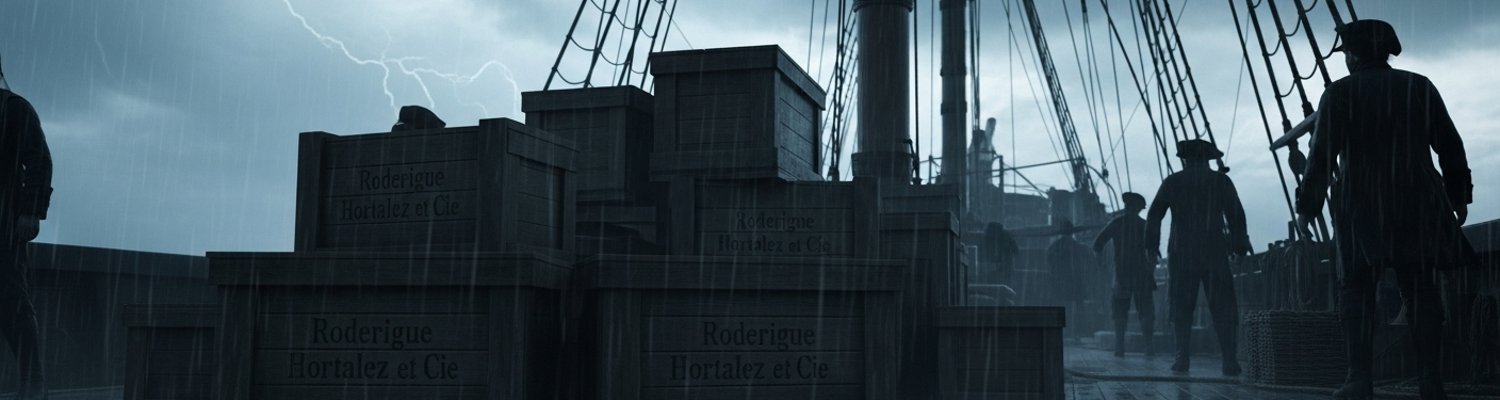
Archival evidence shows that in May 1776, King Louis XVI gave his quiet approval, authorizing one million livres from the French treasury for the operation. Vergennes then instructed Beaumarchais to establish the mechanism for the transfer. The result was a ghost company, a commercial front registered not in France, but with a Spanish name to further obscure its origins: Roderigue Hortalez et Cie. Beaumarchais established the firm’s headquarters in a large, private mansion in Paris that had formerly served as the Dutch embassy, the Hôtel des Ambassadeurs de Hollande. Vergennes persuaded his counterpart in Spain to match the French contribution, and King Carlos III secretly provided another million livres. A third million was raised from private French merchants. The total startup capital was three million livres. The company’s official business was import-export, trading French goods for American tobacco and rice in the Caribbean. This cover story provided the necessary pretext for hiring ships and purchasing large quantities of military-grade supplies. On July 18, 1776, Beaumarchais met with the newly arrived American commissioner, Silas Deane, and offered him credit through the company, formalizing the operational pipeline.
The purpose of Roderigue Hortalez et Cie was singular. It was to funnel massive quantities of French and Spanish military surplus into the hands of the Continental Army. The first shipments organized by Beaumarchais contained clothing and equipment for 25,000 to 30,000 men, over 200 cannons, tens of thousands of muskets, and vast stores of gunpowder. The muskets were primarily French infantry-standard Model 1763 and 1766 Charleville muskets, a .69 caliber flintlock that would become a workhorse for American forces. The initial convoys sailed not directly to America, but to neutral ports in the West Indies, like the Dutch island of St. Eustatius, where the transaction to American agents could take place. The first of these ghost convoys successfully landed its cargo at Portsmouth, New Hampshire, in early 1777, providing three million livres’ worth of materiel. This infusion included 200 field guns, thousands of muskets, powder, blankets, and shoes. These specific supplies were instrumental in the American victory at Saratoga in October 1777, the battle that ultimately convinced France to enter the war openly.
The subterranean supply channel established by France was a lifeline. Without it, the Continental Army would have likely ceased to be a credible fighting force. A deep look into operational logs shows this was not a matter of a few scattered shipments, but a sustained, clandestine logistics operation designed to systematically equip an entire army. The volume of materiel funneled through Rodrigue Hortalez et Cie was transformative. By the fall of 1776, initial shipments included over 300,000 pounds of gunpowder, 30,000 muskets, and complete uniforms for 30,000 soldiers. For certain categories of equipment, it was the entirety of their supply. Some analyses suggest that up to 90 percent of the arms used by the Americans during the Saratoga Campaign originated from these secret French shipments. The operation was an effective construct of plausible deniability. Ships sailed from French and Spanish ports not to America, but to the neutral Dutch island of St. Eustatius in the Caribbean. There, the military cargo was offloaded and sold to American agents in a series of sham transactions before being reloaded onto American vessels for the final leg of the journey to ports like Portsmouth, New Hampshire.
The gunpowder was a weapon in itself. Before the French intervention, the colonies had only one significant powder mill, the Frankford Mill in Pennsylvania, whose output was minimal and of inconsistent quality. General Washington’s own correspondence from January 1776 reveals an army with almost no powder in its magazines. The French powder was a different class of munition. Under the direction of the chemist Antoine Lavoisier, who had been appointed to run the French national gunpowder administration in 1775, the manufacturing process was revolutionized. Lavoisier applied exacting chemical standards, settling on a precise ratio of 75% saltpeter, 12.5% charcoal, and 12.5% sulfur, which improved its explosive force. This new French powder was considered the best in the world, giving American troops a distinct tactical advantage. It burned more rapidly and consistently, reducing misfires and increasing the muzzle velocity of musket balls. This translated directly to greater range and hitting power on the battlefield. British officers took note when American lines, armed with French powder, could engage them effectively at distances their own weapons could not match.
The primary firearm supplied through this channel was the French Model 1763 and its successor, the Model 1766 Charleville musket. These .69 caliber, smoothbore flintlocks were a significant upgrade for the Continental Army, which was initially plagued by a chaotic mix of personal hunting pieces, captured British Brown Bess muskets, and outdated colonial militia arms. The Charleville was a standardized, military-grade weapon. Tens of thousands were shipped to America. One shipment in March 1777 alone brought 6,000 Charlevilles for the Continental Army and another 5,000 for state militias. Its robust design and the fact that it was issued in such large quantities helped standardize both ammunition and training for American forces, a necessary step in transforming a collection of militias into a professional army. Over 100,000 French muskets, primarily Charlevilles, were supplied over the course of the war. This weapon was so foundational that the first domestically produced American military musket, the Springfield Model 1795, was a direct copy of the Charleville design.
The entire clandestine enterprise depended on a fragile, 3,000-mile-long line of communication stretched across the Atlantic. This connection was perpetually at risk of being severed. A review of the operational records of the Committee of Secret Correspondence reveals a system reliant on methods that were ingenious but disturbingly vulnerable. Dispatches containing arms requisitions, shipping manifests, and diplomatic instructions were painstakingly encrypted. American commissioners like Silas Deane and Benjamin Franklin used nomenclator ciphers. This was a laborious system where a pre-shared dictionary or codebook assigned numbers or symbols to specific words, names, and concepts. To add another layer of security, sensitive sections were often written between the lines of an innocuous business letter using sympathetic stain, an invisible ink developed by Dr. James Jay. This ink, typically a solution based on tannic acid, became visible only when the recipient applied a specific chemical reagent or heat. These precautions were only as strong as their weakest link. A captured codebook rendered all past and future messages transparent. The reliance on verbal instructions carried by trusted couriers represented an even greater gamble, a desperate measure for information too sensitive to write down.
The ocean was the first enemy.
The physical act of transporting a message from Paris to Philadelphia was a battle against time and nature. A typical westbound crossing could take anywhere from six weeks to three months, a period of agonizing uncertainty for commanders waiting for confirmation of supplies or intelligence. The vessels themselves, often small brigs or sloops chosen for their speed and ability to evade patrols, were highly susceptible to the Atlantic’s fury. Archival accounts are filled with descriptions of voyages beset by winter gales, hurricanes, or weeks of dead calm that could exhaust provisions and water. Navigators, operating without modern technology, relied on sextants, often-unreliable chronometers, and dead reckoning to plot their course. A minor miscalculation could send a ship hundreds of miles off course. The loss of a ship meant the complete and permanent loss of the information it carried, a void of intelligence that could leave an entire army in the field blind to its own supply chain.
Even if a courier survived the voyage, he then had to run a gauntlet of human predators. The Royal Navy, the most powerful maritime force in the world, was tasked with blockading the American coast and interdicting rebel communication. British frigates patrolled the sea lanes off France and the American colonies, stopping and searching any vessel suspected of aiding the insurrection. The capture of a diplomatic pouch could expose the entire French operation, providing London with undeniable proof of French complicity and a pretext for open war before Paris was prepared. The threat was not just at sea. British intelligence maintained an extensive and highly effective spy network in Paris, focused intently on the activities of the American commissioners. The operation’s greatest vulnerability was a man at its very center: Edward Bancroft. Bancroft, a physician and scientist from Massachusetts, served as the trusted secretary to the American commission in Paris, working intimately with both Silas Deane and Benjamin Franklin. He was also, from December 1776, a paid agent of the British Crown. Bancroft had access to nearly every dispatch, every coded letter, and every secret negotiation. He would write his own reports in invisible ink and leave them in a dead drop, a hole in a tree in the Tuileries Garden, for his British handlers. Through Bancroft, the British government often had copies of American dispatches within days of them being written, long before the originals ever began their perilous journey across the ocean.
A review of operational records shows the Continental Army was planning in the dark. The intelligence lag was not a matter of hours or days, but months. A general in the field requiring confirmation of a French arms shipment from Rodrigue Hortalez et Cie would not receive a reply for anywhere between three and six months. This was the round-trip time for a fast dispatch vessel across the Atlantic. This rendered tactical agility based on transatlantic logistics nearly impossible. A plan for a summer offensive conceived in April, contingent on the arrival of French gunpowder and artillery, would not know if its foundational supplies even existed until July or August. By that time the strategic window had likely closed. This delay forced a reactive posture upon American commanders, who had to base their major movements on what materiel they had on hand, not what was promised.
The British exploited this vulnerability with systematic precision. The Royal Navy’s blockading squadrons were not merely a blunt instrument to stop trade; they were an intelligence collection mechanism. A standing order for frigate captains patrolling the sea lanes off the French coast and the American eastern seaboard was the seizure of all mail. Admiralty records from the period are filled with intercepted correspondence, providing London with a near-complete picture of American diplomatic and logistical planning. A particularly damaging capture occurred in May 1777, when a British patrol intercepted a letter from General George Washington to Congress. The dispatch contained a detailed breakdown of the Continental Army’s entire order of battle, including the organization of regiments, brigades, and divisions, along with their associated commanders. This document, Washington’s entire command structure, was laid bare for General William Howe.
This stream of intercepted data was powerfully augmented by a human intelligence network operating at the heart of the American mission in Paris. While Edward Bancroft was the most damaging agent, he was part of a larger system. His handler, Paul Wentworth, ran a network designed to get intelligence from Bancroft’s dead-drop location into the hands of Lord Stormont, the British ambassador. From there, the copied American dispatches were sent by diplomatic courier to London. King George III and his ministers often read American requests for aid and reports on convoy schedules at the same time as, or even before, their intended recipients in the Continental Congress. The British knew the precise details of the French-American Treaty of Alliance just two days after it was signed. This allowed the Royal Navy to plan patrols and interceptions with foreknowledge of ship departures, cargo manifests, and intended destinations.
A close review of operational logs from 1777 shows the birth of a new tactical instrument within the Continental Army: dedicated light infantry regiments. These units were not militia pressed into skirmish lines; they were a direct response to the effectiveness of British light companies and Hessian Jägers. Their purpose was speed, battlefield intelligence, and the ability to screen the main army. These tasks demanded a level of discipline and equipment homogeneity the army had previously lacked. The formation of these elite units, such as the Corps of Light Infantry temporarily commanded by Brigadier General Anthony Wayne in 1779, was entirely dependent on the materiel funneled through Beaumarchais’s ghost company. These soldiers could not function with a chaotic mix of personal hunting rifles and captured arms. They required standardized, reliable, military-grade weapons.
The French Model 1766 Charleville musket was that weapon. Tens of thousands of these .69 caliber flintlocks arrived in shipments, allowing Washington to equip entire brigades with a single, uniform firearm for the first time. This solved a crippling supply nightmare. For a light infantry company operating ahead of the main force, the ability to interchange ammunition, flints, and even parts from damaged muskets was a matter of survival. An officer could now be certain that the paper cartridges in his men’s boxes would fit every musket in the line. This standardization, paid for by French and Spanish coin, directly translated into heightened combat effectiveness. It allowed commanders like Daniel Morgan to integrate his riflemen, known for their long-range accuracy but slow rate of fire, with light infantry who could deliver rapid, disciplined volleys at closer ranges. The high-quality French gunpowder also gave them a distinct advantage, providing increased muzzle velocity and battlefield reliability.
The operational tempo of the entire Continental Army was tethered to the arrival of these ghost convoys. Campaign planning became an exercise in hope and frustration. A review of Washington’s correspondence reveals a commander forced to make strategic decisions based on quartermaster reports that were months out of date. An offensive designed for June was contingent on a shipment of French artillery and powder that had sailed from Nantes in March. Whether it had been captured by the Royal Navy, lost in an Atlantic storm, or was sitting on a dock in Portsmouth was entirely unknown. The Battle of Brandywine in September 1777 serves as a case study. Washington’s army, positioned to defend Philadelphia, was a force of haves and have-nots. Some brigades, newly equipped with French Charlevilles and bayonets, were able to stand and fight toe-to-toe with British regulars. Others, armed with a miscellany of older, less reliable weapons and few bayonets, were prone to breaking. The British flanking maneuver that ultimately won the battle exploited weaknesses in the American line that were a direct result of these equipment disparities.
For the common soldier, the war was a contest of attrition fought not just against British regulars, but against his own equipment. A cracked shoe sole in the frozen mud of a New Jersey winter meant frostbite, amputation, or desertion. A broken firing pin on a non-standard musket rendered a man a spectator in a firefight. The absence of a bayonet meant that if a British line closed for a charge, the only options were to run or die. These were immediate, life-or-death realities for every man in the ranks. The failure of a single wagon, its axle broken on a primitive road, could mean a company went without rations, its fighting strength sapped by hunger before a shot was even fired.
The non-arrival of a promised shipment was a catastrophic event. It had cascading tactical consequences. An army planning an offensive based on the expected arrival of a convoy from France was gambling its existence on a vessel surviving a 3,000-mile Atlantic crossing, evading Royal Navy patrols, and finding a safe harbor. A delay of weeks could render a strategic plan obsolete. The complete loss of the ship meant an entire military operation had to be aborted, leaving units exposed and objectives unmet. This forced American commanders into a fundamentally reactive posture, basing campaigns on the meager supplies they had on hand rather than what was strategically required.
It was into this void that the ghost convoys of Roderigue Hortalez et Cie sailed. The materiel provided by Beaumarchais was the foundation for some of the Continental Army’s most significant engagements. Evidence from the Saratoga campaign is definitive. Analyses suggest that as much as 90 percent of the arms used by the American forces who surrounded and defeated General John Burgoyne’s army came from these secret French shipments. This included tens of thousands of Model 1766 Charleville muskets, a .69 caliber weapon that allowed entire brigades to be standardized for the first time. The French de Vallière cannons that arrived on the ship Amphitrite in early 1777 were instrumental in the siege that forced Burgoyne’s surrender on October 17. These guns gave the Americans a field artillery capability they previously lacked, allowing them to counter British batteries and tighten the ring around the trapped army. Every crate of muskets and every barrel of high-grade French gunpowder offloaded at Portsmouth directly translated into increased combat effectiveness, arming units that could screen the main army, execute complex maneuvers, and stand in a line of battle.