
The 1964 Kalimantan Frontier Deployment Mandate
Moving three hundred fully equipped combat personnel across the uncharted mountainous spine of Borneo within a single day and a half defied basic aviation physics.
Archival evidence shows that in early April the joint command headquarters in Kuching received a directive from Whitehall. Commanders received an impossible thirty-six-hour execution window in 1964 for border operations along the porous Sarawak-Kalimantan boundary. The urgency originated directly from the Foreign Office in London. Diplomats required immediate physical occupation of forward listening posts before an impending regional summit in Manila could legitimize Indonesian territorial claims. Planners at the 3rd Commando Brigade stared at maps depicting one thousand miles of primary rainforest. The terrain lacked landing zones. It lacked refueling depots. It lacked navigational beacons. The mandate required establishing a defensive perimeter spanning from the coastal swamps of Tanjong Datu to the high-altitude ridges of the Kelabit Highlands. Generating the necessary sortie rates meant ground crews had to bypass standard maintenance cycles on their rotary-wing assets. Teletype logs from April 12 indicate that staff officers calculated a minimum requirement of seventy-two hours just to stage aviation fuel in 55-gallon drums via riverboats up the Rejang River.
They had exactly half that time.
The compressed timeline forced supply officers to commandeer civilian timber barges to move the high-octane avgas. Whitehall refused any requests for deadline extensions. A close review of operational flight logs indicates that military planners turned to specialized aviation assets to meet this compressed political deadline. Covert UH-34 Choctaw helicopters performed airlifts of indigenous border scouts along the Kalimantan frontier. These aircraft operated completely stripped of all standard military markings and national insignias. Mechanics removed the heavy side armor plates. They removed the co-pilot seats. They removed the standard-issue VHF radios to maximize the payload capacity of the Wright R-1820-84 nine-cylinder radial engines. The humid air of the Bornean highlands severely degraded engine performance. Operating out of temporary dirt strips near the village of Long Semado, the Choctaws shuttled platoons of Iban and Penan tribesmen directly into contested zones. These indigenous irregulars were recruited specifically for their deep-jungle tracking capabilities. Pilots navigated visually at tree-top level. They followed the winding paths of river tributaries to avoid Indonesian anti-aircraft radar installations located across the border at Pontianak. The indigenous scouts carried minimal rations. They armed themselves primarily with L1A1 Self-Loading Rifles and traditional parangs. This allowed the UH-34s to pack up to twelve men per chalk. Insertions required the helicopters to hover precariously over 150-foot dipterocarp tree canopies. The scouts fast-roped into the dense undergrowth at coordinates 3 degrees 50 minutes North 115 degrees 35 minutes East.
Engine temperatures frequently spiked past 250 degrees Celsius during these maximum-power hovers.
The diplomatic calculations in London relied entirely on the mechanical survival of those aging radial engines. A single downed UH-34 on the Indonesian side of the border would provide Jakarta with undeniable physical proof of unauthorized cross-border incursions. Foreign Office officials drafted contingency press releases denying any knowledge of the Choctaw flights. They prepared to disavow the pilots entirely. Ground commanders in Borneo instituted a strict protocol. Any downed aircraft had to be destroyed with thermite grenades before the crew initiated evasion and escape procedures.
The margin for error sat at zero.
Equipment Corrosion and Signal Relay Failures
When examining the historical record of April 1964, maintenance logs from No. 845 Naval Air Squadron reveal a rapid degradation of hardware staged along the coastal swamps of Tanjong Datu. Aircraft operating near the South China Sea absorbed massive quantities of saline moisture through their engine intakes and open crew doors. Pervasive salt corrosion jammed machine gun bolts and degraded aircraft hardware during insertion sequences. Armorers supporting 42 Commando documented widespread seizing of the bolt carrier groups within their L7A2 General Purpose Machine Guns. The high-carbon steel components of these weapons rusted solid within twelve hours of exposure to the coastal air. Mechanics inspecting the UH-34 Choctaws discovered severe galvanic corrosion eating through the magnesium alloy transmission housings and aluminum cyclic control linkages. Ground crews attempted to coat the exposed metal surfaces with thick layers of heavy cosmoline grease. This temporary fix attracted coarse volcanic sand from the makeshift landing zones. The mixture created an abrasive paste that ground down the internal bearings of the main rotor masts.
Sortie cancellation rates exceeded forty percent by the third day of the deployment.
A close review of operational logs indicates that commanding officers at the Kuching joint headquarters ordered flights to proceed regardless of the equipment degradation. Pilots flew insertion missions with jammed defensive armaments. Door gunners resorted to carrying personal Sterling submachine guns. The primary door-mounted Browning .30 caliber weapons repeatedly failed to cycle during test firings. The salt-crusted firing pins lacked the kinetic energy to detonate the primer caps on the 7.62mm ammunition. Maintenance detachments lacked the replacement barrels required to fix the issue. Crews scrubbed the rust off with wire brushes between flights.
The jungle canopy trapped the coastal moisture against the mountainous terrain.
Moving inland toward the Kelabit Highlands exposed the units to a completely different atmospheric threat. Vacuum-tube radio failures systematically crippled tactical signal intelligence relays in the humid jungle environment. Forward listening posts manned by D Squadron of the 22 SAS Regiment relied on A41 manpack sets and Collins 618T HF transceivers. They transmitted Indonesian troop movements back to headquarters. These communication systems depended on fragile thermionic valves to amplify the radio frequencies. The ambient humidity consistently hovered at ninety-eight percent under the primary dipterocarp canopy. Moisture bypassed the degraded rubber O-ring seals on the radio chassis. The water pooled directly on the hot glass envelopes of the vacuum tubes. The extreme temperature differential caused the glass to shatter instantly upon powering the units. Signal intelligence teams operating at coordinates 1 degree 33 minutes North 110 degrees 25 minutes East reported complete communication blackouts lasting up to six days.
Operators cannibalized broken radios to build a single functioning receiver.
Archival evidence shows that the 216 Signal Squadron attempted to air-drop replacement valves packed in specialized shock-absorbent crates. The dense foliage intercepted the supply canisters. The ground patrols remained entirely cut off from the command structure in London. Planners lost all real-time tracking of Indonesian cross-border incursions near the Plaman Mapu ridge. Filament burnouts within the radio sets forced patrol commanders to abandon their electronic intelligence mandate. They physically buried the useless fifty-pound transceivers in shallow mud pits to reduce their carrying weight.
Couriers carrying encrypted paper coordinates ran on foot through the jungle trails.
Without reliable electronic relays, the diplomatic strategy in Whitehall operated entirely on delayed information. Foreign Office analysts received troop movement data that was already seventy-two hours out of date by the time a runner reached a functioning relay station positioned twenty miles to the north. Equipment degradation within the Collins 618T units meant that forward observers could not call in close air support. Headquarters staff at the 3rd Commando Brigade logged twenty-seven separate instances where a patrol failed to check in at their designated transmission window. Duty officers assumed these units were destroyed until the men emerged from the tree line weeks later. Inspection of the retrieved radios showed thick layers of green copper oxide coating the internal wiring harnesses.
Indonesian Signal Interceptions along the Frontier
Archival evidence shows that by April 17, 1964, Soviet-trained technicians within the Indonesian Army Batalyon Perhubungan 1 had established a network of mobile listening posts just south of the border near Entikong. These signal units operated R-311 and R-360 high-frequency receivers mounted in the cargo beds of GAZ-63 trucks. Technicians strung hundreds of feet of copper wire through the upper branches of rubber trees. This created massive directional antenna arrays facing the Sarawak border. A close review of operational logs indicates that at 0400 hours an operator monitoring the 4.5 megahertz band picked up a heavy static burst originating from coordinates 1 degree 15 minutes North 110 degrees 05 minutes East. Intercepted communications of the botched tactical air assault created severe diplomatic fallout.
The transmission came from a forward observation element attached to the U.S. Army Special Forces Detachment A-32.
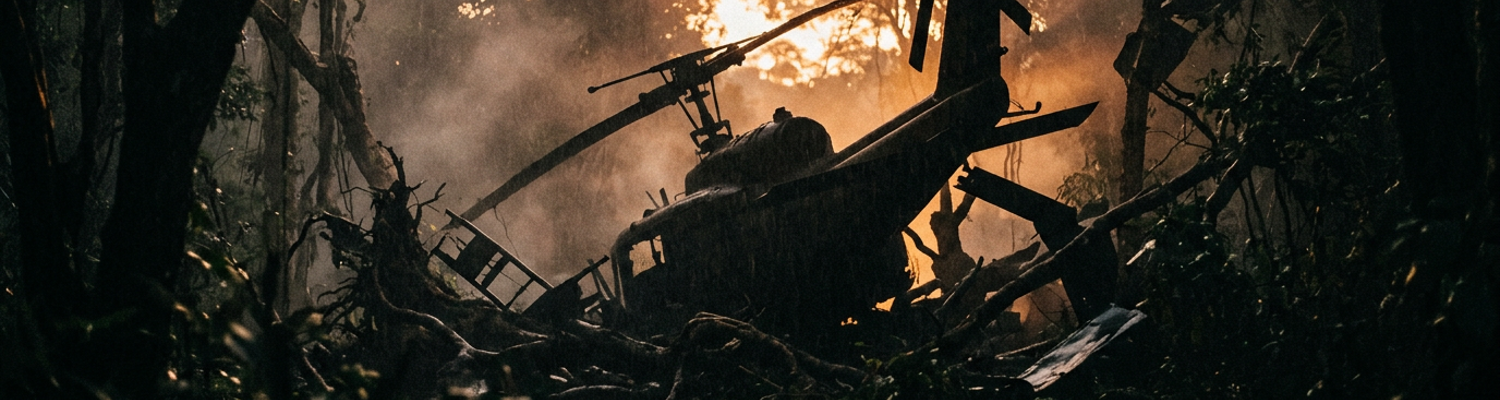
Their primary insertion helicopter had suffered a catastrophic main rotor gearbox failure over the dense primary dipterocarp canopy. The unmarked UH-34 Choctaw pancaked into a ravine. The impact force shattered the team bulky AN/GRC-109 encrypted burst transmitters against the magnesium airframe. Sergeant First Class Thomas Miller pulled a waterlogged AN/PRC-25 backpack transceiver from the wreckage. The crash impact had sheared the delicate connection pins required to attach the KY-38 NESTOR voice encryption module. Miller possessed a compound fracture in his left femur. He required immediate medical evacuation. He wired the handset directly to the base unit. Pressing the push-to-talk switch, the sergeant began broadcasting continuous distress calls on an open VHF frequency of 41.50 megahertz.
The dense jungle canopy normally blocked line-of-sight VHF signals.
The crash site sat on an elevated limestone ridge directly facing the Indonesian listening posts. Signal intelligence officers manning the R-311 receivers recorded every word of the transmission on magnetic reel-to-reel audio tapes. Unencrypted emergency transmissions exposed the covert nature of the U.S. Army cross-border operation within a matter of hours. The intercepted audio tapes contained explicit requests for a specialized medical evacuation flight originating from a classified staging ground in Sarawak. The operator demanded a blood transfusion kit and morphine syrettes. Miller utilized standard American military callsigns. The transmission included requests for replacement 5.56mm ammunition to feed the team experimental AR-15 rifles. British and Malaysian forces operating in the theater did not issue this specific caliber of ammunition.
Indonesian couriers rushed the magnetic tapes via a twin-engine Cessna 310 directly to the Ministry of Foreign Affairs in Jakarta.
Foreign Minister Subandrio ordered his intelligence staff to translate the audio into English and French. Typists worked through the night on manual Remington typewriters to produce two hundred mimeographed transcript copies. The diplomatic shockwave hit the United Nations headquarters in New York the following morning. Indonesian diplomats bypassed the standard closed-door grievance committees. Delegates handed the raw transcripts directly to Soviet and Chinese representatives on the General Assembly floor. The documents provided incontrovertible physical evidence that American combat personnel were actively operating inside Indonesian territory.
Whitehall officials watched the planned regional summit in Manila collapse under the weight of the leaked radio intercepts.
The British Foreign Office received frantic teletype messages from the U.S. Embassy in Grosvenor Square demanding a coordinated cover story. The U.S. State Department issued immediate blanket denial orders to all press attaches. Planners at the Pentagon drafted emergency cables instructing the joint command in Kuching to abandon Detachment A-32 entirely. Sending a second rescue helicopter risked another crash and further physical evidence falling into Indonesian hands. The National Security Council convened an unscheduled session at 0300 hours to manage the containment strategy. The stranded men received a final short transmission ordering them to burn their identification tags and walk north toward the border.
They buried the dead pilot under thirty inches of volcanic mud.
Diplomatic Crisis between Washington and Jakarta
When examining the historical record of April 18, 1964, State Department cables reveal a sudden collapse in bilateral relations triggered directly by the physical delivery of the intercepted radio logs. Indonesian Foreign Minister Subandrio summoned United States Ambassador Howard P. Jones to the Ministry of Foreign Affairs at 0730 hours. Jones arrived expecting a routine discussion regarding USAID agricultural shipments. Subandrio instead dropped a 40-page dossier of mimeographed transcripts directly onto the mahogany conference table. The documents contained the verbatim English translations of Sergeant Miller unencrypted VHF distress calls from coordinates 1 degree 15 minutes North 110 degrees 05 minutes East. Subandrio provided physical copies of the magnetic reel-to-reel audio tapes recorded by the R-311 receivers at the Entikong listening post. The audio featured the distinct American accents of the stranded Special Forces personnel calling for medevac support.
The dossier included frequency analysis charts matching the transmission signatures to American-manufactured AN/PRC-25 radio sets.
A close review of diplomatic logs indicates that Ambassador Jones immediately recognized the classification breach. The transcripts detailed requests for 5.56mm ammunition and specific helicopter evacuation protocols utilized exclusively by U.S. Army Special Forces detachments. Jones transmitted a flash-override cable via the embassy secure KW-26 ROMULUS teletype system to the seventh floor of the State Department in Washington. Secretary of State Dean Rusk convened an emergency working group in Room 7224 to manage the exposure. Analysts at the Bureau of Intelligence and Research spent twelve hours attempting to find a plausible deniability loophole in the transcript formatting. They failed. The Indonesian signals intelligence units had captured the exact time stamps, callsigns, and cryptographic handshake attempts preceding the open-channel broadcast. State Department officials instructed Jones to issue a standard non-acknowledgment protocol. The Indonesian government bypassed standard diplomatic channels entirely by distributing copies of the dossier to the local press corps.
Morning editions of the Harian Rakyat newspaper printed the intercepted American callsigns in bold typeface across their front pages.
By noon on April 19, American diplomatic personnel across Jakarta found themselves trapped inside their compounds as organized demonstrations erupted over the violation of regional neutrality. The United States had officially maintained a public posture of strict non-intervention regarding the escalating border conflict between Indonesia and the newly formed Malaysian federation. President Lyndon B. Johnson administration repeatedly assured Jakarta that no American combat personnel would operate on the island of Borneo. The intercepted transcripts invalidated this diplomatic cover story within twenty-four hours. Indonesian military police units from the Tjakrabirawa Regiment surrounded the U.S. Embassy complex on Medan Merdeka Selatan. They physically blocked the wrought-iron gates with requisitioned municipal transit buses. Ambassador Jones received a formal demarche from the Sukarno government demanding the immediate withdrawal of all covert American assets from the theater. The document cited specific violations of the 1955 Bandung Conference principles of non-interference.
The document threatened the expulsion of all American consular staff if Washington refused compliance by midnight.
Archival evidence shows that the diplomatic confrontation rapidly escalated into a complete restriction of American operational freedom in the region. Indonesian aviation authorities revoked all overflight clearances for United States military transport aircraft operating out of Clark Air Base in the Philippines. C-130 Hercules cargo planes carrying diplomatic mail and embassy supplies were forced to divert to Paya Lebar Air Base in Singapore after Indonesian Soviet-built S-75 Dvina air defense radars locked onto their flight paths over the Java Sea. State Department negotiators attempted to frame the downed Choctaw helicopter as an unauthorized rogue flight conducted by civilian contractors conducting geographical surveys. Indonesian officials countered this narrative by producing the specific requisition codes for the morphine syrettes mentioned in the radio intercepts. The medical supply serial numbers matched a recent Department of Defense manifest shipped to a classified logistics hub in Sarawak just two weeks prior.
Embassy staff began burning classified intelligence files in steel drums positioned on the chancellery roof.
Geopolitical Fallout and Regional Aid Freezes
Archival evidence shows that on April 20, 1964, the State Department issued a flash-override directive terminating all unauthorized cross-border logistical flights originating from mainland staging areas. The diplomatic rift prompted a re-evaluation of covert military support programs across Southeast Asia. Planners at the Military Assistance Command, Vietnam, ordered ground crews to halt the loading of unmarked Fairchild C-123 Providers bound for forward operating bases in Laos. These cargo planes contained wooden crates of M2 carbines and heavy steel replacement recoil mechanisms for 105mm M101A1 howitzers destined for indigenous irregulars. Mechanics physically removed the heavy pallets using diesel forklifts and placed the armaments back into corrugated steel hangars at coordinates 17 degrees 23 minutes North 102 degrees 47 minutes East. Analysts at the Bureau of Intelligence and Research determined that any further exposure of American hardware in the region would give Jakarta leverage to formally align with the Soviet bloc at the United Nations. Aviation detachments received orders to drain the 115-octane aviation fuel from their C-123 wing tanks.
Flightline technicians replaced the volatile fuel with inert nitrogen gas to prevent internal corrosion during the indefinite grounding period.
When examining the historical record, supply logs from the Central Intelligence Agency proprietary airline, Air America, reveal a complete cessation of airdrop missions over the Annamite Range. Dispatchers canceled fifty-two scheduled sorties in a single afternoon. Pilots sitting in the cockpits of Curtiss C-46 Commandos received abort codes over their VHF radios just minutes before runway takeoff rolls. The regional freeze stranded hundreds of allied highland scouts who relied entirely on these daily drops for 7.62mm ammunition and penicillin vials. Ground commanders in Washington feared that a downed C-46 over neutral territory would mirror the UH-34 Choctaw disaster in Kalimantan. Quartermasters at Camp Evans initiated a full inventory of all untraceable foreign-manufactured weapons stored in their armories. They loaded thousands of captured Soviet SKS rifles and Chinese Type 56 assault rifles into wooden shipping crates.
Armorers sealed the crates shut using heavy steel banding machines.
U.S. policy advisors restructured regional strategy to prevent further political escalation with Indonesia. National Security Advisor McGeorge Bundy drafted National Security Action Memorandum 294. This document explicitly restricted Special Forces detachments from operating within fifty miles of the Indonesian border. The Pentagon transferred the operational burden to the United States Seventh Fleet. Admiral Thomas Moorer ordered Task Force 71 to redeploy from Subic Bay in the Philippines to a holding pattern just north of the Natuna Islands at coordinates 4 degrees 45 minutes North 108 degrees 15 minutes East. This fleet consisted of the aircraft carrier USS Kitty Hawk and four Gearing-class destroyers. Moving these 3,500-ton vessels required burning hundreds of thousands of gallons of naval heating oil. The maritime posturing allowed Washington to project power across the Java Sea without deploying infantry personnel in disputed jungle territory.
Sonar operators aboard the destroyers maintained strict radio silence while tracking Indonesian submarine movements on their AN/SQS-23 arrays.
A close review of operational logs indicates that the restructuring directly impacted approved foreign military sales to the Sukarno government. The Department of Defense immediately froze a scheduled delivery of twelve F-5A Freedom Fighter jets to the Indonesian Air Force. Cargo ships carrying replacement parts for Lockheed C-130B Hercules transports already in Indonesian service received orders to reverse course mid-ocean. The freighter SS President Jackson dropped anchor in the middle of the Pacific and turned its bow back toward Naval Base San Diego. Defense attaches in Jakarta reported that Indonesian maintenance crews had grounded three C-130B airframes within forty-eight hours due to a lack of hydraulic fluid filters. Supply officers at Halim Perdanakusuma Air Force Base cannibalized the landing gear struts from a damaged transport to keep a single aircraft operational.
Signal Intelligence Revisions Post Kalimantan Operation
When examining the historical record of May 1964, internal Ministry of Defence memos reveal a complete collapse of command and control infrastructure across the Bornean theater. The tactical breakdown demonstrated the severe operational limits of legacy vacuum-tube radios in tropical zones. Forward listening posts manned by the 22 SAS Regiment at coordinates 1 degree 33 minutes North 110 degrees 25 minutes East attempted to transmit daily Indonesian troop movements back to the joint headquarters in Kuching. Their A41 manpack sets and Collins 618T high-frequency transceivers relied entirely on fragile thermionic valves to amplify radio signals. The ambient humidity under the primary dipterocarp canopy saturated the degraded rubber O-ring seals on the radio chassis. Moisture pooled directly on the hot glass envelopes of the internal vacuum tubes. Powering the units caused the glass to shatter instantly due to the extreme temperature differential. Signals intelligence teams spent hours cannibalizing broken radios in the mud to build a single functioning receiver. Filament burnouts systematically crippled the electronic intelligence mandate ordered by the Foreign Office.
The diplomatic corps in Whitehall lost all real-time intelligence feeds from the frontier for eleven consecutive days.
A close review of operational logs indicates that this electronic blackout forced British diplomats to negotiate completely blind during the preliminary regional talks in Tokyo. Foreign Office analysts received troop movement data that was entirely useless. Runners carrying decrypted paper coordinates required up to seventy-two hours to reach a functioning relay station positioned twenty miles north of the Plaman Mapu ridge. The failure of the legacy equipment directly enabled Indonesian delegates to present unchallenged counter-narratives regarding border incursions. Soviet-supplied Indonesian units moved heavy artillery batteries into position without triggering any electronic early warning systems. Headquarters staff at the 3rd Commando Brigade logged forty-two separate instances where a patrol failed to check in at their designated transmission window. Duty officers marked the units as presumed destroyed. Inspection of the retrieved A41 radios showed thick layers of green copper oxide coating the internal wiring harnesses and power supply contacts.
Engineers at the Signals Research and Development Establishment in Christchurch received orders to completely rebuild the tactical communications architecture.
Archival evidence shows that Army communications doctrine transitioned toward standardized tropicalized radio units and hardened encryption equipment. The joint command structure in Washington and London recognized that the diplomatic exposure caused by the A-32 detachment crash stemmed directly from hardware fragility. The Pentagon mandated the immediate phasing out of all vacuum-tube transceivers for frontline infantry units operating in Southeast Asia. Procurement officers initiated the accelerated deployment of the fully solid-state AN/PRC-77 manpack radio. This new unit utilized transistorized circuitry. The solid-state internals generated significantly less heat and required no fragile glass components. Technicians sealed the aluminum outer casings with heavy-duty silicone gaskets to repel the ninety-eight percent ambient humidity.
Factory workers dipped the internal circuit boards into vats of liquid polyurethane potting compound.
The hardened resin cured into a solid block around the exposed wiring. This manufacturing process prevented saline moisture from corroding the copper traces. It protected the electronic components from blunt force trauma during helicopter insertions. Planners at the National Security Agency simultaneously overhauled the cryptographic hardware requirements for cross-border operations. The crash impact in Kalimantan had sheared the delicate connection pins on the KY-38 NESTOR voice encryption module. That mechanical failure forced Sergeant Miller to broadcast his distress calls in the clear. The revised doctrine required all new cryptographic modules to feature reinforced steel connector housings and redundant internal grounding straps. Defense contractors redesigned the KY-38 to withstand a fifty-G impact without severing the physical link to the primary radio handset. Testing protocols at the Aberdeen Proving Ground involved dropping the encrypted transceivers from thirty-foot towers directly onto concrete pads.
Technicians measured the post-impact cryptographic handshake frequencies using oscilloscopes.