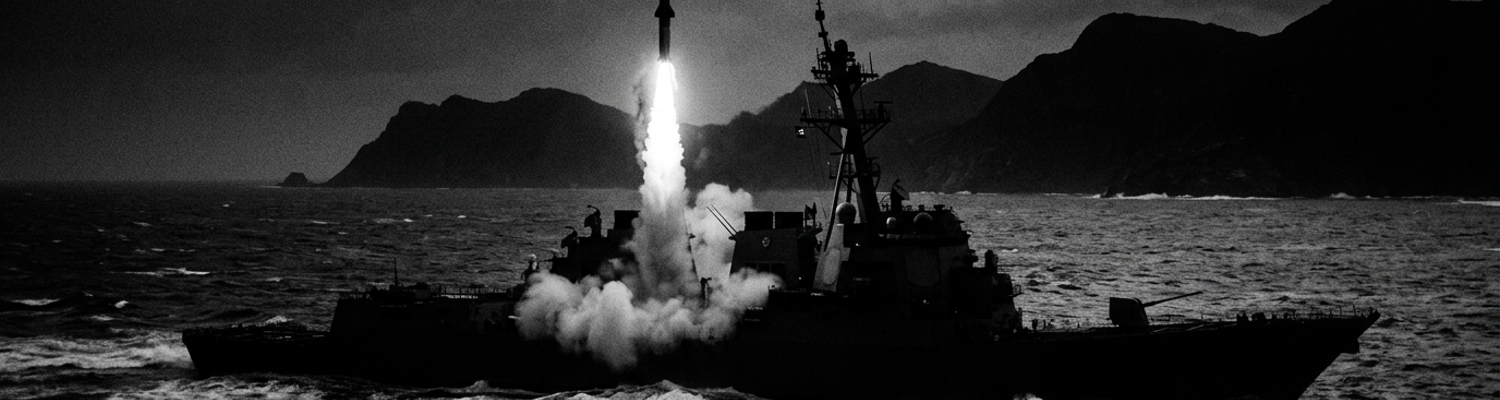

Coastal Threats After the HSV-2 Swift Attack
A close review of operational logs indicates that the United States Navy had severely miscalculated shore-based anti-ship capabilities in the Bab el Mandeb strait prior to October 2016.
Eight days before the primary engagement, the Emirati catamaran HSV-2 Swift transited north through the narrow passage off the Yemeni port of Al Mukha.
Spotters operating along the coastline tracked the non-combatant transport ship as it slowed near the shipping channel.
Houthi and allied coastal defense fighters fired an anti-ship cruise missile from a camouflaged flatbed truck positioned on the coastal highway. The weapon struck the port bow above the waterline. It penetrated the light commercial grade aluminum plating before detonating within the main vehicle deck. Fuel lines ruptured immediately. This fed a massive secondary fire that reached temperatures exceeding six hundred degrees Celsius. Flames swept through the command deck. The intense heat melted the forward superstructure and burned out the bridge within thirty minutes. Swift survived only because the hull did not submerge.
The vessel became a hollowed out aluminum shell dead in the water.
Commercial aluminum hulls offered zero passive protection against shaped charge warheads.
Archival evidence shows that coastal missile units had systematically hidden these weapon systems along the Tihamah coastal plain long before the first shot was fired. Ground crews converted standard civilian Mercedes Benz Actros flatbed trucks into improvised transporter erector launchers. They mounted twin box launch canisters under civilian cargo tarpaulins. These launchers carried Iranian supplied Noor missiles. The Noor is an engineered copy of the Chinese C-802 equipped with a 165 kilogram semi-armor-piercing warhead and a turbojet sustainer engine. Crews drove the converted trucks directly into the mangrove bluffs and tidal scrub forests south of Al Khawkhah and Mocha. Saline vegetation and high salinity mud masked the vehicle tires. Operators used thermal blankets and foliage mats to suppress engine heat signatures from overhead infrared sensors.
Operators leveled the launch rails using wooden cribbing pressed into the mud.
This avoided the need for concrete firing pads.
To prevent electronic detection, coastal units strictly observed emission control and left their mobile search radars powered down. Targeting data arrived instead through spotters aboard civilian wooden fishing dhows. These spotters transmitted warship positions over standard maritime VHF frequencies and cellular networks.
The coastline appeared completely quiet on Western radar scopes.
When examining the historical record of theater intelligence, an extensive reconnaissance failure left Fifth Fleet combatants exposed prior to the October 9 engagement. United States Central Command deployed high altitude U-2 surveillance aircraft and MQ-9 Reaper drones to survey western Yemen. Imagery analysts focused the sensor sweeps on fixed surface-to-air missile positions and hardened military compounds around Sanaa and Al Hudaydah. Commercial flatbeds hauling missile canisters looked identical to agricultural transport and freight haulers traveling along Coastal Highway 45. Ground clutter from mangrove roots and sandbars prevented synthetic aperture radar passes from distinguishing the metallic rails. Signals intelligence intercepts failed because ground crews communicated through motorcycle couriers and hardwired field lines rather than radios.
Joint intelligence summaries distributed to the USS Mason strike group contained fatal flaws.
The reports concluded that coastal fighters lacked the integrated sensors needed to target dynamic surface warships beyond visual range. Warships of the destroyer squadron entered the Bab el Mandeb operating under obsolete assessments. These assessments treated the threat as disorganized and blind.
At 1900 Zulu, USS Mason patrolled twelve miles north of the Swift wreckage with its SPG-62 illuminators in standby mode.
Five Minutes to Impact in the Bab el Mandeb
Archival evidence shows that the tactical picture dissolved into a high threat intercept problem the moment shore based emitters established lock.
Aboard USS Mason, cruising south southwest at fifteen knots through the Bab el Mandeb, the AN/SPY-1D phased array radar struggled against severe atmospheric ducting. Heavy land clutter generated by the volcanic bluffs of Perim Island degraded the sensor picture. Super refraction along the water interface scattered the S-band energy. This painted false returns across the console displays in the Combat Information Center.
At nineteen hundred Zulu, automated Doppler filtering isolated two low altitude tracks.
The contacts broke out of the mainland ground clutter south of Dhubab. Both flew ten to fifteen meters above the water surface at Mach 0.85. This matched the electronic signature and flight performance of Iranian produced Noor anti-ship cruise missiles. Weapons control computers designated the pair as immediate threats closing on a vector of two two zero degrees. Bearing lines placed the weapons on an intercept profile aimed directly at the destroyer and the defenseless amphibious transport dock USS Ponce steaming five miles to the north.
Mach 0.85 left the watch team less than ninety seconds to execute a defense.
A close review of operational logs indicates that Combat Information Center watchstanders had to calculate kinetic firing solutions under extreme compressed timeline parameters. Tactical Action Officer Lieutenant Commander Timothy Yuhas and his console operators confronted severe spatial limitations within Aegis Baseline 7.1. The inbound cruise missiles had popped up over the radar horizon at barely twelve nautical miles. Standard sequential engagement doctrines became obsolete instantly. Operators at the Command and Decision consoles scrambled to deconflict missile flight paths with USS Ponce.
They established target illumination arcs for the ship AN/SPG-62 directors.
Split second manual overrides were required to verify that the contacts were not regional commercial airliners descending on approach into Djibouti across the strait. Standing orders left no time to request flag level clearance from Fifth Fleet headquarters in Bahrain. Commanding Officer Christopher Gilbertson confirmed weapons free over the internal net. He released an intercept salvo consisting of two RIM-66M-5 Standard Missile-2 Block IIIA rounds and a single RIM-162 Evolved SeaSparrow Missile from the forward Mk 41 vertical launch cells.
Solid fuel boosters ignited inside the vertical launch cells with zero latency.
When examining the historical record of soft kill electronic countermeasures, ship survivability hinged upon the rapid deployment of the Mk 53 Decoy Launching System. Console watchstanders fired the port and starboard Mk 137 launcher tubes to deploy Mk 234 Nulka active expendable decoys into the relative wind. Each Nulka round fired a solid propellant hover rocket equipped with thrust vector control mechanisms. This allowed the decoy to climb rapidly to fifty meters altitude. It hovered along a calculated flight profile offset from the physical track of the destroyer.
Once airborne, the active electronic repeater payload began transmitting an artificial radio frequency signature.
This synthetic radar return mimicked an eight thousand ton warship. It overwhelmed the narrow acquisition gate of the approaching Noor missiles X-band monopulse seekers. Instead of homing on the metallic superstructure of the destroyer, the lead missile seeker locked onto the high intensity electronic signature floating in open water. Telemetry shows the missile made a hard terminal correction toward the hovering decoy. It exhausted its aerodynamic energy and slammed into the sea four miles from the ship.
The second missile lost terminal guidance and impacted the water twelve thousand yards off the port quarter.
Layered Surface-to-Air Missile Interceptions
A close review of operational logs indicates that the fire control loop resolved the incoming raid into a two missile salvo engagement against the lead inbound target.
Console operators assigned the initial kinetic solution to the RIM-66M-5 Standard Missile-2 Medium Range Block IIIB. This interceptor was built specifically to counter low altitude threats in high clutter coastal waters. Forward vertical launch cells unlatched. Exhaust gases vented down the plenum chambers as two SM-2MR Block IIIB rounds fired in rapid succession along an intercept corridor over the southern Red Sea. Each Block IIIB missile utilized a dual mode guidance package.
This paired conventional X-band semi-active radar homing with an auxiliary side mounted forward looking infrared seeker.
The primary radar receiver locked onto reflections cast by the AN/SPG-62 radio frequency illuminators. The passive infrared array detected thermal emissions from the Microturbo TRI-60 turbojet exhaust pipe of the Noor missile. Operating together, these guidance channels allowed the autopilot to differentiate between the true anti-ship cruise missile and the dense radar backscatter rising from wave crests and thermal humidity layers across the Bab el Mandeb.
Both Mk 104 dual thrust solid rocket motors burned out within six seconds of egress.
Archival evidence shows that tactical doctrine forced the watch team to construct a second tier of kinetic defense as the closure rate accelerated. Tactical Action Officer Lieutenant Commander Timothy Yuhas authorized the discharge of a single RIM-162 Evolved SeaSparrow Missile from an eight cell forward launcher module housing quad pack canisters. Packed tightly into a Mk 25 canister inside vertical launch cell number seven, the ESSM functioned as an emergency close-in point-defense barrier. It was designed to eliminate targets penetrating inside the terminal intercept footprint of medium range missiles.
The weapon left the launcher at an initial acceleration exceeding fifty gravities.
It relied on rear mounted aerodynamic tail fins combined with solid propellant thrust vector control rings to execute an immediate pitch over maneuver toward the intercept bearing. Guidance algorithms directed the interceptor using S-band midcourse uplink updates sent directly from shipboard computers. It then transitioned to terminal semi-active homing slaved to the forward director. The interceptor closed the distance at Mach 4. It placed a thirty nine kilogram blast fragmentation warhead squarely across the projected arrival vector of the threat.
Point defense doctrine eliminated the safety margin between friendly hulls.
When examining the historical record of modern naval warfare, the engagement marked the first operational combat interception combining SM-2 and ESSM interceptors under Aegis weapon system control. Aegis Baseline 7.1 Phase 3 managed the multi layered engagement architecture. It tracked four distinct airframes simultaneously across three separate velocity profiles. Weapon control computers scheduled precise terminal illumination windows for the AN/SPG-62 directors.
The system rapidly time shared radio frequency pulses between the outgoing SM-2MR rounds and the inbound ESSM.
This synchronized firing sequence proved that a Flight IIA Arleigh Burke class destroyer could simultaneously execute area air defense and close range point defense under high density electronic stress without mutual sensor interference. Combat system telemetry recorded that the lead Noor cruise missile exploded mid air. It showered high velocity debris across the water eleven nautical miles northwest of Perim Island.
Radar contact dropped from the console sweeps at 1903 Zulu.
Sustained Condition I Watches and Crew Fatigue
A close review of operational logs indicates that the physical breakdown of the crew began long before the second salvo appeared on the radar screens.
Between October 9 and October 13, Captain Christopher Gilbertson held USS Mason at Condition I for roughly ninety six consecutive hours. Repeated coastal radar locks triggered recurrent General Quarters alarms. Watchstanders in the Combat Information Center sat strapped into high backed consoles beneath red battle lanterns. They consumed vacuum sealed field rations and tepid water without leaving their stations. Temperatures within auxiliary machinery rooms and lower engineering flats regularly climbed past forty six degrees Celsius.
This drove heat exhaustion rates upward among propulsion technicians tending the General Electric LM2500 gas turbines.
Sleep cycles dissolved entirely. Watch teams operated on twenty minute catnaps taken on bare deckplates behind the fire control consoles. Helmet straps dug deep sores into their chins. Constant adrenaline spikes degraded cognitive processing speeds across both enlisted console track supervisors and division officers.
Sleep debt accumulated at an unsustainable rate.
Archival evidence shows that environmental degradation in the lower Red Sea amplified the psychological burden by flooding weapon system computers with phantom threats. Intense solar radiation heating the shallow waters south of Zubair Island created a sharp surface duct. This trapped S-band radio frequency waves beneath a dense blanket of marine humidity and warm air. This super refraction bounced AN/SPY-1D radar energy back into the receiver arrays off ocean swells.
It generated hundreds of false low altitude surface tracks.
These tracks mimicked the Doppler velocity signatures of incoming cruise missiles. Combat Information Center operators had to manually scrub each anomalous return. They cross referenced raw video returns against passive electronic warfare intercepts from the AN/SLQ-32(V)3 suite. A single misidentified clutter spike could prompt an erroneous surface-to-air missile launch. A single disregarded track risked a fatal hull breach. Commercial fishing dhows made of dense teak wood drifted through shipping lanes without transponders. This complicated identification protocols because their low radar cross sections appeared identical to small sea skimming anti-ship weapons breaking through coastal thermal bands.
False tracks demanded immediate engagement calculations.
When examining the historical record of theater task grouping, Mason carried the total air defense responsibility for nearby coalition units that could not protect themselves. Steaming five nautical miles off the port beam, the aging amphibious transport dock USS Ponce served as an afloat forward staging base. It possessed virtually no kinetic defense against sea skimming missiles. The vintage steam plant propulsion limited her speed to twelve knots. Her defensive armament consisted only of twin Phalanx close-in weapon systems designed as a desperate last line of defense against terminal impacts.
Gilbertson repositioned Mason directly between the Yemeni coastline and the vulnerable flank of the support vessel.
He absorbed the threat axis onto the forward intercept arcs of the destroyer. Command decisions required tactical air coordinators to maintain Link 16 datalinks while tracking every airborne vector relative to the slow transit corridor of the amphibious ship. This effectively turned the Arleigh Burke class destroyer into a physical shield for four hundred personnel aboard the support vessel.
Aegis Link 16 tracks tied Ponce survival directly to the forward missile battery.
Operational reports record that watch officers instituted manual cross check redundancy protocols to compensate for severe human cognitive decline on day four. Tactical action officers forced console operators to read out sensor values aloud across internal intercom channels. They confirmed switch positions before activating fire control directors. Technicians running the chill water cooling loops on the AN/SPY-1D transmitter skids fought rising salt accumulation on air filters. They blew out clogged vents with compressed nitrogen while wearing flash gear. At 0800 Zulu on October 12, the tactical action officer manually de-escalated three successive radar pop-ups identified twenty miles north of Perim Island. He confirmed the contacts were low flying pelicans trapped inside the coastal thermal duct rather than a coordinated Noor missile strike.
Retaliatory Tomahawk Strikes by USS Nitze
A close review of operational logs indicates that theater targeting boards had overlooked the shore based sensor network until the second salvo exploded over the water.
Central Command target folders showed that three coastal radar sites located near Ras Isa, north of Al Mukha, and along the bluffs of Dhubab had been cataloged as dormant since early 2015. Coalition air campaigns previously bombed nearby military barracks. Intelligence analysts classified the vintage Soviet manufactured installations as abandoned hardware. The arrays consisted of P-12 Spoon Rest early warning radars and stationary maritime search sets.
They appeared decrepit on satellite imagery.
Ground crews aligned with Houthi and allied coastal defense units revived the hardware away from overhead surveillance. Technicians wired commercial diesel generators directly into salvaged step up transformers. This bypassed destroyed municipal substations. Ground operators avoided emitting during standard reconnaissance satellite overflights. They kept electronic signatures dark.
When surface targets entered the strait, operators brought the magnetrons online for twenty second bursts.
They painted coordinates for concealed mobile missile launchers before turning off the transmitters. Dormant intelligence classifications masked active shore based cueing networks.
Archival evidence shows that weapon release authority moved swiftly after the October 12 missile raid against USS Mason. Under authorization from the National Command Authority, United States Naval Forces Central Command assigned the kinetic retaliation to USS Nitze. Nitze was an Arleigh Burke class destroyer operating under Destroyer Squadron 26. The warship moved into launch positions fifty miles off the Yemeni coastline during the pre-dawn darkness of October 13.
Fire control technicians operating the Tactical Tomahawk Weapon Control System initialized digital mission profiles.
They programmed five RGM-109E Tomahawk Land Attack Missiles. Target coordinates corresponded to the exact positions of the three coastal radar emitters. At zero one hundred hours local time, solid fuel booster motors fired within the forward Mk 41 vertical launch cells. The blast hatches expelled the land attack missiles. The missiles deployed their aerodynamic surfaces. They transitioned to Williams F107 cruise turbofans and dropped to low altitude ingress profiles over the water.
Guided by GPS and digital terrain correlation software, all five one thousand pound warheads detonated against the radar towers, command vans, and antenna feeds.
Nitze fired five missiles and scored direct hits across all three compounds.
When examining the historical record of theater maritime security, the tactical effect of the strike altered the operational dynamics of the chokepoint immediately. Destroying the sensor facilities blinded the coastal defense missile batteries along the western littoral. Deprived of coastal surveillance radar telemetry, shore units lacked the sensor reach required to compute dynamic over the horizon firing solutions against fast moving warships or commercial cargo ships transiting the Bab el Mandeb channel. Civilian dhows and optical shore spotters could not calculate elevation, velocity, and distance data with the precision needed to program active radar seeker acquisition gates on the Noor cruise missiles.
Tactical commanders along Coastal Highway 45 withdrew remaining mobile launcher trucks inland toward the Taiz mountains.
They evaded retaliatory strike packages from carrier air wings aboard USS Dwight D. Eisenhower. The destruction suppressed guided anti-ship cruise missile launches along the southern Red Sea corridor. Commercial freight traffic resumed through the Bab el Mandeb without receiving a single guided missile launch for the remainder of 2016.