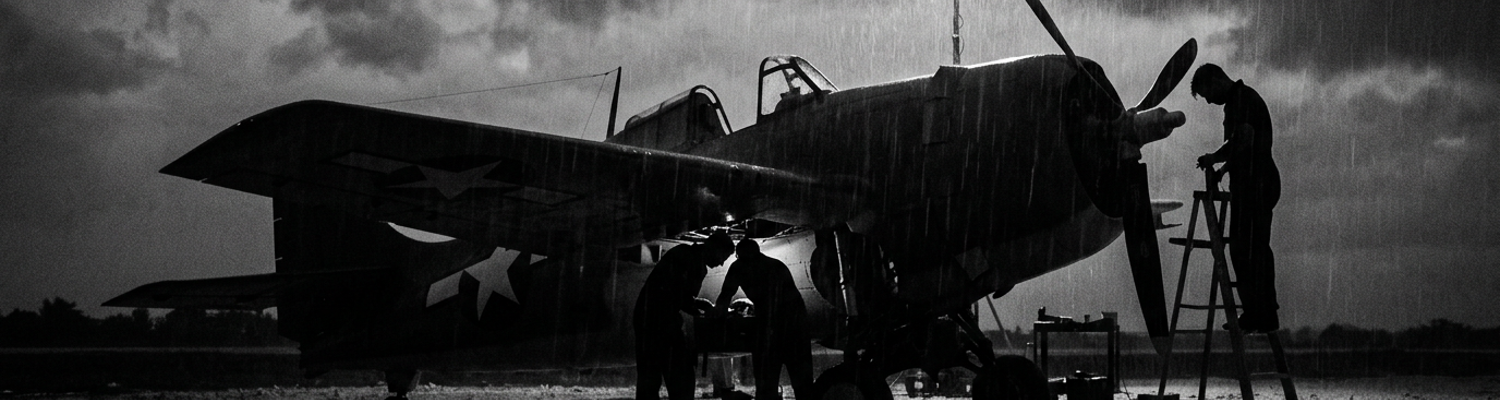

Special Task Air Group One Deployment
Archival evidence shows the delivery of 2,000-pound AN-M66 general-purpose bombs to a crushed-coral airstrip in August 1944. Technicians stacked this high-explosive ordnance alongside crates of highly sensitive RCA Block I television transmitters and multi-channel radio receivers. Navy Special Task Air Group 1 assembled this combination of heavy explosives and fragile electronics to execute an experimental combat mandate. The unit combined heavy blast-radius munitions with early remote-guidance hardware. The operation required engineers to mount complex vacuum-tube technology inside crude plywood airframes.
Special Task Air Group 1 deployed a squadron of Interstate TDR-1 assault drones from Green Island.
This isolated coral atoll was also known as Nissan Island. Commodore Oscar Smith directed the unit to construct a forward operating base on the recently secured runway. The TDR-1 aircraft featured a tubular steel frame covered by molded wood. Two 220-horsepower Lycoming O-435-2 engines powered the airframe. Maintenance crews faced severe technical failures upon uncrating the machines in the South Pacific theater. Tropical humidity continuously shorted the delicate vacuum tubes inside the nose-mounted television cameras.
Ground personnel placed the electronic components inside improvised lightbulb-heated dry boxes to prevent complete system failure before takeoff.
The TBM Avenger control aircraft required constant calibration of their joystick-operated VHF radio links. Spare parts remained scarce across the supply chain. Radar operators in the rear seats of the Avengers managed a complex array of frequency dials to keep the command signal locked onto the drone receivers. Technical troubleshooting occurred around the clock under blackout conditions. Flight mechanics replaced corroded wiring harnesses daily just to keep the telemetry relays functional across the humid Pacific air.
Engineers cannibalized wrecked aircraft to source replacement potentiometers for the drone control boxes.
The primary objective for this untested hardware involved neutralizing entrenched Japanese anti-aircraft batteries on Ballale Island in the Solomons. A close review of operational logs indicates that the Imperial Japanese Navy had fortified the small island with multiple Type 96 25mm triple-mount cannons and heavy 120mm dual-purpose guns. Conventional dive bomber squadrons had previously taken severe casualties attempting to suppress these exact coordinates located just south of Bougainville. Planners programmed the TDR-1s to approach the island at an altitude of two hundred feet. This low approach evaded early warning radar networks. Controlling TBM Avengers trailed up to eight miles behind the unmanned aircraft. Operators stared into five-inch green cathode-ray tubes mounted in the rear cockpits of the Avengers.
They guided the explosive-laden drones directly toward the reinforced concrete revetments housing the anti-aircraft cannons.
TDR One Drone Systems and Television Controls
When examining the historical record of operations at Nissan Island, the technical specifications of the Interstate TDR-1 reveal a complex integration of aviation and early electronics. The assault drones utilized primitive television cameras and VHF radio control receivers. These systems transmitted live video feeds directly from the nose of the unmanned aircraft. Engineers from the Radio Corporation of America designed the Block I television system around a highly temperamental Iconoscope vacuum tube. This tube generated excessive internal heat during continuous operation. Ground crews mounted this eighty-seven-pound camera unit behind a specially molded glass blister on the plywood nose of the TDR-1.
The system broadcast a low-resolution 350-line image at forty frames per second over a specialized ultra-high-frequency band.
Inside the fuselage, mechanics bolted an AN/ARW-18 VHF radio receiver to the tubular steel airframe. This unit processed incoming flight control telemetry. The tropical environment of the Solomon Islands immediately attacked these fragile systems. Saltwater spray and ninety-percent humidity corroded the exposed copper wiring harnesses connecting the camera to the main power bus. Maintenance personnel spent hundreds of hours scraping green oxidation off the multi-pin connectors with pocket knives. The television transmitters frequently failed to sync with the VHF receivers during engine run-ups on the crushed-coral airstrip.
The Lycoming engines generated an electromagnetic field that disrupted the unshielded coaxial cables routing the video signal to the dorsal whip antenna.
Radiomen scavenged lead foil from chewing gum wrappers and cigarette packs to wrap the junction boxes. They created crude Faraday cages to block the engine interference. Once airborne, the TDR-1 required constant radio commands to maintain level flight. The drone lacked any autonomous autopilot capabilities. Every pitch, roll, and yaw adjustment depended entirely on a continuous stream of frequency-modulated pulses sent from a trailing control ship.
If the VHF signal dropped for more than three seconds, the TDR-1 would enter an unrecoverable spiral dive into the Pacific Ocean.
To command these remote weapons, the Navy designated specially modified TBF Avenger torpedo bombers as the primary control aircraft. These trailing Avengers followed the drones at a strict distance of seven to eight miles. Technicians stripped the standard radar equipment from the aft section to fit a bulky five-inch green phosphor screen and a specialized joystick control panel known as the ARW-18 transmitter unit. The operator sat facing aft or sideways. He stared into the heavily hooded monitor to block out the harsh South Pacific sunlight. The green cathode-ray tube displayed the shaky live feed transmitted from the drone nose camera. Moving the miniature joystick on the control box translated the hand movements into specific audio tones. The radio equipment broadcast these tones across the VHF spectrum. The TDR-1 receiver decoded them into mechanical movements via pneumatic servos connected to the flight control surfaces.
Pacific Environmental Degradation of Vacuum Electronics
Archival evidence shows that by early September 1944, the physical geography of Nissan Island actively disassembled the TDR-1 drone fleet. Positioned just four degrees south of the equator at coordinates 4 degrees 30 minutes South 154 degrees 13 minutes East, the forward operating base sat entirely exposed to the weather patterns of the Solomon Sea. Tropical downpours and corrosive salt spray rapidly eroded fragile vacuum tube control receivers mounted inside the aircraft. The RCA Block I television transmitters and AN/ARW-18 VHF receivers relied on exposed glass-envelope vacuum tubes. The 807 beam power tubes and 12SN7 twin triodes plugged directly into unplated copper sockets.
Prevailing winds drove aerosolized seawater across the crushed-coral airstrip directly into the ventilation louvers of the parked drones.
This salt-laden moisture settled onto the exposed electrical grids. The copper blackened. Galvanic corrosion immediately attacked the dissimilar metals at the tube bases. This generated a thick layer of non-conductive green copper oxide across the primary signal pathways. Within days of deployment, the electrical resistance across these corroded terminals spiked. This choked off the high-voltage direct current required to heat the tungsten filaments inside the vacuum tubes. Commodore Oscar Smith ordered Special Task Air Group 1 ground crews to institute a twenty-four-hour maintenance rotation. Mechanics scrubbed the oxidation off the vacuum tube pins using steel wool and aviation fuel.
High humidity caused frequent short circuits and telemetry drift across the entire remote-guidance network.
The TDR-1 design lacked hermetically sealed bulkheads. The primary avionics bays remained completely open to the jungle air. At ninety-five percent relative humidity, microscopic water droplets condensed inside the paper-and-wax capacitors of the VHF receivers. The moisture altered the dielectric constant of the internal components. This physical change caused the tuned radio circuits to drift out of their assigned frequency bands. A receiver calibrated on the ground to accept a 73 MHz command signal would mechanically shift to 74 MHz once airborne. It completely ignored the flight inputs broadcast by the trailing TBF Avenger control aircraft.
High-voltage dynamotors regularly suffered catastrophic internal arcing.
A close review of operational logs indicates that engineers resorted to desperate thermal management to keep the mission functioning. Aviation radiomen constructed wooden dry boxes lined with asbestos scavenged from steam pipe insulation. They wired standard incandescent light bulbs inside these sealed crates to generate a constant ambient heat of 110 degrees Fahrenheit. Every vacuum tube, potentiometer, and wire harness was manually extracted from the TDR-1 airframes after a flight and placed into these heated lockers. The continuous heat evaporated the accumulated moisture from the paper capacitors. Before a scheduled strike launch against the Japanese anti-aircraft batteries on Ballale Island, technicians sprinted from the dry boxes to the flightline with armfuls of hot electronic components.
They bolted the warm receivers back into the unsealed plywood bays minutes before engine ignition.
Improvised Technical Repair and Field Modifications
Inventory logs from September 1944 show Special Task Air Group 1 stockpiling 2,000-pound AN-M66 general-purpose bombs directly beside the crushed-coral airstrip on Nissan Island. Ground crews loaded this heavy ordnance into the plywood bays of the Interstate TDR-1 assault drones. The integration of high-explosive payloads with delicate RCA Block I television transmitters required continuous electrical continuity across the primary control bus. A close review of operational logs indicates that the standard factory wiring harnesses installed in the TDR-1s failed at a rate approaching seventy percent during the first two weeks of deployment.
Saltwater spray saturated the unshielded copper wires connecting the nose-mounted Iconoscope cameras to the fuselage power distribution blocks.
The resulting galvanic corrosion stripped the insulation and caused massive short circuits. These shorts prematurely armed the bomb fuses on the tarmac. Technicians recorded voltage drops severe enough to shut down the flight control servos during pre-flight engine run-ups. To restore electrical function to the grounded drone fleet, Navy technicians on Nissan Island fabricated improvised wiring harnesses from salvaged PB4Y patrol bomber radio parts. A Consolidated PB4Y-1 Liberator attached to a passing patrol squadron had recently crash-landed at the northern edge of the Green Island runway. The crash heavily damaged its undercarriage but left its internal avionics bays intact.
STAG-1 maintenance personnel stripped the wrecked bomber of its heavy-gauge transmission cables.
These cables originally serviced the SCR-274-N command radio sets. They featured thick vulcanized rubber jackets highly resistant to saltwater degradation. Mechanics laid the salvaged PB4Y cables out on canvas tarps under blackout tents. They cut them to match the exact lengths of the TDR-1 control pathways. They used portable soldering irons powered by daisy-chained jeep batteries to splice the heavy bomber wiring directly into the delicate multi-pin connectors of the AN/ARW-18 VHF receivers. Ground crews wrapped the exposed splice joints in layers of friction tape and painted them with aviation fuel to shrink the adhesive tight against the copper.
The supply depot on Nissan Island carried no specialized electronic sealants.
Aviation machinist mates manufactured their own chemical barriers using raw industrial materials scavenged from the motor pool. They combined heavy cosmoline rust preventive with melted beeswax and thick black pine tar. Crews heated this mixture inside empty .50 caliber ammunition cans over open kerosene fires until it liquified into a highly viscous sludge. Technicians extracted the AN/ARW-18 receiver units from the drones. They manually painted the hot compound over every seam, rivet hole, and access panel on the aluminum chassis using stiff-bristled brushes. As the mixture cooled in the Pacific air, it hardened into a dense watertight shell. This shell completely encapsulated the fragile radio components.
In-Flight Telemetry Troubleshooting Under Fire
Archival evidence shows that maintaining the video relay during an active strike required Special Task Air Group 1 technicians to operate inside heavily modified TBF Avenger torpedo bombers under severe physical duress. Ground crews on Nissan Island stripped the aft gunner compartments of their standard defensive armaments and heavy radar arrays. This accommodated the bulky ARW-18 VHF control panels and five-inch cathode-ray tube monitors. This heavy electronic payload forced the engineers to wedge themselves between the exposed aluminum ribs of the fuselage and the primary flight control cables.
The South Pacific sun blasted directly through the unshaded plexiglass greenhouse canopies during mid-day combat runs over the Bougainville Strait.
Ambient temperatures inside the unventilated rear compartments routinely exceeded 120 degrees Fahrenheit. The engineers wore heavy canvas flight suits, Mae West life preservers, and AN-B-10 type headsets. They hunched over the glowing green monitors while trapped in this sweltering microclimate. The ARW-18 units and the cathode-ray tubes generated their own continuous radiant heat. Sweat pooled in the goggles of the operators and dripped directly onto the exposed high-voltage terminal boards of the television receivers. A single drop of saline moisture hitting the 400-volt dynamotor contacts could trigger an instant short circuit across the telemetry relays.
The technicians wrapped their hands in dry cotton rags to absorb the perspiration before touching the joystick potentiometers.
A close review of operational logs from a September 1944 strike against the Japanese seaplane base at Kahili details the compounding mechanical failures experienced by these airborne engineers. Commodore Oscar Smith directed the Avenger control ships to trail the explosive-laden TDR-1 drones at a distance of seven miles and an altitude of just three hundred feet. This low-level approach kept the aircraft below the primary detection lobes of the Japanese early warning radar networks situated along the southern coast of Bougainville. The dense turbulent air just above the Solomon Sea violently tossed the heavy Avengers.
The technicians fought severe motion sickness while attempting to maintain visual focus on the low-resolution 350-line video feed.
As the formation crossed the shoreline near coordinates 6 degrees 41 minutes South 155 degrees 47 minutes East, Imperial Japanese Navy anti-aircraft batteries opened fire. The trailing Avengers flew directly into the resulting flak barrages. Concussive shockwaves from near-miss artillery bursts slammed into the aluminum skin of the control aircraft. These extreme acoustic and kinetic vibrations ripped through the airframes. The mechanical shaking repeatedly loosened the delicate multi-pin relay connections plugging the ARW-18 control boxes into the main fuselage power bus.
The heavy 18-pin Amphenol connectors backed out of their unthreaded sockets.
Every time an artillery shell detonated within two hundred yards, the resulting vibration severed the telemetry link. The cathode-ray tube instantly flashed to static. The TDR-1 drone would immediately begin to bank into a deadly spiral dive toward the jungle canopy. To keep the mission functioning under direct fire, the technicians abandoned standard safety protocols. Men wedged their shoulders against the vibrating fuselage bulkheads for physical leverage. Reaching directly into the exposed wiring harnesses, the radiomen physically forced the loose relay connections back together. Operators clamped their bare fingers around the hot metal collars of the multi-pin connectors.
Mid-Mission Resoldering and Relay Maintenance
A close review of operational logs indicates that the internal temperatures of the ARW-18 VHF control panels reached critical failure thresholds during mid-day strike missions in September 1944. The trailing TBF Avenger control aircraft operated at an altitude of three hundred feet over the Bougainville Strait. These low-level flights subjected the aircraft to continuous solar radiation through the plexiglass greenhouse canopies. Inside the aft gunner compartments, the ambient heat combined with the continuous thermal output of the 400-volt dynamotors powering the remote guidance systems.
The continuous 73 MHz frequency-modulated pulses required to transmit flight telemetry to the Interstate TDR-1 drones caused the internal relays to overheat.
Copper contact points inside the aluminum chassis absorbed this thermal load until the factory-applied solder binding the wiring harnesses to the terminal boards began to liquify. The constant kinetic vibration from the Wright R-2600 Twin Cyclone engine exacerbated the structural degradation of these weakened electrical joints. As the formation approached the Japanese seaplane base at Kahili, anti-aircraft batteries initiated a heavy barrage of 120mm flak. The resulting concussive shockwaves tore through the thin aluminum skin of the control planes. A near-miss artillery burst violently jolted the lead Avenger.
The mechanical shock snapped the softened solder joints completely off the primary video relay board.
Archival evidence shows that flight mechanics executed emergency resoldering procedures directly inside the bouncing aircraft to preserve the mission. The TDR-1 drone flew completely blind seven miles ahead of the control ship. Without continuous VHF radio commands, pneumatic servos inside the unmanned aircraft would mechanically force the elevators into an unrecoverable dive within three seconds. The technician wedged in the aft compartment abandoned his flight control joystick. He grabbed a heavy steel screwdriver to pry the sealed aluminum faceplate off the ARW-18 control box. Exposed high-voltage terminals sparked openly in the cramped unventilated cabin.
The mechanic retrieved a heavy-duty soldering iron wired directly into the 24-volt direct current auxiliary power outlet.
This tool was a field modification installed by ground crews specifically for these catastrophic mid-air failures. Japanese tracer fire from Type 96 25mm triple-mount cannons punched jagged holes through the tail section of the bomber. The technician braced his heavy boots against the vibrating fuselage ribs to steady his hands against the violent turbulence. He pressed the heated iron tip against the severed copper relay wire. Sweating heavily in his canvas flight suit, the radioman fed a spool of rosin-core solder directly into the overheated joint while the pilot aggressively banked to evade incoming artillery shells.
The technician held the burning wire in place with his bare thumb until the solder hardened.
These improvised airborne repairs successfully maintained the remote command links through the terminal dive phase. The five-inch cathode-ray tube flickered heavily before the rolling green image of the Kahili coastline reappeared on the phosphor screen. The technician wiped blood and sweat from his goggles and immediately shoved the miniature joystick forward. The repaired telemetry relay transmitted the specific 73 MHz audio tone required to actuate the tail elevators. Seven miles away, the TDR-1 responded to the frequency-modulated pulse and leveled out at an altitude of exactly forty feet. Flak bursts filled the low-resolution video feed as the distance closed. He flipped the dedicated toggle switch labeled Arm to activate the nose fuse.
Impact of STAG One Innovations on Naval Aviation
A close review of operational logs indicates that the crude field modifications executed on Nissan Island directly enabled the first successful remote-controlled combat strikes in naval history. Throughout late September and October of 1944, Special Task Air Group 1 launched forty-six Interstate TDR-1 assault drones against heavily fortified Imperial Japanese Navy positions across Bougainville and Rabaul. The improvised rubber shock absorbers installed behind the glass nose cones successfully stabilized the eighty-seven-pound RCA Block I television cameras against the violent vibrations of the Lycoming O-435-2 engines. This physical stabilization allowed the operators sitting in the rear compartments of trailing TBF Avenger control ships to positively identify camouflaged Type 96 25mm triple-mount cannons through their heavily hooded cathode-ray monitors.
Aviation machinist mates locked the internal paper-and-wax capacitors against the corrosive ninety-five percent tropical humidity.
By sealing the unshielded AN/ARW-18 VHF receivers in scavenged cosmoline and pine tar, the ground crews prevented the 73 MHz command frequencies from drifting out of band during the low-level approach over the Bougainville Strait. These specific technical interventions kept the remote telemetry online long enough for the operators to guide the plywood airframes directly into the reinforced concrete revetments. The aircrews destroyed entrenched anti-aircraft batteries without exposing a single human pilot to the terminal shrapnel radius. During the final assault runs against Ballale Island, the heavy-gauge transmission cables stripped from a wrecked PB4Y Liberator patrol bomber proved necessary to maintaining electrical continuity under direct fire.
Japanese 120mm dual-purpose guns threw dense walls of flak across the flight path.
Shrapnel shredded the drone wings. Concussive shockwaves from near-miss artillery bursts slammed into the unmanned aircraft. The vulcanized rubber jackets of the salvaged bomber wiring resisted the kinetic shock and maintained the high-voltage direct current flowing from the fuselage power bus to the nose-mounted Iconoscope vacuum tubes. Operators holding position seven miles away maintained full pitch and roll control via their ARW-18 transmitter joysticks. They steered the explosive-laden drones through the artillery barrages at a precise airspeed of 140 knots. The 350-line video feed held completely steady as the TDR-1 descended below an altitude of forty feet.
Transmission terminated instantly upon the physical impact of the 2,000-pound AN-M66 general-purpose bomb.
Archival evidence shows that the desperate troubleshooting routines developed on the crushed-coral airstrip at coordinates 4 degrees 30 minutes South 154 degrees 13 minutes East established the foundational maintenance protocols for all subsequent uncrewed combat aerial vehicles. Before the deployment of STAG-1, the United States Navy possessed no standard operating procedures for managing fragile remote-guidance avionics in a combat theater. Commodore Oscar Smith mandated a rigid twenty-four-hour maintenance rotation to combat the aggressive galvanic corrosion attacking the unplated copper sockets of the 807 beam power tubes and 12SN7 twin triodes. Ground crews transformed their improvised thermal management tactics into official pre-flight requirements.
The practice of storing every vacuum tube inside asbestos-lined lightbulb-heated dry boxes became a mandatory step for flightline preparation.
Technicians formalized the exact timing required to sprint these heated electronic components from the wooden lockers to the aircraft bays to prevent thermal fracturing of the glass envelopes in the humid Pacific air. These field-expedient practices at Green Island dictated the first physical checklists for drone operations. Ground personnel proved that remote-controlled hardware lacked the environmental resilience of standard manned aircraft and required localized climate control to function at a basic level. Maintenance crews instituted a strict procedural requirement to physically scrub the green copper oxide off the multi-pin connectors using steel wool and aviation fuel exactly twenty minutes before engine ignition. Engineers shipped these detailed maintenance logs back to the Radio Corporation of America laboratories in New Jersey.